
uspto-grants-2001_11 · 10.6084/m9.figshare.5104873.v1 · US06313145B1
查看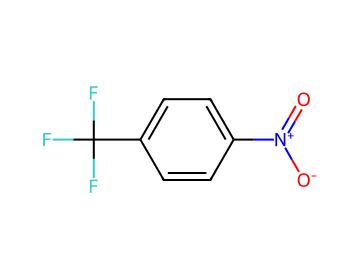
IDENTITY
COMPUTED
PROPERTIES
P-nitrobenzotrifluoride appears as a thin, oily straw colored liquid with a fishlike odor. May be toxic by ingestion, inhalation and skin absorption. Insoluble in water and denser than water. Used to make other chemicals.
GHS
Danger
H302 (100%): Harmful if swallowed [Warning Acute toxicity, oral];H312 (11.1%): Harmful in contact with skin [Warning Acute toxicity, dermal];H315 (100%): Causes skin irritation [Warning Skin corrosion/irritation];H319 (100%): Causes serious eye irritation [Warning Serious eye damage/eye irritation];H330 (97.8%): Fatal if inhaled [Danger Acute toxicity, inhalation];H335 (97.8%): May cause respiratory irritation [Warning Specific target organ toxicity, single exposure; Respiratory tract irritation]
P260, P261, P264, P264+P265, P270, P271, P280, P284, P301+P317, P302+P352, P304+P340, P305+P351+P338, P316, P317, P319, P320, P321, P330, P332+P317, P337+P317, P362+P364, P403+P233, P405, and P501 (click each P-code to see the statement)
Aggregated GHS information provided per 45 reports by companies from 5 notifications to the ECHA C&L Inventory. Each notification may be associated with multiple companies.;Information may vary between notifications depending on impurities, additives, and other factors. The percentage value in parenthesis indicates the notified classification ratio from companies that provide hazard codes. Only hazard codes with percentage values above 10% are shown. For more detailed information, please visit ECHA C&L website.
HAZARDS
Poison
Excerpt from ERG Guide 152 [Substances - Toxic (Combustible)]:;Combustible material: may burn but does not ignite readily. Containers may explode when heated. Those substances designated with a (P) may polymerize explosively when heated or involved in a fire. Runoff may pollute waterways. Substance may be transported in a molten form. (ERG, 2024)
Excerpt from ERG Guide 152 [Substances - Toxic (Combustible)]:;Highly toxic, may be fatal if inhaled, ingested or absorbed through skin. Contact with molten substance may cause severe burns to skin and eyes. Avoid any skin contact. Fire may produce irritating, corrosive and/or toxic gases. Runoff from fire control or dilution water may be corrosive and/or toxic and cause environmental contamination. (ERG, 2024)
Hydrocarbons, Aromatic;Nitro, Nitroso, Nitrate, and Nitrite Compounds, Organic;Fluorinated Organic Compounds
Organonitrate compounds range from slight to strong oxidizing agents. If mixed with reducing agents, including hydrides, sulfides and nitrides, they may begin a vigorous reaction that culminates in a detonation. The aromatic nitro compounds may explode in the presence of a base such as sodium hydroxide or potassium hydroxide even in the presence of water or organic solvents. The explosive tendencies of aromatic nitro compounds are increased by the presence of multiple nitro groups.
Insoluble in water.
Acute Tox. 4 (100%);Acute Tox. 4 (11.1%);Skin Irrit. 2 (100%);Eye Irrit. 2 (100%);Acute Tox. 2 (97.8%);STOT SE 3 (97.8%)
SAFETY
Excerpt from ERG Guide 152 [Substances - Toxic (Combustible)]:;SMALL FIRE: Dry chemical, CO2 or water spray.;LARGE FIRE: Water spray, fog or regular foam. If it can be done safely, move undamaged containers away from the area around the fire. Dike runoff from fire control for later disposal. Avoid aiming straight or solid streams directly onto the product.;FIRE INVOLVING TANKS, RAIL TANK CARS OR HIGHWAY TANKS: Fight fire from maximum distance or use unmanned master stream devices or monitor nozzles. Do not get water inside containers. Cool containers with flooding quantities of water until well after fire is out. Withdraw immediately in case of rising sound from venting safety devices or discoloration of tank. ALWAYS stay away from tanks in direct contact with flames. For massive fire, use unmanned master stream devices or monitor nozzles; if this is impossible, withdraw from area and let fire burn. (ERG, 2024)
Excerpt from ERG Guide 152 [Substances - Toxic (Combustible)]:;Refer to the "General First Aid" section. Specific First Aid: Removal of solidified molten material from skin requires medical assistance. (ERG, 2024)
Excerpt from ERG Guide 152 [Substances - Toxic (Combustible)]:;ELIMINATE all ignition sources (no smoking, flares, sparks or flames) from immediate area. Do not touch damaged containers or spilled material unless wearing appropriate protective clothing. Stop leak if you can do it without risk. Prevent entry into waterways, sewers, basements or confined areas. Cover with plastic sheet to prevent spreading. Absorb or cover with dry earth, sand or other non-combustible material and transfer to containers. DO NOT GET WATER INSIDE CONTAINERS. (ERG, 2024)
Excerpt from ERG Guide 152 [Substances - Toxic (Combustible)]:;IMMEDIATE PRECAUTIONARY MEASURE: Isolate spill or leak area in all directions for at least 50 meters (150 feet) for liquids and at least 25 meters (75 feet) for solids.;SPILL: Increase the immediate precautionary measure distance, in the downwind direction, as necessary.;FIRE: If tank, rail tank car or highway tank is involved in a fire, ISOLATE for 800 meters (1/2 mile) in all directions; also, consider initial evacuation for 800 meters (1/2 mile) in all directions. (ERG, 2024)
Excerpt from ERG Guide 152 [Substances - Toxic (Combustible)]:;Wear positive pressure self-contained breathing apparatus (SCBA). Wear chemical protective clothing that is specifically recommended by the manufacturer when there is NO RISK OF FIRE. Structural firefighters' protective clothing provides thermal protection but only limited chemical protection. (ERG, 2024)
ALIASES
REACTIONS
uspto-grants-2001_11 · 10.6084/m9.figshare.5104873.v1 · US06313145B1
查看
uspto-grants-2003_02 · 10.6084/m9.figshare.5104873.v1 · US06518267B1
查看
uspto-grants-1976_11 · 10.6084/m9.figshare.5104873.v1 · US03993704
查看
uspto-grants-2004_08 · 10.6084/m9.figshare.5104873.v1 · US06777437B2
查看
uspto-grants-2004_11 · 10.6084/m9.figshare.5104873.v1 · US06822100B2
查看