
uspto-grants-2015_04 · 10.6084/m9.figshare.5104873.v1 · US09018246B2
查看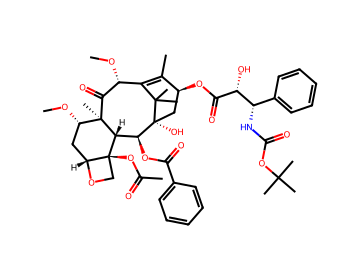
[(1S,2S,3R,4S,7R,9S,10S,12R,15S)-4-acetyloxy-1-hydroxy-15-[(2R,3S)-2-hydroxy-3-[(2-methylpropan-2-yl)oxycarbonylamino]-3-phenylpropanoyl]oxy-9,12-dimethoxy-10,14,17,17-tetramethyl-11-oxo-6-oxatetracyclo[11.3.1.03,10.04,7]heptadec-13-en-2-yl] benzoate
IDENTITY
COMPUTED
PROPERTIES
170
Solid
GHS
Danger
H302 (85.7%): Harmful if swallowed [Warning Acute toxicity, oral];H311 (42.9%): Toxic in contact with skin [Danger Acute toxicity, dermal];H315 (85.7%): Causes skin irritation [Warning Skin corrosion/irritation];H317 (14.3%): May cause an allergic skin reaction [Warning Sensitization, Skin];H318 (14.3%): Causes serious eye damage [Danger Serious eye damage/eye irritation];H335 (14.3%): May cause respiratory irritation [Warning Specific target organ toxicity, single exposure; Respiratory tract irritation];H341 (85.7%): Suspected of causing genetic defects [Warning Germ cell mutagenicity];H360 (57.1%): May damage fertility or the unborn child [Danger Reproductive toxicity];H361 (14.3%): Suspected of damaging fertility or the unborn child [Warning Reproductive toxicity];H361fd (14.3%): Suspected of damaging fertility; Suspected of damaging the unborn child [Warning Reproductive toxicity];H362 (57.1%): May cause harm to breast-fed children [Reproductive toxicity, effects on or via lactation];H372 (57.1%): Causes damage to organs through prolonged or repeated exposure [Danger Specific target organ toxicity, repeated exposure];H373 (28.6%): May causes damage to organs through prolonged or repeated exposure [Warning Specific target organ toxicity, repeated exposure];H400 (14.3%): Very toxic to aquatic life [Warning Hazardous to the aquatic environment, acute hazard];H410 (14.3%): Very toxic to aquatic life with long lasting effects [Warning Hazardous to the aquatic environment, long-term hazard]
P203, P260, P261, P262, P263, P264, P264+P265, P270, P271, P272, P273, P280, P301+P317, P302+P352, P304+P340, P305+P354+P338, P316, P317, P318, P319, P321, P330, P332+P317, P333+P317, P361+P364, P362+P364, P391, P403+P233, P405, and P501 (click each P-code to see the statement)
Aggregated GHS information provided per 7 reports by companies from 7 notifications to the ECHA C&L Inventory. Each notification may be associated with multiple companies.;Information may vary between notifications depending on impurities, additives, and other factors. The percentage value in parenthesis indicates the notified classification ratio from companies that provide hazard codes. Only hazard codes with percentage values above 10% are shown. For more detailed information, please visit ECHA C&L website.
HAZARDS
Acute Tox. 4 (85.7%);Acute Tox. 3 (42.9%);Skin Irrit. 2 (85.7%);Skin Sens. 1 (14.3%);Eye Dam. 1 (14.3%);STOT SE 3 (14.3%);Muta. 2 (85.7%);Repr. 1B (57.1%);Repr. 2 (14.3%);Repr. 2 (14.3%);Lact. (57.1%);STOT RE 1 (57.1%);STOT RE 2 (28.6%);Aquatic Acute 1 (14.3%);Aquatic Chronic 1 (14.3%)
TOXICITY
In the clinical trials and open label studies of cabazitaxel in metastatic prostate cancer, serum enzyme elevations were usually not mentioned and hepatic adverse events did not appear in lists of serious adverse events. The product label for cabazitaxel states that elevations of serum ALT and AST above 5 times ULN occur in less than 1% of treated patients. Cabazitaxel has not been linked convincingly to instances of idiosyncratic, clinically apparent liver injury with jaundice.;Cabazitaxel has been linked to acute hypersensitivity reactions that typically occur with the initial infusions and rarely with subsequent administration. Acute hypersensitivity reactions occur with the other taxanes (docetaxel and paclitaxel) which can be severe and lead to acute hepatic necrosis, multiorgan failure and death. While similar reactions have not been reported with cabazitaxel, its use has been limited. Thus, cabazitaxel has not been linked to instances of idiosyncratic, clinically apparent liver injury, but has been found to cause acute hypersensitivity reactions which have the potential to lead to acute hepatic necrosis (as have docetaxel and paclitaxel).;Likelihood score: E* (unproven, but suspected rare cause of clinically apparent liver injury).
Drug Induced Liver Injury Rank (DILIrank 2.0)
Cabazitaxel
Ambiguous-DILI-concern
4
Adverse reactions
DOI:10.1016/j.drudis.2016.02.015
PHARMACOLOGY
L - Antineoplastic and immunomodulating agents;L01 - Antineoplastic agents;L01C - Plant alkaloids and other natural products;L01CD - Taxanes;L01CD04 - Cabazitaxel
QL - Antineoplastic and immunomodulating agents;QL01 - Antineoplastic agents;QL01C - Plant alkaloids and other natural products;QL01CD - Taxanes;QL01CD04 - Cabazitaxel
_In vitro_, the binding of cabazitaxel to human serum proteins was 89% to 92% and was not saturable up to 50,000 ng/mL. Cabazitaxel is mainly bound to human serum albumin (82%) and lipoproteins (88% for HDL, 70% for LDL, and 56% for VLDL). The _in vitro_ blood-to-plasma concentration ratio in human blood ranged from 0.90 to 0.99, indicating that cabazitaxel was equally distributed between blood and plasma.
Cabazitaxel demonstrates a broad spectrum of antitumour activity against advanced human tumours xenografted in mice, including intracranial human glioblastomas. Cabazitaxel has a low affinity to P-glycoprotein, allowing it to penetrate the blood-brain barrier without being subject to extensive P-gp-mediated active efflux. Cabazitaxel works against docetaxel-sensitive tumours and tumour models resistant to docetaxel and other chemotherapy drugs.
Microtubules are cytoskeletal polymers that regulate cell shape, vesicle transport, cell signalling, and cell division. They are made up of alpha-tubulin and beta-tubulin heterodimers. Microtubules extend toward the mitotic spindle during mitosis to allow the separation and distribution of chromosomes during cell division. Cabazitaxel binds to the N-terminal amino acids of the beta-tubulin subunit and promotes microtubule polymerization while simultaneously inhibiting disassembly: this results in the stabilization of microtubules, preventing microtubule cell division. Cabazitaxel ultimately blocks mitotic and interphase cellular functions and tumour proliferation.
Following a one-hour intravenous infusion, plasma concentrations of cabazitaxel can be described by a three-compartment pharmacokinetic model with α-, β-, and γ- half-lives of four minutes, two hours, and 95 hours, respectively.
More than 95% of cabazitaxel is extensively metabolized in the liver. CYP3A4 and CYP3A5 are responsible for 80% to 90% of drug metabolism, while CYP2C8 is involved to a lesser extent. While cabazitaxel is the main circulating moiety in human plasma, seven metabolites have been detected in plasma, including three active metabolites arising from O-demethylation - [docetaxel], RPR112698, and RPR123142. The main metabolite accounts for 5% of total cabazitaxel exposure.
51F690397J
CABAZITAXEL
Physiologic Effects [PE] - Microtubule Inhibition
Established Pharmacologic Class [EPC] - Microtubule Inhibitor
Cabazitaxel is a Microtubule Inhibitor. The physiologic effect of cabazitaxel is by means of Microtubule Inhibition.
Based on the population pharmacokinetic analysis, after an intravenous dose of cabazitaxel 25 mg/m2 every three weeks, the mean Cmax in patients with metastatic prostate cancer was 226 ng/mL (CV 107%) and was reached at the end of the one-hour infusion (Tmax). The mean AUC in patients with metastatic prostate cancer was 991 ng x h/mL (CV 34%). No major deviation from the dose proportionality was observed from 10 to 30 mg/m2 in patients with advanced solid tumours.
After a one-hour intravenous infusion [<sup>14</sup>C]-cabazitaxel 25 mg/m<sup>2</sup>, approximately 80% of the administered dose was eliminated within two weeks. Cabazitaxel is mainly excreted in the feces as numerous metabolites (76% of the dose), while renal excretion of cabazitaxel and metabolites account for 3.7% of the dose (2.3% as unchanged drug in urine). Around 20 metabolites of cabazitaxel are excreted into human urine and feces.
Steady-state volume of distribution (V<sub>ss</sub>) was 4,864 L (2,643 L/m<sup>2</sup> for a patient with a median BSA of 1.84 m<sup>2</sup>).
Based on the population pharmacokinetic analysis, cabazitaxel has a plasma clearance of 48.5 L/h (CV 39%; 26.4 L/h/m<sup>2</sup> for a patient with a median BSA of 1.84 m<sup>2</sup>) in patients with metastatic prostate cancer.
Cytoplasm;Extracellular;Membrane
ALIASES
REACTIONS
uspto-grants-2015_04 · 10.6084/m9.figshare.5104873.v1 · US09018246B2
查看