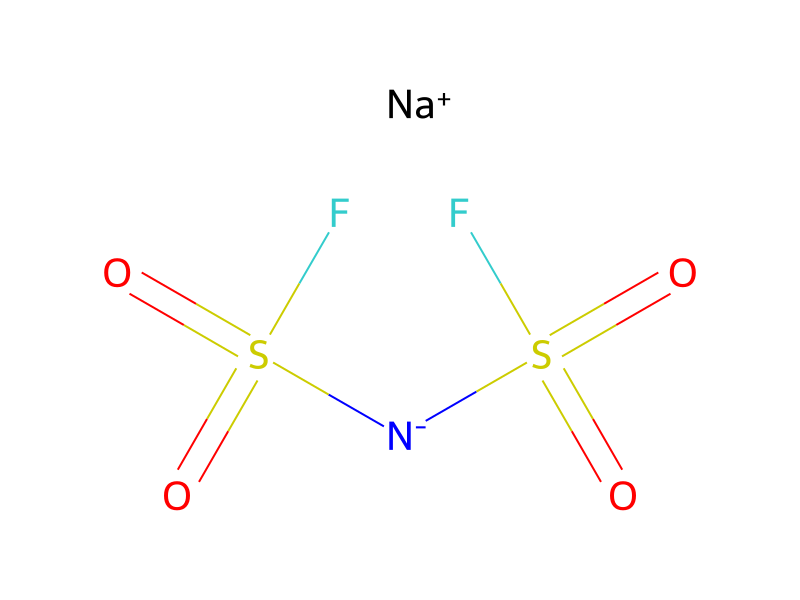
Grundinformationen
- Standard-SMILES
O=S(=O)(F)[N-]S(=O)(=O)F.[Na+]- InChIKey
VCCATSJUUVERFU-UHFFFAOYSA-N- Summenformel
- F2NNaO4S2
- Durchschnittliche Molmasse
- 203,13 g/mol
Namen und Bezeichner
- Bevorzugter Name
- Sodium Bis(fluorosulfonyl)imide
- IUPAC
- sodium bis(fluorosulfonyl)azanide
- Englischer Name
- Sodium Bis(fluorosulfonyl)imide
- Summenformel
- F2NNaO4S2
- Molmasse
- 204.13
Namen und Synonyme
Weitere Namen anzeigen
Datenbank-Bezeichner
- CAS
100669-96-3- PubChem CID
- 102310776
- EC Number
- 834-502-3
- Nikkaji
- J3.140.755I
Eigenschaften
Berechnete Struktureigenschaften
- Polarare Oberfläche (TPSA)
- 86 Ų
- H-Brücken-Donoren
- 0
- H-Brücken-Akzeptoren
- 7
- Frei drehbare Bindungen
- 2
- Schwere Atome
- 10
- Formalladung
- 0
- Komplexität
- 235
Physikochemische Eigenschaften
- Schmelzpunkt
- 109 to · 109.0 to 114.0 °C
- Dichte
- 2.4 g/cm3 · 2.4 g/cm3
- Wasserlöslichkeit
- Soluble in water
- Löslichkeit
- 0.1 M · 0.1 M carbonate: soluble (lit.) || soluble (ethers: soluble(lit.)) || soluble (glymes: soluble(lit.)) || water: very soluble (lit.)
- Aggregatzustand
- powder to crystal
- Farbe
- White to Almost white
- Major Application
- battery manufacturing
- InChI
- InChI=1S/F2NO4S2.Na/c1-8(4,5)3-9(2,6)7;/q-1;+1
- InChIKey
- VCCATSJUUVERFU-UHFFFAOYSA-N
- SMILES
- [Na+].[N-](S(F)(=O)=O)S(F)(=O)=O
Sicherheit und Regulatorisches
GHS-Klassifizierung
GHS Classification
Danger
H301 (33.3%): Toxic if swallowed [Danger Acute toxicity, oral]
P260, P261, P264, P264+P265, P270, P271, P280, P301+P316, P301+P317, P301+P330+P331, P302+P361+P354, P304+P340, P305+P354+P338, P316, P317, P319, P321, P330, P363, P403+P233, P405, and P501 (click each P-code to see the statement)
Aggregated GHS information provided per 3 reports by companies from 3 notifications to the ECHA C&L Inventory. Each notification may be associated with multiple companies.
Gefahrenhinweise
Sicherheitsdaten
- wgk
- WGK 3
- ridadr
- 1759
- hs_code
- 2935.90.9500
- hazard_class
- 8
- packing_group
- II
- Speicherklasse
- 11 - Combustible Solids
Chemie und Industrie
Anwendungen
VerwendenA highly concentrated electrolyte based on sodium bis(fluorosulfonyl)imide (NaFSI) enables the use of Na metal anodes for room-temperature sodium metal batteries based on a Na3V2(PO4)3 cathode with the charging cut-off voltage of 3.7 V versus Na/Na+[1].
Anbieter50 Anbieter
Zugehörige Reaktionen
Keine Reaktionsaufzeichnungen unter den aktuellen Filterkriterien.
Verknüpfte Notizen
Wird geladen…