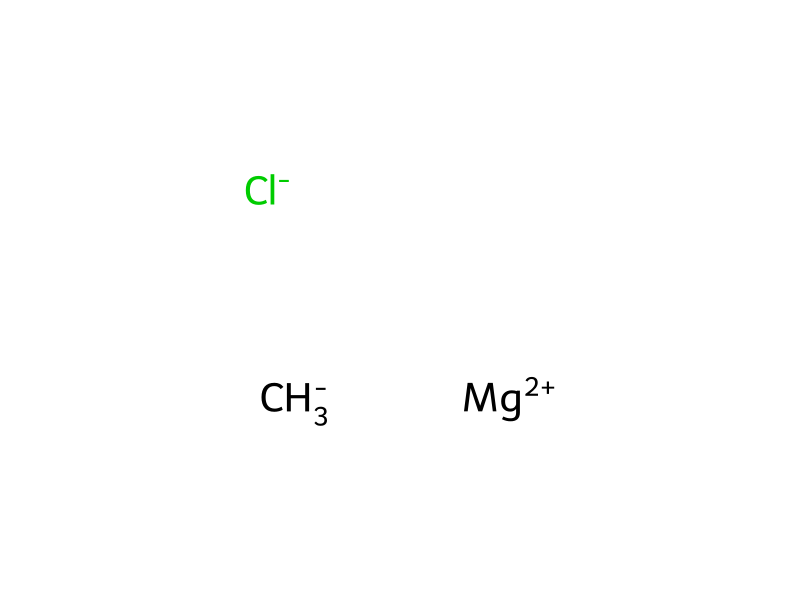
Grundinformationen
- Standard-SMILES
[CH3-].[Cl-].[Mg+2]- InChIKey
RQNMYNYHBQQZSP-UHFFFAOYSA-M- Summenformel
- CH3ClMg
- Durchschnittliche Molmasse
- 74,79 g/mol
Überblick
Methylmagnesium chloride is an alkylmagnesium halide and a one-carbon compound.
Namen und Bezeichner
- Bevorzugter Name
- Methylmagnesium chloride
- IUPAC
- magnesium;carbanide;chloride
- Lokaler Name
- Methylmagnesiumchlorid
- Englischer Name
- Methylmagnesium chloride
- Summenformel
- CH3ClMg
- Molmasse
- 74.79
Namen und Synonyme
Weitere Namen anzeigen
Datenbank-Bezeichner
- CAS
676-58-4- PubChem CID
- 12670
- DTXSID
DTXSID7052365- ChEBI
CHEBI:51492- EC Number
- 211-629-7
Eigenschaften
Berechnete Struktureigenschaften
- Polarare Oberfläche (TPSA)
- 0 Ų
- H-Brücken-Donoren
- 0
- H-Brücken-Akzeptoren
- 2
- Frei drehbare Bindungen
- 0
- Schwere Atome
- 3
- Formalladung
- 0
- Komplexität
- 4,8
Experimentelle und physikochemische Eigenschaften
Physical Description
Wet Solid
In 3 M Tetrahydrofuran solution: Brown liquid with an odor of ether; [MSDSonline]
Other Experimental Properties
Moisture sensitive
... May react violently with water. /Methyl magnesium bromide in ethyl ether/
Physikochemische Eigenschaften
- Siedepunkt
- 66 °C · 66 °C
- Dichte
- 1.013 g/mL · 1.013 g/mL at 25 °C
- Dampfdruck
- 200 hPa · 200 hPa ( 20 °C)
- Flammpunkt
- 1 °F · −1 °F
- storage temp.
- 30 °C · Store below +30°C.
- Löslichkeit
- Miscible with diethyl ether and tetrahydrofuran.
- Aggregatzustand
- Liquid
- Farbe
- Pale brown to dark green
- PH
- 7 · >7 (20°C in H2O)
- Explosionsgrenze
- 1.5 % · 1.5% (v/v) THF)
- Wasserlöslichkeit
- reacts
- BRN
- 3587199 · 3587199
- InChI
- 1S/CH3.ClH.Mg/h1H3;1H;/q;;+1/p-1
- InChIKey
- RQNMYNYHBQQZSP-UHFFFAOYSA-M
- SMILES
- C[Mg]Cl
- CAS Datenbank
- 676 · 676-58-4(CAS DataBase Reference)
- EPA chemische Informationen
- Magnesium, chloromethyl- (676-58-4)
Sicherheit und Regulatorisches
GHS-Klassifizierung
GHS Classification
Danger
H225 (36.5%): Highly Flammable liquid and vapor [Danger Flammable liquids]
P210, P222, P223, P231, P231+P232, P233, P240, P241, P242, P243, P260, P264, P264+P265, P280, P301+P330+P331, P302+P335+P334, P302+P361+P354, P303+P361+P353, P304+P340, P305+P354+P338, P316, P317, P321, P363, P370+P378, P402+P404, P403+P235, P405, and P501 (click each P-code to see the statement)
Aggregated GHS information provided per 263 reports by companies from 14 notifications to the ECHA C&L Inventory. Each notification may be associated with multiple companies.
Gefahrenhinweise
Regulatory Information
Chemical: Magnesium, chloromethyl-
Magnesium, chloromethyl- is listed on the EPA's Chemical Data Reporting (CDR) system. Manufacturers and importers of Magnesium, chloromethyl- are required to report information about their production and use of this chemical to the EPA under the Toxic Substances Control Act (TSCA). (40 eCFR Part 711)
REACH registered substance: Methylmagnesium chloride (EC: 211-629-7)
Magnesium, chloromethyl-: Does not have an individual approval but may be used under an appropriate group standard
Hazards Summary
A dangerous fire and explosion risk; [Hawley] Apart from their instability in air and their caustic basic properties, organomagnesium compounds and the precipitated inorganic magnesium salts produced during their use display no pronounced toxicity or side effects of environmental concern. [Ullmann] Reacts violently with water producing highly flammable gases; May form explosive peroxides; A corrosive substance that can cause injury to the skin, eyes, and respiratory tract; Inhalation may cause chemical pneumonitis; [MSDSonline]
DOT Emergency Guidelines
/GUIDE 138: SUBSTANCES - WATER-REACTIVE (EMITTING FLAMMABLE GASES)/ Fire or Explosion: Produce flammable gases on contact with water. May ignite on contact with water or moist air. Some react vigorously or explosively on contact with water. May be ignited by heat, sparks or flames. May re-ignite after fire is extinguished. Some are transported in highly flammable liquids. Runoff may create fire or explosion hazard. /Organometallic substance, liquid, water-reactive, flammable/
/GUIDE 138: SUBSTANCES - WATER-REACTIVE (EMITTING FLAMMABLE GASES)/ Health: Inhalation or contact with vapors, substance, or decomposition products may cause severe injury or death. May produce corrosive solutions on contact with water. Fire will produce irritating, corrosive and/or toxic gases. Runoff from fire control may cause pollution. /Organometallic substance, liquid, water-reactive, flammable/
/GUIDE 138: SUBSTANCES - WATER-REACTIVE (EMITTING FLAMMABLE GASES)/ Public Safety: CALL Emergency Response Telephone Number ... . As an immediate precautionary measure, isolate spill or leak area in all directions for at least 50 meters (150 feet) for liquids and at least 25 meter (75 feet) for solids. Keep unauthorized personnel away. Stay upwind. Keep out of low areas. Ventilate the area before entry. /Organometallic substance, liquid, water-reactive, flammable/
/GUIDE 138: SUBSTANCES - WATER-REACTIVE (EMITTING FLAMMABLE GASES)/ Protective Clothing: Wear positive pressure self-contained breathing apparatus (SCBA). Wear chemical protective clothing that is specifically recommended by the manufacturer. It may provide little or no thermal protection. Structural firefighters' protective clothing will only provide limited protection in fire situations ONLY; it is not effective in spill situations where direct contact with the substance is possible. /Organometallic substance, liquid, water-reactive, flammable/
For more DOT Emergency Guidelines (Complete) data for METHYLMAGNESIUM CHLORIDE (8 total), please visit the HSDB record page.
Shipping Name/ Number DOT/UN/NA/IMO
UN 3053; Magnesium alkyls
IMO 4.2; Magnesium alkyls
Sicherheit und Schutzausrüstung
Disposal Methods
SRP: At the time of review, criteria for land treatment or burial (sanitary landfill) disposal practices are subject to significant revision. Prior to implementing land disposal of waste residue (including waste sludge), consult with environmental regulatory agencies for guidance on acceptable disposal practices.
Protective Action Criteria (PAC)
1.2 [mg/m3]
13 [mg/m3]
79 [mg/m3]
Toxikologische Informationen
Antidote and Emergency Treatment
Basic treatment: Establish a patent airway. Suction if necessary. Watch for signs of respiratory insufficiency and assist ventilations if needed. Administer oxygen by nonrebreather mask at 10 to 15 L/min. Monitor for pulmonary edema and treat if necessary ... . Monitor for shock and treat if necessary ... . Anticipate seizures and treat if necessary ... . For eye contamination, flush eyes immediately with water. Irrigate each eye continuously with normal saline during transport ... . Do not use emetics. For ingestion, rinse mouth and administer 5 ml/kg up to 200 ml of water for dilution if the patient can swallow, has a strong gag reflex, and does not drool ... . Cover skin burns with dry sterile dressings after decontamination ... . /Poison A and B/
Advanced treatment: Consider orotracheal or nasotracheal intubation for airway control in the patient who is unconscious, has severe pulmonary edema, or is in respiratory arrest. Positive pressure ventilation techniques with a bag valve mask device may be beneficial. Monitor cardiac rhythm and treat arrhythmias as necessary ... . Start an IV with D5W /SRP: "To keep open", minimal flow rate/. Use lactated Ringer's if signs of hypovolemia are present. Watch for signs of fluid overload. Consider drug therapy for pulmonary edema ... . For hypotension with signs of hypovolemia, administer fluid cautiously. Watch for signs of fluid overload ... . Treat seizures with diazepam (Valium) ... . Use proparacaine hydrochloride to assist eye irrigation ... . /Poison A and B/
Basic treatment: Establish a patent airway. Suction if necessary. Watch for signs of respiratory insufficiency and assist ventilations if necessary. Administer oxygen by nonrebreather mask at 10 to 15 L/min. Monitor for pulmonary edema and treat if necessary ... . Monitor for shock and treat if necessary ... . For eye contamination, flush eyes immediately with water. Irrigate each eye continuously with normal saline during transport ... . Do not use emetics. For ingestion, rinse mouth and administer 5 ml/kg up to 200 ml of water for dilution if the patient can swallow, has a strong gag reflex, and does not drool ... . /Magnesium and Related Compounds/
Advanced treatment: Consider orotracheal or nasotracheal intubation for airway control in the patient who is unconscious or in severe respiratory distress. Positive pressure ventilation techniques with a bag valve mask device may be beneficial. Monitor cardiac rhythm and treat arrhythmias if necessary ... . Start an IV with D5W /SRP: "To keep open", minimal flow rate/. Use lactated Ringer's if signs of hypovolemia are present. Watch for signs of fluid overload. Consider drug therapy for pulmonary edema ... . For hypotension with signs of hypovolemia, administer fluid cautiously. Consider vasopressors for hypotension with a normal fluid volume. Watch for signs of fluid overload ... . Use proparacaine hydrochloride to assist eye irrigation ... . /Magnesium and Related Compounds/
Sicherheitsdaten
- F
- 1-3-10
- wgk
- 1
- tsca
- TSCA listed
- ridadr
- UN 3399 4.3/PG 2
- hs_code
- 29319090
- risk_code
- 11-14/15-34-19-15-37-14
- hazard_code
- F,C
- safety_code
- 26-30-36/37/39-43-45-7/8-33-29-16
- hazard_class
- 4.3
- packing_group
- I
- Speicherklasse
- 4.3 - Hazardous materials which set free flammable gases upon contact with water
- Giftige Stoffe Daten
- 676-58-4(Hazardous Substances Data)
- Hazard Classifications
- Carc. 2Eye Dam. 1Flam. Liq. 2Skin Corr. 1BSTOT SE 3Water-react 1
- Selbstentzündungstemperatur
- 609 °F
Chemie und Industrie
Verwendung und Herstellung
Uses
Used as alkylating agent in organic synthesis and as a Grignard reagent; Also used to make tetramethyllead, styrallyl alcohol, and pharmaceuticals; [HSDB]
Alkylating agent in organic synthesis; grignard reagent
CHEM INT FOR MFR OF TETRAMETHYLLEAD
CHEM INT FOR MFR OF ALCOHOLS, EG, STYRALLYL ALCOHOL
CHEM INT FOR PHARMACEUTICALS, EG, STEROIDS
U.S. Exports
(1979) No Data
(1981) No Data
U.S. Imports
(1979) No Data
(1981) No Data
U.S. Production
2023: <75,000 lb
(1977) AT LEAST 4.58X10+7 GRAMS
(1981) PROBABLY GREATER THAN 2.27X10+6 GRAMS
General Manufacturing Information
All Other Basic Organic Chemical Manufacturing
Magnesium, chloromethyl-: ACTIVE
Anwendungen
VerwendenMethylmagnesium chloride is used as a Grignard reagent and an alkylating agent in organic synthesis.
Darstellung
synthetischereaction of methyl chloride and magnesium in anhydrous diethyl ether, usually in the presence of an initiator.
Vor- und nachgelagerte Produkte
Vorgelagerte Rohstoffe
Nachgelagerte Produkte
Anbieter50 Anbieter
Ergänzende Hinweise
DefinitionChEBI: Methylmagnesium chloride is an alkylmagnesium halide and a one-carbon compound. available as a solutionin tetrahydrofuran.
Zugehörige Reaktionen
Keine Reaktionsaufzeichnungen unter den aktuellen Filterkriterien.
Verknüpfte Notizen
Wird geladen…