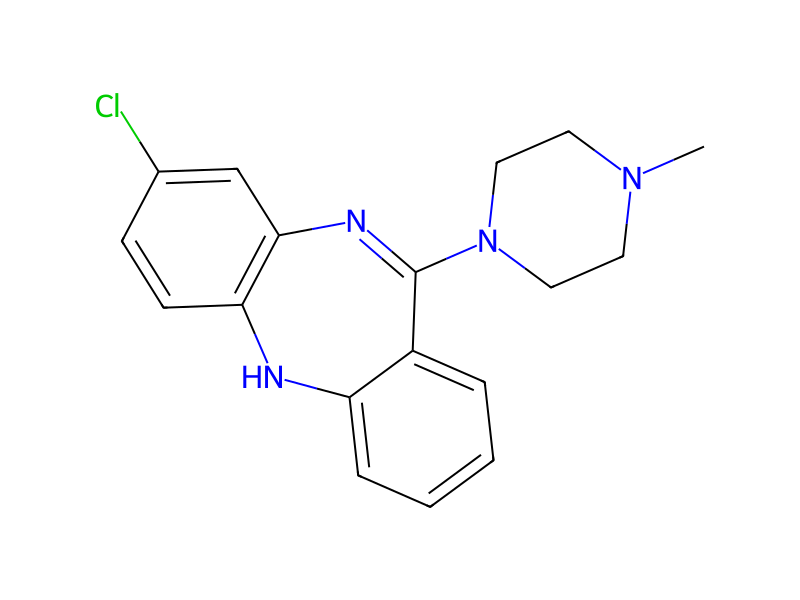
Grundinformationen
- Standard-SMILES
CN1CCN(C2=Nc3cc(Cl)ccc3Nc3ccccc32)CC1- InChIKey
QZUDBNBUXVUHMW-UHFFFAOYSA-N- Summenformel
- C18H19ClN4
- Durchschnittliche Molmasse
- 326,8 g/mol
- Monoisotopische Masse
- 326,12982429
Überblick
Clozapine is a benzodiazepine that is 5H-dibenzo[b,e][1,4]diazepine substituted by a chloro group at position 8 and a 4-methylpiperazin-1-yl group at position 11. It is a second generation antipsychotic used in the treatment of psychiatric disorders like schizophrenia. It has a role as a xenobiotic, an adrenergic antagonist, a histamine antagonist, a serotonergic antagonist, a dopaminergic antagonist, a muscarinic antagonist, a second generation antipsychotic, a GABA antagonist, an EC 3.4.21.26 (prolyl oligopeptidase) inhibitor and an environmental contaminant. It is a benzodiazepine, an organochlorine compound, a N-arylpiperazine and a N-methylpiperazine.
Namen und Bezeichner
- Bevorzugter Name
- Clozapine
- IUPAC
- 3-chloro-6-(4-methylpiperazin-1-yl)-11H-benzo[b][1,4]benzodiazepine
- Lokaler Name
- Clozapin
- Englischer Name
- Clozapine
- Summenformel
- C18H19ClN4
- Molmasse
- 326.82
Namen und Synonyme
Weitere Namen anzeigen
Datenbank-Bezeichner
- CAS
1333667-72-3、5786-21-0- PubChem CID
- 135398737
- DTXSID
DTXSID5022855- ChEMBL
CHEMBL253391、CHEMBL42- ChEBI
CHEBI:3766- UNII
- J60AR2IKIC
- EC Number
- 227-313-7
- Nikkaji
- J8.061F
Eigenschaften
Berechnete Struktureigenschaften
- XLogP
- 3,1
- Polarare Oberfläche (TPSA)
- 30,9 Ų
- H-Brücken-Donoren
- 1
- H-Brücken-Akzeptoren
- 3
- Frei drehbare Bindungen
- 1
- Schwere Atome
- 23
- Formalladung
- 0
- Komplexität
- 446
Experimentelle und physikochemische Eigenschaften
Drugs
Pharmaceuticals -> Antipsychotics
Pharmaceuticals -> Used in Switzerland
Pharmaceuticals -> Listed in ZINC15
LogP
log Kow = 3.23
2.7
3.32
Solubility
Solubility wt/wt at 25 °C: water <0.01
Solubility wt/wt at 25 °C: Acetone >5; acetonitrile 1.9; chloroform >20; ethhyl acetate >5; absolute ethanol 4.0
1.86e-01 g/L
Human Drugs
Breast Feeding; Lactation; Milk, Human; Antipsychotic Agents
FDA approved drugs -> Active ingredient
FDA approved drugs -> Active ingredient
Pharmaceuticals
Medicines for psychotic disorders
Melting Point
183-184 °C
183-184 °C
183 - 184 °C
Dissociation Constants
7.9
7.63
7.63
7.8
7.5
pKa = 7.50
Collision Cross Section
177.5 Ų [M+H]+ [CCS Type: TW; Method: calibrated with polyalanine and drug standards]
177.01 Ų [M+Na]+ [CCS Type: TW; Method: calibrated with polyalanine and drug standards]
178.8 Ų [M+H]+ [CCS Type: TW; Method: Major Mix IMS/Tof Calibration Kit (Waters)]
Physikochemische Eigenschaften
- Schmelzpunkt
- 182 · 182-185°C
- Siedepunkt
- 482.71 °C · 482.71°C (rough estimate)
- Dichte
- 1.1327 · 1.1327 (rough estimate)
- Brechungsindex
- 1.611 · 1.6110 (estimate)
- Flammpunkt
- 9 ℃ · 9℃
- storage temp.
- 2 · 2-8°C
- Löslichkeit
- 1 mg/mL · ethanol: 1 mg/mL
- pka
- 3.7 · 3.70, 7.60(at 25℃)
- Aggregatzustand
- powder
- Farbe
- pale yellow
- Merck
- 14 · 14,2423
- Stabilität
- 1 year · Stable for 1 year from date of purchase as supplied. Solutions in DMSO may be stored at -20°C for up to 3 months.
- Major Application
- pharmaceutical (small molecule)
- InChI
- InChI=1S/C18H19ClN4/c1-22-8-10-23(11-9-22)18-14-4-2-3-5-15(14)20-16-7-6-13(19)12-17(16)21-18/h2-7,12,20H,8-11H2,1H3
- InChIKey
- QZUDBNBUXVUHMW-UHFFFAOYSA-N
- SMILES
- N1=C(N2CCN(C)CC2)C2=CC=CC=C2NC2=CC=C(Cl)C=C12
- CAS Datenbank
- 5786 · 5786-21-0(CAS DataBase Reference)
- NIST chemische Informationen
- Clozapine(5786-21-0)
Sicherheit und Regulatorisches
GHS-Klassifizierung
GHS Classification
Danger
H301 (100%): Toxic if swallowed [Danger Acute toxicity, oral]
P203, P264, P270, P280, P301+P316, P318, P321, P330, P405, and P501 (click each P-code to see the statement)
Aggregated GHS information provided per 118 reports by companies from 15 notifications to the ECHA C&L Inventory. Each notification may be associated with multiple companies.
Danger
H301: Toxic if swallowed [Danger Acute toxicity, oral]
Gefahrenhinweise
FDA Requirements
The Approved Drug Products with Therapeutic Equivalence Evaluations identifies currently marketed prescription drug products, including clozapine, approved on the basis of safety and effectiveness by FDA under sections 505 of the Federal Food, Drug, and Cosmetic Act.
Special Reports
Stephens P; A Review of Clozapine: An Antipsychotic for Treatment Resistant Schizophrenia. Comp Psychiatry 31 (4): 315-26 (1990). This report reviews over 25 years of literature of the development, pharmacology, proposed mechanism of action, efficacy, adverse effects, and recommendations for use of clozapine.
Ereshefsky L et al; Clin Pharm 8 (10): 691-709 (1989). The pharmacology, pharmacokinetics, clinical efficacy, adverse effects, dosage, and cost of the atypical antipsychotic drug clozapine are reviewed.
Sicherheit und Schutzausrüstung
Fire Fighting Procedures
Advice for firefighters: Wear self-contained breathing apparatus for firefighting if necessary.
Suitable extinguishing media: Use water spray, alcohol-resistant foam, dry chemical or carbon dioxide.
Cleanup Methods
ACCIDENTAL RELEASE MEASURES. Personal precautions, protective equipment and emergency procedures: Wear respiratory protection. Avoid dust formation. Avoid breathing vapours, mist or gas. Ensure adequate ventilation. Evacuate personnel to safe areas. Avoid breathing dust.; Environmental precautions: Prevent further leakage or spillage if safe to do so. Do not let product enter drains.; Methods and materials for containment and cleaning up: Pick up and arrange disposal without creating dust. Sweep up and shovel. Keep in suitable, closed containers for disposal.
Disposal Methods
SRP: At the time of review, regulatory criteria for small quantity disposal are subject to significant revision, however, household quantities of waste pharmaceuticals may be managed as follows: Mix with wet cat litter or coffee grounds, double bag in plastic, discard in trash.
SRP: Expired or waste pharmaceuticals shall carefully take into consideration applicable DEA, EPA, and FDA regulations. It is not appropriate to dispose by flushing the pharmaceutical down the toilet or discarding to trash. If possible return the pharmaceutical to the manufacturer for proper disposal being careful to properly label and securely package the material. Alternatively, the waste pharmaceutical shall be labeled, securely packaged and transported by a state licensed medical waste contractor to dispose by burial in a licensed hazardous or toxic waste landfill or incinerator.
Preventive Measures
Gloves must be inspected prior to use. Use proper glove removal technique (without touching glove's outer surface) to avoid skin contact with this product. Dispose of contaminated gloves after use in accordance with applicable laws and good laboratory practices. Wash and dry hands.
Appropriate engineering controls: Avoid contact with skin, eyes and clothing. Wash hands before breaks and immediately after handling the product.
Precautions for safe handling: Avoid contact with skin and eyes. Avoid formation of dust and aerosols. Provide appropriate exhaust ventilation at places where dust is formed.
Personal Protective Equipment (PPE)
Respiratory protection: Where risk assessment shows air-purifying respirators are appropriate use a full-face particle respirator type N100 (US) or type P3 (EN 143) respirator cartridges as a backup to engineering controls. If the respirator is the sole means of protection, use a full-face supplied air respirator. Use respirators and components tested and approved under appropriate government standards such as NIOSH (US) or CEN (EU).
Body Protection: Complete suit protecting against chemicals, The type of protective equipment must be selected according to the concentration and amount of the dangerous substance at the specific workplace.
Skin protection: Handle with gloves.
Eye/face protection: Face shield and safety glasses Use equipment for eye protection tested and approved under appropriate government standards such as NIOSH (US) or EN 166(EU).
Toxikologische Informationen
Treatment
Establish and maintain an airway; ensure adequate oxygenation and ventilation. Activated charcoal, which may be used with sorbitol, may be as or more effective than emesis or lavage, and should be considered in treating overdosage. Cardiac and vital signs monitoring is recommended along with general symptomatic and supportive measures. Additional surveillance should be continued for several days because of the risk of delayed effects. Avoid epinephrine and derivatives when treating hypotension, and quinidine and procainamide when treating cardiac arrhythmia. There are no specific antidotes for Clozapine. (L1712)
Health Effects
Clozapine may cause side effects; most are minor, although some are serious and potentially fatal. Common side effects include extreme constipation, bed-wetting, night-time drooling, muscle stiffness, sedation, tremors, orthostatic hypotension, hyperglycemia, and weight gain. The risk of developing extrapyramidal symptoms such as tardive dyskinesia is below that of typical antipsychotics; this may be due to clozapine's anticholinergic effects. Extrapyramidal symptoms may subside somewhat after a person switches from another antipsychotic to clozapine. Clozapine also carries five black box warnings, including warnings for agranulocytosis, CNS depression, leukopenia, neutropenia, seizure disorder, bone marrow suppression, dementia, hypotension, myocarditis, orthostatic hypotension (with or without syncope) and seizures. Lowering of the seizure threshold may be dose related and slow initial titration of dose may decrease the risk for precipitating seizures. Slow titration of dosing may also decrease the risk for orthostatic hypotension and other adverse cardiovascular side effects. Many male patients have experienced cessation of ejaculation during orgasm as a side effect of clozapine, though this is not documented in official drug guides. (Wikipedia)
Hepatotoxicity
Serum enzyme elevations arise in up to two-thirds of patients on clozapine but are usually modest and resolve spontaneously after 6 to 12 weeks, often not requiring dose modification or discontinuation. ALT elevations above 3 times ULN arise in 10% to 20% of patients but are usually transient. Occasionally, serum enzyme elevations are associated with symptoms of nausea, weakness and abdominal discomfort, and therapy should be discontinued or managed with careful dose reduction.
Ecotoxicity Values
LC50; Species: Pimephales promelas (Fathead minnow) eggs, age <48 hr; Conditions: freshwater, renewal, 22.0-24.0 °C, pH 8.3-8.5, hardness 110-150 mg/L CaCO3, alkalinity 100-130 mg/L CaCO3, conductivity 500-560 umhos/cm, dissolved oxygen 7.5-8.0 mg/L; Concentration: 30.8 ug/L for 28 days posthatch
Environmental Fate
TERRESTRIAL FATE: Based on a classification scheme(1), an estimated Koc value of 1.3X10+4(SRC), determined from a structure estimation method(2), indicates that clozapine is expected to be immobile mobility in soil(SRC). The pKa value of 7.60(3) indicates that this compound will exist almost entirely in the cation form in the environment and cations generally adsorb more strongly to soils containing organic carbon and clay than their neutral counterparts(4). Volatilization from moist soil is not expected because the compound exists as an cation and cations do not volatilize. Clozapine is not expected to volatilize from dry soil surfaces(SRC) based upon an estimated vapor pressure of 1.1X10⁻⁸ mm Hg at 25 °C(SRC), determined from a fragment constant method(2). Biodegradation data in soil were not available(SRC, 2015).
AQUATIC FATE: Based on a classification scheme(1), an estimated Koc value of 1.3X10+4(SRC), determined from a structure estimation method(2), indicates that clozapine is expected to adsorb to suspended solids and sediment(SRC). The pKa value of 7.60(3) indicates clozapine will exist almost entirely in the cation form at pH values of 5 to 9 and, therefore, volatilization from water surfaces is not expected to be an important fate process(SRC). According to a classification scheme(4), an estimated BCF of 63(SRC), from an estimated log from its log Kow of 3.23(5) and a regression-derived equation(2), suggests the potential for bioconcentration in aquatic organisms is moderate(SRC). Biodegradation data in water were not available(SRC, 2015).
ATMOSPHERIC FATE: According to a model of gas/particle partitioning of semivolatile organic compounds in the atmosphere(1), clozapine, which has an estimated vapor pressure of 1.1X10⁻⁸ mm Hg at 25 °C(SRC), determined from a fragment constant method(2), is expected to exist solely in the particulate phase in the ambient atmosphere. Particulate-phase clozapine may be removed from the air by wet and dry deposition(SRC). Clozapine absorbs UV light at wavelengths >290 nm(4) and, therefore, may be susceptible to direct photolysis by sunlight(SRC).
Toxicity Summary
IDENTIFICATION AND USE: Clozapine has been shown to be an effective, relatively rapid-acting, broad-spectrum antipsychotic agent in both uncontrolled and controlled studies of patients with schizophrenia.Clozapine has been used in a limited number of patients with advanced, idiopathic parkinsonian syndrome for the management of dopaminomimetic psychosis associated with antiparkinsonian drug therapy, but adverse effects such as sedation, confusion, and increased parkinsonian manifestations may limit the benefit of clozapine therapy in these patients. Clozapine is used to reduce the risk of recurrent suicidal behavior in patients with schizophrenia or schizoaffective disorder who are judged to be at chronic risk for such behavior, based on history and recent clinical state. Although the safety and efficacy of clozapine in children and adolescents younger than 16 years of age have not been established, the drug has been successfully used for the management of childhood-onset schizophrenia in a limited number of treatment-resistant children and adolescents. Clozapine is used for the symptomatic management of schizophrenia in severely ill patients whose disease fails to respond adequately to other antipsychotic therapy. HUMAN EXPOSURE AND TOXICITY: The most frequent adverse effects of clozapine involve the central and autonomic nervous systems (e.g., drowsiness or sedation, hypersalivation) and the cardiovascular system (e.g., tachycardia, hypotension). While the frequency and severity of some adverse effects (e.g., extrapyramidal reactions, tardive dyskinesia) appear to be less with clozapine than with other antipsychotic agents, other potentially serious adverse effects (e.g., agranulocytosis, seizures) may occur more frequently with clozapine therapy, and the potential risks and benefits should be evaluated carefully whenever therapy with the drug is considered. Although it has been suggested that a local genetic or environmental factor or factors may have been involved in the Finnish cases, the existence of such a factor has not been documented. During a 2 month period in Finland there were 18 reports of severe blood disorders (9 fatal) associated with clozapine. Agranulocytosis accounted for 8 of the deaths and leukemia probably for the ninth. Experience in 22 other countries outside Finland where clozapine had been marketed indicated an incidence of agranulocytosis of 0.3 per 1000 compared with an incidence almost 20 times as high in Finland and with 0.1 to 0.8 per 1000 for other tricyclic neuroleptics. patients who received flexible dosages of clozapine (mean dosage: 274.2 mg daily) for approximately 2 years had a 26% reduction in their risk for suicide attempts or hospitalization to prevent suicide compared with those who received flexible dosages of olanzapine (mean dosage: 16.6 mg daily); the treatment-resistant status of patients was not predictive of response to clozapine or olanzapine. ANIMAL STUDIES: Repeated oral administration to rats (6 months) and to dogs (3 months) decreased wt gain with doses of 20 mg/kg or more in rats and of 10 mg/kg or more in dogs. Hepatic hypertrophy, which was not strictly dose-dependent, was not associated with either histological changes or changes in blood chemistry and was completely reversible after discontinuation of treatment. No toxic signs were observed in rats or in dogs. Clozapine in daily oral doses of 20 or 40 mg/kg to rats and rabbits had no teratogenic effects and no influence on the fertility of male and female rats. At 40 mg/kg, however, clozapine inhibited growth of suckling young of treated mothers. Fertility of F1 treated mothers was normal and development of F2 showed no abnormalities. Clozapine hydrochloride inhibited conditioned avoidance behavior in rats, also inhibited writhing syndrome induced by phenylbenzoquinone in mice, and decreased body temp. Clozapine hydrochloride antagonized tremor and lacrimation induced by oxotremorine in mice, decreased the acute toxicity of physostigmine and 5-hydroxyindol acetate level in brain.
The reported mortality rate of clozapine intoxication is approximately 12%. A 36-year-old man experienced rhabdomyolysis following an overdose of clozapine 125 mg tablets. After 5 days, the patient was discharged from the hospital when the creatinine kinase levels returned within normal range. Monitor creatinine kinase levels to diagnose possible rhabdomyolysis. Another acute overdose in a 60-year-old man reported venous thromboembolism and pulmonary embolism; therefore, it is essential to monitor patients initiated on clozapine who may be at an increased risk of thromboembolic events.
The mechanism of action of Clozapine, as with other drugs used to treat schizophrenia, is unknown. However, it has been proposed that the drug's therapeutic activity in schizophrenia is mediated through a combination of dopamine type 2 (D<sub>2</sub>) and serotonin type 2 (5HT<sub>2</sub>) receptor antagonism. Atypical antipsychotic drugs such as clozapine have been proposed to block the 5HT2 and D2 receptors at therapeutic doses as evidenced by blockage in accelerating levels of growth hormone and cortisol secretion. The antipsychotic activity of clozapine is assumed to be the cause of D2 blockade while interacting with other receptors as well. With regards to mode of action in blocking dopaminergic receptors, clozapine exhibits higher affinity for D4 compared to the D2 receptor subtype. In addition, D1 antagonistic activity of clozapine enhances dopaminergic activity by increased extracellular brain dopamine concentrations specifically in the prefrontal cortex which is believed to explain its efficacy against negative symptoms generally observed in schizophrenia when using other drugs. Interestingly, clozapine has not been able to block arousal behavior which is the case when using other dopamine agonists after prolonged treatment. Interaction of clozapine with the immune system has also been found important when using this drug. Neutrophil apoptosis otherwise known as agranulocytosis was detected after administration of clopazine alone and bioactived clozapine to nitrenium ion at supratherapeutic and therapeutic levels, respectively. At supratherapeutic concentrations, clozapine can be toxic due to the drug itself or its stable metabolite products. At therapeutic levels however, the chemically reactive nitrenium ion is believed to bound to cellular protein, deplete intracellular GSH, and lead to final polymorphonuclear (PMN) and mononuclear leukocyte cytotoxicity in vitro. Agranulocytosis induced by bioactived clozapine can be inhibited by using antioxidants and genistein. PMN apoptosis is believed to be achieved by decelerating the life span of circulating cells after clozapine administration. Clozapine has also shown to interact with GABA receptors. Clozapine is able to induce release of glutamate and D-serine and decrease expression of glutamate transporters in astrocytic cell cultures with no neurons.
Effluent Concentrations
The liquid chromatography-electrospray ionization-tandem mass spectrometer (LC-MS/MS) method coupled with an automated solid-phase extraction procedure has been developed to identify 22 psychiatric pharmaceuticals, including seven anxiolytic-sedative-hypnotics, six antidepressants, and nine anti-schizophrenia drugs, in wastewater samples from two psychiatric hospital wastewater treatment plants (P-WWTPs) and three municipal wastewater treatment plants (M-WWTPs) in Beijing, China. Analyte recoveries from spiking experiments in the WWTP influent and effluent at three concentrations ranged from 70% to 110%, excluding sulpiride, ziprasidone, and olanzapine. Method detection limits for five, eight, and nine analytes in the WWTP influent and effluent were 20-80, 1-16, and <1 ng/L, respectively. High psychiatric pharmaceutical concentrations (e.g., approx 942 ng/L oxazepam, 5552-12,782 ng/L clozapine, 2762-9832 ng/L sulpiride, and 2030-4967 ng/L quetiapine) were frequently observed in P-WWTP influent compared to M-WWTPs. Although P-WWTPs typically had higher removal rates, significantly higher concentrations of the target compounds were observed in the P-WWTP secondary effluent than in the M-WWTP influent (e.g., approx 752 ng/L oxazepam, approx 8183 ng/L clozapine, approx 10,833 ng/L sulpiride, and approx 1168 ng/L quetiapine). Thus, the discharge control of psychiatric pharmaceuticals from psychiatric hospitals requires improvement.
Soil Adsorption/Mobility
Using a structure estimation method based on molecular connectivity indices(1), the Koc of cloazpine can be estimated to be 1.3X10+4(SRC). According to a classification scheme(2), this estimated Koc value suggests that clozapine is expected to be immobile in soil. The pKa value of 7.60(3) indicates that this compound will exist almost entirely in the cation form in the environment and cations generally adsorb more strongly to soils containing organic carbon and clay than their neutral counterparts(4). Clozapine has been shown to absorb to biosolids in wastetreatment sludge; log Koc values of 3.56, 3.54 and 3.41 have been reported in sludges from Denver, CO and Mines Park, AS(5), corresponding to Koc values of 3,630, 3,567 for the Denver sludge samples and 2570 for the Arkansas sludge sample(SRC).
Human Toxicity Excerpts
/HUMAN EXPOSURE STUDIES/ Elderly patients with dementia-related psychosis treated with antipsychotic drugs are at an increased risk of death. Analyses of seventeen placebo-controlled trials (modal duration of 10 weeks), largely in patients taking atypical antipsychotic drugs, revealed a risk of death in the drug-treated patients of between 1.6 to 1.7 times the risk of death in placebo-treated patients. Over the course of a typical 10-week controlled trial, the rate of death in drug-treated patients was about 4.5%, compared to a rate of about 2.6% in the placebo group. Although the causes of death were varied, most of the deaths appeared to be either cardiovascular (e.g., heart failure, sudden death) or infectious (e.g., pneumonia) in nature. Observational studies suggest that, similar to atypical antipsychotic drugs, treatment with conventional antipsychotic drugs may increase mortality. The extent to which the findings of increased mortality in observational studies may be attributed to the antipsychotic drug as opposed to some characteristic(s) of the patients is not clear. Clozapine is not approved for the treatment of patients with dementia-related psychosis.
/SIGNS AND SYMPTOMS/ The most frequent adverse effects of clozapine involve the central and autonomic nervous systems (e.g., drowsiness or sedation, hypersalivation) and the cardiovascular system (e.g., tachycardia, hypotension). While the frequency and severity of some adverse effects (e.g., extrapyramidal reactions, tardive dyskinesia) appear to be less with clozapine than with other antipsychotic agents, other potentially serious adverse effects (e.g., agranulocytosis, seizures) may occur more frequently with clozapine therapy, and the potential risks and benefits should be evaluated carefully whenever therapy with the drug is considered. Because of the substantial risk of clozapine-associated agranulocytosis, which may persist over an extended period of time and be life-threatening or fatal if not detected early and therapy interrupted, clozapine is available for use only through patient-management systems that ensure baseline and periodic blood tests prior to delivery of the next supply of medication; dispensing is contingent on the results of the white blood cell (WBC) count and absolute neutrophil count (ANC).
/SIGNS AND SYMPTOMS/ Orthostatic hypotension, with or without syncope, can occur with clozapine treatment. Rarely, collapse can be profound and be accompanied by respiratory and/or cardiac arrest. Orthostatic hypotension is more likely to occur during initial titration in association with rapid dose escalation. In patients who have had even a brief interval off clozapine, i.e., 2 or more days since the last dose, treatment should be started with 12.5 mg once or twice daily. Since collapse, respiratory arrest and cardiac arrest during initial treatment has occurred in patients who were being administered benzodiazepines or other psychotropic drugs, caution is advised when clozapine is initiated in patients taking a benzodiazepine or any other psychotropic drug.
/CASE REPORTS/ One patient receiving clozapine experienced a generalized tonic-clonic (grand mal) seizure following accidental ingestion of an extra dose (total dose ingested within 24 hours: 1050 mg); the same patient had another seizure several weeks later, 2 hours after a usual 450-mg morning dose. Results of plasma clozapine determinations obtained at the time of the seizures revealed plasma clozapine concentrations of approximately 2000 ng/mL in each case. Another patient who had been taking clozapine for 27 months had a generalized tonic-clonic seizure following an apparent intentional overdosage (total dose ingested within 24 hours: approximately 3 g), after which the patient made an uneventful recovery. One hour after the seizure, the patient's plasma clozapine concentration was 1313 ng/mL.
For more Human Toxicity Excerpts (Complete) data for CLOZAPINE (10 total), please visit the HSDB record page.
Regulatorische Informationen
FDA Requirements
The Approved Drug Products with Therapeutic Equivalence Evaluations identifies currently marketed prescription drug products, including clozapine, approved on the basis of safety and effectiveness by FDA under sections 505 of the Federal Food, Drug, and Cosmetic Act.
Sicherheitsdaten
- wgk
- 3
- ridadr
- UN 2811 6.1/PG 3
- hs_code
- 29339900
- RTECS-Nr.
- HP1750000
- risk_code
- 22-36/37/38-68-63-39/23/24/25-23/24/25-11
- Toxizität
- LD50 in mice, rats (mg/kg): 61, 58 i.v.; 199, 260 orally (Lindt)
- hazard_code
- Xn,Xi,T,F
- safety_code
- 26-36/37-45-16-7
- hazard_class
- 6.1(b)
- packing_group
- III
- Speicherklasse
- 6.1C - Combustible acute toxic Cat.3toxic compounds or compounds which causing chronic effects
- Giftige Stoffe Daten
- 5786-21-0(Hazardous Substances Data)
- Hazard Classifications
- Acute Tox. 3 Oral
Chemie und Industrie
Pharmakologische Informationen
ATC Code
N05AH02
N - Nervous system
QN - Nervous system
N05AH02
Pharmacodynamics
Clozapine is a psychotropic agent belonging to the chemical class of benzisoxazole derivatives that is universally regarded as the treatment of choice for treatment-resistant schizophrenia. Although it is thought to mediate its pharmacological effect through antagonism of the dopamine type 2 (D<sub>2</sub>) and the serotonin type 2A (5-HT<sub>2A</sub>) receptors, research have shown that clozapine can act on various types of receptors. Patients should be counseled regarding the risk of hypersensitivity reactions such as agranulocytosis and myocarditis with clozapine use. Clozapine-induced agranulocytosis, which is a reduction in the absolute neutrophil count or white blood cell count, places the patient at an increased risk for infection. Agranulocytosis is most likely to occur in the first 3-6 months of therapy, but it can still occur after years of treatment. The mechanism is thought to be a dose-independent and immune-mediated reaction against neutrophils. Patients are strictly monitored by lab testing (complete blood count with differential) to ensure agranulocytosis is detected and treated if it occurs. Testing is initially completed at one-week intervals but is expanded to two-week intervals at six months, and then four-week intervals at twelve months if lab results have been within an appropriate range. Monitoring parameters may change if there is any break in therapy. In Canada, the patient's lab values are reported to the manufacturer for hematological monitoring, and in the USA, the patient's lab values are reported to the REMS (Risk Evaluation and Mitigation Strategy) program. These programs function to notify the care provider of any significant drop in WBC/neutrophil count, or if there is a drop below a threshold level. Patients who enter the "Red" zone (WBC<2x10⁹/L or ANC<1.5x10⁹/L) should normally not be re-challenged. Clozapine-induced myocarditis is a hypersensitivity reaction that usually occurs in the third week of clozapine therapy and about 2% of clozapine patients. Monitor the patient's troponin, CRP, and ECG at baseline, and 28 days into treatment. Follow guidelines for appropriate next steps according to the patient's lab results. If myocarditis occurs, the patient should not be re-challenged with clozapine.
Mechanism of Action
The mechanism of action of clozapine is unknown. However, it has been proposed that the therapeutic efficacy of clozapine in schizophrenia is mediated through antagonism of the dopamine type 2 (D<sub>2</sub>) and the serotonin type 2A (5-HT<sub>2A</sub>) receptors. Clozapine also acts as an antagonist at adrenergic, cholinergic, histaminergic, and other dopaminergic and serotonergic receptors. Clozapine demonstrated binding affinity to the following receptors: histamine H1 (Ki 1.1 nM), adrenergic α1A (Ki 1.6 nM), serotonin 5-HT6 (Ki 4 nM), serotonin 5-HT2A (Ki 5.4 nM), muscarinic M1 (Ki 6.2 nM), serotonin 5-HT7 (Ki 6.3 nM), serotonin 5-HT2C (Ki 9.4 nM), dopamine D4 (Ki 24 nM), adrenergic α2A (Ki 90 nM), serotonin 5-HT3 (Ki 95 nM), serotonin 5-HT1A (Ki 120 nM), dopamine D2 (Ki 160 nM), dopamine D1 (Ki 270 nM), dopamine D5 (Ki 454 nM), and dopamine D3 (Ki 555 nM). Clozapine acts as an antagonist at other receptors, but with lower potency. Antagonism at receptors other than dopamine and 5HT<sub>2</sub> with similar receptor affinities may explain some of the other therapeutic and side effects of clozapine. Clozapine's antagonism of muscarinic M1-5 receptors may explain its anticholinergic effects. Clozapine's antagonism of histamine H1 receptors may explain the somnolence observed with this drug. Clozapine's antagonism of adrenergic α1 receptors may explain the orthostatic hypotension observed with this drug.
Clozapine is classified as an 'atypical' antipsychotic drug because its profile of binding to dopamine receptors and its effects on various dopamine mediated behaviors differ from those exhibited by more typical antipsychotic drug products. In particular, although clozapine does interfere with the binding of dopamine at D1, D2, D3 and D5 receptors, and has a high affinity for the D4 receptor, it does not induce catalepsy nor inhibit apomorphine-induced stereotypy. This evidence, consistent with the view that clozapine is preferentially more active at limbic than at striatal dopamine receptors, may explain the relative freedom of clozapine from extrapyramidal side effects. Clozapine also acts as an antagonist at adrenergic, cholinergic, histaminergic and serotonergic receptors.
Biological Half-Life
The mean elimination half-life of clozapine after a single 75 mg dose was 8 hours (range: 4 to 12 hours), compared to a mean elimination half-life of 12 hours (range: 4 to 66 hours), after achieving a steady state with 100 mg twice daily dosing. A comparison of single-dose and multiple-dose administration of clozapine demonstrated that the elimination half-life increased significantly after multiple dosing relative to that after single-dose administration, suggesting the possibility of concentration-dependent pharmacokinetics.
The mean elimination half-life of clozapine after a single 75 mg dose was 8 hours (range: 4 to 12 hours), compared to a mean elimination half-life, after achieving steady-state with 100 mg b.i.d. dosing, of 12 hours (range: 4 to 66 hours).
Metabolism/Metabolites
Clozapine is almost completely metabolized prior to excretion, and only trace amounts of unchanged drug are detected in the urine and feces. Clozapine is a substrate for many cytochrome P450 isozymes, in particular CYP1A2, CYP2D6, and CYP3A4.The unmethylated, hydroxylated, and N-oxide derivatives are components in both urine and feces. Pharmacological testing has shown the desmethyl metabolite (norclozapine) to have only limited activity, while the hydroxylated and N-oxide derivatives were inactive.
Manic and schizophrenic patients were given neuroleptic clozapine at 300-500 mg daily and metabolites of clozapine were isolated from urine and analyzed by gas chromatography-mass spectrometry. Clozapine was converted into 2 metabolites by replacement of chlorine atom by a hydroxyl or methylsulfide group. Further metabolites were the N-demethyl deriv of 1st two metabolites. A metabolite with an oxidized piperazine ring was also found, and possibility of a metabolite with an oxidized sulfur is suggested.
/Clozapine/ is metabolized to N-oxideclozapine and N-desmethylclozapine, which have less pharmacological activity than the parent compound and are excreted in the urine and, to a lesser extent, in the feces.
Clozapine has known human metabolites that include Clozapine N-glucuronide, Clozapine-N-oxide, and N-Desmethylclozapine.
Hepatic Route of Elimination: Approximately 50% of the administered dose is excreted in the urine and 30% in the feces. Half Life: 8 hours (range 4-12 hours)
FDA Pharmacological Classification
J60AR2IKIC
CLOZAPINE
Established Pharmacologic Class [EPC] - Atypical Antipsychotic
Clozapine is an Atypical Antipsychotic.
CLOZAPINE
Atypical Antipsychotic [EPC]
MeSH Pharmacological Classification
Drugs that bind to but do not activate serotonin receptors, thereby blocking the actions of serotonin or SEROTONIN RECEPTOR AGONISTS.
Agents that control agitated psychotic behavior, alleviate acute psychotic states, reduce psychotic symptoms, and exert a quieting effect. They are used in SCHIZOPHRENIA; senile dementia; transient psychosis following surgery; or MYOCARDIAL INFARCTION; etc. These drugs are often referred to as neuroleptics alluding to the tendency to produce neurological side effects, but not all antipsychotics are likely to produce such effects. Many of these drugs may also be effective against nausea, emesis, and pruritus.
Drugs that bind to but do not activate GABA RECEPTORS, thereby blocking the actions of endogenous GAMMA-AMINOBUTYRIC ACID and GABA RECEPTOR AGONISTS.
Absorption, Distribution and Excretion
In humans, clozapine tablets (25 mg and 100 mg) are equally bioavailable relative to a CLOZARIL solution. Following oral administration of clozapine 100 mg twice daily, the average steady-state peak plasma concentration was 319 ng/mL (range: 102 to 771 ng/mL), occurring at the average of 2.5 hours (range: 1 to 6 hours) after dosing. The average minimum concentration at steady state was 122 ng/mL (range: 41 to 343 ng/mL), after 100 mg twice daily dosing.
Approximately 50% of the administered dose is excreted in the urine and 30% in the feces.
The median volume of distribution of clozapine was calculated to be 508 L (272–1290 L).
The median clearance of clozapine is calculated to be 30.3 L/h (14.4–45.2 L/h).
Clozapine is almost completely metabolized prior to excretion and only trace amounts of unchanged drug are detected in the urine and feces. Approximately 50% of the administered dose is excreted in the urine and 30% in the feces. The demethylated, hydroxylated and N-oxide derivatives are components in both urine and feces. Pharmacological testing has shown the desmethyl metabolite to have only limited activity, while the hydroxylated and N-oxide derivatives were inactive.
In man, clozapine tablets (25 mg and 100 mg) are equally bioavailable relative to a clozapine solution. Following a dosage of 100 mg b.i.d., the average steady-state peak plasma concentration was 319 ng/mL (range: 102 to 771 ng/mL), occurring at the average of 2.5 hours (range: 1 to 6 hours) after dosing. The average minimum concentration at steady-state was 122 ng/mL (range: 41 to 343 ng/mL), after 100 mg b.i.d. dosing. Food does not appear to affect the systemic bioavailability of clozapine. Thus, clozapine may be administered with or without food. Clozapine is approximately 97% bound to serum proteins.
Verwendung und Herstellung
Uses
MEDICATION
Antipsychotic Agents; GABA Antagonists; Serotonin Antagonists
Use (kg) in Switzerland (2009): >500
For use in patients with treatment-resistant schizophrenia.
Methods of Manufacturing
Clozapine may be prepared by means of intramolecular condensation of 2-amino-4-chlorodiphenylamine-2'-carboxylic acid 4-methylpiperazide in the presence of phosphorous oxychloride and N,N-dimethylformamide. The desired product is extracted with benzene, extracted from the organic solution with dilute acetic acid, and then precipitated by addition of concentrated ammonia water.
Preparation: France patent 1334944 (1963 to Wander); Schmutz, Hunziker, United States of America patent 3539573 (1970); Netherlands patent 293201 (1966 to Wander).
Use Classification
Pharmaceuticals
Pharmaceuticals -> Neuroleptics
Anwendungen
HistoryThe development of clozapine began in the late 1950s by researchers at the Swiss pharmaceutical company Wander. In the early 1960s, a team led by Fritz Hunziker and Jörg Schmutz synthesized the compound, a tricyclic dibenzoxazine. Clozapine's pharmacological properties differed significantly from traditional antipsychotics; it possessed potent antipsychotic activity and exhibited almost no extrapyramidal symptoms. Clozapine was approved in Europe for the treatment of schizophrenia in 1972 and in the United States in 1975. However, subsequent cases of agranulocytosis—particularly the fatal case in Finland—led to its withdrawal from the US market in 1975. Throughout the 1980s, a research team led by John Kane and Herbert Meltzer demonstrated through rigorous clinical trials that clozapine had a significant therapeutic effect on treatment-resistant schizophrenia unresponsive to traditional antipsychotics. This evidence prompted the US Food and Drug Administration (FDA) to conditionally re-approve its marketing in 1989, but only under the condition of using a rigorous blood monitoring system.
VerwendenClozapine is a neuroleptic, which expresses antipsychotic and sedative action. It does not cause general depression and extrapyramidal disorders. It is used for severe and chronic forms of schizophrenia, maniacal conditions, manic-depressive psychosis, psychomotor excitement, and various other psychotic conditions.
Vor- und nachgelagerte Produkte
Vorgelagerte Rohstoffe
Nachgelagerte Produkte
Anbieter50 Anbieter
Ergänzende Hinweise
DefinitionChEBI: A benzodiazepine that is 5H-dibenzo[b,e][1,4]diazepine substituted by a chloro group at position 8 and a 4-methylpiperazin-1-yl group at position 11. It is a second generation antipsychotic used in the treatment of psychiatr c disorders like schizophrenia.
Zugehörige Reaktionen
Keine Reaktionsaufzeichnungen unter den aktuellen Filterkriterien.
Verknüpfte Notizen
Wird geladen…