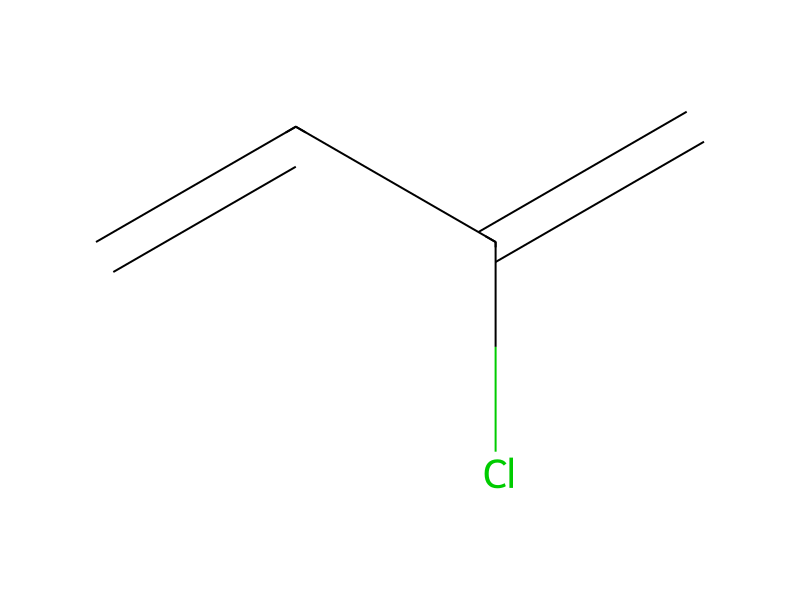
Grundinformationen
- Standard-SMILES
C=CC(=C)Cl- InChIKey
YACLQRRMGMJLJV-UHFFFAOYSA-N- Summenformel
- C4H5Cl
- Durchschnittliche Molmasse
- 88,5355 g/mol
Namen und Bezeichner
- Bevorzugter Name
- Polychloroprene
- Englischer Name
- Polychloroprene
- Summenformel
- C4H5Cl
- Molmasse
- 88.5355
Namen und Synonyme
Datenbank-Bezeichner
- CAS
9010-98-4
Eigenschaften
Physikochemische Eigenschaften
- Schmelzpunkt
- 260 °C · >260 °C
- Dichte
- 1.23 g/mL · 1.23 g/mL at 25 °C(lit.)
- storage temp.
- -196 °C · -196°C
- Aggregatzustand
- chunks
- Farbe
- White to beige
- Dielectric constant
- 6 · 6.0(Ambient)
- InChI
- InChI=1S/C4H5Cl/c1-3-4(2)5/h3H,1-2H2
- InChIKey
- YACLQRRMGMJLJV-UHFFFAOYSA-N
- SMILES
- C=C(Cl)C=C
- CAS Datenbank
- 9010 · 9010-98-4(CAS DataBase Reference)
- EPA chemische Informationen
- Chloroprene polymer (9010-98-4)
Sicherheit und Regulatorisches
Sicherheitsdaten
- wgk
- 3
- tsca
- TSCA listed
- RTECS-Nr.
- EI9640000
- safety_code
- 24/25
- Speicherklasse
- 11 - Combustible Solids
- Giftige Stoffe Daten
- 9010-98-4(Hazardous Substances Data)
Chemie und Industrie
Anwendungen
BeschreibungNeoprene, also known as polychloroprene and chloroprene rubber, is an elastomer produced by polymerization of chloroprene.
HistoryPolychloroprene was discovered in 1930 at E. I. DuPont de Nemours & Co. inWilmington Delaware. The discovery grew out of a need to develop a synthetic substitute for natural rubber. DuPont first marketed this first commercially successful synthetic elastomer as DuPrene in 1933. In response to new technology development that significantly improved the product and manufacturing process, the name was changed to Neoprene in 1936. The current commercially acceptable generic name for this class of chlorinated elastomers is CR or chloroprene rubber. polychloroprene structure
VerwendenPolychloroprene is a (Solid) Mechanical rubber products, lining oil-loading hose and reaction equipment, adhesive cement, binder for rocket fuels, coatings for electric wiring, gaskets and seals. (Liquid) Specialty items made by dipping or electrophoresis from the latex. (Foam) Adhesive tape to replace metal fasteners for automotive accessories, seat cushions, carpet backing, sealant
Darstellung
synthetischePolychloroprene is made from one of two starting materials, acetylene or butadiene. Acetylene can be dimerized and then chloronated to form chloroprene. Alternatively, when adequate butadiene is available, this can be directly halogenated (eqs. 7 and 8). In either case, the chloroprene product can then be polymerized to polychloroprene. Essentially a butadiene elastomer with chlorine present in the backbone,the polymer exhibits excellent tensile strength and low hysteresis, much like natural rubber. Tensile strength properties up to 28 MPa are possible with the proper reinforcing system (see FILLERS). The polarity imparted by the chlorine atom improves the oil and solvent resistance approaching those of nitrile polymers. The polymer can be protected with para-phenylenediamine antiozonants to give ozone resistance, and heat aging is also good. As a result, chloroprene elastomers are used in a wide variety of applications needing a balance of such properties.
Vor- und nachgelagerte Produkte
Vorgelagerte Rohstoffe
Nachgelagerte Produkte
Anbieter50 Anbieter
Ergänzende Hinweise
DefinitionChEBI: A macromolecule composed of repeating (2Z)-2-chlorobut-2-ene-1,4-diyl units.
Zugehörige Reaktionen
Keine Reaktionsaufzeichnungen unter den aktuellen Filterkriterien.
Verknüpfte Notizen
Wird geladen…