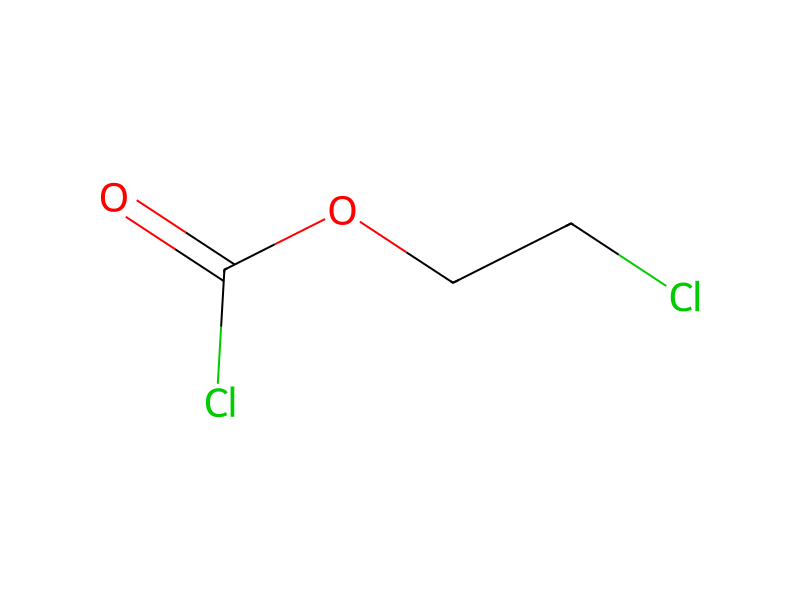
Grundinformationen
- Standard-SMILES
O=C(Cl)OCCCl- InChIKey
SVDDJQGVOFZBNX-UHFFFAOYSA-N- Summenformel
- C3H4Cl2O2
- Durchschnittliche Molmasse
- 142,97 g/mol
Überblick
Chloroethyl chloroformate is a liquid. (EPA, 1998)
Namen und Bezeichner
- Bevorzugter Name
- 2-Chloroethyl chloroformate
- IUPAC
- 2-chloroethyl carbonochloridate
- Englischer Name
- 2-Chloroethyl Chloroformate
- Molmasse
- 0
Namen und Synonyme
Weitere Namen anzeigen
Datenbank-Bezeichner
- CAS
27-11-2- UNII
- 4D32H07Z9I
- EC Number
- 210-982-4
- Nikkaji
- J1.696I
Eigenschaften
Berechnete Struktureigenschaften
- XLogP
- 1,8
- Polarare Oberfläche (TPSA)
- 26,3 Ų
- H-Brücken-Donoren
- 0
- H-Brücken-Akzeptoren
- 2
- Frei drehbare Bindungen
- 3
- Schwere Atome
- 7
- Formalladung
- 0
- Komplexität
- 64
Experimentelle und physikochemische Eigenschaften
Density
1.3847 (EPA, 1998) - Denser than water; will sink
1.3847 @ 20 °C/4 °C
1.3847 @ 20°C
Solubility
Insol in cold water
Sol in alcohol, ether, acetone, benzene
Boiling Point
312.3 °F at 760 mmHg (EPA, 1998)
155 °C
155.7 °C @760 [mm Hg]
Vapor Pressure
13 mm Hg at 48-49 °C
13 [mm Hg]
Physical Description
Chloroethyl chloroformate is a liquid. (EPA, 1998)
Colorless liquid; [HSDB] Clear colorless liquid; [MSDSonline]
Other Experimental Properties
Decomp in alkaline soln and hot water
Chloroformates are reactive intermediates that combine acid chloride, and ester functions. They undergo many reactions of acid chlorides, however, the rates are usually slower. Reactions of chloroformates, like other acid chlorides, proceed faster with better yields when alkali hydroxides or tertiary amines are present to react with the HCl as it forms. /Chloroformates/
Hydrolyze in water /chloroformates/
Conversion factor: 5.84 mg/cu m = 1 ppm
Flash point: 158 °F (70 °C)
Sicherheit und Regulatorisches
GHS-Klassifizierung
GHS Classification
Danger
H301 (13.2%): Toxic if swallowed [Danger Acute toxicity, oral]
P260, P261, P264, P264+P265, P270, P271, P280, P301+P316, P301+P330+P331, P302+P352, P302+P361+P354, P304+P340, P305+P351+P338, P305+P354+P338, P316, P319, P321, P330, P332+P317, P337+P317, P362+P364, P363, P403+P233, P405, and P501 (click each P-code to see the statement)
Aggregated GHS information provided per 53 reports by companies from 9 notifications to the ECHA C&L Inventory. Each notification may be associated with multiple companies.
Gefahrenhinweise
Regulatory Information
Chemical: Carbonochloridic acid, 2-chloroethyl ester
Status: Active Update: 27-03-2023 https://echa.europa.eu/registration-dossier/-/registered-dossier/31392
Hazards Summary
A strong skin and eye irritant; [HSDB] Slowly decomposed by water forming ethanol, hydrogen chloride, and carbon dioxide; Evolves hydrogen chloride in moist air; May cause burns; [CAMEO] A corrosive substance that can cause injury to the skin, eyes, and respiratory tract; Inhalation may cause pulmonary edema and chemical pneumonitis; A lachrymator; [MSDSonline] See CHLOROFORMATES.
Reactivity Profile
CHLOROETHYL CHLOROFORMATE is an acid halide. Acid halides are water reactive; some are violently reactive. They are incompatible with strong oxidizing agents, alcohols, amines, alkali. May react vigorously or explosively if mixed with diisopropyl ether or other ethers in the presence of trace amounts of metal salts [J. Haz. Mat., 1981, 4, 291].
CERCLA Reportable Quantities
Releases of CERCLA hazardous substances are subject to the release reporting requirement of CERCLA section 103, codified at 40 CFR part 302, in addition to the requirements of 40 CFR part 355. Chloroethyl chloroformate is an extremely hazardous substance (EHS) subject to reporting requirements when stored in amounts in excess of its threshold planning quantity (TPQ) of 1,000 lbs.
Sicherheit und Schutzausrüstung
Nonfire Spill Response
(Non-Specific -- Ethyl Chloroformate) Keep unnecessary people away; isolate hazard area and deny entry. Stay upwind; keep out of low areas. Isolate for 1/2 mile in all directions if tank car or truck is involved in fire. Shut off ignition sources; no flares, smoking or flames in hazard area. Do not touch spilled material; stop leak if you can do so without risk. Use water spray to reduce vapors.
Disposal Methods
SRP: At the time of review, criteria for land treatment or burial (sanitary landfill) disposal practices are subject to significant revision. Prior to implementing land disposal of waste residue (including waste sludge), consult with environmental regulatory agencies for guidance on acceptable disposal practices.
Preventive Measures
SRP: The scientific literature for the use of contact lenses in industry is conflicting. The benefit or detrimental effects of wearing contact lenses depend not only upon the substance, but also on factors including the form of the substance, characteristics and duration of the exposure, the uses of other eye protection equipment, and the hygiene of the lenses. However, there may be individual substances whose irritating or corrosive properties are such that the wearing of contact lenses would be harmful to the eye. In those specific cases, contact lenses should not be worn. In any event, the usual eye protectionequipment should be worn even when contact lenses are in place.
Protective Action Criteria (PAC)
1.8 [mg/m3]
20 [mg/m3]
120 [mg/m3]
Personal Protective Equipment (PPE)
For emergency situations, wear a positive pressure, pressure-demand, full facepiece self-contained breathing apparatus (SCBA) or pressure- demand supplied air respirator with escape SCBA and a fully-encapsulating, chemical resistant suit. (EPA, 1998)
Toxikologische Informationen
Environmental Fate
TERRESTRIAL FATE: Chloroformates hydrolyze readily in water(1); therefore, aqueous hydrolysis will be the dominant fate process in moist soils(SRC). The low-boiling chloroformic esters, such as chloroethyl chloroformate, are highly volatile(2); therefore, evaporation from dry surfaces to the atmosphere will occur(SRC). Results of a single biodegradation study (using the Japanese MITI protocol) have classified ethyl chloroformate (a compound similar in structure to chloroethyl chloroformate) as biodegradable(3) but ethyl chloroformate hydrolyzes so fast the the biodegradation rates are probably for the hydrolysis products.
AQUATIC FATE: Chloroformates hydrolyze readily in water(1); ethyl chloroformate has an hydrolysis half-life of 31.5 min at 25 °C(1) and chloroethyl chloroformate is predicted to hydrolyze at a faster rate(2) forming the chloroethyl carbonate which can further hydrolyze to 2-chloroethanol and formic acid; therefore, aqueous hydrolysis will be the dominant fate process in the aquatic environment(SRC). Aqueous volatilization, bioconcentration, biodegradation, and adsorption to sediment are not expected to be important fate processes due to rapid hydrolysis(SRC).
ATMOSPHERIC FATE: Based upon a vapor pressure of 13 mm Hg at 48-49 °C(1), chloroethyl chloroformate is expected to exist primarily in the vapor-phase in the ambient atmosphere(2,SRC). It will degrade in the ambient atmosphere by reaction with photochemically produced hydroxyl radicals with an estimated half-life of about 14 days(3,SRC). Since chloroformates hydrolyzes readily in water(4), atmospheric degradation may occur through dissolution into clouds or through contact with rain or other atmospheric water(SRC).
Soil Adsorption/Mobility
Using a structure estimation method based on molecular connectivity indexes, the Koc for chloroethyl chloroformate can be estimated to be approximately 15(1,SRC). According to a suggested classification scheme(2), this estimated Koc value suggests that chloroethyl chloroformate has high mobility in soil(SRC). However, chloroformates hydrolyzes readily in water(3); therefore, leaching in soil is not expected to be an important fate process(SRC).
Environmental Biodegradation
Using the Japanese MITI protocol (4 week incubation period with activated sludge inoculum), ethyl chloroformate (a compound similar in structure to chloroethyl chloroformate) was classified as biodegradable with a theoretical BOD of 81-86%(1) but this probably refers to the hydrolysis product(SRC).
Volatilization from Water/Soil
The Henry's Law Constant for chloroethyl chloroformate can be estimated to be 1.1X10⁻³ atm-cu m/mole using a structure estimation method(1,SRC); this value of Henry's Law Constant indicates that volatilization from water is potentially an important fate process(2). However, chloroformates hydrolyze readily in water(3); therefore, volatilization from water is not expected to be important(SRC). The low- boiling chloroformic esters, such as chloroethyl chloroformate, are highly volatile(4); therefore, evaporation from dry surfaces will occur(SRC).
Environmental Abiotic Degradation
The rate constant for the vapor-phase reaction of chloroethyl chloroformate with photochemically produced hydroxyl radicals has been estimated to be 1.13X10⁻¹² cu cm/molecule-sec at 25 °C which corresponds to an atmospheric half-life of about 14 days at an atmospheric concn of 5X10+5 hydroxyl radicals per cu cm(1,SRC). Chloroformates hydrolyze readily in pure water(2); although the hydrolysis rate specific to chloroethyl chloroformate was not found, the rate constant for the aqueous hydrolysis of ethyl chloroformate in water at 25 °C has been experimentally determined to be 3.67X10⁻⁴/sec which corresponds to a half life of 31.5 min(2); an hydrolysis rate estimation program(3) predicts that chloroethyl chloroformate will hydrolyze as much as three times faster than ethyl chloroformate(SRC).
Probable Routes of Human Exposure
... by ingestion and inhalation.
The low-boiling chloroformic esters (such as chloroethyl chloroformate) are highly volatile(1); therefore, occupational exposure can occur through inhalation(SRC).
Environmental Fate/Exposure Summary
Chloroethyl chloroformate's use as a chemical intermediate could release the compound to the environment through various waste streams generated at sites of production and use. If released to the atmosphere, it will degrade in the vapor phase by reaction with photochemically produced hydroxyl radicals (estimated half-life of about 14 days). Since chloroformates hydrolyze readily in water, atmospheric degradation may occur through dissolution into clouds or through contact with rain or other atmospheric water. If released to water or moist soil, hydrolysis will be the dominate degradation process. If released to dry surfaces, chloroethyl chloroformate will evaporate into the atmosphere. Occupational exposure is most likely to occur through inhalation. (SRC)
Regulatorische Informationen
CERCLA Reportable Quantities
Releases of CERCLA hazardous substances are subject to the release reporting requirement of CERCLA section 103, codified at 40 CFR part 302, in addition to the requirements of 40 CFR part 355. Chloroethyl chloroformate is an extremely hazardous substance (EHS) subject to reporting requirements when stored in amounts in excess of its threshold planning quantity (TPQ) of 1,000 lbs.
Chemie und Industrie
Verwendung und Herstellung
Uses
Used as intermediate; [HSDB]
Intermediate for synthesis of pesticides, perfumes, drugs, polymers, dyes, and other chemicals /chloroformates/
Formulations/Preparations
Typical specifications of commercial chloroformates: purity, 98%; phosgene, <0.1%, iron, <10 ppm; acidity as HCl, <0.1%; alcohol or phenol, <2% /chloroformic esters/
Commercial products have concentrations of 97-99 wt% /chloroformic esters/
97%
General Manufacturing Information
Carbonochloridic acid, 2-chloroethyl ester: ACTIVE
Most chloroformate production is used captively and production figures are not available /chloroformic esters/
Can be prepared by reacting phosgene with ethylene oxide
Anbieter1 Anbieter
Zugehörige Reaktionen
Keine Reaktionsaufzeichnungen unter den aktuellen Filterkriterien.
Verknüpfte Notizen
Wird geladen…