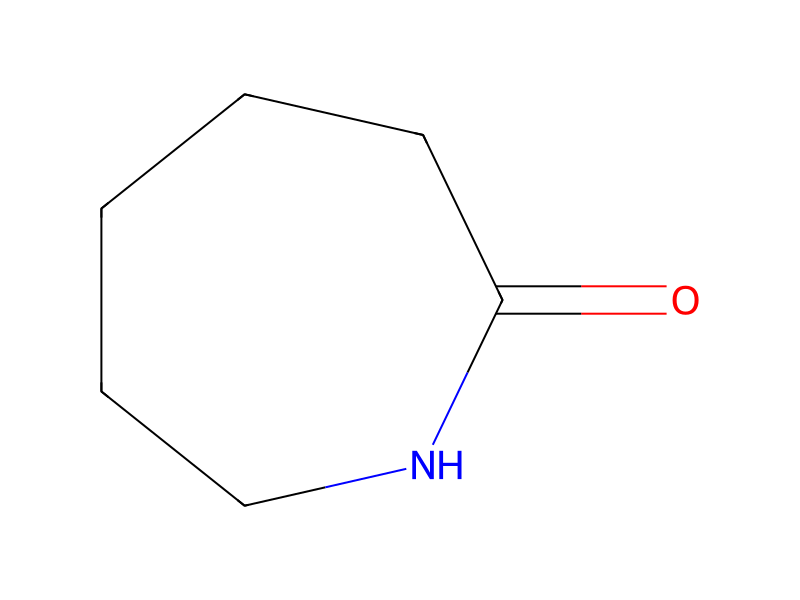
Grundinformationen
- Standard-SMILES
O=C1CCCCCN1- InChIKey
JBKVHLHDHHXQEQ-UHFFFAOYSA-N- Summenformel
- C6H11NO
- Durchschnittliche Molmasse
- 113,16 g/mol
Überblick
Caprolactam is a clear to milky white-colored solution with a mild, disagreeable odor. Contact may cause slight irritation to skin, eyes, and mucous membranes. May be mildly toxic by ingestion. The primary hazard is the threat to the environment. Immediate steps should be taken to limit its spread to the environment. As a liquid it can easily penetrate the soil and contaminate groundwater and nearby streams. Used to make other chemicals.
Namen und Bezeichner
- Bevorzugter Name
- Caprolactam
- IUPAC
- azepan-2-one
- Englischer Name
- 2H-Azepin-2-one, hexahydro-, homopolymer
- Summenformel
- C6H11NO
- Molmasse
- 113.15764
Namen und Synonyme
Weitere Namen anzeigen
Datenbank-Bezeichner
- CAS
9012-16-2- ChEMBL
CHEMBL276218- ChEBI
CHEBI:28579- UNII
- 6879X594Z8
- EC Number
- 203-313-2、918-077-2、919-537-5
- Nikkaji
- J3.605F
Eigenschaften
Berechnete Struktureigenschaften
- XLogP
- -0,1
- Polarare Oberfläche (TPSA)
- 29,1 Ų
- H-Brücken-Donoren
- 1
- H-Brücken-Akzeptoren
- 1
- Frei drehbare Bindungen
- 0
- Schwere Atome
- 8
- Formalladung
- 0
- Komplexität
- 90,5
Experimentelle und physikochemische Eigenschaften
Chemical Classes
Hazardous Air Pollutants (HAPs)
Industrial compound
LogP
-0.19
-0.08
Density
1.02 at 170.6 °F (USCG, 1999) - Denser than water; will sink
Specific gravity: 1.02 at 75 °C/4 °C (liq)
Density: 1.05 @ 25 °C/4 °C /70% aq soln/
Relative density (water = 1): 1.02
1.02
1.02 @ 75°C in Liquid form
Color/Form
Hygroscopic leaflets from petroleum ether
White, crystalline solid or flakes ... [Note: Significant vapor concentrations would be expected only at elevated temperatures].
White flakes or fused
Sicherheit und Regulatorisches
GHS-Klassifizierung
GHS Classification
Warning
H302: Harmful if swallowed [Warning Acute toxicity, oral]
P261, P264, P264+P265, P270, P271, P280, P301+P317, P302+P352, P304+P340, P305+P351+P338, P317, P319, P321, P330, P332+P317, P337+P317, P362+P364, P403+P233, P405, and P501 (click each P-code to see the statement)
This chemical does not meet GHS hazard criteria for < 0.1% (1 of 1874) of reports.
Warning
H302 (99.9%): Harmful if swallowed [Warning Acute toxicity, oral]
Gefahrenhinweise
Regulatory Information
Chemical: 2H-Azepin-2-one, hexahydro-
Hazard Traits - Ocular Toxicity; Respiratory Toxicity
Commission Regulation (EC) No 1565/2000 (Repealed by Com. Implementing Reg. (EU) No 872/2012)
2H-Azepin-2-one, hexahydro- is listed on the EPA's Chemical Data Reporting (CDR) system. Manufacturers and importers of 2H-Azepin-2-one, hexahydro- are required to report information about their production and use of this chemical to the EPA under the Toxic Substances Control Act (TSCA). (40 eCFR Part 711)
Status: Active Update: 19-04-2023 https://echa.europa.eu/registration-dossier/-/registered-dossier/15939
Caprolactam: Does not have an individual approval but may be used under an appropriate group standard
Fire Hazards
Special Hazards of Combustion Products: Toxic oxides of nitrogen (USCG, 1999)
Combustible. Gives off irritating or toxic fumes (or gases) in a fire.
Hazards Summary
Caprolactam is used in the manufacture of synthetic fibers. Acute (short-term) exposure to caprolactam may result in irritation and burning of the eyes, nose, throat, and skin in humans. Headaches, malaise, confusion, and nervous irritation have been observed in workers exposed to caprolactam by inhalation. Chronic (long-term) exposure of workers to caprolactam has been observed to cause peeling of the hands and some eye, nose, and throat irritation, but no other effects on general health. EPA has not classified caprolactam for carcinogenicity.
May cause skin sensitization; A skin, eye, and respiratory tract irritant; Inhalation of high concentrations may cause CNS effects; [ICSC] Liver and kidney changes occur in subchronic animal studies using intraperitoneal doses. [ACGIH]
TSCA Requirements
Pursuant to section 8(d) of TSCA, EPA promulgated a model Health and Safety Data Reporting Rule. The section 8(d) model rule requires manufacturers, importers, and processors of listed chemical substances and mixtures to submit to EPA copies and lists of unpublished health and safety studies. 2H-Azepin-2-one, hexahydro- is included on this list.
OSHA Standards
Vacated 1989 OSHA PEL TWA 1 mg/cu m; STEl 3 mg/cu m is still enforced in some states. /Dust/
Vacated 1989 OSHA PEL TWA 5 ppm (20 mg/cu m); STEL 10 ppm (40 mg/cu m) is still enforced in some states.
Reactivity Profile
CAPROLACTAM is hygroscopic. This compound can react with strong oxidizing agents and strong bases. It can also react with chlorinated hydrocarbons and nitro compounds. A potentially explosive reaction occurs with acetic acid + dinitrogen trioxide. (NTP, 1992)
Atmospheric Standards
This action promulgates standards of performance for equipment leaks of Volatile Organic Compounds (VOC) in the Synthetic Organic Chemical Manufacturing Industry (SOCMI). The intended effect of these standards is to require all newly constructed, modified, and reconstructed SOCMI process units to use the best demonstrated system of continuous emission reduction for equipment leaks of VOC, considering costs, non air quality health and environmental impact and energy requirements. Caprolactam is produced, as an intermediate or a final product, by process units covered under this subpart.
Listed as a hazardous air pollutant (HAP) generally known or suspected to cause serious health problems. The Clean Air Act, as amended in 1990, directs EPA to set standards requiring major sources to sharply reduce routine emissions of toxic pollutants. EPA is required to establish and phase in specific performance based standards for all air emission sources that emit one or more of the listed pollutants. Caprolactam is included on this list.
Sicherheit und Schutzausrüstung
First Aid Measures
Fresh air, rest. Refer for medical attention.
Remove contaminated clothes. Rinse skin with plenty of water or shower.
Rinse with plenty of water (remove contact lenses if easily possible). Refer for medical attention.
Rinse mouth. Refer for medical attention .
First Aid
EYES: First check the victim for contact lenses and remove if present. Flush victim's eyes with water or normal saline solution for 20 to 30 minutes while simultaneously calling a hospital or poison control center. Do not put any ointments, oils, or medication in the victim's eyes without specific instructions from a physician. IMMEDIATELY transport the victim after flushing eyes to a hospital even if no symptoms (such as redness or irritation) develop.
(General first aid procedures)
Disposal Methods
SRP: At the time of review, criteria for land treatment or burial (sanitary landfill) disposal practices are subject to significant revision. Prior to implementing land disposal of waste residue (including waste sludge), consult with environmental regulatory agencies for guidance on acceptable disposal practices.
Controlled incineration (oxides of nitrogen are removed from the effluent gas by scrubbers and/or thermal devices). Also caprolactam may be recovered from caprolactam still bottoms or nylon waste. Recommendable method: Incineration.
The following wastewater treatment technologies have been investigated for caprolactam: biological treatment.
Spillage Disposal
Let solidify. Personal protection: particulate filter respirator adapted to the airborne concentration of the substance. Sweep spilled substance into covered containers. If appropriate, moisten first to prevent dusting. Wash away remainder with plenty of water.
Preventive Measures
SRP: The scientific literature for the use of contact lenses in industry is conflicting. The benefit or detrimental effects of wearing contact lenses depend not only upon the substance, but also on factors including the form of the substance, characteristics and duration of the exposure, the uses of other eye protection equipment, and the hygiene of the lenses. However, there may be individual substances whose irritating or corrosive properties are such that the wearing of contact lenses would be harmful to the eye. In those specific cases, contact lenses should not be worn. In any event, the usual eye protection equipment should be worn even when contact lenses are in place.
ALL VESSELS & PIPING SHOULD BE REGULARLY CHECKED FOR LEAKS ... EXHAUST VENTILATION SHOULD BE INSTALLED.
CONCN OF.../60 MG/CU M SHOULD/ BE AVOIDED, & HENCE WORKSHOPS SHOULD BE EFFECTIVELY VENTILATED.
SRP: The scientific literature for the use of contact lenses in industry is conflicting. The benefit or detrimental effects of wearing contact lenses depend not only upon the substance, but also on factors including the form of the substance, characteristics and duration of the exposure, the uses of other eye protection equipment, and the hygiene of the lenses. However, there may be individual substances whose irritating or corrosive properties are such that the wearing of contact lenses would be harmful to the eye. In those specific cases, contact lenses should not be worn. In any event, the usual eye protection equipment should be worn even when contact lenses are in place.
For more Preventive Measures (Complete) data for CAPROLACTAM (7 total), please visit the HSDB record page.
Toxikologische Informationen
Target Organs
Developmental
Eyes, skin, respiratory system, central nervous system, cardiovascular system, liver, kidneys
Environmental Fate
TERRESTRIAL FATE: Based on a classification scheme(1), an estimated Koc value of 57(SRC), determined from a structure estimation method(2), indicates that caprolactam is expected to have high mobility in soil(SRC). Volatilization of caprolactam from moist soil surfaces is not expected to be an important fate process(SRC) given an estimated Henry's Law constant of 5.4X10⁻¹¹ atm-cu m/mole from its vapor pressure, 1.9X10⁻³ mm Hg at 25 °C(5), and water solubility, 5.25X10+6 mg/l(6). Caprolactam is not expected to volatilize from dry soil surfaces(SRC) based upon a vapor pressure of 1.9X10⁻³ mm Hg at 25 °C(5). Caprolactam is degraded in aquatic environments with a half life of 5 to 15 days, and is expected to be degraded in aerobic soils in a similar timeframe(6).
AQUATIC FATE: Based on a classification scheme(1), an estimated Koc value of 57(SRC), determined from an estimation method(2), indicates that caprolactam is not expected to adsorb to suspended solids or to sediments in water(SRC). Volatilization from water surfaces is not expected(3) based upon an estimated Henry's Law constant of 5.4X10⁻¹¹ atm-cu m/mole(SRC) calculated from its vapor pressure, 1.9X10⁻³ mm Hg at 25 °C(4), and water solubility, 5.25X10+6 mg/l(5). According to a classification scheme(6), an estimated BCF of 3.1(SRC), from an estimated log Kow of 0.66(7) suggests the potential for bioconcentration in aquatic organisms is low. Biodegradation in aquatic environments is expected to be extensive; complete degradation of 50-100 ug/ml caprolactam was observed in nutrient-amended or sediment-associated lake water in 21 days(8). Slightly less caprolactam was degraded (36-85%) after 21 days if higher concentrations (1000 to 2000 ug/ml) were used. However, in none of these control cases was any complete degradation (mineralization) of the caprolactam observed. Based on very slow hydrolysis rates of other aliphatic acid amides, hydrolysis is not expected to be an important fate process(5). Experiments conducted with sterile natural waters, however, demonstrated that caprolactam is abiotically degraded. It is not known whether or not the product of this abiotic degradation is the product of hydrolysis, aminocaproic acid(5).
ATMOSPHERIC FATE: According to a model of gas/particle partitioning of semivolatile organic compounds in the atmosphere(1), caprolactam, which has a vapor pressure of 1.9X10⁻³ mm Hg at 25 °C(4), is expected to exist solely as a vapor in the ambient atmosphere. Vapor-phase caprolactam is degraded in the atmosphere by reaction with photochemically-produced hydroxyl radicals(SRC); the half-life for this reaction in air is estimated to be 21 hours(SRC), calculated from its rate constant of 18X10-12 cu cm/molecule-sec at 25 °C(3). Caprolactam does not absorb light in the environmental spectrum (>290 nm), indicating there is little potential for direct photolysis.
Exposure Routes
The substance can be absorbed into the body by inhalation of its aerosol.
inhalation, ingestion, skin and/or eye contact
Signs and Symptoms
Cough. Abdominal cramps. Dizziness. Headache. Confusion.
Redness.
Redness. Pain.
Nausea. Vomiting. Abdominal pain. Diarrhoea.
irritation skin, eyes, respiratory system; epistaxis (nosebleed); dermatitis, skin sensitization; asthma; irritability, confusion, dizziness, headache; abdominal cramps, diarrhea, nausea, vomiting; liver, kidney injury
Ongoing Test Status
The following link will take the user to the National Toxicology Program (NTP) Test Agent Search Results page, which tabulates all of the "Standard Toxicology & Carcinogenesis Studies", "Developmental Studies", and "Genetic Toxicity Studies" performed with this chemical. Clicking on the "Testing Status" link will take the user to the status (i.e., in review, in progress, in preparation, on test, completed, etc.) and results of all the studies that the NTP has done on this chemical. [http://ntp-apps.niehs.nih.gov/ntp_tox/index.cfm?fuseaction=ntpsearch.searchresults&searchterm=105-60-2]
Effluent Concentrations
July 1976, dye manufacturing plant in MA, concn range 36-150 ug/L(1). Qualitatively identified in water samples taken from advance waste treatment plants in Lake Tahoe, CA Oct 1974 and Washington D.C. Sept 1974(2). Present in trace amounts in the waste waters from nylon 6 manufacturing plants in Japan and Russia(3).
EPA IRIS Information
Caprolactam
Developmental
5 x 10 ^-1 mg/kg-day
Soil Adsorption/Mobility
Using a structure estimation method based on molecular connectivity indices(1), the Koc for caprolactam is estimated to be 57(SRC). According to a classification scheme(2), this estimated Koc value suggests that caprolactam is expected to have high mobility in soil.
TSCA Test Submissions
Acute dermal toxicity was evaluated in groups of 4 male albino New Zealand strain rabbits receiving single occluded applications of undiluted E-caprolactam at dose levels of 0.5, 1.0 and 2.0 gm/kg of body weight. The test material was held in contact with the intact skin for a 24 hour period. Mortality was observed in 1 animal in the 0.5 gm/kg dose group and in all animals in the 2.0 gm/kg dose group (period of observation not reported); the LD50 was calculated to be 1.41 gm/kg of body weight. Clinical observation were not reported. Gross necropsy revealed mottled livers, congested and hemorrhagic lungs and congested kidneys.
Caprolactam (CAS # 105-60-2) was evaluated for acute inhalation toxicity in SPF1-Wistar/Chbb rats (10/sex/group) administered single nose-only exposures to the aerosol (MMAD 50% = 2.69 um; 86.6% capable of alveolar exposure) in air at mean analytical concentrations of 0, 5.25, 8.35, and 10.12 mg/l for 4 hours. During exposures, the animals exhibited eyelid closure, shallow to spasmodic respiration, and mild to marked defense reactions; steppage gait, bloody nasal exudate, spasmodic respiration, bloody lacrimation, squatting, bristling fur, and severe tremor were noted during 14-day post-exposure recovery. No change in bodyweights or bodyweight gains after exposures could be attributed to substance exposure. Mortality was dose-related, occurred before Day 2 following exposures, and was consistent with LD50's of 9.6 and 7.08 mg/l (p < 0.05 based on a probit analysis of D.J. Finney), respectively, for male and female rats. Among study lethalities, gross pathology on necropsy included general circulatory congestion, elevated hyperemia of the lung, and moderate to severe fatty degeneration of the liver. Histologic evaluation revealed fine-droplet fatty degeneration of peripheral acini in the liver and ischemic tubular nephrosis of the renal cortex in a solitary lethality of a 10.12 mg/l exposure.
The effect of subchronic dietary treatments on renal function was evaluated in groups of 6 male and 6 female Fischer 344, Sprague-Dawley and Wistar strain rats administered caprolactam at dietary levels of 0. 0.01, 0.05, 0.1, and 0.5%, available ad libitum, for 90 days. Mortality was observed in one Sprague-Dawley male from the 0.01% feeding level. Clinical observations revealed no treatment-related effects. Body weight were significantly lower (p <= 0.05) than controls in: Fischer 344 females at the 0.50% level; in Sprague-Dawley males at the 0.1% and 0.5% levels; in Sprague-Dawley females at the 0.01%, 0.05% and 0.50% levels; in Wistar males at 0.05% and 0.50%; and in Wistar females at 0.50%. Serum chemistry analysis revealed significant increases (p <= 0.05) in BUN, serum chloride levels and decreases in BUN, serum creatine levels, serum chloride levels, serum sodium levels, and serum hematocrit levels; these results, however, appear to be random and not related to the test material. Urinalysis data revealed dose-related increases in urine volume in Fischer 344 males and females at the 3 highest doses. Dose related increases in the kidney/body weight ratio were observed in Sprague-Dawley males at 0.10 and 0.50% and in Wistar males at 0.50%. Gross necropsy revealed no compound-related incipient nephrosis, chronic inflammation, cytomegalic and chromophobic epithelial cells, protenaceous deposits, increased cytoplasmic vacuolization int eh tubules, increased hyalin droplets, and tubular epithelial hyperplasia and basophilia. In a similar study also evaluating the effects of caprolactam, the only compound-related effect was the altering renal function (fractional reabsorption of water) at the highest dose level (0.50%).
Caprolactam (CAS # 105-60-2) was evaluated for subchronic oral toxicity specific to the kidney in groups (100/sex/strain) of Fischer 344, Sprague-Dawley, and Wistar rats randomized to nominal dietary exposures (ad libitum) of 0, 0.01, 0.05, 0.10, and 0.50% for a minimum 84 of 90 consecutive days. Dietary exposures were continued as rats of each strain (2 x 6, 2 x 8 and 2 x 6/sex/dose group) participated in Phases I and II of 3 distinct analyses of previously documented or implied renal toxicity: Phase 1 employed non-invasive techniques to establish the locale of renal toxicity, dose-response correlation, and sex and/or strain specificity by (Part A) measurement of biological markers of degenerative effects on the renal early proximal tubule (PT) and PT reabsorptive processes and (Parts B & C) determination of relative sensitivity and expression of toxicity in stressed (dehydrated or extracellular volume expansion) kidneys. Phase II used invasive procedures on anesthetized animals to (Part A) monitor proteinaceous material in Bowman space and/or the proximal tubule, and (Part B) directly measure glomerular filtration, urine clearance or reabsorption of free water and electrolytes, and blood and urine osmolality. Recovery from (Part A) any nephrotoxic effects (functional and/or histological) and, (Part B, per protocol amendment) specifically those effects documented in Phase 1 was examined in Phase III animals allowed 90-day recovery following cessation of 90 days' dietary exposure. Only all-strain lethalities and those strains demonstrating histological renal toxicity in Phase 1 high dose groups were terminated by pathology in Phase II (for light microscopy evaluation of changes in function and structure per protocol amendment) and Phase III (for evidence of recovery from toxic effects). Results of Phase I revealed functional nephrotoxicity in the stressed kidney only, including inhibited natriuresis upon volume expansion and diminished urine concentrating capacity during water deprivation, suggesting a distal tubule target of toxic action. Treated rats showed no gross pathology, but had increased kidney weights and increased incidence of hyalin droplets within renal tubules, more pronounced in males than females, and in Fischer 344 and Sprague-Dawley than in Wistar rats. Additionally, colloidal iron staining of glomeruli did not correlate with either level of exposure or with occurrence of tubular eosinophilic hyalin droplets. In Phase II, kidney weights were also increased and only fractional reabsorption of water in Fischer 344 or Sprague-Dawley high dose rats was altered, again supporting a distal tubule site of nephrotoxic effects in these strains. Based on urine concentrating capacity, the function of kidneys is fully reclaimed during 90-day recovery, which was verified on histological assessment concluding Phase III of study.
For more TSCA Test Submissions (Complete) data for CAPROLACTAM (12 total), please visit the HSDB record page.
Regulatorische Informationen
TSCA Requirements
Pursuant to section 8(d) of TSCA, EPA promulgated a model Health and Safety Data Reporting Rule. The section 8(d) model rule requires manufacturers, importers, and processors of listed chemical substances and mixtures to submit to EPA copies and lists of unpublished health and safety studies. 2H-Azepin-2-one, hexahydro- is included on this list.
Atmospheric Standards
This action promulgates standards of performance for equipment leaks of Volatile Organic Compounds (VOC) in the Synthetic Organic Chemical Manufacturing Industry (SOCMI). The intended effect of these standards is to require all newly constructed, modified, and reconstructed SOCMI process units to use the best demonstrated system of continuous emission reduction for equipment leaks of VOC, considering costs, non air quality health and environmental impact and energy requirements. Caprolactam is produced, as an intermediate or a final product, by process units covered under this subpart.
Listed as a hazardous air pollutant (HAP) generally known or suspected to cause serious health problems. The Clean Air Act, as amended in 1990, directs EPA to set standards requiring major sources to sharply reduce routine emissions of toxic pollutants. EPA is required to establish and phase in specific performance based standards for all air emission sources that emit one or more of the listed pollutants. Caprolactam is included on this list.
Sicherheitsdaten
- Alarmwort
- Warnung
- Gefahrenhinweise
- Code Gefahrenhinweise Gefahrenklasse Abteilung Alarmwort Symbol P-Code H302
Chemie und Industrie
Pharmakologische Informationen
Metabolism/Metabolites
METAB STUDIES OF CAPROLACTAM IN RAT & RABBIT PRODUCED EQUIVOCAL RESULTS AS FAR AS THEIR APPLICATION TO MAN IS CONCERNED; RABBIT APPEARED TO METABOLIZE CAPROLACTAM COMPLETELY, WHEREAS RAT EXCRETED CAPROLACTAM ONLY IN PART AS METABOLITE EPSILON-AMINO ACID.
EPSILON-CAPROLACTAM IS EXCRETED BY RATS PARTLY AS LACTAM & PARTLY AS EPSILON-AMINO ACID.
Absorption, Distribution and Excretion
... STUDY IN WHICH ANIMALS WERE ADMIN DAILY 50-100 MG EPSILON-CAPROLACTAM/KG ... RESULTED IN NO ACCUMULATION ... .
DETOXICATION RATE OF EPSILON-CAPROLACTAM WAS DETERMINED TO BE BETWEEN 60-70 MG/KG/HR FOR RATS. ... RAPID RATE OF ELIMINATION ... FROM BODY PREVENT ACCUM @ LEVEL CONSIDERABLY GREATER THAN RECOMMENDED TLV.
The distribution of (14)C caprolactam was studied by whole body autoradiography in male and female mice 3 hr after oral administration of 6.4-6.9 mg/kg body weight. Radioactivity was rapidly absorbed from the stomach and distributed throughout the entire animal; there was efficient elimination by the kidneys and liver. Material secreted by the liver into bile and intestinal contents did not appear to be reabsorbed via the enterohepatic circulation.
When pregnant Swiss-Webster mice were treated by oral intubation with 6.5-6.7 mg/k body weight (14)C caprolactam, rapid transfer of the radioactivity across the placenta was demonstrated by whole body autoradiography, with near complete elimination from the fetal and maternal compartments 24 hr after treatment.
When pregnant Swiss-Webster mice were treated by oral intubation with 6.5-6.7 mg/k body weight (14)C caprolactam, rapid transfer of the radioactivity across the placenta was demonstrated by whole-body autoradiography, with near-complete elimination from the fetal and maternal compartments 24 h after treatment.
Verwendung und Herstellung
Uses
Caprolactam is primarily used in the manufacture of synthetic fibers (especially Nylon 6). Caprolactam is also used in brush bristles, textile stiffeners, film coatings, synthetic leather, plastics, plasticizers, paint vehicles, cross-linking for polyurethanes, and in the synthesis of lysine.
Used as a monomer for synthetic fibers, plastics, coatings, plasticizers, and paint vehicles and as a cross-linking agent for polyurethanes. [ACGIH]
Painting (Pigments, Binders, and Biocides) [Category: Paint]
Mfr synthetic fibers of the polyamide type (Perlon); solvent for high mol wt polymers
Manufacture of synthetic fibers (especially nylon 6), plastics, bristles, film, coatings, synthetic leather, plasticizers and paint vehicles, cross-linking agent for polyurethanes, synthesis of amino acid lysine.
US FDA PERMITS USE OF CAPROLACTAM ETHYLENE-ETHYL ACRYLATE GRAFT POLYMERS AS COMPONENT OF SIDE SEAM CEMENTS INTENDED FOR USE IN CONTACT WITH FOOD ...
U.S. Exports
(1972) 9.13X10+9 GRAMS
(1984) 2.68X10+10 g
(1996) 1.83X10+8 lbs; averaged 184 million pounds annually in the 1992-1996 period.
U.S. Imports
(1972) 2.74X10+10 GRAMS
(1983) 8.63X10+8 g
(1996) 5.6X10+7 lbs
U.S. Production
2023: 1,000,000,000 - <2,500,000,000 lb
(1972) 2.91X10+11 GRAMS
(1984) 4.68X10+11 g
(1988) 1.3X10+0 LBS
(1990) 1.38 billion lb
For more U.S. Production (Complete) data for CAPROLACTAM (8 total), please visit the HSDB record page.
Consumption Patterns
93% FOR NYLON 6 FIBERS; 7% FOR NYLON 6 PLASTICS AND FILMS (1973)
86.4% NYLON-6 FIBERS, INCL MONO-FILAMENT; 9.6% NYLON-6 RESINS AND FILM; 3.7% EXPORTS; 0.3% MISC (1984)
CHEMICAL PROFILE: Caprolactam. Nylon 6 fibers, including monofilament, 87%; nylon 6 resins and film, 10%; exports, 3%.
CHEMICAL PROFILE: Caprolactam. Demand: 1985: 1,021 million lb; 1986: 1,070 million lb; 1990 /projected/: 1,200 million lb.
For more Consumption Patterns (Complete) data for CAPROLACTAM (8 total), please visit the HSDB record page.
Methods of Manufacturing
... Catalytic hydrogenation of phenol to cyclohexanone, reaction with ammonia to cyclohexanone oxime with ammonia to cyclohexanone with Beckmann rearrangement with sulfuric acid catalyst; catalytic oxidation of cyclohexane with cyclohexanone, reaction with hydroxylamine sulfate and ammonia to cyclohexanone oxime followed by sulfuric acid catalyzed Beckmann rearrangement ... .
UV-catalyzed reaction of cyclohexane with nitrosyl chloride to cyclohexanone oxime hydrochloride, followed by Beckmann rearrangement
Catalytic oxidation of cyclohexane to cyclohexanol, reacting with peracetic acid to form caprolactone, and further reaction with ammonia.
... BY MELTING EPSILON-AMINO-N-CAPRYLIC ACID FOLLOWED BY VACUUM DISTILLATION ... FROM TOLUENE BY OXIDATION ... FOLLOWED BY HYDROGENATION /IN ITALY/ ... BY PHOTOCHEMICAL NITROSATION OF CYCLOHEXANE /IN JAPAN/ ...
Use Classification
Flavouring Agent -> FLAVOURING_AGENT -> JECFA Functional Classes
Flavoring Agents -> JECFA Flavorings Index
Zugehörige Reaktionen
Keine Reaktionsaufzeichnungen unter den aktuellen Filterkriterien.
Verknüpfte Notizen
Wird geladen…