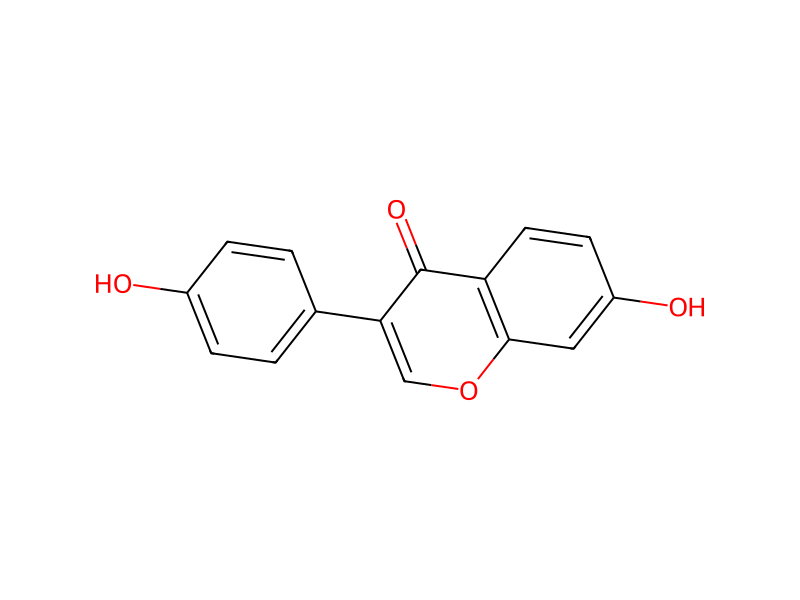
Grundinformationen
- Standard-SMILES
O=c1c(-c2ccc(O)cc2)coc2cc(O)ccc12- InChIKey
ZQSIJRDFPHDXIC-UHFFFAOYSA-N- Summenformel
- C15H10O4
- Durchschnittliche Molmasse
- 254,24 g/mol
Überblick
Daidzein is a member of the class of 7-hydroxyisoflavones that is 7-hydroxyisoflavone substituted by an additional hydroxy group at position 4'. It has a role as an EC 2.7.7.7 (DNA-directed DNA polymerase) inhibitor, an antineoplastic agent, an EC 3.2.1.20 (alpha-glucosidase) inhibitor, a plant metabolite and a phytoestrogen. It is a conjugate acid of a daidzein(1-).
Namen und Bezeichner
- Bevorzugter Name
- Daidzein
- IUPAC
- 7-hydroxy-3-(4-hydroxyphenyl)chromen-4-one
- Englischer Name
- Daidzein-d4
- Summenformel
- C15H10O4
- Molmasse
- 254.24
Namen und Synonyme
Weitere Namen anzeigen
Datenbank-Bezeichner
- CAS
1219803-57-2- ChEMBL
CHEMBL8145- ChEBI
CHEBI:28197- UNII
- 6287WC5J2L
- EC Number
- 207-635-4
- Nikkaji
- J6.014C
Eigenschaften
Berechnete Struktureigenschaften
- XLogP
- 2,5
- Polarare Oberfläche (TPSA)
- 66,8 Ų
- H-Brücken-Donoren
- 2
- H-Brücken-Akzeptoren
- 4
- Frei drehbare Bindungen
- 1
- Schwere Atome
- 19
- Formalladung
- 0
- Komplexität
- 382
Experimentelle und physikochemische Eigenschaften
Collision Cross Section
155.8 Ų [M+H]+ [CCS Type: DT; Buffer gas: N2; Ionization: ESI+; Dataset: TOXCAST; Source Identifier: DTXSID9022310]
162.33 Ų [M-H]- [CCS Type: DT; Method: stepped-field]
156.2 Ų [M+H]+
Physikochemische Eigenschaften
- storage temp.
- -20 °C · Store at -20°C
- Löslichkeit
- 10 mg/ml,DMSO: · DMF: 10 mg/ml,DMSO: 30 mg/ml,Ethanol: 0.1 mg/ml
- Aggregatzustand
- A solid
- Farbe
- White to off-white
Sicherheit und Regulatorisches
GHS-Klassifizierung
GHS Classification
This chemical does not meet GHS hazard criteria for 3.7% (3 of 81) of reports.
Warning
H315 (95.1%): Causes skin irritation [Warning Skin corrosion/irritation]
P264, P264+P265, P280, P302+P352, P305+P351+P338, P321, P332+P317, P337+P317, and P362+P364 (click each P-code to see the statement)
Aggregated GHS information provided per 81 reports by companies from 5 notifications to the ECHA C&L Inventory. Each notification may be associated with multiple companies.
Gefahrenhinweise
Toxikologische Informationen
Sicherheitsdaten
- Alarmwort
- Warnung
- Gefahrenhinweise
- Code Gefahrenhinweise Gefahrenklasse Abteilung Alarmwort Symbol P-Code H315
Chemie und Industrie
Pharmakologische Informationen
Verwendung und Herstellung
Uses
Isoflavones compounds are found in a number of plants, but soybeans and soy products like tofu and textured vegetable protein are the primary food source. Equol represents the main active product of daidzein metabolism, produced via specific microflora in the gut.
Anwendungen
VerwendenDaidzein-d4 (4-hydroxyphenyl-2,3,5,6-d4) (CAS# 1219803-57-2) is a useful isotopically labeled research compound.
Anbieter9 Anbieter
Zugehörige Reaktionen
Keine Reaktionsaufzeichnungen unter den aktuellen Filterkriterien.
Verknüpfte Notizen
Wird geladen…