Grundinformationen
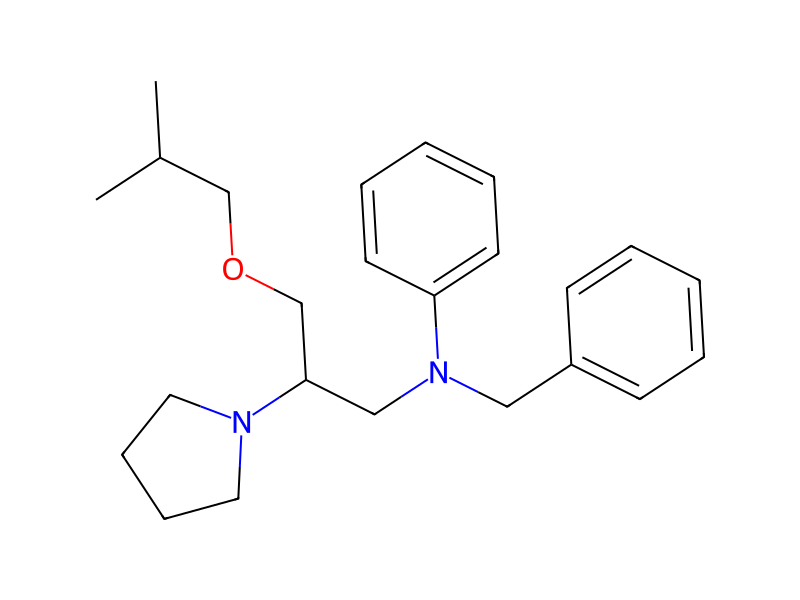
- Standard-SMILES
CC(C)COCC(CN(Cc1ccccc1)c1ccccc1)N1CCCC1- InChIKey
UIEATEWHFDRYRU-UHFFFAOYSA-N- Summenformel
- C24H34N2O
- Durchschnittliche Molmasse
- 366,5 g/mol
- Monoisotopische Masse
- 366,26711371
Überblick
Bepridil is a tertiary amine in which the substituents on nitrogen are benzyl, phenyl and 3-(2-methylpropoxy)-2-(pyrrolidin-1-yl)propyl. It has a role as a vasodilator agent, an antihypertensive agent, an anti-arrhythmia drug and a calcium channel blocker. It is a tertiary amine and a member of pyrrolidines.
Namen und Bezeichner
- Bevorzugter Name
- Bepridil
- IUPAC
- N-benzyl-N-[3-(2-methylpropoxy)-2-pyrrolidin-1-ylpropyl]aniline
- Englischer Name
- BEPRIDIL
- Summenformel
- C24H34N2O
- Molmasse
- 366.54
Namen und Synonyme
Weitere Namen anzeigen
Datenbank-Bezeichner
- CAS
49571-04-2、64706-54-3- PubChem CID
- 2351
- DTXSID
DTXSID3022663- ChEMBL
CHEMBL1008- ChEBI
CHEBI:3061- UNII
- 755BO701MA
- EC Number
- 256-384-7
- Nikkaji
- J19.767J
Eigenschaften
Berechnete Struktureigenschaften
- XLogP
- 5,3
- Polarare Oberfläche (TPSA)
- 15,7 Ų
- H-Brücken-Donoren
- 0
- H-Brücken-Akzeptoren
- 3
- Frei drehbare Bindungen
- 10
- Schwere Atome
- 27
- Formalladung
- 0
- Komplexität
- 382
Experimentelle und physikochemische Eigenschaften
Solubility
Slightly soluble
6.55e-03 g/L
Physikochemische Eigenschaften
- Siedepunkt
- 0.1 · bp0.1 184°; bp0.5 192°
- Dichte
- 1.0392 · 1.0392 (rough estimate)
- Brechungsindex
- 20 · nD20 1.5538
- storage temp.
- 2 · 2-8°C
- pka
- 9.21 · 9.21±0.20(Predicted)
- Wasserlöslichkeit
- 7.43 g/L · 7.43g/L(37 ºC)
Sicherheit und Regulatorisches
Toxikologische Informationen
Drug Induced Liver Injury
Drug-Induced Liver Injury Severity and Toxicity (DILIst)
bepridil
DILI Positive
DOI:10.1016/j.drudis.2019.09.022
Sicherheitsdaten
- Alarmwort
- Warnung
- Gefahrenhinweise
- Code Gefahrenhinweise Gefahrenklasse Abteilung Alarmwort Symbol P-Code H302
Chemie und Industrie
Pharmakologische Informationen
ATC Code
C - Cardiovascular system
QC - Cardiovascular system
Pharmacodynamics
Bepridil is a calcium channel blocker that has well characterized anti-anginal properties and known but poorly characterized type 1 anti-arrhythmic and anti-hypertensive properties. It is not related chemically to other calcium channel blockers such as diltiazem hydrochloride, nifedipine and verapamil hydrochloride.
Mechanism of Action
Bepridil has inhibitory effects on both the slow calcium (L-type) and fast sodium inward currents in myocardial and vascular smooth muscle, interferes with calcium binding to calmodulin, and blocks both voltage and receptor operated calcium channels. Bepridil inhibits the transmembrane influx of calcium ions into cardiac and vascular smooth muscle. This has been demonstrated in isolated myocardial and vascular smooth muscle preparations in which both the slope of the calcium dose response curve and the maximum calcium-induced inotropic response were significantly reduced by bepridil. In cardiac myocytes <i>in vitro</i>, bepridil was shown to be tightly bound to actin. Bepridil regularly reduces heart rate and arterial pressure at rest and at a given level of exercise by dilating peripheral arterioles and reducing total peripheral resistance (afterload) against which the heart works.
MeSH Pharmacological Classification
Agents used for the treatment or prevention of cardiac arrhythmias. They may affect the polarization-repolarization phase of the action potential, its excitability or refractoriness, or impulse conduction or membrane responsiveness within cardiac fibers. Anti-arrhythmia agents are often classed into four main groups according to their mechanism of action: sodium channel blockade, beta-adrenergic blockade, repolarization prolongation, or calcium channel blockade.
Drugs used in the treatment of acute or chronic vascular HYPERTENSION regardless of pharmacological mechanism. Among the antihypertensive agents are DIURETICS; (especially DIURETICS, THIAZIDE); ADRENERGIC BETA-ANTAGONISTS; ADRENERGIC ALPHA-ANTAGONISTS; ANGIOTENSIN-CONVERTING ENZYME INHIBITORS; CALCIUM CHANNEL BLOCKERS; GANGLIONIC BLOCKERS; and VASODILATOR AGENTS.
A class of drugs that act by selective inhibition of calcium influx through cellular membranes.
Drugs used to cause dilation of the blood vessels.
Vor- und nachgelagerte Produkte
Vorgelagerte Rohstoffe
Anbieter13 Anbieter
Ergänzende Hinweise
DefinitionChEBI: A tertiary amine in which the substituents on nitrogen are benzyl, phenyl and 3-(2-methylpropoxy)-2-(pyrrolidin-1-yl)propyl.
Zugehörige Reaktionen
Keine Reaktionsaufzeichnungen unter den aktuellen Filterkriterien.
Verknüpfte Notizen
Wird geladen…