HuagongsheHuagongshe Chemie-Druckbericht · Nur für Forschungszwecke
(2-Aminophenyl)boronic acid
2-Boronoaniline · CHEMBRDG-BB 3201036 · 2-Aminophenylboronicaci · AMinobenzeneboronic acid · 2-AMINOPHENYLBORONIC ACID · o-Aminophenylboronic Acid · 2-AMINOBENZENEBORONIC ACID · 2-Aminobenzeneboronicacid,96%
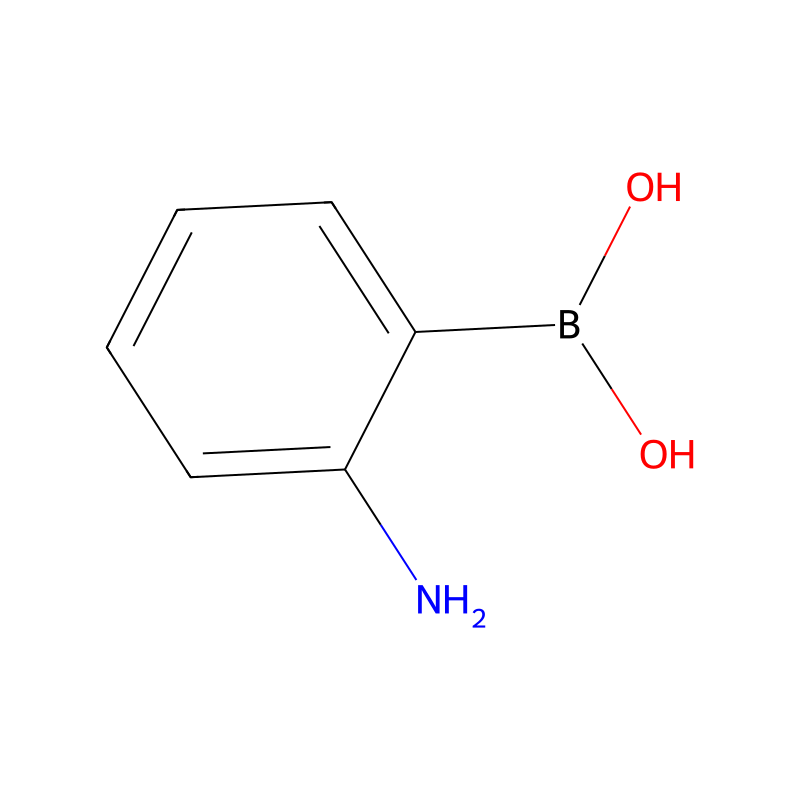
Identifikatoren & physikalische Daten
| CAS No. | 5570-18-3 |
|---|---|
| Summenformel | C6H8BNO2 |
| Durchschnittliche Molmasse | 136,95 g/mol |
| Monoisotopische Masse | 137,0648089 g/mol |
| SMILES | Nc1ccccc1B(O)O |
| InChIKey | DIRRKLFMHQUJCM-UHFFFAOYSA-N |
| PubChem CID | 2773216 |
| EC No. | 611-303-8 |
| DTXSID | DTXSID50901275 |
Chemische & physikalische Eigenschaften
| Polarare Oberfläche (TPSA) | 66,5 |
|---|---|
| H-Brücken-Donoren | 3 |
| H-Brücken-Akzeptoren | 3 |
| Frei drehbare Bindungen | 1 |
| Schwere Atome | 10 |
| Formalladung | 0 |
| Komplexität | 110 |
| Schmelzpunkt | 188-190°C |
| Siedepunkt | 346.9±44.0 °C(Predicted) |
| Dichte | 1.23±0.1 g/cm3(Predicted) |
| Lagerbedingungen | under inert gas (nitrogen or Argon) at 2–8 °C |
| Aggregatzustand | solid |
| pKa (Säurekonstante) | 8.83±0.53(Predicted) |
| Farbe | light yellow |
| BRN | 2962939 |
| CAS Datenbank | 5570-18-3(CAS DataBase Reference) |
Sicherheit & Vorschriften
| GHS-Einstufung | WarningH315 (100%): Causes skin irritation [Warning Skin corrosion/irritation]P261, P264, P264+P265, P271, P280, P302+P352, P304+P340, P305+P351+P338, P319, P321, P332+P317, P337+P317, P362+P364, P403+P233, P405, and P501 (click each P-code to see the statement)Aggregated GHS information provided per 8 reports by companies from 5 notifications to the ECHA C&L Inventory. Each notification may be associated with multiple companies. |
|---|---|
| Hazard Classes and Categories | Skin Irrit. 2 (100%) |
| Zollcode | 29310095 |
| R-Sätze (R) | 36/37/38-20/21/22 |
| Gefahrensymbole | Xi,Xn |
| hazard_note | Harmful |
| Sicherheitshinweise (S) | 26-36/37/39-37-36 |
Anwendungen & Verwendung
Verwenden
2-Aminobenzeneboronic acid derivative is used in the synthesis of quinolines by reacting with alpha, beta unsaturated ketones. Its hydrochloride derivative is used in the preparation of designed boronate ligands for glucose-selective holographic sensors.