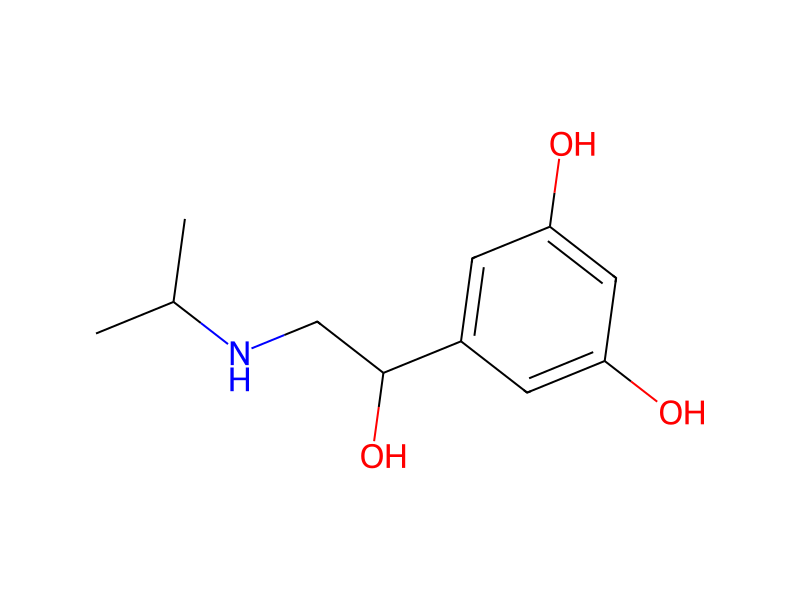
Grundinformationen
- Standard-SMILES
CC(C)NCC(O)c1cc(O)cc(O)c1- InChIKey
LMOINURANNBYCM-UHFFFAOYSA-N- Summenformel
- C11H17NO3
- Durchschnittliche Molmasse
- 211,26 g/mol
- Monoisotopische Masse
- 211,1208434
Überblick
Metaproterenol is a member of phenylethanolamines.
Namen und Bezeichner
- Bevorzugter Name
- Metaproterenol
- IUPAC
- 5-[1-hydroxy-2-(propan-2-ylamino)ethyl]benzene-1,3-diol
- Lokaler Name
- Orciprenalin
- Englischer Name
- Orciprenaline
- Summenformel
- C11H17NO3
- Molmasse
- 211.26
Namen und Synonyme
Weitere Namen anzeigen
Datenbank-Bezeichner
- CAS
586-06-1- PubChem CID
- 4086
- DTXSID
DTXSID8048529- ChEMBL
CHEMBL776- ChEBI
CHEBI:6792- UNII
- 53QOG569E0
- EC Number
- 209-569-1
- Nikkaji
- J6.736I
Eigenschaften
Berechnete Struktureigenschaften
- XLogP
- 0,7
- Polarare Oberfläche (TPSA)
- 72,7 Ų
- H-Brücken-Donoren
- 4
- H-Brücken-Akzeptoren
- 4
- Frei drehbare Bindungen
- 4
- Schwere Atome
- 15
- Formalladung
- 0
- Komplexität
- 177
Experimentelle und physikochemische Eigenschaften
Solubility
9.7mg/L
6.92e+00 g/L
Human Drugs
Breast Feeding; Lactation; Milk, Human; Anti-Asthmatic Agents; Bronchodilator Agents; Beta Adrenergic Agonists
Pharmaceuticals
Collision Cross Section
144.64 Ų [M+H-H2O]+ [CCS Type: TW; Method: calibrated with polyalanine and drug standards]
149.9 Ų [M+H]+ [CCS Type: TW; Method: calibrated with polyalanine and drug standards]
150.12 Ų [M+H]+
Physikochemische Eigenschaften
- Schmelzpunkt
- 100 ° · 100°
- Siedepunkt
- 350.94 °C · 350.94°C (rough estimate)
- Dichte
- 1.124 · 1.1240 (rough estimate)
- Brechungsindex
- 1.5718 · 1.5718 (estimate)
- pka
- 9.11 · 9.11±0.10(Predicted)
- CAS Datenbank
- 586 · 586-06-1(CAS DataBase Reference)
Sicherheit und Regulatorisches
GHS-Klassifizierung
Gefahrenhinweise
Toxikologische Informationen
Drug Induced Liver Injury
Benchmark Dataset for the Liver Toxicity Knowledge Base (LTKB)
metaproterenol
Medihaler-Iso
Adrenergics
Not Applicable
no-DILI-concern
Chemie und Industrie
Pharmakologische Informationen
ATC Code
R - Respiratory system
R - Respiratory system
QR - Respiratory system
QR - Respiratory system
Pharmacodynamics
Orciprenaline (also known as metaproterenol), a synthetic amine, is structurally and pharmacologically similar to isoproterenol. Orciprenaline is used exclusively as a bronchodilator. The pharmacological effects of beta adrenergic agonist drugs, such as orciprenaline, are at least in part attributable to stimulation through beta adrenergic receptors of intracellular adenyl cyclase, the enzyme which catalyzes the conversion of adenosine triphosphate (ATP) to cyclic- 3',5'- adenosine monophosphate (c-AMP). Increased cAMP levels lead to relaxation of bronchial smooth muscles and inhibition of the release of inalammatory mediators from mast cells that are involved in promoting immediate hypersensitivity .
Mechanism of Action
Orciprenaline stimulates the β2-adrenergic receptor expressed in the lungs, uterus, and vasculature supplying skeletal muscles by acting as a moderately selective agonist. It exerts minimal or no effect on alpha-adrenergic receptors. Intracellularly, the actions of orciprenaline are mediated by cAMP, the production of which is augmented by beta stimulation. The drug is believed to work by activating adenylate cyclase, the enzyme responsible for producing the cellular mediator cAMP.
FDA Pharmacological Classification
53QOG569E0
METAPROTERENOL
Mechanisms of Action [MoA] - Adrenergic beta2-Agonists
Established Pharmacologic Class [EPC] - beta2-Adrenergic Agonist
Metaproterenol is a beta2-Adrenergic Agonist. The mechanism of action of metaproterenol is as an Adrenergic beta2-Agonist.
MeSH Pharmacological Classification
Agents that cause an increase in the expansion of a bronchus or bronchial tubes.
Drugs that mimic the effects of stimulating postganglionic adrenergic sympathetic nerves. Included here are drugs that directly stimulate adrenergic receptors and drugs that act indirectly by provoking the release of adrenergic transmitters.
Drugs that prevent preterm labor and immature birth by suppressing uterine contractions (TOCOLYSIS). Agents used to delay premature uterine activity include magnesium sulfate, beta-mimetics, oxytocin antagonists, calcium channel inhibitors, and adrenergic beta-receptor agonists. The use of intravenous alcohol as a tocolytic is now obsolete.
Compounds bind to and activate ADRENERGIC BETA-2 RECEPTORS.
Verwendung und Herstellung
Anwendungen
VerwendenBronchodilator.
Vor- und nachgelagerte Produkte
Vorgelagerte Rohstoffe
Anbieter31 Anbieter
Zugehörige Reaktionen
Keine Reaktionsaufzeichnungen unter den aktuellen Filterkriterien.
Verknüpfte Notizen
Wird geladen…