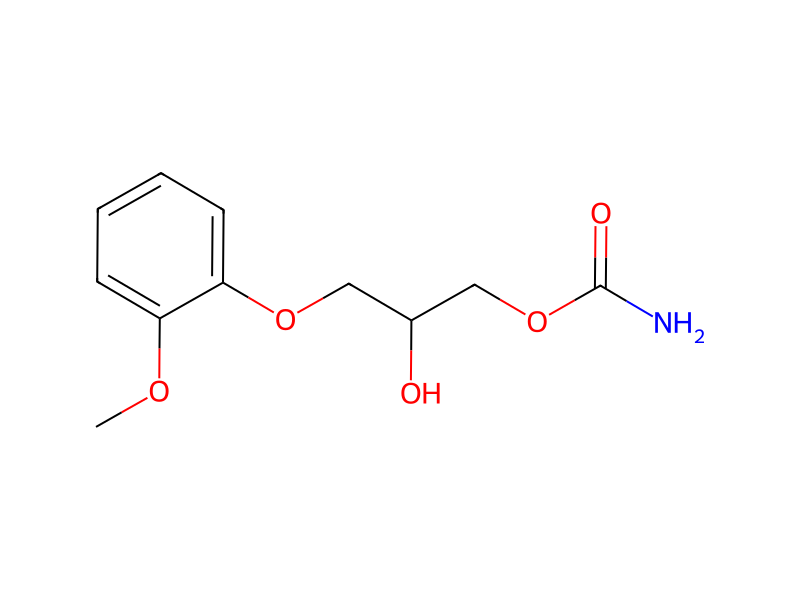
Grundinformationen
- Standard-SMILES
COc1ccccc1OCC(O)COC(N)=O- InChIKey
GNXFOGHNGIVQEH-UHFFFAOYSA-N- Summenformel
- C11H15NO5
- Durchschnittliche Molmasse
- 241,24 g/mol
- Monoisotopische Masse
- 241,09502258
Überblick
2-hydroxy-3-(2-methoxyphenoxy)propyl carbamate is a carbamate ester that is glycerol in which one of the primary alcohol groups has been converted to its 2-methoxyphenyl ether while the other has been converted to the corresponding carbamate ester. It is a carbamate ester, an aromatic ether and a secondary alcohol.
Namen und Bezeichner
- Bevorzugter Name
- Methocarbamol
- IUPAC
- [2-hydroxy-3-(2-methoxyphenoxy)propyl] carbamate
- Lokaler Name
- 3-(2-Methoxyphenoxy)-1,2-propandiol-1-carbamat
- Englischer Name
- Methocarbamol
- Summenformel
- C11H15NO5
- Molmasse
- 241.24
Namen und Synonyme
Weitere Namen anzeigen
Datenbank-Bezeichner
- CAS
532-03-6- PubChem CID
- 4107
- DTXSID
DTXSID6023286- ChEMBL
CHEMBL1201117- ChEBI
CHEBI:77498- UNII
- 125OD7737X
- EC Number
- 208-524-3、927-845-6
- Nikkaji
- J2.065F
Eigenschaften
Berechnete Struktureigenschaften
- XLogP
- 0,6
- Polarare Oberfläche (TPSA)
- 91 Ų
- H-Brücken-Donoren
- 2
- H-Brücken-Akzeptoren
- 5
- Frei drehbare Bindungen
- 7
- Schwere Atome
- 17
- Formalladung
- 0
- Komplexität
- 236
Experimentelle und physikochemische Eigenschaften
LogP
log Kow = 0.61
0.1
0.36
Solubility
2.5g/100mL
Sol in alcohol, propylene glycol
In water, 7.20X10+3 mg/L at 25 °C
4.21e+00 g/L
29.9 [ug/mL] (The mean of the results at pH 7.4)
Human Drugs
Breast Feeding; Lactation; Milk, Human; Muscle Relaxants, Central
FDA approved drugs -> Active ingredient
FDA approved drugs -> Active ingredient
Melting Point
92-94 °C
93 °C
Stability/Shelf Life
Methocarbamol solutions containing 4 mg/mL in sterile water for injection or 5% dextrose or 0.9% sodium chloride injection are stable for 6 days at room temperature. Because formation of haze in diluted solutions of methocarbamol may be unpredictable, all diluted solutions of the drug should be inspected visually for presence of a haze prior to administration regardless of storage conditions. Because compatibility of methocarbamol injection with other drugs may depend on several factors (e.g., the concentration of the drugs, specific diluents used, resulting pH, temperature), specialized references should be consulted for specific compatibility information.
Collision Cross Section
154.6 Ų [M+Na]+ [CCS Type: DT; Buffer gas: N2; Ionization: ESI+; Dataset: TOXCAST; Source Identifier: DTXSID6023286]
146.08 Ų [M+H-H2O]+ [CCS Type: TW; Method: calibrated with polyalanine and drug standards]
Physikochemische Eigenschaften
- Schmelzpunkt
- 95 · 95-97°C
- Siedepunkt
- 384.01 °C · 384.01°C (rough estimate)
- Dichte
- 1.2611 · 1.2611 (rough estimate)
- Brechungsindex
- 1.508 · 1.5080 (estimate)
- storage temp.
- Sealed in dry,Room Temperature
- Löslichkeit
- DMSO (Slightly), Methanol (Slightly)
- Aggregatzustand
- Solid
- pka
- 13.08 · 13.08±0.20(Predicted)
- Farbe
- White to Off-White
- Merck
- 14 · 14,5980
- Henry's Law Constant
- 1.5 · 1.5×1010 mol/(m3Pa) at 25℃, HSDB (2015)
- Major Application
- clinical testing
- InChI
- InChI=1S/C11H15NO5/c1-15-9-4-2-3-5-10(9)16-6-8(13)7-17-11(12)14/h2-5,8,13H,6-7H2,1H3,(H2,12,14)
- InChIKey
- GNXFOGHNGIVQEH-UHFFFAOYSA-N
- SMILES
- C(OC(=O)N)C(O)COC1=CC=CC=C1OC
- CAS Datenbank
- 532 · 532-03-6(CAS DataBase Reference)
- NIST chemische Informationen
- Methocarbamol(532-03-6)
- EPA chemische Informationen
- Methocarbamol (532-03-6)
Sicherheit und Regulatorisches
GHS-Klassifizierung
GHS Classification
Danger
H302 (100%): Harmful if swallowed [Warning Acute toxicity, oral]
P233, P260, P261, P264, P270, P271, P272, P280, P284, P301+P317, P302+P352, P304+P340, P321, P330, P333+P317, P342+P316, P362+P364, P403, and P501 (click each P-code to see the statement)
Aggregated GHS information provided per 107 reports by companies from 2 notifications to the ECHA C&L Inventory. Each notification may be associated with multiple companies.
Warning
H302: Harmful if swallowed [Warning Acute toxicity, oral]
Gefahrenhinweise
FDA Requirements
The Approved Drug Products with Therapeutic Equivalence Evaluations List identifies currently marketed prescription drug products, incl methocarbamol, approved on the basis of safety and effectiveness by FDA under sections 505 of the Federal Food, Drug, and Cosmetic Act.
The Generic Animal Drug and Patent Restoration act requires that each sponsor of an approved animal drug must submit to the FDA certain information regarding patents held for the animal drug or its method of use. The Act requires that this information, as well as a list of all animal drug products approved for safety and effectiveness, be made available to the public. Methocarbamol is included on this list.
Oral dosage form new animal drugs. Methocarbamol tablets. ... Conditions of use: The drug is administered to dogs and cats as an adjunct to therapy for acute inflammatory and traumatic conditions of the skeletal muscles in order to reduce muscular spasms. ... For use only by or on the order of a licensed veterinarian.
Implantation or injectable dosage form new animal drugs. Methocarbamol injection. Conditions of use: (i) Dogs and cats. ... (ii) Horses. ... Indications for use. As an adjunct for treating acute inflammatory and traumatic conditions of the skeletal muscles and to reduce muscular spasms. ... Limitations. For intravenous use only.
Hazard Classes and Categories
Acute Tox. 4 (100%)
Acute toxicity (Oral) - Category 4
Sicherheit und Schutzausrüstung
Storage Conditions
Methocarbamol tablets should be stored in tight containers at a temperature less than 40 °C, preferably between 15-30 °C. methocarbamol injection should be stored at 15-30 °C; freezing of the injection should be avoided.
IV infusion solutions prepared from methocarbamol injection should not be refrigerated since precipitation and haze formation may occur. At 4 °C, precipitation and haze occur at methocarbamol concentrations of about 15 mg/mL or higher when the drug is diluted in 5% dextrose, 5% dextrose and 0.45% sodium chloride, or 0.9% sodium chloride injection and also occasionally occur at lower concentrations.
Disposal Methods
SRP: At the time of review, criteria for land treatment or burial (sanitary landfill) disposal practices are subject to significant revision. Prior to implementing land disposal of waste residue (including waste sludge), consult with environmental regulatory agencies for guidance on acceptable disposal practices.
Toxikologische Informationen
Interactions
Additive CNS depression may occur when methocarbamol is administered concomitantly with other CNS depressants, including alcohol. If methocarbamol is used concomitantly with other depressant drugs, caution should be used to avoid overdosage.
A case is presented of a fatal drug interaction caused by ingestion of methocarbamol (Robaxin) and ethanol. ... Therapeutic concentrations of methocarbamol are reported to be 24 to 41 ug/mL. Biological fluids were screened for ethanol ... and quantitated by gas-liquid chromatography (GLC). Determination of methocarbamol concentrations in biological tissue homogenates and fluids were obtained by colorimetric analysis of diazotized methocarbamol. Blood ethanol concentration was 135 mg/dL (0.135% w/v) and urine ethanol was 249 mg/dL (0.249% w/v). Methocarbamol concentrations were: blood, 257 ug/mL; bile, 927 ug/L; urine, 255 ug/L; gastric, 3.7 g; liver, 459 ug/g; and kidney, 83 ug/g. The combination of ethanol and carbamates is contraindicated since acute alcohol intoxication combined with carbamate usage can lead to combined central nervous system depression as a result of the interactive sedative-hypnotic properties of the compound
.../Methocarbamol/ is capable of inducing hepatic microsomal enzymes that metabolize warfarin in animals.
Imipramine enhances CNS effect of.../methocarbamol/ in animals...
Methocarbamol may inhibit the effects of pyridostigmine bromide. Use with caution in patients with myasthenia gravis receiving anticholinesterase agents.
Hepatotoxicity
While the product label for methocarbamol states that it can cause jaundice (including cholestatic jaundice), there is little published evidence to suggest that methocarbamol is a cause of hepatic injury or clinically apparent drug induced liver disease. During clinical trials of methocarbamol, some patients had to stop treatment because of nausea, dizziness, or other nonspecific complaints, but no serum aminotransferase levels or other laboratory results were reported. Methocarbamol appears to be well tolerated, but the lack of monitoring of serum aminotransferase levels during clinical trials with methocarbamol makes it impossible to rule out the possibility of mild liver injury occurring with treatment.
Environmental Fate
TERRESTRIAL FATE: Based on a classification scheme(1), an estimated Koc value of 51(SRC), determined from a log Kow of 0.61(2) and a regression-derived equation(3), indicates that methocarbamol is expected to have high mobility in soil(SRC). Volatilization of methocarbamol from moist soil surfaces is not expected to be an important fate process(SRC) given an estimated Henry's Law constant of 6.5X10⁻¹⁶ atm-cu m/mole(SRC), using a fragment constant estimation method(4). Methocarbamol is not expected to volatilize from dry soil surfaces(SRC) based upon an estimated vapor pressure of 3.4X10⁻⁷ mm Hg(SRC), determined from a fragment constant method(5). Methocarbamol is not expected to readily biodegrade in the environment based on the results of a Japanese MITI test where methocarbamol reached 4% of its theoretical BOD in activated sludge after 4 weeks(6).
AQUATIC FATE: Based on a classification scheme(1), an estimated Koc value of 51(SRC), determined from a log Kow of 0.61(2) and a regression-derived equation(3), indicates that methocarbamol is not expected to adsorb to suspended solids and sediment(SRC). Volatilization from water surfaces is not expected(3) based upon an estimated Henry's Law constant of 6.5X10⁻¹⁶ atm-cu m/mole(SRC), developed using a fragment constant estimation method(4). According to a classification scheme(5), an estimated BCF of 1.7(SRC), from its log Kow(2) and a regression-derived equation(6), suggests the potential for bioconcentration in aquatic organisms is low(SRC). Methocarbamol is not expected to readily biodegrade in the environment based on the results of a Japanese MITI test where methocarbamol reached 4% of its theoretical BOD in activated sludge after 4 weeks(7).
ATMOSPHERIC FATE: According to a model of gas/particle partitioning of semivolatile organic compounds in the atmosphere(1), methocarbamol, which has an estimated vapor pressure of 3.4X10⁻⁷ mm Hg at 25 °C(SRC), determined from a fragment constant method(2), will exist in both the vapor and particulate phases in the ambient atmosphere. Vapor-phase methocarbamol is degraded in the atmosphere by reaction with photochemically-produced hydroxyl radicals(SRC); the half-life for this reaction in air is estimated to be 8.5 hours(SRC), calculated from its rate constant of 4.5X10⁻¹¹ cu cm/molecule-sec at 25 °C(SRC) that was derived using a structure estimation method(3). Particulate-phase methocarbamol may be removed from the air by wet or dry deposition(SRC). Methocarbamol does not contain chromophores that absorb at wavelengths >290 nm(4) and therefore is not expected to be susceptible to direct photolysis by sunlight(SRC).
Adverse Effects
Severe adverse effects noted in the methocarbamol package insert include seizures, leukopenia, and cholestatic jaundice. According to the LiverTox resource governed by the National Institute of Diabetes and Digestive and Kidney Diseases (NIDDK), methocarbamol has not been linked to liver or kidney injury. According to drug monographs, there have been reports of seizures in patients with a history of epilepsy after IV administration and cases of polysubstance toxicity. The product labeling indicates that neurologic adverse drug reactions are more common, with sedation being the most prevalent, followed by dizziness and headache. Other reported neurologic adverse drug reactions include confusion, amnesia, falls, syncope, and diplopia. Gastrointestinal adverse effects include dyspepsia, nausea, emesis, metallic taste, and cholestatic jaundice. IV administration of methocarbamol has been associated with thrombophlebitis and injection site pain related to the extravasation of hypertonic solution. Methocarbamol may cause urine discoloration, but this is not clinically significant.
Soil Adsorption/Mobility
The Koc of methocarbamol is estimated as 51(SRC), using a log Kow of 0.61(1) and a regression-derived equation(2). According to a classification scheme(3), this estimated Koc value suggests that methocarbamol is expected to have high mobility in soil.
Human Toxicity Excerpts
/HUMAN EXPOSURE STUDIES/ Methocarbamol, a compound related to mephenesin, has in vitro hemolytic potential. A study was performed to determine whether any hemolysis was detectable after intravenous injection. Methocarbamol and its vehicle (50% polyethylene glycol-300) was compared with vehicle alone and with normal saline controls in high- and low-dose regimens in normal volunteers. Significant increases in plasma hemoglobin were detected 30 min after intravenous injection of methocarbamol or its vehicle alone. Maximum initial plasma hemoglobin levels were approximately 10 mg/dL with vehicle alone, but only 4 mg/dL with the methocarbamol added. Serum haptoglobin levels fell after both high-dose methocarbamol and vehicle during the 3-day period of treatment. Hemolysis, though detectable, did not exceed levels found under physiologic circumstances such as exercise, and represents only a small fraction of the normal daily hemolysis of aged erythrocytes.
/SIGNS AND SYMPTOMS/ Limited information is available on the acute toxicity of methocarbamol. Extreme drowsiness reportedly occurred in one adult who ingested 22-30 g of the drug; treatment was symptomatic and recovery was uneventful. Another adult survived an ingestion of 30-50 g; the principal symptom was drowsiness.
/CASE REPORTS/ A case is presented of a fatal drug interaction caused by ingestion of methocarbamol (Robaxin) and ethanol. ... Therapeutic concentrations of methocarbamol are reported to be 24 to 41 ug/mL. Biological fluids were screened for ethanol ... and quantitated by gas-liquid chromatography (GLC). Determination of methocarbamol concentrations in biological tissue homogenates and fluids were obtained by colorimetric analysis of diazotized methocarbamol. Blood ethanol concentration was 135 mg/dL (0.135% w/v) and urine ethanol was 249 mg/dL (0.249% w/v). Methocarbamol concentrations were: blood, 257 ug/mL; bile, 927 ug/L; urine, 255 ug/L; gastric, 3.7 g; liver, 459 ug/g; and kidney, 83 ug/g. The combination of ethanol and carbamates is contraindicated since acute alcohol intoxication combined with carbamate usage can lead to combined central nervous system depression as a result of the interactive sedative-hypnotic properties of the compounds.
/OTHER TOXICITY INFORMATION/ The mean elimination half-life of methocarbamol in elderly healthy volunteers was slightly prolonged and the fraction of bound methocarbamol was slightly decreased compared to younger healthy volunteers.
Drug Induced Liver Injury
Drug Induced Liver Injury Rank (DILIrank 2.0)
Methocarbamol
Ambiguous-DILI-concern
5
Adverse reactions
DOI:10.1016/j.drudis.2016.02.015
Environmental Bioconcentration
An estimated BCF of 1.7 was calculated for methocarbamol(SRC), using a log Kow of 0.61(1) and a regression-derived equation(2). According to a classification scheme(3), this BCF suggests the potential for bioconcentration in aquatic organisms is low(SRC).
Volatilization from Water/Soil
The Henry's Law constant for methocarbamol is estimated as 6.5X10⁻¹⁶ atm-cu m/mole(SRC) using a fragment constant estimation method(1). This Henry's Law constant indicates that methocarbamol is expected to be essentially nonvolatile from water surfaces(2). Methocarbamol is not expected to volatilize from dry soil surfaces(SRC) based upon an estimated vapor pressure of 3.4X10⁻⁷ mm Hg(SRC), determined from a fragment constant method(3).
Regulatorische Informationen
FDA Requirements
The Approved Drug Products with Therapeutic Equivalence Evaluations List identifies currently marketed prescription drug products, incl methocarbamol, approved on the basis of safety and effectiveness by FDA under sections 505 of the Federal Food, Drug, and Cosmetic Act.
The Generic Animal Drug and Patent Restoration act requires that each sponsor of an approved animal drug must submit to the FDA certain information regarding patents held for the animal drug or its method of use. The Act requires that this information, as well as a list of all animal drug products approved for safety and effectiveness, be made available to the public. Methocarbamol is included on this list.
Oral dosage form new animal drugs. Methocarbamol tablets. ... Conditions of use: The drug is administered to dogs and cats as an adjunct to therapy for acute inflammatory and traumatic conditions of the skeletal muscles in order to reduce muscular spasms. ... For use only by or on the order of a licensed veterinarian.
Implantation or injectable dosage form new animal drugs. Methocarbamol injection. Conditions of use: (i) Dogs and cats. ... (ii) Horses. ... Indications for use. As an adjunct for treating acute inflammatory and traumatic conditions of the skeletal muscles and to reduce muscular spasms. ... Limitations. For intravenous use only.
Sicherheitsdaten
- wgk
- 3
- tsca
- TSCA listed
- hs_code
- 29222990
- RTECS-Nr.
- TY8750000
- risk_code
- 22-42/43
- hazard_code
- Xn
- safety_code
- 36
- Speicherklasse
- 3 - Flammable liquids
- Giftige Stoffe Daten
- 532-03-6(Hazardous Substances Data)
- Hazard Classifications
- Acute Tox. 4 DermalAcute Tox. 4 InhalationAcute Tox. 4 OralEye Irrit. 2Flam. Liq. 2
Chemie und Industrie
Pharmakologische Informationen
ATC Code
M - Musculo-skeletal system
QM - Musculo-skeletal system
Pharmacodynamics
Methacarbamol is a skeletal muscle relaxant with an unknown mechanism of action. Methacarbamol has been shown to block spinal polysynaptic reflexes, decrease nerve transmission in spinal and supraspinal polysynaptic pathways, and prolong the refractory period of muscle cells. Methocarbamol does not act as a local anesthetic upon injection. In animal studies, methocarbamol also prevents convulsions after electric shock.
Mechanism of Action
The mechanism of action of methocarbamol is thought to be dependant on its central nervous system depressant activity. This action may be mediated through blocking spinal polysynaptic reflexes, decreasing nerve transmission in spinal and supraspinal polysynaptic pathways, and prolonging the refractory period of muscle cells. Methocarbamol has been found to have no effect on contraction of muscle fibres, motor end plates, or nerve fibres.
Precise mechanism of action has not been determined. These agents act in the central nervous system (CNS) rather than directly on skeletal muscle. Several of these medications have been shown to depress polysynaptic reflexes preferentially. The muscle relaxant effects of most of these agents may be related to their CNS depressant (sedative) effects. /Skeletal Muscle Relaxants/
Biological Half-Life
The elimination half life is 1.14 hours in healthy subjects and 1.24 hours in subjects with renal insufficiency. Older studies report half lives of 1.6-2.15 hours.
Methocarbamol has a serum half-life of 0.9-1.8 hours.
... Pharmacokinetics of methocarbamol were studied in eight healthy, adult horses after intravenous (iv) and oral administration of large dosages. ... Plasma methocarbamol concentration declined very rapidly during the initial or rapid disposition phase after iv administration; the terminal elimination half-life ranged from 59 to 90 mins. ...
/Investigators/ determined plasma methocarbamol concentrations over 24 hr following a 1.5 g methocarbamol dose (off-dialysis day) to 8 chronic hemodialysis patients and compared these results to those from 17 healthy male volunteers. The harmonic mean elimination half-life was similar between the two groups, 1.24 and 1.14 hr, respectively. ...
... Pharmacokinetics of methocarbamol were studied in eight healthy, adult horses after intravenous (iv) and oral administration of large dosages. ... Plasma methocarbamol concentration declined very rapidly during the initial or rapid disposition phase after iv administration; the terminal elimination half-life ranged from 59 to 90 mins. ...
Metabolism/Metabolites
Methocarbamol is metabolized in the liver by demethylation to 3-(2-hydroxyphenoxy)-1,2-propanediol-1-carbamate or hydroxylation to 3-(4-hydroxy-2-methoxyphenoxy)-1,2-propanediol-1-carbamate. Methocarbamol and its metabolites are conjugated through glucuronidation or sulfation.
Methocarbamol is extensively metabolized, presumably in the liver, by dealkylation and hydroxylation.
Based on limited data, about 10-15% of a single oral dose is excreted in urine as unchanged drug, about 40-50% as the glucuronide and sulfate conjugates of 3-(2-hydroxyphenoxy)-1,2-propanediol-1-carbamate and 3-(4-hydroxy-2-methoxyphenoxy)-1,2-propanediol-1-carbamate, and the remainder as unidentified metabolites.
In dogs, rats and in man, methocarbamol gave p-hydroxymethocarbamol and o-demethylation product. All three substances were excreted in urine as glucuronic acid and ester sulfate conjugates.
Permethylation and g.l.c.-mass spectrometric analysis of bile from an isolated rat liver perfusion to which methocarmol was added showed seven components not present in control bile: methocarbamol, glucuronides of methocarbamol and desmethyl-methocarbamol, and four glucuronides of hydroxylated methocarbamol metabolites. 2. An interesting rearrangement of a methyl group has been found in the mass spectrum of 3-(2-methoxyphenyloxy)-1,2-dimethoxypropane, the permethylation product from methocarbamol.
FDA Pharmacological Classification
125OD7737X
METHOCARBAMOL
Physiologic Effects [PE] - Centrally-mediated Muscle Relaxation
Established Pharmacologic Class [EPC] - Muscle Relaxant
Methocarbamol is a Muscle Relaxant. The physiologic effect of methocarbamol is by means of Centrally-mediated Muscle Relaxation.
METHOCARBAMOL
MeSH Pharmacological Classification
A heterogeneous group of drugs used to produce muscle relaxation, excepting the neuromuscular blocking agents. They have their primary clinical and therapeutic uses in the treatment of muscle spasm and immobility associated with strains, sprains, and injuries of the back and, to a lesser degree, injuries to the neck. They have been used also for the treatment of a variety of clinical conditions that have in common only the presence of skeletal muscle hyperactivity, for example, the muscle spasms that can occur in MULTIPLE SCLEROSIS. (From Smith and Reynard, Textbook of Pharmacology, 1991, p358)
Absorption, Distribution and Excretion
The time to maximum concentration is 1.1 hours for both healthy patients and those on hemodialysis. The maximum plasma concentration is 21.3mg/L for healthy patients and 28.7mg/L in hemodialysis patients. The area under the curve for healthy patients is 52.5mg/L\*hr and 87.1mg/L*hr in hemodialysis patients. AUC% based on terminal elimination half life is 2% for healthy patients and 4% for hemodialysis patients. Older studies report maximum plasma concentrations in 0.5 hours.
In humans the majority of the dose is eliminated in the urine. In dogs, 88.85% of the dose is eliminated in urine and 2.14% in the feces. In rats, 84.5-92.5% of the dose is eliminated in the urine and 0-13.3% is eliminated in the feces.
Volume of distribution data in humans is scarce. In horses, the volume of distribution is 515-942mL/kg at steady state or 724-1130mL/kg.
0.2-0.8L/h/kg.
Methocarbamol is rapidly and almost completely absorbed from the GI tract. Blood or serum concentrations of methocarbamol required for sedative, skeletal muscle relaxant, or toxic effects are not known.
Following oral administration of a single dose of methocarbamol, peak blood or serum concentrations of the drug appear to be attained in approximately 1-2 hours; the onset of action is usually within 30 minutes. Data from an unpublished study indicate that peak blood concentrations (measured as total carbamates and expressed in terms of methocarbamol) average 16.5 mcg/mL following a single 2-g oral dose, while data from a published study (using an assay relatively specific for methocarbamol) indicate that peak serum concentrations average 29.8 mcg/mL following the same dose. Data from the unpublished study also indicate that after IV administration of 1 g of methocarbamol at a rate of 300 mg/minute, blood concentrations of 19 mcg/mL are attained immediately and that the onset of action is almost immediate.
Verwendung und Herstellung
Uses
In dogs, cats, and horses methocarbamol is indicated as adjunct therapy of acute inflammatory and traumatic conditions of skeletal muscle and to reduce muscle spasms.
... control muscular spasticity resulting from tetanus
For use as an adjunct to rest, physical therapy, and other measures for the relief of discomforts associated with acute, painful musculoskeletal conditions.
THERAP CAT: Muscle relaxant (skeletal)
For more Uses (Complete) data for METHOCARBAMOL (7 total), please visit the HSDB record page.
Use (kg; approx.) in Germany (2009): >7500
Methods of Manufacturing
Prepn from 3-(o-methoxyphenoxy)-2-hydroxypropyl chlorocarbonate: Murphey, US patent 2,770,649 (1956 to AH Robins).
Production: guaifenesin and phosgene and ammonia (phosgenation/dehydrochlorination)
Prepared by reaction of 3-(2-methoxyphenoxy)-1,2-propanediol with phosgene and ammonium hydroxide.
Formulations/Preparations
Oral /formulations/: Tablets 500 mg methocarbamol, (Global, Sandoz, United Research, Watson, West-Ward); 750 mg methocarbamol Tablets, (Global, Sandoz, United Research, Watson, West-Ward); Tablets, film-coated 500 mg Robaxin with povidone and propylene glycol, (Schwarz); 750 mg Robaxin with povidone and propylene glyco), (Schwarz); Parenteral Injection 100 mg/mL Robaxin with 50% polyethylene glycol 300, (Baxter).
METHOCARBAMOL, NF (ROBAXIN) TABLETS, 500 & 750 MG; INJECTION, 1 G/10 ML. /FROM TABLE/
Anwendungen
VerwendenMethocarbamol suppresses multisynaptic pathways in the spinal cord. It is used for relieving spasms and skeletal muscle pain as well as for treating tetanus. Synonyms of this drug are delaxin, forbaxin, robamol, robaxin, and tresortil.
Vor- und nachgelagerte Produkte
Vorgelagerte Rohstoffe
Anbieter50 Anbieter
Zugehörige Reaktionen
Keine Reaktionsaufzeichnungen unter den aktuellen Filterkriterien.
Verknüpfte Notizen
Wird geladen…