Grundinformationen
- Standard-SMILES
C=CC[N+]1([C@H]2C[C@H]3[C@@H]4CC[C@H]5C[C@H](O)[C@@H](N6CCOCC6)C[C@]5(C)[C@H]4CC[C@]3(C)[C@H]2OC(C)=O)CCCC1- InChIKey
YXRDKMPIGHSVRX-OOJCLDBCSA-N- Summenformel
- C32H53N2O4+
- Durchschnittliche Molmasse
- 529,8 g/mol
- Monoisotopische Masse
- 529,3999846
Überblick
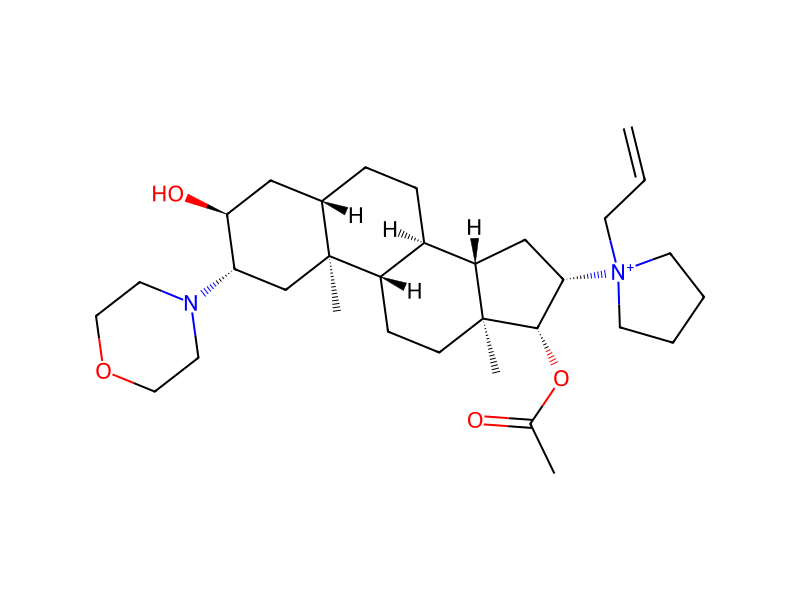
Rocuronium is a 5alpha-androstane compound having 3alpha-hydroxy-, 17beta-acetoxy-, 2beta-morpholino- and 16beta-N-allyllyrrolidinium substituents. It has a role as a muscle relaxant, a neuromuscular agent and a drug allergen. It is a quaternary ammonium ion, an androstane, a 3alpha-hydroxy steroid, a member of morpholines, an acetate ester and a tertiary amino compound. It derives from a hydride of a 5alpha-androstane.
Namen und Bezeichner
- Bevorzugter Name
- Rocuronium
- IUPAC
- [(2S,3S,5S,8R,9S,10S,13S,14S,16S,17R)-3-hydroxy-10,13-dimethyl-2-morpholin-4-yl-16-(1-prop-2-enylpyrrolidin-1-ium-1-yl)-2,3,4,5,6,7,8,9,11,12,14,15,16,17-tetradecahydro-1H-cyclopenta[a]phenanthren-17-yl] acetate
- Englischer Name
- rocuronium
- Summenformel
- C32H53N2O4+
- Molmasse
- 529.79
Namen und Synonyme
Rocuronium143558-00-3Rocuronium ionRocuronium cationWRE554RFEZCHEBI:8884DTXSID60483391-[(1S,2S,4S,5S,7S,10R,11S,13S,14R,15S)-14-(acetyloxy)-5-hydroxy-2,15-dimethyl-4-(morpholin-4-yl)tetracyclo[8.7.0.0^{2,7}.0^{11,15}]heptadecan-13-yl]-1-(prop-2-en-1-yl)pyrrolidin-1-iumEsmerone1-((1S,2S,4S,5S,7S,10R,11S,13S,14R,15S)-14-(acetyloxy)-5-hydroxy-2,15-dimethyl-4-(morpholin-4-yl)tetracyclo(8.7.0.0^(2,7).0^(11,15))heptadecan-13-yl)-1-(prop-2-en-1-yl)pyrrolidin-1-iumRefChem:56463DTXCID1028314
Weitere Namen anzeigen
1-[17β-(Acetyloxy)-3α-hydroxy-2β-morpholino-5α-androstan-16β-yl]-1-(2-propenyl)pyrrolidinium1-[(2beta,3alpha,5alpha,16beta,17beta)-17-(Acetyloxy)-3-hydroxy-2-(4-morpholinyl)androstan-16-yl]-1-(2-propenyl)pyrrolidinium
1-(17-(acetoyl)-3-hydroxy-2-(4-morpholinyl)androstan-16-yl)-1-(2-propenyl)pyrrolidiniumAndrostane-3,17-diol, 2-(4-morpholinyl)-16-(1-(2-propen-1-yl)-1-pyrrolidiniumyl)-, 17-acetate, (2beta,3alpha,5alpha,16beta,17beta)-ZemuronUNII-WRE554RFEZ[(2S,3S,5S,8R,9S,10S,13S,14S,16S,17R)-3-hydroxy-10,13-dimethyl-2-morpholin-4-yl-16-(1-prop-2-enylpyrrolidin-1-ium-1-yl)-2,3,4,5,6,7,8,9,11,12,14,15,16,17-tetradecahydro-1H-cyclopenta[a]phenanthren-17-yl] acetateC32H53BrN2O4NCGC00167433-01RBr
Datenbank-Bezeichner
- CAS
119302-91-9、143558-00-3- PubChem CID
- 441290
- DTXSID
DTXSID6048339- ChEMBL
CHEMBL1201244- ChEBI
CHEBI:8884- UNII
- WRE554RFEZ
- Nikkaji
- J441.674K
Eigenschaften
Berechnete Struktureigenschaften
- XLogP
- 5
- Polarare Oberfläche (TPSA)
- 59 Ų
- H-Brücken-Donoren
- 1
- H-Brücken-Akzeptoren
- 5
- Frei drehbare Bindungen
- 6
- Schwere Atome
- 38
- Formalladung
- 1
- Komplexität
- 898
Experimentelle und physikochemische Eigenschaften
DrugsPharmaceuticals -> Listed in ZINC15
Solubility
Complete
2.84e-05 g/L
Human DrugsBreast Feeding; Lactation; Muscle Relaxants; Neuromuscular Nondepolarizing Agents
Physical DescriptionSolid
Physikochemische Eigenschaften
- storage temp.
- -20 °C · Store at -20°C
- Löslichkeit
- DMSO
- Aggregatzustand
- Powder
Sicherheit und Regulatorisches
Toxikologische Informationen
Adverse EffectsAllergic Reactions
Toxicity SummaryReversal of rocuronium-induced paralysis is possible with the use of 2 subgroups of drugs.
Drug Induced Liver Injury
Drug-Induced Liver Injury Severity and Toxicity (DILIst)
rocuronium
DILI Negative
Intravenous
DOI:10.1016/j.drudis.2019.09.022
Effects During Pregnancy and Lactation◉ Summary of Use during Lactation
Chemie und Industrie
Pharmakologische Informationen
Protein BindingApproximately 30% bound to human plasma proteins.
Pharmacodynamics
Neuromuscular blocking agents are drugs that cause skeletal muscle relaxation primarily by causing a decreased response to the neurotransmitter acetylcholine (ACh) at the myoneural (neuromuscular) junction of skeletal muscle. At that site, ACh normally produces electrical depolarization of the postjunctional membrane of motor end-plate, which leads to conduction of muscle action potential and subsequently induces skeletal muscle contraction. Neuromuscular agents are classified as depolarizing or nondepolarizing. Rocuronium is a nondepolarizing neuromuscular blocking agent with a rapid to intermediate onset depending on dose and intermediate duration. Rocuronium, like vecuronium is longer acting in infants than in children. However, unlike vecuronium, rocuronium retains the characteristics of an intermediate-acting NMBD in infants.
Mechanism of Action
Rocuronium acts by competing for cholinergic receptors at the motor end-plate. This action is antagonized by acetylcholinesterase inhibitors, such as neostigmine and edrophonium. Rocuronium acts by competitively binding to nicotinic cholinergic receptors. The binding of vecuronium decreases the opportunity for acetylcholine to bind to the nicotinic receptor at the postjunctional membrane of the myoneural junction. As a result, depolarization is prevented, calcium ions are not released and muscle contraction does not occur. Evidence also suggests that nondepolarizing agents can affect ACh release. It has been hypothesized that nondepolarzing agents bind to postjunctional ("curare") receptors and may therefore interfere with the sodium and potassium flux, which is responsible for depolarization and repolarization of the membranes involved in muscle contraction.
Biological Half-LifeThe rapid distribution half-life is 1-2 minutes and the slower distribution half-life is 14-18 minutes. Renal impairment has no net effect on half-life, however, half-life is almost doubled in patients with impaired liver function.
Metabolism/MetabolitesRocuronium is metabolized to a less active metabolite, 17-desacetyl-rocuronium, and is eliminated primarily by the liver.
FDA Pharmacological Classification
WRE554RFEZ
ROCURONIUM
Physiologic Effects [PE] - Neuromuscular Nondepolarizing Blockade
Established Pharmacologic Class [EPC] - Nondepolarizing Neuromuscular Blocker
Rocuronium is a Nondepolarizing Neuromuscular Blocker. The physiologic effect of rocuronium is by means of Neuromuscular Nondepolarizing Blockade.
ROCURONIUM
MeSH Pharmacological Classification
Drugs that interrupt transmission at the skeletal neuromuscular junction without causing depolarization of the motor end plate. They prevent acetylcholine from triggering muscle contraction and are used as muscle relaxants during electroshock treatments, in convulsive states, and as anesthesia adjuvants.
Absorption, Distribution and Excretion
Poorly absorbed from the GI tract.
Studies of distribution, metabolism, and excretion in cats and dogs indicate that rocuronium is eliminated primarily by the liver.
0.3 L/kg [3 to <12 mos]
0.25 L/kg/hr [Adults (Ages 27 to 58 years)]
Cellular LocationsExtracellular
Anbieter16 Anbieter
北京华美互利生物化工010-56205725 · [email protected]
杭州摩库生物医药科技有限公司+86-057181025280; +8617767106207 · [email protected]
四川星优天下医药科技有限公司18328380615 · [email protected]
MedChemexpress LLC021-58955995 · [email protected]
PT CHEM GROUP LIMITED+86-85511178; +86-85511178 · [email protected]
四川省维克奇生物科技有限公司028-81700200 18116577057 · [email protected]
青岛海智微元生物科技有限公司18317699790 18317699790 · [email protected]
上海陶术生物科技股份有限公司+1-781-999-5354; +1-00000000000 · [email protected]
BOC Sciences16314854226 · [email protected]
成都华纯科技有限公司400-1166-196 15982826727 · [email protected]
Musechem+1-800-259-7612 · [email protected]
Hebei Chuanghai Biotechnology Co., Ltd+86-15350571055 · [email protected]
上海佰世凯生物科技有限公司021-20908456 · [email protected]
TargetMol中国(陶术生物)15002134094 · [email protected]
Hebei Chuanghai Biotechnology Co., Ltd+86-15350571055 · [email protected]
Guangzhou TongYi biochemistry technology Co.,LTD[email protected]
Ergänzende Hinweise
DefinitionChEBI: A 5alpha-androstane compound having 3alpha-hydroxy-, 17beta-acetoxy-, 2beta-morpholino- and 16beta-N-allyllyrrolidinium substituents.
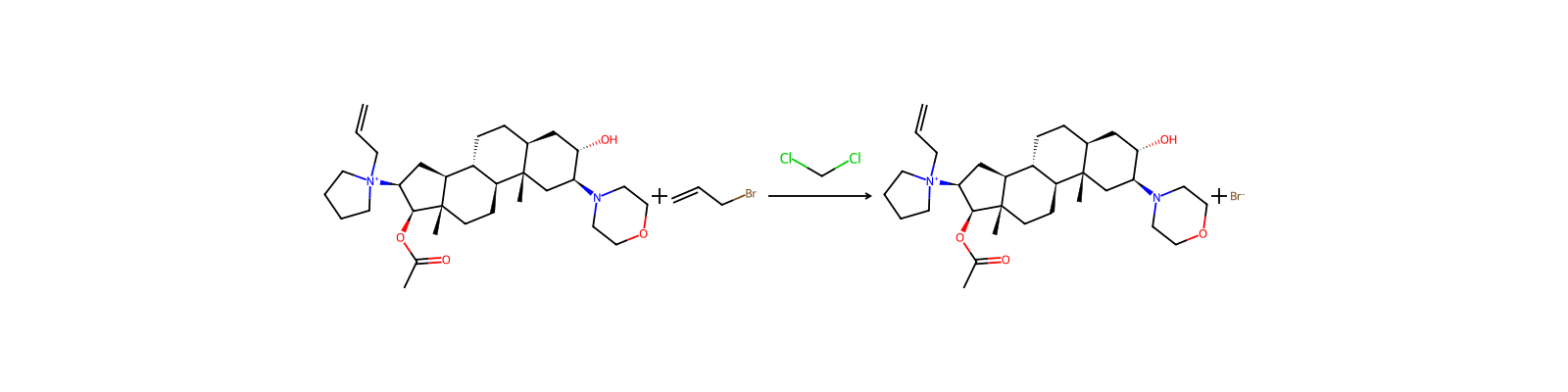
Zugehörige Reaktionen
1
Verknüpfte Notizen
Wird geladen…