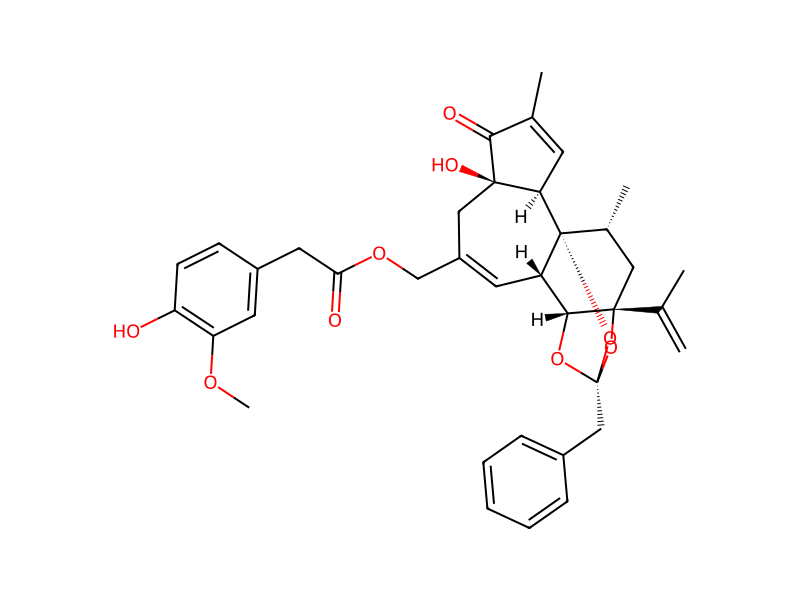
Grundinformationen
- Standard-SMILES
C=C(C)[C@]12C[C@@H](C)[C@@]34O[C@](Cc5ccccc5)(O[C@@H]1[C@@H]3C=C(COC(=O)Cc1ccc(O)c(OC)c1)C[C@]1(O)C(=O)C(C)=C[C@@H]41)O2- InChIKey
DSDNAKHZNJAGHN-MXTYGGKSSA-N- Summenformel
- C37H40O9
- Durchschnittliche Molmasse
- 628,7 g/mol
- Monoisotopische Masse
- 628,26723286
Überblick
Resiniferatoxin is a heteropentacyclic compound found in Euphorbia poissonii with molecular formula C37H40O9. It is an agonist of the transient receptor potential cation channel subfamily V member 1 (TrpV1). It has a role as a TRPV1 agonist, an analgesic, a neurotoxin and a plant metabolite. It is a tertiary alpha-hydroxy ketone, a diterpenoid, a monomethoxybenzene, a carboxylic ester, a member of phenols, an organic heteropentacyclic compound, an enone and an ortho ester.
Namen und Bezeichner
- Bevorzugter Name
- Resiniferatoxin
- IUPAC
- [(1R,2R,6R,10S,11R,13S,15R,17R)-13-benzyl-6-hydroxy-4,17-dimethyl-5-oxo-15-prop-1-en-2-yl-12,14,18-trioxapentacyclo[11.4.1.01,10.02,6.011,15]octadeca-3,8-dien-8-yl]methyl 2-(4-hydroxy-3-methoxyphenyl)acetate
- Englischer Name
- RESINIFERATOXIN
- Summenformel
- C37H40O9
- Molmasse
- 628.71
Namen und Synonyme
Weitere Namen anzeigen
Datenbank-Bezeichner
- CAS
57444-62-9- PubChem CID
- 5702546
- DTXSID
DTXSID00894764- ChEMBL
CHEMBL17976- ChEBI
CHEBI:8809- UNII
- A5O6P1UL4I
- EC Number
- 637-354-6
- Nikkaji
- J282.917G
Eigenschaften
Berechnete Struktureigenschaften
- XLogP
- 4,5
- Polarare Oberfläche (TPSA)
- 121 Ų
- H-Brücken-Donoren
- 2
- H-Brücken-Akzeptoren
- 9
- Frei drehbare Bindungen
- 9
- Schwere Atome
- 46
- Formalladung
- 0
- Komplexität
- 1.330
Physikochemische Eigenschaften
- Siedepunkt
- 768.7 · 768.7±60.0 °C(Predicted)
- Dichte
- 1.35 · 1.35±0.1 g/cm3(Predicted)
- storage temp.
- -20 °C · -20°C
- Löslichkeit
- 100 mM · Soluble in DMSO to 100mM and to 50mM in ethanol
- Aggregatzustand
- Solid
- pka
- 9.85 · 9.85±0.20(Predicted)
- Farbe
- White to off-white
- Biologische Quelle
- Euphorbia poisonii
- BRN
- 5371150 · 5371150
- Stabilität
- 2 years · Stable for 2 years from date of purchase as supplied. Solutions in DMSO or ethanol may be stored at -20°C for up to 1 month.
- InChIKey
- DSDNAKHZNJAGHN-MXTYGGKSSA-N
- SMILES
- C1(CC(OCC2C[C@@]3(O)[C@]([H])([C@]45O[C@]6(CC7=CC=CC=C7)O[C@]([H])([C@]4([H])C=2)[C@](C(C)=C)(C[C@H]5C)O6)C=C(C)C3=O)=O)=CC=C(O)C(OC)=C1
Sicherheit und Regulatorisches
GHS-Klassifizierung
GHS Classification
Danger
H301 (100%): Toxic if swallowed [Danger Acute toxicity, oral]
P260, P264, P270, P280, P301+P316, P301+P330+P331, P302+P361+P354, P304+P340, P305+P354+P338, P316, P321, P330, P363, P405, and P501 (click each P-code to see the statement)
Aggregated GHS information provided per 44 reports by companies from 6 notifications to the ECHA C&L Inventory. Each notification may be associated with multiple companies.
Gefahrenhinweise
Toxikologische Informationen
Toxicity Summary
Resiniferatoxin activates the vanilloid receptor in a subpopulation of primary afferent sensory neurons involved in nociception (the transmission of physiological pain). RTX causes a novel ion channel in the plasma membrane of sensory neurons, the transient receptor potential vanilloid 1, to become permeable to cations, most particularly the calcium cation. This evokes a powerful irritant effect followed by desensitization and analgesia. (L1244)
Sicherheitsdaten
- F
- 10-23
- wgk
- 3
- ridadr
- UN 2928 6.1/PG 2
- hs_code
- 29329990
- RTECS-Nr.
- CY1633700
- risk_code
- 25-35
- hazard_code
- T
- safety_code
- 26-36/37/39-45
- hazard_class
- 6.1(a)
- packing_group
- II
- Speicherklasse
- 6.1C - Combustible acute toxic Cat.3toxic compounds or compounds which causing chronic effects
- Hazard Classifications
- Acute Tox. 3 OralSkin Corr. 1A
Chemie und Industrie
Verwendung und Herstellung
Uses
Resiniferatoxin (RTX) is a plant toxin and ultrapotent capsaicin analog that occurs in various species of plants, such as resin spurge (Euphorbia resinifera). (L1244) Investigated for use/treatment in interstitial cystitis and urinary incontinence.
Anwendungen
VerwendenResiniferatoxin has been used as an agonist to transient receptor potential vanilloid 2 (TRPV2): for complex preparation for cryo-electron microscopy structural studies to test its effect towards immune responses toP.aeruginosa in sensory neurons associated with the cornea to study its effects in the denervation of the peripheral sensory nerves in psoriatic mice
Vor- und nachgelagerte Produkte
Vorgelagerte Rohstoffe
Anbieter50 Anbieter
Zugehörige Reaktionen
Keine Reaktionsaufzeichnungen unter den aktuellen Filterkriterien.
Verknüpfte Notizen
Wird geladen…