Grundinformationen
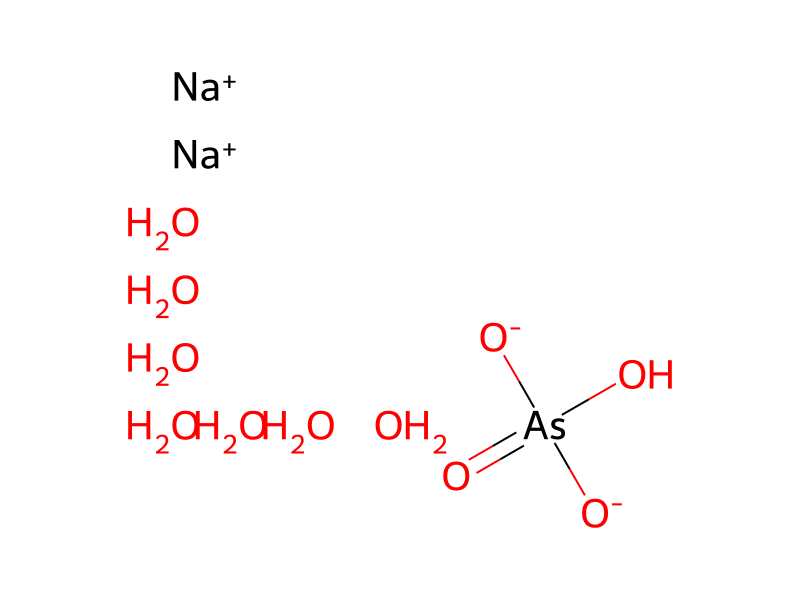
- Standard-SMILES
O.O.O.O.O.O.O.O=[As]([O-])([O-])O.[Na+].[Na+]- InChIKey
KOLXPEJIBITWIQ-UHFFFAOYSA-L- Summenformel
- Na2(AsHO4).7H2O
- Durchschnittliche Molmasse
- 312,01 g/mol
- Monoisotopische Masse
- 311,96257136
Überblick
Sodium arsenate heptahydrate appears as odorless white crystals. Becomes anhydrous at 212 °F. Aqueous solution is alkaline to litmus. (NTP, 1992)
Namen und Bezeichner
- Bevorzugter Name
- Sodium arsenate, dibasic heptahydrate
- IUPAC
- disodium;hydrogen arsorate;heptahydrate
- Englischer Name
- SODIUM ARSENATE, HEPTAHYDRATE
- Summenformel
- AsH15Na2O11
- Molmasse
- 312.01
Namen und Synonyme
Weitere Namen anzeigen
Datenbank-Bezeichner
- CAS
10048-95-0- PubChem CID
- 61460
- DTXSID
DTXSID3032048- ChEMBL
CHEMBL3188962- ChEBI
CHEBI:91257- UNII
- 90ZQ7G407W
- EC Number
- 677-900-0
Eigenschaften
Berechnete Struktureigenschaften
- Polarare Oberfläche (TPSA)
- 90,4 Ų
- H-Brücken-Donoren
- 8
- H-Brücken-Akzeptoren
- 11
- Frei drehbare Bindungen
- 0
- Schwere Atome
- 14
- Formalladung
- 0
- Komplexität
- 46,5
Experimentelle und physikochemische Eigenschaften
Density
1.88 (NTP, 1992) - Denser than water; will sink
1.87
1.9 g/cm³
Solubility
greater than or equal to 100 mg/mL at 77 °F (NTP, 1992)
5.46 g/100 cc water @ 0 °C; 100 g/100 cc water @ 100 °C; sol in glycerol
Solubility in water, g/100ml at 21 °C: 39
Decomposition
When heated to decomp it emits toxic fumes of arsenic.
180 °C
Melting Point
135 °F (NTP, 1992)
57 °C when rapidly heated
130 °C
Physical Description
Sodium arsenate heptahydrate appears as odorless white crystals. Becomes anhydrous at 212 °F. Aqueous solution is alkaline to litmus. (NTP, 1992)
Odorless solid; Effloresces in warm air; [Merck Index] Colorless solid; [ICSC] White odorless solid; [CAMEO] White crystalline solid; [MSDSonline]
COLOURLESS CRYSTALS.
Physikochemische Eigenschaften
- Schmelzpunkt
- 180 °C · 180 °C (dec.)(lit.)
- Dichte
- 1 · 1,88 g/cm3
- Löslichkeit
- 2 O: · H2O: slightly soluble(lit.)
- Aggregatzustand
- Granular
- Wichte
- 1.88 · 1.88
- Farbe
- White
- PH
- 8.5 · 8.5-9.0 (25°C, 50g/L)
- Wasserlöslichkeit
- Soluble in water and glycerol.
- Stabilität
- Stable. Incompatible with strong reducing agents, strong oxidizing agents, strong acids. Incompatible with iron, aluminium and zinc in the presence of water.
- InChI
- 1S/AsH3O4.2Na.7H2O/c2-1(3,4)5;;;;;;;;;/h(H3,2,3,4,5);;;7*1H2/q;2*+1;;;;;;;/p-2
- InChIKey
- KOLXPEJIBITWIQ-UHFFFAOYSA-L
- SMILES
- O.O.O.O.O.O.O.[Na+].[Na+].O[As]([O-])([O-])=O
- CAS Datenbank
- 10048 · 10048-95-0(CAS DataBase Reference)
- EPA chemische Informationen
- Disodium arsenate heptahydrate (10048-95-0)
Sicherheit und Regulatorisches
GHS-Klassifizierung
GHS Classification
Danger
H301 (100%): Toxic if swallowed [Danger Acute toxicity, oral]
P203, P261, P264, P270, P271, P273, P280, P301+P316, P304+P340, P316, P318, P321, P330, P391, P403+P233, P405, and P501 (click each P-code to see the statement)
Aggregated GHS information provided per 44 reports by companies from 4 notifications to the ECHA C&L Inventory. Each notification may be associated with multiple companies.
Danger
H301: Toxic if swallowed [Danger Acute toxicity, oral]
Gefahrenhinweise
Regulatory Information
Chemical: Arsenic acid (H3AsO4), disodium salt, heptahydrate
Restricted substance: Sodium arsenate dibasic heptahydrate
Sodium arsenate, dibasic, heptahydrate: HSNO Approval: HSR006141 Approved with controls
Fire Hazards
Literature sources indicate that this chemical is nonflammable. (NTP, 1992)
Not combustible. Gives off irritating or toxic fumes (or gases) in a fire. Risk of fire and explosion on contact with metals. See Chemical Dangers.
Health Hazards
SYMPTOMS: Symptoms of exposure to this class of compounds may include garlicky odor of the breath and feces, sweetish metallic taste, constriction of the throat, difficulty in swallowing, burning and colicky pains in the esophagus, stomach and bowel; vomiting, profuse and painful diarrhea (feces may become bloody), dehydration with intense thirst; muscular cramps, hematuria, albuminuria, glycosuria, sinus tachycardia and occasionally ventricular arrhythmias; cyanosis, feeble pulse, cold extremities, vertigo, headache, stupor, delirium, mania, syncope, coma, convulsions, general paralysis, ventricular fibrillation, peripheral neuropathy with sensory and motor involvement, severe gastritis or gastroenteritis, weakness, loss of fluid and electrolytes resulting in collapse, shock and death; muscle spasm, encephalopathy, mild gastrointestinal disturbances, anorexia, low-grade fever, pallor, inflammation of the nose, throat, eyes and larynx; stomatitis, salivation, skin afflictions such as erythema, eczema, pigmentation (arsenic melanosis), diffuse alopecia, keratosis (especially of the palms and soles), scaling and desquamation, brittle nails, white lines or bands in the nails (Mees lines), loss of hair and nails, and localized subcutaneous edema (especially of the eyelids); renal damage, hepatomegaly with jaundice (and sometimes pruritis) which may evolve into cirrhosis with ascites; idiopathic portal hypertension with bleeding esophageal varices in chronic poisonings; enteropathy, neonatal death and severe blood dyscrasias. Other symptoms may include cold and clammy skin, fall in blood pressure, circulatory failure, oliguria, anuria, restlessness, nausea, dizziness, chills, irritability, acute pulmonary edema, dyspnea, cough with foamy sputum, rales, polyneuritis, optic neuritis, anesthesias, burning pains in the hands and feet, bronzing of the skin, abdominal cramps, anemia, aplastic anemia and chronic nephritis. Exposure can cause inflammation of the mucous membranes; and irritation, redness and pain of the eyes and skin. Chronic exposure can cause hepatitis and damage to the cardiovascular system, central nervous system, liver and kidneys. Repeated or prolonged contact can result in lesions of the skin and perforation of the nasal septum. It can cause laryngitis, bronchitis, irritation of the nose and throat and unconsciousness. It can also cause nervousness and stomach irritation. Eye contact may result in conjunctivitis.
Hazards Summary
A skin, eye, and respiratory tract irritant; May cause arsenic poisoning; [ICSC] Dibasic sodium arsenate contains 40% arsenic in the anhydrous form and 24% arsenic in the more common hydrate form; [HSDB] Intraperitoneal TDLo (mouse) = 43 mg/kg; [Ullmann] See Sodium arsenate, dibasic. See Arsenic and the linked occupational diseases.
Special Reports
U.S. Environmental Protection Agency's Integrated Risk Information System (IRIS) on Arsenic, inorganic (7440-38-2).[Available from the Substance File List as of March 15, 2000: http://www.epa.gov/iris/subst/index.html]
IARC. Monographs on the Evaluation of the Carcinogenic Risk of Chemicals to Man. Geneva: World Health Organization, International Agency for Research on Cancer, 1972-PRESENT. (Multivolume work). Volume 84 (2004). Some Drinking-water Disinfectants and Contaminants, including Arsenic.[Available from, as of July 22, 2009: http://monographs.iarc.fr/ENG/Monographs/vol84/volume84.pdf]
National Toxicology Program. Eleventh Report on Carcinogens (2005). The Report on Carcinogens is an informational scientific and public health document that identifies and discusses substances (including agents, mixtures, or exposure circumstances) that may pose a carcinogenic hazard to human health. Inorganic Arsenic Compounds are listed as known to be human carcinogens. /Arsenic Compounds, Inorganic/[Available from, as of July 31, 2009: http://ntp.niehs.nih.gov/ntp/roc/eleventh/profiles/s015arse.pdf]
Chemical Dangers
Decomposes on heating. This produces toxic fumes. Reacts with acids. This produces toxic arsine gas (see ICSC 0222). Attacks many metals such as iron, aluminium and zinc in the presence of water. This produces toxic fumes of arsenic and arsine.
Sicherheit und Schutzausrüstung
Fire Fighting
Fires involving this material can be controlled with a dry chemical, carbon dioxide or Halon extinguisher. (NTP, 1992)
In case of fire in the surroundings, use appropriate extinguishing media.
First Aid Measures
Fresh air, rest. Refer for medical attention.
Remove contaminated clothes. Rinse and then wash skin with water and soap.
First rinse with plenty of water for several minutes (remove contact lenses if easily possible), then refer for medical attention.
Rinse mouth. Give a slurry of activated charcoal in water to drink. Refer for medical attention .
First Aid
EYES: First check the victim for contact lenses and remove if present. Flush victim's eyes with water or normal saline solution for 20 to 30 minutes while simultaneously calling a hospital or poison control center. Do not put any ointments, oils, or medication in the victim's eyes without specific instructions from a physician. IMMEDIATELY transport the victim after flushing eyes to a hospital even if no symptoms (such as redness or irritation) develop.
Nonfire Spill Response
SMALL SPILLS AND LEAKAGE: If you spill this chemical, you should dampen the solid spill material with water, then transfer the dampened material to a suitable container. Use absorbent paper dampened with water to pick up any remaining material. Seal your contaminated clothing and the absorbent paper in a vapor-tight plastic bag for eventual disposal. Wash all contaminated surfaces with a soap and water solution. Do not reenter the contaminated area until the Safety Officer (or other responsible person) has verified that the area has been properly cleaned.
Disposal Methods
SRP: At the time of review, criteria for land treatment or burial (sanitary landfill) disposal practices are subject to significant revision. Prior to implementing land disposal of waste residue (including waste sludge), consult with environmental regulatory agencies for guidance on acceptable disposal practices.
Storage: Sodium is precipitated as hydroxides by using an excess of lime water, and the arsenic is precipitated as calcium arsenate and calcium arsenite. This "arsenic sludge" is recycled, on the one hand, in order not to lose the valuable metals, and on the other, in order to reduce the problem of arsenic sludge disposal. The following storage possibilities are available today for arsenic residues that cannot be recycled immediately or at all: 1) special dumps sealed against the penetration of ground water, surface water and rain water; 2) galleries in abandoned salt mines; 3) concrete silos. In any case the sludge must be dewatered beforehand until it is compact. Recommendable methods: Precipitation, solidification, landfill. Not recommendable methods: Thermal destruction, discharge to sewer. Peer-review: Soluble arsenic cmpd should be converted to the insoluble sulfide before solidification. (Peer-review conclusions of an IRPTC expert consultation (May 1985))
Spillage Disposal
Personal protection: chemical protection suit including self-contained breathing apparatus. Do NOT let this chemical enter the environment. Sweep spilled substance into covered containers. If appropriate, moisten first to prevent dusting. Carefully collect remainder. Then store and dispose of according to local regulations.
Toxikologische Informationen
Signs and Symptoms
Cough. Headache. Sore throat. Weakness. Further see Ingestion.
Redness. Pain.
Redness. Pain.
Abdominal pain. Burning sensation. Diarrhoea. Vomiting. Shock or collapse.
ICSC Environmental Data
This substance may be hazardous to the environment. Special attention should be given to ground water contamination, aquatic organisms and soil organisms. This substance does enter the environment under normal use. Great care, however, should be taken to avoid any additional release, for example through inappropriate disposal.
Human Toxicity Excerpts
Small doses of inorg arsenic induce mild vasodilation. ... Large doses evoke capillary dilatation; increased capillary permeability may occur in all capillary beds, but it is most pronounced in the splanchnic area. Transudation of plasma may also occur, and the decr in intravascular volume may be significant. Myocardial damage and hypotension appear later. ECG abnormalities may persist for months after recovery from acute intoxication. /Inorganic arsenic/
Chronic exposure to inorg ... arsenicals may cause peripheral ... /neuropathy/ in severe cases, spinal cord may also be involved. After acute ingestion of toxic doses of inorg arsenic, approx 5% of patients have central depression without GI symptoms. ... inorg arsenicals affect bone marrow & alter cellular composition of blood. Hematological evaluation usually reveals anemia with slight-to-moderate leukopenia; eosinophilia may also be present. Anisocytosis becomes evident with incr exposure to arsenic. Vascularity of bone marrow is increased. Some of the chronic hematological effects may result from impaired absorption of folic acid. ... Inorg arsenicals ... are particularly toxic to liver & produce fatty infiltration, central necrosis, & cirrhosis ... Damage may be mild or so severe that death may ensue. Injury is generally to the hepatic parenchyma ... /Arsenic/
Arsenic causes chromosomal breaks in cultured human leukocytes ... There is overwhelming epidemiological evidence that chronic ingestion of arsenic in drinking water ... predisposes to intraepidermal squamous-cell & superficial basal-cell carcinomas of the skin. ... Among metal workers, there is strong correlation between intensity & duration of exposure to arsenic & lung cancer. ... /acute poisoning effects:/ Oliguria with proteinuria and hematuria is usually present; eventually anuria may occur. ... As loss of fluid proceeds, symptoms of shock appear. Hypoxic convulsions may occur terminally, & coma & death ensue. In severe poisoning, death can occur within an hr, but the usual interval is 24 hr. /Arsenic/
Most common early signs of chronic arsenic poisoning are ... garlic odor of breath & perspiration, excessive salivation & sweating, stomatitis ... /other chronic effects incl/ ... generalized itching, sore throat, coryza, lacrimation, numbness, burning or tingling of extremities, dermatitis, vitiligo, & alopecia. ... Bone marrow is seriously injured by arsenic. With severe exposure, all hematological elements may be affected. /Arsenic/
For more Human Toxicity Excerpts (Complete) data for DISODIUM ARSENATE HEPTAHYDRATE (8 total), please visit the HSDB record page.
Evidence for Carcinogenicity
Classification of carcinogenicity: 1) evidence in humans: sufficient; 2) evidence in animals: inadequate; 3) evidence for activity in short-term tests: limited. Summary evaluation of carcinogenic risk to humans 1: The chemical is carcinogenic to humans. / Arsenic and certain arsenic cmpd/
A1: Confirmed human carcinogen. /Arsenic and inorganic compounds, as As/
Evaluation: There is sufficient evidence in humans that arsenic in drinking-water causes cancers of the urinary bladder, lung and skin ... Overall evaluation: Arsenic in drinking-water is carcinogenic to humans (Group 1). /Arsenic in drinking-water/
Arsenic compounds, inorganic: known to be a human carcinogen.
CLASSIFICATION: A; human carcinogen. BASIS FOR CLASSIFICATION: Based on sufficient evidence from human data. An increased lung cancer mortality was observed in multiple human populations exposed primarily through inhalation. Also, increased mortality from multiple internal organ cancers (liver, kidney, lung, and bladder) and an increased incidence of skin cancer were observed in populations consuming drinking water high in inorganic arsenic. HUMAN CARCINOGENICITY DATA: Sufficient. ANIMAL CARCINOGENICITY DATA: Inadequate. /Inorganic Arsenic/ /Based on former classification system/
Human Toxicity Values
DNA inhibition human cell types other than lymphocyte 10 umol/l /Disodium arsenate/
DNA inhibition human lymphocyte 100 nmol/l /Disodium arsenate/
Cytogenetic analysis human leukocyte 7200 nmol/l /Disodium arsenate/
Cytogenetic analysis human lymphocyte 500 nmol/l /Disodium arsenate/
Sister chromatid exchange human lymphocyte 2500 ug/l /Disodium arsenate/
Non-Human Toxicity Values
Unscheduled DNA synthesis Escherichia coli 130 ug/well /Disodium arsenate/
Gene conversion and mitotic recombination Bacillis subtilis 100 mmol/l /Disodium arsenate/
Microsomal mutagenicity assay mouse lymphocyte 18 mg/l /Disodium arsenate/
Oncogenic transformation hamster embryo 2500 ug/l /Disodium arsenate/
For more Non-Human Toxicity Values (Complete) data for DISODIUM ARSENATE HEPTAHYDRATE (6 total), please visit the HSDB record page.
Regulatorische Informationen
CERCLA Reportable Quantities
CERCLA requires that the person in charge of a vessel or facility notify the National Response Center immediately when there is a release of sodium arsenate in an amount equal to or greater than its reportable quantity of 1000 lb or 454 kg. The toll free telephone number of the NRC is (800) 424-8802; in the Washington metropolitan area (202) 42-2675. The rule for determining when notification is required is stated in 40 CFR 302.6 (see section D.3.b). [50FR 13 456 (4/14/85)] /Sodium arsenate/
Sicherheitsdaten
- wgk
- 3
- tsca
- Yes
- ridadr
- UN 1685 6.1/PG 2
- hs_code
- 28429090
- RTECS-Nr.
- CG0900000
- risk_code
- 45-23/25-50/53
- Toxizität
- cyt-dmg-orl 454 ppm SOGEBZ 10,608,74
- hazard_code
- T,N
- safety_code
- 53-45-60-61
- hazard_class
- 6.1
- packing_group
- II
- Speicherklasse
- 6.1A - Combustible acute toxic Cat. 1 and 2very toxic hazardous materials
- Giftige Stoffe Daten
- 10048-95-0(Hazardous Substances Data)
- Hazard Classifications
- Acute Tox. 3 InhalationAcute Tox. 3 OralAquatic Acute 1Aquatic Chronic 1Carc. 1A
Chemie und Industrie
Pharmakologische Informationen
Metabolism/Metabolites
Arsenate has long been known to uncouple mitochondrial oxidative phosphorylation. Mechanism is thought to be related to competitive substitution of arsenate for inorganic phosphate, with subsequent formation of unstable arsenate ester that is rapidly hydrolyzed. /Inorganic arsenate/
Verwendung und Herstellung
Uses
Used in dyeing and printing with Turkey-red oil, formerly as an anthelmintic and dermatologic, and as a veterinary drug (anti-parasitic, skin diseases, blood diseases, rheumatism, and asthma); [HSDB]
Textiles (Printing, Dyeing, or Finishing) [Category: Industry]
Technical grade, about 98% pure, is used in dyeing with Turkey-red oil and in printing fabrics; mnf of other arsenates /anhydrous/
Medication: formerly as anthelmintic; dermatologic agent /anhydrous/
Medication (Vet): Has been used in parasitism (internally and externally), also for nonparasitic skin and blood diseases, in rheumatism, asthma & heaves, and as an alternative. /anhydrous/
Anwendungen
VerwendenIt is used as a source of soluble arsenic.
Anbieter26 Anbieter
Ergänzende Hinweise
DefinitionChEBI: A hydrate that is the heptahydrate form of disodium hydrogen arsenate.
Zugehörige Reaktionen
Keine Reaktionsaufzeichnungen unter den aktuellen Filterkriterien.
Verknüpfte Notizen
Wird geladen…