HuagongsheHuagongshe Chemie-Druckbericht · Nur für Forschungszwecke
HRID 16372Erstellt: 23. Oktober 2026
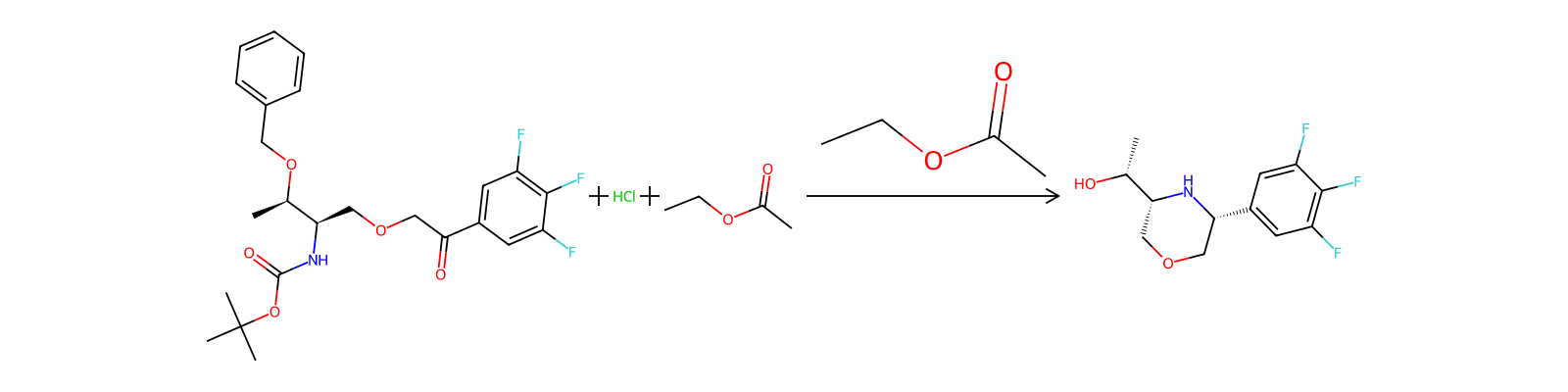
Hydrogen chloride-ethyl acetate → (R)-1-[(3R,5R)-5-(3,4,5-trifluorophenyl)morpholin-3-yl]ethanol
https://huagongshe.com/de/reaction/16372
Beteiligte Stoffe
| Rolle | Name | HCID | Einwaage |
|---|
| Edukt | Hydrogen chloride-ethyl acetate | HCID 21866389 | — |
| Edukt | {(1R,2R)-2-benzyloxy-1-[2-oxo-2-(3,4,5trifluorophenyl)ethoxymethyl]-propyl}carbamic acid t-butyl ester | HCID 68718327 | — |
| Lösungsmittel | Ethyl Acetate | HCID 8857 | — |
| Produkt | (R)-1-[(3R,5R)-5-(3,4,5-trifluorophenyl)morpholin-3-yl]ethanol | HCID 67374002 | 51,1% |
Reaktionsschritte
To a solution of {(1R,2R)-2-benzyloxy-1-[2-oxo-2-(3,4,5trifluorophenyl)ethoxymethyl]-propyl}carbamic acid t-butyl ester (13.9 g, purity: about 84.9%) in ethyl acetate (20 mL) was added a 4 N hydrochloric acid/ethyl acetate solution (63 mL), and the resultant solution was stirred at room temperature for 5 hours. Solvent was removed by distillation under reduced pressure, and to the resultant product in methanol (100 ml) was added 10% palladium-carbon (1 g, 50% water content). Under a hydrogen atmosphere, the reaction mixture was stirred for 10 hours. The catalyst was filtered off over Celite. To the resultant product was added methanol (100 ml) and 20% palladium hydroxide-carbon (1 g), and under a hydrogen atmosphere, the reaction mixture was stirred for 8 hours. The catalyst was filtered off over Celite, and solvent was removed by distillation under reduced pressure. The residue was passed through a silica pad (carrier: silica gel, 500 cc; elution solvent: 5% triethylamine/ethyl acetate, 6 L), and the filtrate was then concentrated by distillation under reduced pressure. The residue was diluted with ethyl acetate. The resultant solution was washed with brine, and then dried over anhydrous magnesium sulfate. Solvent was removed by distillation under reduced pressure, to thereby obtain the titled compound (3.97 g). The physical properties of the compound were as follows. ESI-MS; m/z 262 [M++H]. 1H-NMR (CDCl3) δ (ppm): 1.22 (d, J=6.8 Hz, 3H), 1.93 (brs, 1H), 2.88 (ddd, J=10.0, 6.8, 3.6 Hz, 1H), 3.14 (dd, J=11.2, 10.0 Hz, 1H), 3.31 (dd, J=10.4, 10.4 Hz, 1H), 3.64 (ddd, J=12.4, 6.0, 6.0 Hz, 1H), 3.76 (dd, J=11.2, 3.2 Hz, 1H), 3.83 (dd, J=11.2, 3.2 Hz, 1H), 3.91 (dd, J=10.0, 3.2 Hz, 1H), 7.05 (dd, J=8.0, 6.4 Hz, 2H).
Herkunft & Nachweise
| DOI | 10.6084/m9.figshare.5104873.v1 |
|---|
| Patentnummer | US07737141B2 |
|---|
| Quelldatensatz | uspto-grants-2010_06 |
|---|
| ORD ID | ord-7bd0a11d9b2e44faad19b5fb3ebaf637 |
|---|
| Quellennotiz | uspto-grants-2010_06 |
|---|