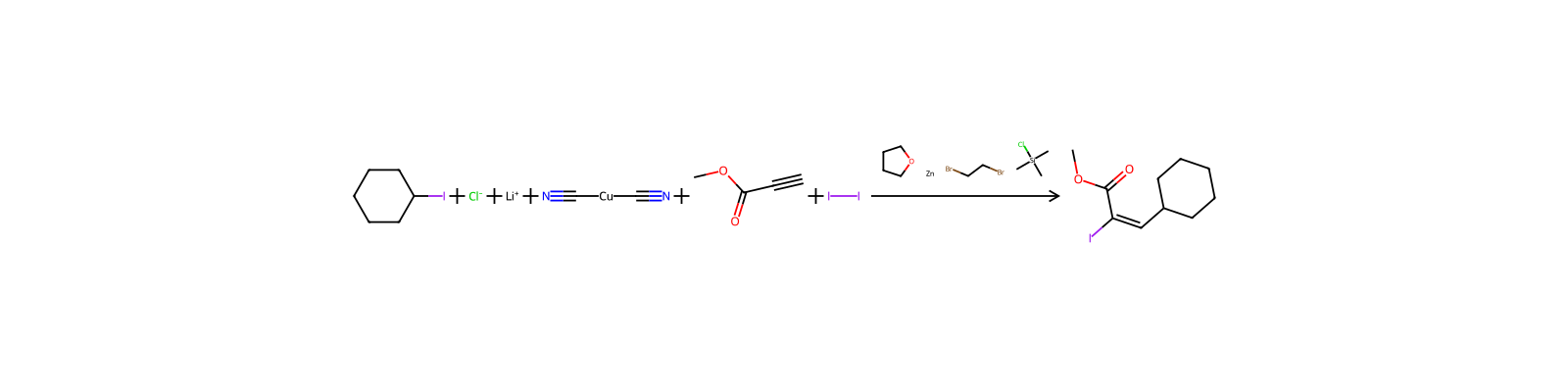
Beteiligte Stoffe
| Rolle | Name | HCID | Einwaage |
|---|
| Edukt | Iodine | HCID 807 | — |
| Edukt | Iodocyclohexane | HCID 12289 | — |
| Edukt | Methyl propiolate | HCID 13536 | — |
| Edukt | Lithium Chloride | HCID 433294 | — |
| Edukt | HCID 178418260 | HCID 178418260 | — |
| Katalysator | Chlorotrimethylsilane | HCID 6397 | — |
| Katalysator | 1,2-Dibromoethane | HCID 7839 | — |
| Katalysator | Zinc | HCID 23994 | — |
| Lösungsmittel | Tetrahydrofuran | HCID 8028 | — |
| Produkt | (E)-3-cyclohexyl-2-iodo-acrylic acid methyl ester | HCID 86583971 | 99,4% |
Reaktionsschritte
A mixture of zinc dust (16.34 g, 250 mmol, Aldrich, −325 mesh) and dry tetrahydrofuran (6 mL) under argon was treated with 1,2-dibromoethane (0.94 g, 5 mmol). The zinc suspension was then heated with a heat gun to ebullition, allowed to cool, and heated again. This process was repeated three times to make sure the zinc dust was activated. The activated zinc dust suspension was then treated with trimethylsilyl chloride (0.54 g, 5 mmol), and the suspension was stirred for 15 min at 25° C. The reaction mixture was then treated dropwise with a solution of cyclohexyl iodide (21 g, 100 mmol) in dry tetrahydrofuran (30 mL) over 15 min. During the addition, the temperature rose to 60° C., The reaction mixture was then stirred for 3 h at 40-45° C. The reaction mixture was then cooled to 25° C. and diluted with dry tetrahydrofuran (60 mL). The stirring was stopped to allow the excess zinc dust to settle down (˜3 h). In a separate reaction flask, a mixture of lithium chloride (8.48 g, 200 mmol, predried at 130° C. under high vacuum for 3 h) and copper cyanide (8.95 g, 100 mmol) in dry tetrahydrofuran (110 mL) was stirred for 10 min at 25° C. to obtain a clear solution. The reaction mixture was cooled to −70° C. and then slowly treated with the freshly prepared zinc solution using a syringe. After the addition, the reaction mixture was allowed to warm to 0° C. where it was stirred for 5 min. The reaction mixture was again cooled back to −70° C. and then slowly treated with methyl propiolate (7.56 g, 90 mmol). The resulting reaction mixture was stirred for 15 h at −70° C. to −50° C. and then slowly treated with a solution of iodine (34.26 g, 135 mmol) in dry tetrahydrofuran (30 mL), with the temperature kept at −70° C. to −60° C. After addition of the iodine solution, the cooling bath was removed, and the reaction mixture was allowed to warm to 25° C. where it was stirred for 2 h. The reaction mixture was then poured into a solution consisting of a saturated aqueous ammonium chloride solution (400 mL) and ammonium hydroxide (100 mL), and the organic compound was extracted into ethyl acetate (3×250 mL). The combined organic extracts were successively washed with a saturated aqueous sodium thiosulfate solution (1×500 mL) and a saturated aqueous sodium chloride solution (1×500 mL), dried over anhydrous magnesium sulfate, filtered, and concentrated in vacuo. Flash chromatography (Merck Silica gel 60, 230-400 mesh, 9/1 hexanes/diethyl ether) afforded (E)-3-cyclohexyl-2-iodo-acrylic acid methyl ester (26.3 g, 99%) as a light pink oil: EI-HRMS m/e calcd for C10H15IO2 (M+) 294.0117, found 294.0114.
Herkunft & Nachweise
| DOI | 10.6084/m9.figshare.5104873.v1 |
|---|
| Patentnummer | US06353111B1 |
|---|
| Quelldatensatz | uspto-grants-2002_03 |
|---|
| ORD ID | ord-da19231fd85441d586cc217c4fe722ad |
|---|
| Quellennotiz | uspto-grants-2002_03 |
|---|