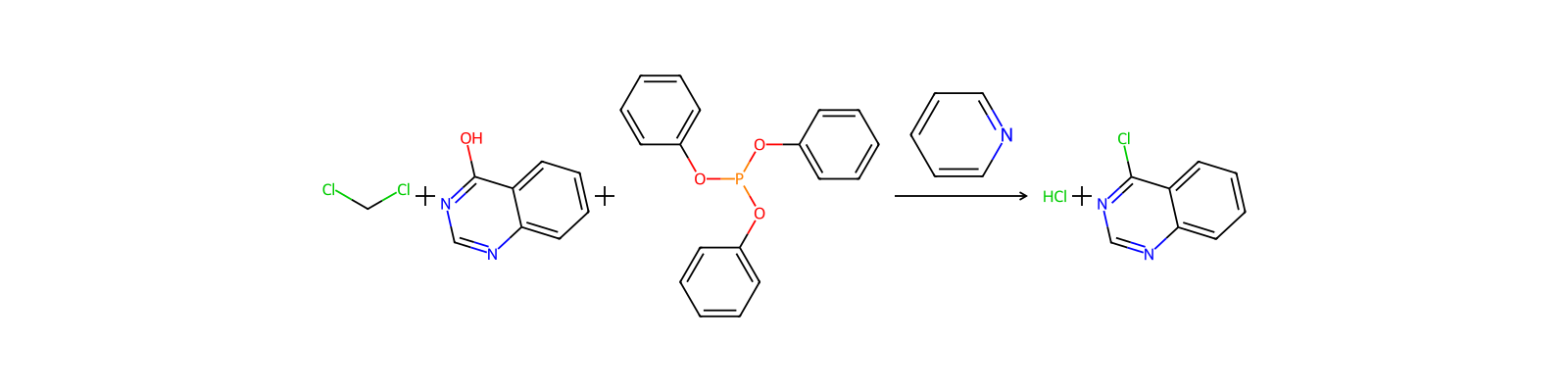
Beteiligte Stoffe
| Rolle | Name | HCID | Einwaage |
|---|
| Edukt | Dichloromethane | HCID 6344 | — |
| Edukt | Triphenyl phosphite | HCID 7540 | — |
| Edukt | HCID 178517962 | HCID 178517962 | — |
| Lösungsmittel | Pyridine | HCID 1049 | — |
| Produkt | 4-Chloroquinazoline hydrochloride | HCID 22478372 | — |
Reaktionsschritte
The compound of Example 2 was prepared on a larger scale, using a preferred process, as follows: To 54 L of methylene chloride, and 1.8 L of pyridine, 6.5 Kg of 4-hydroxyquinazoline was added, and the mixture was cooled to -5° to 10° C. To this mixture 15.7 Kg of triphenyl phosphite was added. Then 3.67 Kg of chlorine gas was bubbled in over a three hour period while the temperature of the mixture was maintained in the range of 0° to 10° C., to produce 4-chloroquinazoline hydrochloride. After stirring the mixture an additional hour, 105 mL of water was added to quench excess halogenating reagent. Then 9.7 Kg of 4-(t-butyl)benzeneethanol was added over a 15 minute period while the mixture was maintained at 10° to 20° C. The mixture was heated to reflux (40°-45° C.) and held at reflux for three hours. After vacuum distilling the contents of the reaction to minimize volume, 56 L of toluene was added. The contents of the reaction were again vacuum distilled, 56 L of heptane were added, and the mixture was cooled to 30°-35° C. The HCl salt of the desired product was isolated by filtration, and washed with toluene/heptane.
Herkunft & Nachweise
| DOI | 10.6084/m9.figshare.5104873.v1 |
|---|
| Patentnummer | US05411963 |
|---|
| Quelldatensatz | uspto-grants-1995_05 |
|---|
| ORD ID | ord-0e46520c518c4a7389a13dc2c9d98083 |
|---|
| Quellennotiz | uspto-grants-1995_05 |
|---|