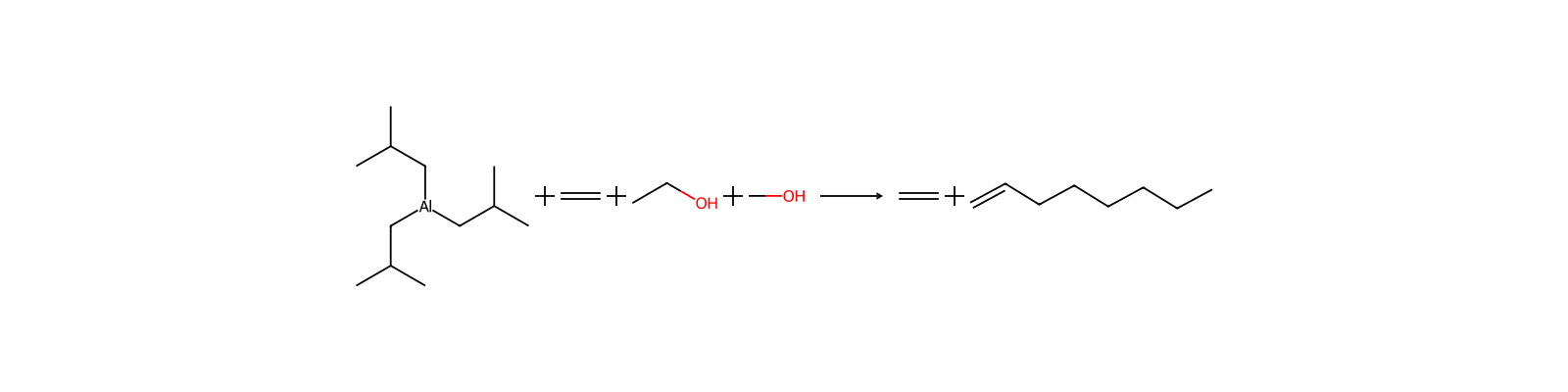
Beteiligte Stoffe
| Rolle | Name | HCID | Einwaage |
|---|
| Edukt | Ethanol | HCID 702 | — |
| Edukt | Methanol | HCID 887 | — |
| Edukt | Ethylene | HCID 6325 | — |
| Edukt | Triisobutylaluminum | HCID 16682931 | — |
| Produkt | Ethene;oct-1-ene | HCID 168495 | — |
Reaktionsschritte
To a 2 liter-stainless steel autoclave thoroughly purged with nitrogen, 600 ml of hexane and 300 ml of 1-octene were introduced, and the temperature of the system was elevated to 60° C. Then, 1 mmol of triisobutylaluminum and 0.5 ml (0.001 mmol in terms of Zr) of the catalyst solution prepared above were injected into the autoclave together with ethylene to initiate polymerization. Thereafter, only ethylene was continuously fed to maintain the total pressure at 3.0 Kg/cm2-G, and the polymerization was performed at 70° C. for 60 minutes. Then, a small amount of ethanol was fed to the system to terminate the polymerization, and the unreacted ethylene was purged out. The resulting reaction solution was introduced into a large excess of methanol to precipitate a polymer. The polymer was separated by filtration and dried overnight under reduced pressure, to obtain a long-chain branched ethylene/1-octene random copolymer.
Herkunft & Nachweise
| DOI | 10.6084/m9.figshare.5104873.v1 |
|---|
| Patentnummer | US06713562B2 |
|---|
| Quelldatensatz | uspto-grants-2004_03 |
|---|
| ORD ID | ord-b94393dbe5344009b8ce3300b994e782 |
|---|
| Quellennotiz | uspto-grants-2004_03 |
|---|