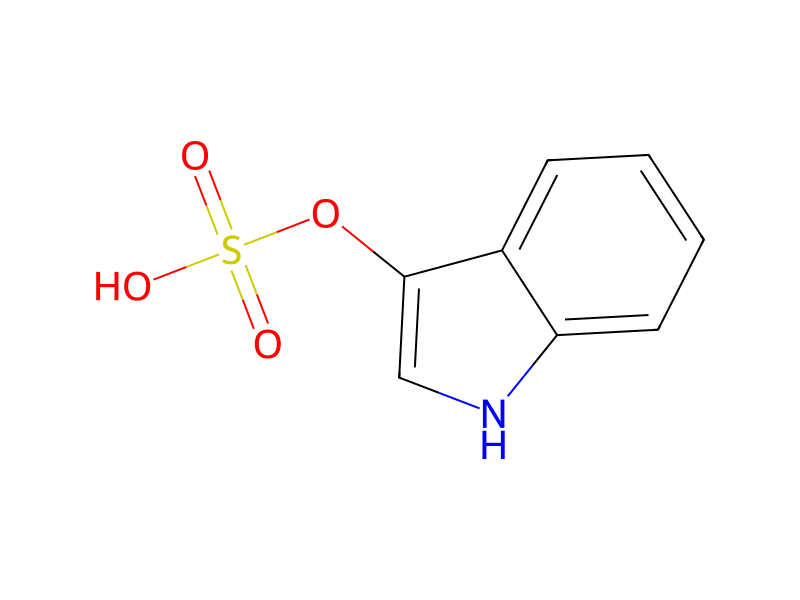
Basic information
- Standard SMILES
O=S(=O)(O)Oc1c[nH]c2ccccc12- InChIKey
BXFFHSIDQOFMLE-UHFFFAOYSA-N- Molecular formula
- C8H7NO4S
- Average molar mass
- 213.21 g/mol
- Monoisotopic mass
- 213.0095787
Overview
Indoxyl sulfate is an aryl sulfate that is indoxyl in which the hydroxyl hydrogen is substituted by a sulfo group. It has a role as a human metabolite. It is a member of indoles and an aryl sulfate. It is functionally related to an indoxyl. It is a conjugate acid of an indoxyl sulfate(1-).
Names & identifiers
- Preferred name
- Indoxyl Sulfate
- IUPAC
- 1H-indol-3-yl hydrogen sulfate
- English name
- Indican
- Molecular formula
- C8H7NO4S
- Molecular weight
- 213.21
Names & synonyms
Show more names
Database identifiers
- CAS
1336-79-4、487-94-5- PubChem CID
- 10258
- DTXSID
DTXSID701043787- ChEMBL
CHEMBL1233636- ChEBI
CHEBI:43355- UNII
- KT0QA88913
- Nikkaji
- J6.028C
Properties
Computed structural properties
- XLogP
- 1.3
- Topological polar surface area
- 87.8 Ų
- Hydrogen bond donors
- 2
- Hydrogen bond acceptors
- 4
- Rotatable bonds
- 2
- Heavy atoms
- 14
- Formal charge
- 0
- Complexity
- 297
Experimental & physicochemical properties
Collision Cross Section
140.6 Ų [M-H]- [CCS Type: DT; Method: single field calibrated with Agilent tune mix (Agilent)]
143.3 Ų [M-H]- [CCS Type: DT; Method: single field calibrated with ESI Low Concentration Tuning Mix (Agilent)]
143.4 Ų [M-H]-
Physicochemical properties
- Density
- 1.666 · 1.666±0.06 g/cm3(Predicted)
- pka
- -3.63 · -3.63±0.18(Predicted)
- FDA UNII
- 0 QA88913 · KT0QA88913
Safety & regulation
Toxicology
Toxicity Summary
Uremic toxins such as Indoxyl sulfate are actively transported into the kidneys via organic ion transporters (especially OAT3). Increased levels of uremic toxins can stimulate the production of reactive oxygen species. This seems to be mediated by the direct binding or inhibition by uremic toxins of the enzyme NADPH oxidase (especially NOX4 which is abundant in the kidneys and heart) (A7868). Reactive oxygen species can induce several different DNA methyltransferases (DNMTs) which are involved in the silencing of a protein known as KLOTHO. KLOTHO has been identified as having important roles in anti-aging, mineral metabolism, and vitamin D metabolism. A number of studies have indicated that KLOTHO mRNA and protein levels are reduced during acute or chronic kidney diseases in response to high local levels of reactive oxygen species (A7869).
Signs and Symptoms
As a uremic toxin, this compound can cause uremic syndrome. Uremic syndrome may affect any part of the body and can cause nausea, vomiting, loss of appetite, and weight loss. It can also cause changes in mental status, such as confusion, reduced awareness, agitation, psychosis, seizures, and coma. Abnormal bleeding, such as bleeding spontaneously or profusely from a very minor injury can also occur. Heart problems, such as an irregular heartbeat, inflammation in the sac that surrounds the heart (pericarditis), and increased pressure on the heart can be seen in patients with uremic syndrome. Shortness of breath from fluid buildup in the space between the lungs and the chest wall (pleural effusion) can also be present.
Chemistry & industry
Pharmacology
Uses & manufacturing
Upstream & downstream products
Upstream raw materials
Suppliers6 total
Additional notes
DefinitionChEBI: An aryl sulfate that is indoxyl in which the hydroxyl hydrogen is substituted by a sulfo group.
Related reactions
No reaction records under the current filter.
Linked notes
Loading…