
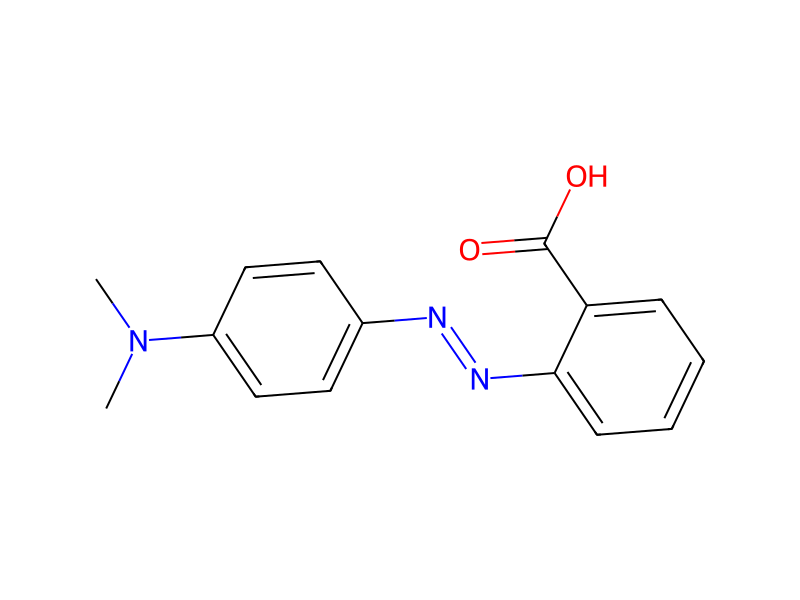
Basic information
- Standard SMILES
CN(C)c1ccc(N=Nc2ccccc2C(=O)O)cc1- InChIKey
CEQFOVLGLXCDCX-UHFFFAOYSA-N- Molecular formula
- C15H15N3O2
- Average molar mass
- 269.3 g/mol
- Monoisotopic mass
- 269.11642672
Overview
Methyl red is an azo dye consisting of benzoic acid substituted at position 2 by a 4-[(dimethylamino)phenyl]diazenyl group. It has a role as a dye. It is a member of azobenzenes, a monocarboxylic acid and a tertiary amino compound. It is a conjugate acid of a methyl red(1-).
Names & identifiers
- Preferred name
- 2-((4-(Dimethylamino)phenyl)diazenyl)benzoic acid
- IUPAC
- 2-[[4-(dimethylamino)phenyl]diazenyl]benzoic acid
- English name
- Methyl Red
- Molecular formula
- C15H15N3O2
- Molecular weight
- 269.3
Names & synonyms
2-((4-(dimethylamino)phenyl)diazenyl)benzoic acid2-[[4-(dimethylamino)phenyl]diazenyl]benzoic acid2-{[4-(dimethylamino)phenyl]diazenyl}benzoic acidDTXSID90859408RefChem:1060520DTXCID70809724Methyl red493-52-7O-METHYL REDC.I. Acid Red 2Acid Red 22-Carboxy-4'-(dimethylamino)azobenzene
Show more names
ACID REDMETHYL RED INDICATORMETHYL RED ETHANOLMETHYL RED, NEUTRALMETHYL RED MIXED SOLUTIONMETHYL RED, WATER SOLUBLEMETHYL RED, SPIRIT SOLUBLEMETHYL RED MIXED SOLUTION RMETHYL RED SOLUTION R
4-Dimethylamino-2'-carboxylazobenzenep-(Dimethylamino)azobenzene-o-carboxylic acidCerven methylova2-(4-Dimethylaminophenylazo)benzoic acidCerven kysela 2o-((p-(Dimethylamino)phenyl)azo)benzoic acidBenzoic acid, 2-[[4-(dimethylamino)phenyl]azo]-2-((4-Dimethylamino)phenylazo)benzoic acid
Database identifiers
- CAS
493-52-7- PubChem CID
- 10303
- DTXSID
DTXSID90859408- ChEMBL
CHEMBL375971- ChEBI
CHEBI:49770- UNII
- 69083AX1ZX
- Nikkaji
- J1.557A
Properties
Computed structural properties
- XLogP
- 3.3
- Topological polar surface area
- 65.3 Ų
- Hydrogen bond donors
- 1
- Hydrogen bond acceptors
- 5
- Rotatable bonds
- 4
- Heavy atoms
- 20
- Formal charge
- 0
- Complexity
- 349
Experimental & physicochemical properties
Collision Cross Section175.2 Ų [M-H]- [CCS Type: DT; Buffer gas: N2; Ionization: ESI-; Dataset: TOXCAST; Source Identifier: DTXSID1042154]
Physicochemical properties
- Melting point
- 179 · 179-182 °C (lit.)
- Boiling point
- 412.44 °C · 412.44°C (rough estimate)
- Density
- 0.839 g/mL · 0.839 g/mL at 25 °C
- bulk density
- 300 · 300-500kg/m3
- vapor density
- 9.3 · 9.3 (vs air)
- refractive index
- 1.593 · 1.5930 (estimate)
- Flash point
- 11 °C · 11 °C
- storage temp.
- 5 °C · Store at +5°C to +30°C.
- solubility
- 1 mg/mL · ethanol: soluble1mg/mL
- form
- Solid
- pka
- 4.95 · 4.95(at 25℃)
- Colour Index
- 13020 · 13020
- color
- Reddish-violet
- PH Range
- 4.4 · 4.4(red)-6.3(yellow)
- Odor
- Odorless
- Water Solubility
- Practically insoluble in water. Soluble in alcohol, acetic acidSoluble in ethanol. Insoluble in water.
- λmax
- 410 nm, · 410nm, 530nm, 427nm, 519nm
- ε(extinction coefficient)
- 10000 at · ≥10000 at 282-288nm in methanol≥20000 at 509-519nm in methanol≥7000 at 329-335nm in methanol
- Merck
- 14 · 14,6119
- BRN
- 750102 · 750102
- Stability
- Stable. Incompatible with strong oxidizing agents.
- Major Application
- Waveguides, LED sensors, photoresists, liquid crystals, sol-gel matrix, optical sensors, paints, toys, detection of thiols, food freshness sensors, dental product, saliva sampling method, detecting lactic acid, carbohydrates
- InChI
- 1S/C15H15N3O2/c1-18(2)12-9-7-11(8-10-12)16-17-14-6-4-3-5-13(14)15(19)20/h3-10H,1-2H3,(H,19,20)
- InChIKey
- CEQFOVLGLXCDCX-MSUUIHNZSA-N
- SMILES
- N(C)(C)c1ccc(cc1)N=Nc2c(cccc2)C(=O)O
- CAS DataBase Reference
- 493 · 493-52-7
- FDA UNII
- 69083 AX1ZX · 69083AX1ZX
- IARC
- 3 · 3 (Vol. 8, Sup 7) 1987
- NIST Chemistry Reference
- 2 · Benzoic acid, 2-[[4-(dimethylamino)phenyl]azo]-(493-52-7)
- EPA Substance Registry System
- Methyl red (493-52-7)
- UNSPSC Code
- 41171621 · 41171621
- NACRES
- 85 · NA.85
- Symbol(GHS)
- 2 · GHS02,GHS07,GHS08
- Signal word
- Danger
- Hazard statements
- 225 · H225-H319-H371
- Precautionary statements
- 210 · P210-P260-P280-P308+P311-P337+P313-P403+P235
- Hazard Codes
- Xn,T,F,Xi,C,N
- Risk Statements
- 10 · 10-20/21/22-68/20/21/22-68-36/38-23/25-11-36/37/38-34-51/53-39/23/24/25-23/24/25
- Safety Statements
- 36 · 36/37-24/25-22-45-33-24-16-7-36-26-36/37/39-61
- RIDADR
- 1170 · UN 1170 3/PG 2
- WGK Germany
- 1 · 1
- RTECS
- 8960000 · DG8960000
- TSCA
- TSCA listed
- HazardClass
- 3 · 3
- PackingGroup
- II
- HS Code
- 29270000 · 29270000
- Storage Class
- 11 · 11 - Combustible Solids
- Hazardous Substances Data
- 493 · 493-52-7(Hazardous Substances Data)
Safety & regulation
Safety data
- wgk
- 1
- tsca
- TSCA listed
- rtecs
- DG8960000
- ridadr
- UN 1170 3/PG 2
- hs_code
- 29270000
- risk_code
- 10-20/21/22-68/20/21/22-68-36/38-23/25-11-36/37/38-34-51/53-39/23/24/25-23/24/25
- Signal word
- Danger
- Symbol(GHS)
- GHS02,GHS07,GHS08
- hazard_code
- Xn,T,F,Xi,C,N
- safety_code
- 36/37-24/25-22-45-33-24-16-7-36-26-36/37/39-61
- hazard_class
- 3
- Storage Class
- 11 - Combustible Solids
- packing_group
- II
- Hazard statements
- H225-H319-H371
- Precautionary statements
- P210-P260-P280-P308+P311-P337+P313-P403+P235
- Hazardous Substances Data
- 493-52-7(Hazardous Substances Data)
Chemistry & industry
Applications
DescriptionMethyl red is a commonly used indicator for acid-base titrations. This chemical is usually yellow but turns red below pH 4.0. Bacteria exhibiting mixed acids fermentation will accumulate acids in the medium, resulting in a color change. Approximately five drops of methyl red reagent are added to an overnight culture grown in MRVP broth to determine the test result. Different bacteria convert dextrose and glucose to pyruvate using different metabolic pathways. Some of these pathways produce unstable acidic products which quickly convert to neutral compounds. Some organisms use the butylene glycol pathway, which produces neutral end products, including acetoin and 2,3-butanediol. Other organisms use the mixed acid pathway, which produces acidic end products such as lactic, acetic, and formic acid. These acidic end products are stable and will remain acidic. The Methyl Red test involves adding the pH indicator methyl red to an inoculated tube of MR-VP broth. If the organism uses the mixed acid fermentation pathway and produces stable acidic end-products, the acids will overcome the buffers in the medium and produce an acidic environment in the medium. When methyl red is added, if acidic end products are present, the methyl red will stay red.
UsesUsed as pH indicator.
UsespH indicator in pH range 4.2 - 6.3Methyl red is used as a pH indicator. It is red in pH less than 4.4 and yellow in pH over 6.2. It is used to study its degradation using Fenton's reagent. In microbiology, it is used to identify bacteria producing stable acids by mechanisms of mixed acid fermentation of glucose.
UsesAs indicator in 0.1% alcoholic solution; pH: 4.4 red, 6.2 yellow. Used for titrating NH3, weak organic bases, e.g., alkaloids; not suitable for organic acids, except oxalic and picric acid. Methyl red is easily reduced, thereby losing its color, and readings should be made promptly. It is gradually being replaced by sulfonphthalein indicators, such as bromcresol green, which are more stable and exhibit a sharper change in color.
General DescriptionMethyl red solution is an azo dye which turns to red when pH is below 4.4 (yellow pH < 6.2, orange pH 4.4-6.2). Some bacteria utilize glucose to form large amounts of acid with the result that the pH value of the medium falls distinct. Other species produce no or less free acid. This difference can be visualized by using methyl red. This test is used to differentiate enteric bacteria.
Preparation methods
Preparation2-Aminobenzoic aciddiazo, and N,N-dimethylaniline coupling.
Upstream & downstream products
Upstream raw materials
Downstream products
Suppliers50 total
国药集团化学试剂有限公司86-21-63210123 · [email protected]
北京华美互利生物化工010-56205725 · [email protected]
梯希爱(上海)化成工业发展有限公司021-67121386 · [email protected]
衢州润东化工有限公司0570-8789886 18892685668 · [email protected]
上海阿拉丁生化科技股份有限公司400-6206333 13167063860 · [email protected]
河北创海生物科技有限公司+86-86-13131129325 · [email protected]
武汉科美沃化工有限公司+86-2785736489 +8618171418573 · [email protected]
上海如吉生物科技发展有限公司+86-21-65211385-8001 36031160 · [email protected]
Dayang Chem (Hangzhou) Co.,Ltd.+86-0571-88938639 17705817739 · [email protected]
Hebei Yanxi Chemical Co., Ltd.+86-17531190177 · [email protected]
上海迈瑞尔生化科技有限公司4006356688 18621169109 · [email protected]
大连美仑生物技术有限公司0411-62910999 13889544652 · [email protected]
阿法埃莎(中国)化学有限公司400-6106006 · [email protected]
北京绿百草科技发展有限公司010-61136123 · [email protected]
上海瀚鸿科技股份有限公司021-54306202 13764082696 · [email protected]
山东洛克化工有限公司17653113209 13065062079 · [email protected]
上海钰康生物科技有限公司+86-18930848214 +86-021-56762820 · [email protected]
上海景颜化工科技有限公司13817811078 · [email protected]
武汉丰泰威远科技有限公司027-87465837 19945049750 · [email protected]
山东西亚化学有限公司13355009207 13355009207 · [email protected]
唐山默内德贸易有限公司0315-8309571 15633399667 · [email protected]
玛雅试剂+86 (573) 82222445 (0)18006601000 452520369 · [email protected]
四川库利南科技有限公司400-1166-196 18981987031 · [email protected]
天津希恩思生化科技有限公司400 638 7771 · [email protected]
湖南汇百侍生物科技有限公司0731-85526065 13308475853 · [email protected]
Hebei Qige Biological Technology Co. Ltd+86 +8618733132031
斯百全化学(上海)有限公司021-021-021-67601398-809-809-809 15221380277 · [email protected]
上海源叶生物科技有限公司13636370518 · [email protected]
艾科试剂4008-755-333 18080918076 · [email protected]
上海思域化工科技有限公司86-21-34053660 · [email protected]
赛默飞世尔科技(中国)有限公司800-810-5118 · [email protected]
北京伊诺凯科技有限公司400-810-7969 010-59572699 · [email protected]
上海遐瑞医药科技有限公司+86 21 61551611
TCI AMERICA800-4238616 · [email protected]
TOKYO CHEMICAL INDUSTRY CO., LTD.03-36680489 · [email protected]
TCI Europe320-37350700 · [email protected]
南京杜莱生物技术有限公司025-84699383-8003;025-846993838003-8003 18013301590 · [email protected]
上海倍卓生物科技有限公司021-61119791,13386096464 · [email protected]
北京环宇世纪化学科技有限公司hysj_bj.com
上海将来实业股份有限公司400-0066400 13621662912 · [email protected]
上海将来实业股份有限公司021-61552785 · [email protected]
成都零六生物科技有限公司400-1166-196 13458535857 · [email protected]
雷丁试剂0510-85629785 18013409632 · [email protected]
上海麦克林生化科技股份有限公司15221275939 15221275939 · [email protected]
杭州杰恒化工有限公司0571-87396432 · [email protected]
上海孚一生物科技有限公司+86 (21) 61124340
成都润泽本土化工有限公司13096311329 028-88469284 616445927 · [email protected]
Sigma-Aldrich西格玛奥德里奇(上海)贸易有限公司021-61415566 800-8193336 · [email protected]
北京诺其雅盛生物科技有限公司4000-819-385 010-62329685 13718666987
九鼎化学(上海)科技有限公司4009209199 · [email protected]
Additional notes
DefinitionChEBI: An azo dye consisting of benzoic acid substituted at position 2 by a 4-[(dimethylamino)phenyl]diazenyl group.
DefinitionAn acid–base indicator that is red in solutions below a pH of 4.2 and yellow above a pH of 6.3. It is often used for the same types of titration as methyl orange but the transition range of methyl red is nearer neutral (pH7) than that of methyl orange. The two molecules are structurally similar.
Definitionmethyl red: An organic dye similarin structure and use to methyl orange.It changes from red below pH4.4 to yellow above pH 6.0 (at 25°C).
Related reactions
1 records
Linked notes
Loading…