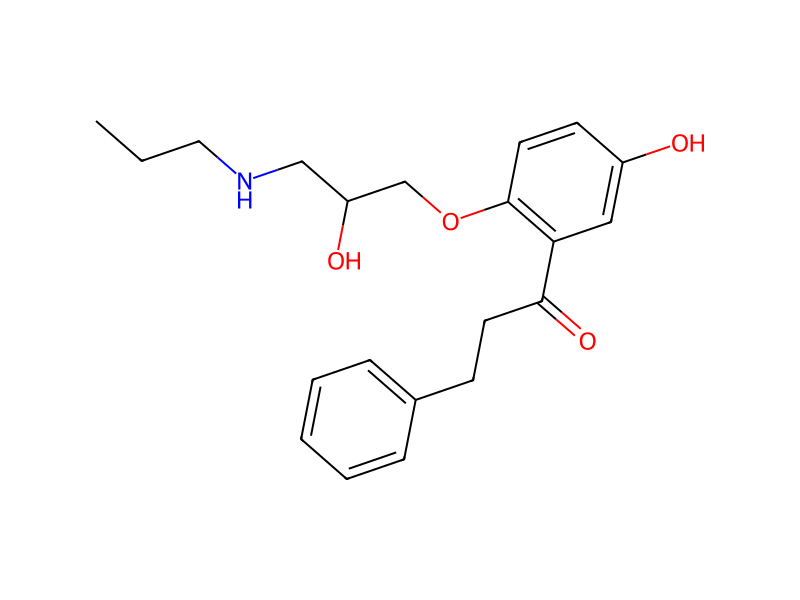
Basic information
- Standard SMILES
CCCNCC(O)COc1ccc(O)cc1C(=O)CCc1ccccc1- InChIKey
LUTWDNUXHDYZRA-UHFFFAOYSA-N- Molecular formula
- C21H27NO4
- Average molar mass
- 357.4 g/mol
- Monoisotopic mass
- 357.19400834
Overview
5-hydroxypropafenone is a member of phenols.
Names & identifiers
- Preferred name
- 5-Hydroxypropafenone
- IUPAC
- 1-[5-hydroxy-2-[2-hydroxy-3-(propylamino)propoxy]phenyl]-3-phenylpropan-1-one
- English name
- 5-Hydroxy propafenone hydrochloride
- Molecular formula
- C21H27NO4
- Molecular weight
- 357.44
Names & synonyms
Show more names
Database identifiers
- CAS
86384-10-3- PubChem CID
- 107927
- DTXSID
DTXSID701006775- ChEMBL
CHEMBL1264- ChEBI
CHEBI:171897- UNII
- 7AC8BF38NP
- Nikkaji
- J258.552I
Properties
Computed structural properties
- XLogP
- 3
- Topological polar surface area
- 78.8 Ų
- Hydrogen bond donors
- 3
- Hydrogen bond acceptors
- 5
- Rotatable bonds
- 11
- Heavy atoms
- 26
- Formal charge
- 0
- Complexity
- 397
Experimental & physicochemical properties
Physicochemical properties
- Melting point
- 210 · 210-216°C
- Boiling point
- 564.4 · 564.4±50.0 °C(Predicted)
- Density
- 1.153 · 1.153±0.06 g/cm3(Predicted)
- storage temp.
- -20 °C · -20°C Freezer
- solubility
- DMSO (Slightly), Methanol (Slightly)
- form
- Solid
- pka
- 9.48 · 9.48±0.20(Predicted)
- color
- White to Light Yellow
- FDA UNII
- 7 AC8BF38NP · 7AC8BF38NP
Chemistry & industry
Pharmacology
MeSH Pharmacological Classification
Drugs that bind to but do not activate beta-adrenergic receptors thereby blocking the actions of beta-adrenergic agonists. Adrenergic beta-antagonists are used for treatment of hypertension, cardiac arrhythmias, angina pectoris, glaucoma, migraine headaches, and anxiety.
Agents used for the treatment or prevention of cardiac arrhythmias. They may affect the polarization-repolarization phase of the action potential, its excitability or refractoriness, or impulse conduction or membrane responsiveness within cardiac fibers. Anti-arrhythmia agents are often classed into four main groups according to their mechanism of action: sodium channel blockade, beta-adrenergic blockade, repolarization prolongation, or calcium channel blockade.
Applications
UsesA metabolite of Propafenone (P757500).
Suppliers13 total
Additional notes
DefinitionChEBI: 5-hydroxypropafenone is a member of phenols.
Related reactions
No reaction records under the current filter.
Linked notes
Loading…