HuagongsheHuagongshe Chemistry Print Report · For research reference only
Cesium carbonate
Caesiumbicarbonate · Hydrogen cesium carbonate · CESIUM HYDROGEN CARBONATE · carbonic acid, cesium salt · Carbonic acid/cesium,(1:x) salt · CESIUM HYDROGEN CARBONATE, 99.9% · CUP Cesium Hydroden Carbonate · Cesium hydrogen carbonate, 98% (metals basis)
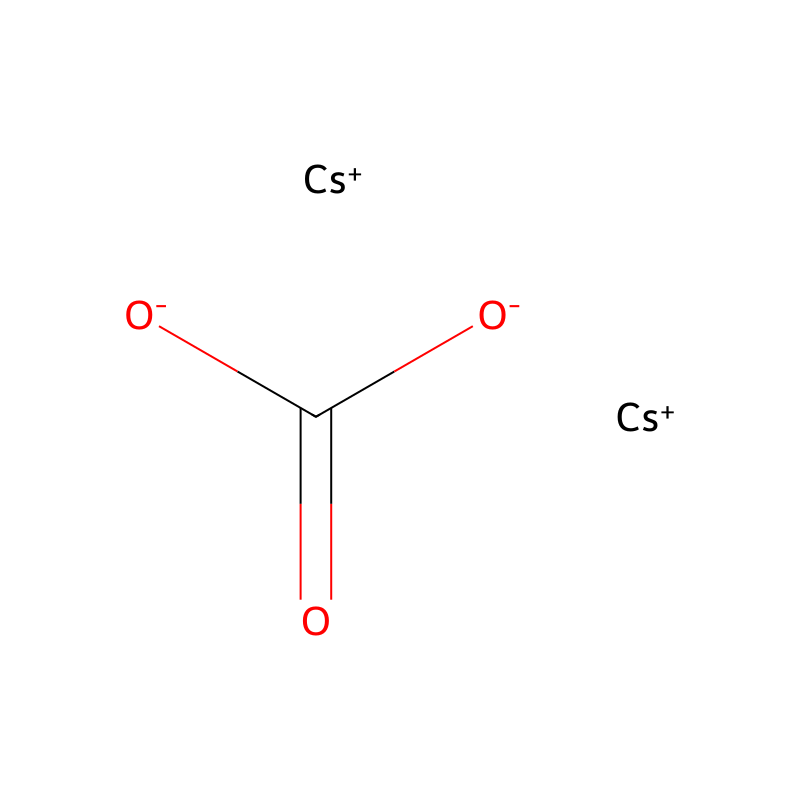
Identifiers & Physical Properties
| CAS No. | 29703-01-3 |
|---|---|
| Molecular formula | CCs2O3 |
| Average molar mass | 325.82 g/mol |
| Monoisotopic mass | 325.7956478 g/mol |
| SMILES | O=C([O-])[O-].[Cs+].[Cs+] |
| InChIKey | FJDQFPXHSGXQBY-UHFFFAOYSA-L |
| PubChem CID | 10796 |
| EC No. | 208-591-9 |
| DTXSID | DTXSID0052178 |
Chemical & Physical Properties
| Topological polar surface area | 63.2 |
|---|---|
| Hydrogen bond donors | 0 |
| Hydrogen bond acceptors | 3 |
| Rotatable bonds | 0 |
| Heavy atoms | 6 |
| Formal charge | 0 |
| Complexity | 18 |
| Density | 4.24 @25 °C |
| Melting point | 793 °C175°C |
| Physical Description | Dry PowderLiquidHighly deliquescent solid[Merck Index] White odorless powder or granulesHygroscopic[Alfa Aesar MSDS] |
| Physical state | Crystalline Aggregates |
| Solubility | Soluble in water. |
| Sensitivity | Hygroscopic |
| InChI | InChI=1S/CH2O3.Cs/c2-1(3)4/h(H2,2,3,4)/q+1/p-1 |
| InChIKey | ZMCUDHNSHCRDBT-UHFFFAOYSA-M |
| SMILES | C([O-])(=O)O.[Cs+] |
| CAS DataBase Reference | 29703-01-3(CAS DataBase Reference) |
| UNSPSC Code | 12352302 |
| NACRES | NA.22 |
| GHS pictogram | GHS08,GHS05 |
| Signal word | Danger |
| GHS hazard statements | H318-H361f-H373 |
| GHS precautionary statements | P202-P260-P280-P305+P351+P338-P308+P313-P405 |
| Target organs | Kidney,Adrenal gland,Testes |
| Personal protective equipment (PPE) | Eyeshields, Gloves, type N95 (US) |
| Safety statements (S) | 24/25 |
| Water hazard class (WGK) | 3 |
| Storage class | 11 - Combustible Solids |
| Hazard class | Eye Dam. 1Repr. 2STOT RE 2 Oral |
Safety & Regulations
| GHS classification | This chemical does not meet GHS hazard criteria for 1% (2 of 200) of reports.DangerH315 (41.5%): Causes skin irritation [Warning Skin corrosion/irritation]H318 (59%): Causes serious eye damage [Danger Serious eye damage/eye irritation]H319 (40%): Causes serious eye irritation [Warning Serious eye damage/eye irritation]H335 (41%): May cause respiratory irritation [Warning Specific target organ toxicity, single exposureRespiratory tract irritation]H361f (54.5%): Suspected of damaging fertility [Warning Reproductive toxicity]H373 (58.5%): May causes damage to organs through prolonged or repeated exposure [Warning Specific target organ toxicity, repeated exposure]P203, P260, P261, P264, P264+P265, P271, P280, P302+P352, P304+P340, P305+P351+P338, P305+P354+P338, P317, P318, P319, P321, P332+P317, P337+P317, P362+P364, P403+P233, P405, and P501 (click each P-code to see the statement)Aggregated GHS information provided per 200 reports by companies from 22 notifications to the ECHA C&L Inventory. Each notification may be associated with multiple companies.Reported as not meeting GHS hazard criteria per 2 of 200 reports by companies.There are 21 notifications provided by 198 of 200 reports by companies with hazard statement code(s).Information may vary between notifications depending on impurities, additives, and other factors. The percentage value in parenthesis indicates the notified classification ratio from companies that provide hazard codes. Only hazard codes with percentage values above 10% are shown. For more detailed information, please visit ECHA C&L website. |
|---|---|
| Regulatory information | Chemical: Carbonic acid, dicesium saltCarbonic acid, cesium salt (1:2) is listed on the EPA's Chemical Data Reporting (CDR) system. Manufacturers and importers of Carbonic acid, cesium salt (1:2) are required to report information about their production and use of this chemical to the EPA under the Toxic Substances Control Act (TSCA). (40 eCFR Part 711)Status: Active Update: 27-01-2023 https://echa.europa.eu/registration-dossier/-/registered-dossier/11170Carbonic acid, dicaesium salt: Does not have an individual approval but may be used under an appropriate group standard |
| Other safety information | Evaluation - Cesium salts |
| Hazards summary | Causes convulsions, elevated blood pressure, and proteinuria in intraperitoneal and subcutaneous lethal-dose studies of mice and rats[RTECS] A skin and strong eye irritant[Alfa Aesar MSDS] See Cesium. |
| Hazard Classes and Categories | Skin Irrit. 2 (41.5%)Eye Dam. 1 (59%)Eye Irrit. 2 (40%)STOT SE 3 (41%)Repr. 2 (54.5%)STOT RE 2 (58.5%)Eye Dam. 1 (100%)Repr. 2 (100%)STOT RE 2 (100%) |
| Protective Action Criteria (PAC) | 7.0 [mg/m3]77 [mg/m3]460 [mg/m3] |
| Personal protective equipment (PPE) | Eyeshields, Gloves, type N95 (US) |
| Water hazard class (WGK) | 3 |
| Signal word | Danger |
| GHS pictogram | GHS08,GHS05 |
| Safety statements (S) | 24/25 |
| Storage class | 11 - Combustible Solids |
| Target organs | Kidney,Adrenal gland,Testes |
| GHS hazard statements | H318-H361f-H373 |
| Hazard class | Eye Dam. 1Repr. 2STOT RE 2 Oral |
| GHS precautionary statements | P202-P260-P280-P305+P351+P338-P308+P313-P405 |
Applications & Uses
Uses
Cesium hydrogen carbonate is used as pharmaceutical intermediate.