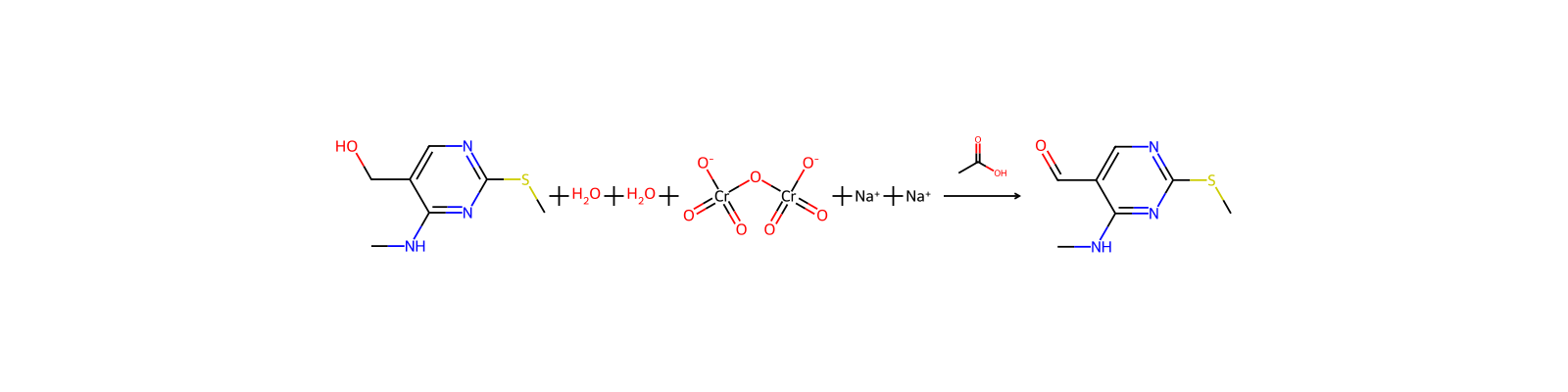
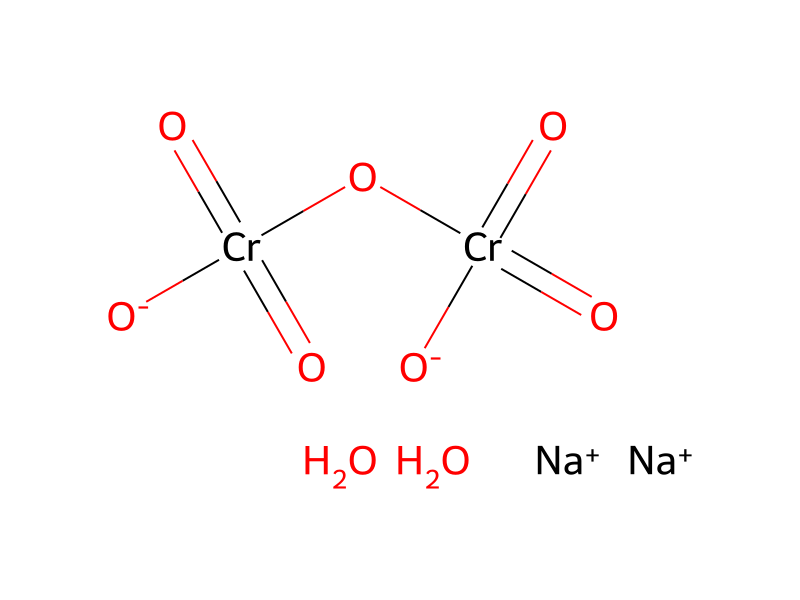
Basic information
- Standard SMILES
O.O.[Na+].[Na+].[O]=[Cr](=[O])([O-])[O][Cr](=[O])(=[O])[O-]- InChIKey
JYDRNIYTFCBIFC-UHFFFAOYSA-N- Molecular formula
- Cr2H4Na2O9
- Average molar mass
- 298 g/mol
- Monoisotopic mass
- 297.84608527
Names & identifiers
- Preferred name
- Sodium dichromate dihydrate
- IUPAC
- disodium;oxido-(oxido(dioxo)chromio)oxy-dioxochromium;dihydrate
- English name
- Sodium dichromate dihydrate
- Molecular formula
- Cr2H5NaO8
- Molecular weight
- 260.01
Names & synonyms
Sodium dichromate dihydrate7789-12-0Disodium dichromate dihydrateDTXSID603206152125XYY2AChromic acid (H2Cr2O7), disodium salt, dihydrateDICHROMIC ACID (H2Cr2O7), DISODIUM SALT, DIHYDRATEDTXCID4012061RefChem:1098784CCRIS 6344UNII-52125XYY2ANCGC00091922-02
Show more names
SODIUM DICHROMATESODIUM BICHROMATESODIUM DICHROMATE GRSodium dichromate diSodium Dichromate ARSODIUM DICHROMATE 2H2OSODIUM DICHROMATE, ACSSodiumbichromateanhydrousSODIUM DICHROMATE, HYDROUSSODIUM DICHROMATE 2HYD XTL
disodium;oxido-(oxido(dioxo)chromio)oxy-dioxochromium;dihydrateEC 234-190-3Sodium dichromate dihydrate (VI)CAS-7789-12-0sodium dichromate-dihydrateSCHEMBL867453sodium dichromate (VI) dihydrateTox21_111178
Database identifiers
- CAS
7789-12-0- PubChem CID
- 108005
- DTXSID
DTXSID6032061- UNII
- 52125XYY2A
- EC Number
- 616-541-6
Properties
Computed structural properties
- Topological polar surface area
- 126 Ų
- Hydrogen bond donors
- 2
- Hydrogen bond acceptors
- 9
- Rotatable bonds
- 0
- Heavy atoms
- 13
- Formal charge
- 0
- Complexity
- 194
Experimental & physicochemical properties
Chemical ClassesMetals -> Chromium Compounds, Inorganic
Density2.35 @ 13°C
Physical DescriptionReddish to bright orange solid; Somewhat deliquescent and soluble in water; [Merck Index] Orange-red odorless crystals; Hygroscopic and soluble in water; [Alfa Aesar MSDS]
Physicochemical properties
- Melting point
- 91 °C · 91 °C(lit.)
- Boiling point
- 400 °C · 400°C
- Density
- 2 · 2,348 g/cm3
- bulk density
- 1200 kg/m3 · 1200kg/m3
- vapor density
- 10 · 10 (vs air)
- storage temp.
- 5 °C · Store at +5°C to +30°C.
- solubility
- Methanol (Slightly, Sonicated)
- form
- Solid
- Specific Gravity
- 2.348 · 2.348
- color
- Red-orange
- Odor
- Odorless
- PH Range
- 3.5 · 3.5-4.0
- PH
- 3.5 · 3.5 (20°C, 100g/L)
- Water Solubility
- 730 g/L · 730 g/L (20 ºC)
- Sensitive
- Hygroscopic
- Merck
- 14 · 14,8609
- Dielectric constant
- 2.9 · 2.9(Ambient)
- InChI
- 1S/2Cr.2Na.2H2O.7O/h;;;;2*1H2;;;;;;;/q;;2*+1;;;;;;;;2*-1
- InChIKey
- JYDRNIYTFCBIFC-UHFFFAOYSA-N
- SMILES
- O.O.[Na+].[Na+].[O-][Cr](=O)(=O)O[Cr]([O-])(=O)=O
- Toxicology and Carcinogenesis
- Toxicology and Carcinogenesis Studies of Sodium Dichromate Dihydrate (CASRN 7789-12-0) in F344/N Rats and B6C3F1 Mice (Drinking Water Studies)
- Substances of Very High Concern (SVHC) Candidate List
- Sodium dichromate (7789-12-0)
- CAS DataBase Reference
- 7789 · 7789-12-0(CAS DataBase Reference)
- FDA UNII
- 52125 XYY2A · 52125XYY2A
- EPA Substance Registry System
- Disodium dichromate dihydrate (7789-12-0)
- UNSPSC Code
- 12352302 · 12352302
- NACRES
- 21 · NA.21
- Symbol(GHS)
- 3 · GHS03,GHS05,GHS06,GHS08,GHS09
- Signal word
- Danger
- Hazard statements
- 272 · H272-H301-H312-H314-H317-H330-H334-H340-H350-H360FD-H372-H410
- Precautionary statements
- 210 · P210-P260-P280-P303+P361+P353-P304+P340+P310-P305+P351+P338
- Hazard Codes
- O,T+,N
- Risk Statements
- 45 · 45-46-60-61-8-21-25-26-34-42/43-48/23-50/53
- Safety Statements
- 53 · 53-45-60-61
- RIDADR
- 3086 · UN 3086 6.1/PG 1
- WGK Germany
- 3 · 3
- RTECS
- 7750000 · HX7750000
- TSCA
- Yes
- HazardClass
- 5.1 · 5.1
- PackingGroup
- III
- HS Code
- 28413000 · 28413000
- Storage Class
- 5.1 B · 5.1B - Oxidizing hazardous materials
- Hazard Classifications
- 2 InhalationAcute · Acute Tox. 2 InhalationAcute Tox. 3 OralAcute Tox. 4 DermalAquatic Acute 1Aquatic Chronic 1Carc. 1BEye Dam. 1Muta. 1BOx. Sol. 2Repr. 1BResp. Sens. 1Skin Corr. 1BSkin Sens. 1STOT RE 1 Inhalation
- Limited Quantities
- 1 kg · 1.0 kg (2.2 lbs) (solid)
- Excepted Quantities
- Max Inner Pack (30g or 30ml) and Max Outer Pack (500g or 500ml)
Safety & regulation
GHS classification
GHS Classification
Danger
H317 (100%): May cause an allergic skin reaction [Warning Sensitization, Skin]
P203, P261, P272, P273, P280, P302+P352, P318, P321, P333+P317, P362+P364, P391, P405, and P501 (click each P-code to see the statement)
Aggregated GHS information provided per 2101 reports by companies from 9 notifications to the ECHA C&L Inventory. Each notification may be associated with multiple companies.
Danger
H301: Toxic if swallowed [Danger Acute toxicity, oral]
Hazard information
Regulatory Information
Chemical: Chromic acid (H2Cr2O7), disodium salt, dihydrate
Chromic acid, disodium salt, dihydrate: HSNO Approval: HSR001440 Approved with controls
Other Safety InformationIMAP assessments - Chromates and dichromates (soluble): Human health tier II assessment
Hazards Summary
An oxidizer that may cause fire on contact with combustible materials; Causes burns; May cause skin and respiratory sensitization; Toxic by ingestion; Highly toxic by inhalation; Harmful by skin absorption; [Alfa Aesar MSDS] See Sodium dichromate. See Chromium and linked occupational diseases.
Hazard Classes and Categories
Skin Sens. 1 (100%)
Carcinogenicity - category 1A
Acute toxicity (Oral) - Category 3
Safety & protection
Threshold Limit Values (TLV)
0.0001 [mg/m3], as Cr(VI), inhalable particulate matter
0.0005 [mg/m3], as Cr(VI), inhalable particulate matter
Permissible Exposure Limit (PEL)0.005 [mg/m3], as Cr(VI)
Protective Action Criteria (PAC)
0.017 [mg/m3]
0.62 [mg/m3]
3.7 [mg/m3]
Toxicology
Adverse EffectsNephrotoxin - The chemical is potentially toxic to the kidneys in the occupational setting.
Carcinogen Classification
Sodium Dichromate Dihydrate
TR-546: Toxicology and Carcinogenesis Studies of Sodium Dichromate Dihydrate (CASRN 7789-12-0) in F344/N Rats and B6C3F1 Mice (Drinking Water Studies) (2008 )
05/16/07
Clear Evidence
Clear Evidence
Clear Evidence
Safety data
- wgk
- 3
- tsca
- Yes
- rtecs
- HX7750000
- ridadr
- UN 3086 6.1/PG 1
- hs_code
- 28413000
- risk_code
- 45-46-60-61-8-21-25-26-34-42/43-48/23-50/53
- Signal word
- Danger
- Symbol(GHS)
- GHS03,GHS05,GHS06,GHS08,GHS09
- hazard_code
- O,T+,N
- safety_code
- 53-45-60-61
- hazard_class
- 5.1
- Storage Class
- 5.1B - Oxidizing hazardous materials
- packing_group
- III
- Hazard statements
- H272-H301-H312-H314-H317-H330-H334-H340-H350-H360FD-H372-H410
- Limited Quantities
- 1.0 kg (2.2 lbs) (solid)
- Excepted Quantities
- Max Inner Pack (30g or 30ml) and Max Outer Pack (500g or 500ml)
- Hazard Classifications
- Acute Tox. 2 InhalationAcute Tox. 3 OralAcute Tox. 4 DermalAquatic Acute 1Aquatic Chronic 1Carc. 1BEye Dam. 1Muta. 1BOx. Sol. 2Repr. 1BResp. Sens. 1Skin Corr. 1BSkin Sens. 1STOT RE 1 Inhalation
- Precautionary statements
- P210-P260-P280-P303+P361+P353-P304+P340+P310-P305+P351+P338
Chemistry & industry
Uses & manufacturing
Uses
Used as an oxidizing agent (to make dyes, inks, and other chemicals), bleaching agent (fats, oils, sponges, and resins), tanning agent, and mordant in dyeing; Also used in electric batteries, for refining petroleum, electro-engraving copper, in corrosion inhibitors and corrosion inhibiting paints, metal treatments, hardening gelatin, defoliation of cotton and other plants and shrubs, and as a topical anti-infective; [Merck Index] Used for metal finishing (chrome plating, electroplating, passivating, anodizing, and brightening), to make vitamin K, colored glass, ceramic glazes, essential oils, and perfumes; [ExPub: ECHA - Annex XV Dossier] Found as a contaminant in drinking water from industrial uses including electroplating, leather tanning, and textile manufacturing; [NTP]
Electroplating [Category: Plate]
Applications
UsesSodium Dichromate Dihydrate is used as a catalyst in the synthesis of Endoperoxide II. Strong oxidizing agent in organic synthesis. Used in metal finishing as an aid in corrosion resistance.
UsesIt is used in preparation of titrant in redox titrations.
General DescriptionSolid orange-yellow crystal or powder.
Upstream & downstream products
Upstream raw materials
Downstream products
Additional notes
DefinitionA red crystallinesolid, Na2Cr2O7.2H2O, solublein water and insoluble in ethanol. Itis usually known as the dihydrate(r.d. 2.52), which starts to lose waterabove 100°C; the compound decomposesabove 400°C. It is made bymelting chrome iron ore with limeand soda ash and acidification of thechromate thus formed. Sodiumdichromate is cheaper than the correspondingpotassium compound buthas the disadvantage of being hygroscopic.It is used as a mordant in dyeing,as an oxidizing agent in organicchemistry, and in analytical chemistry.
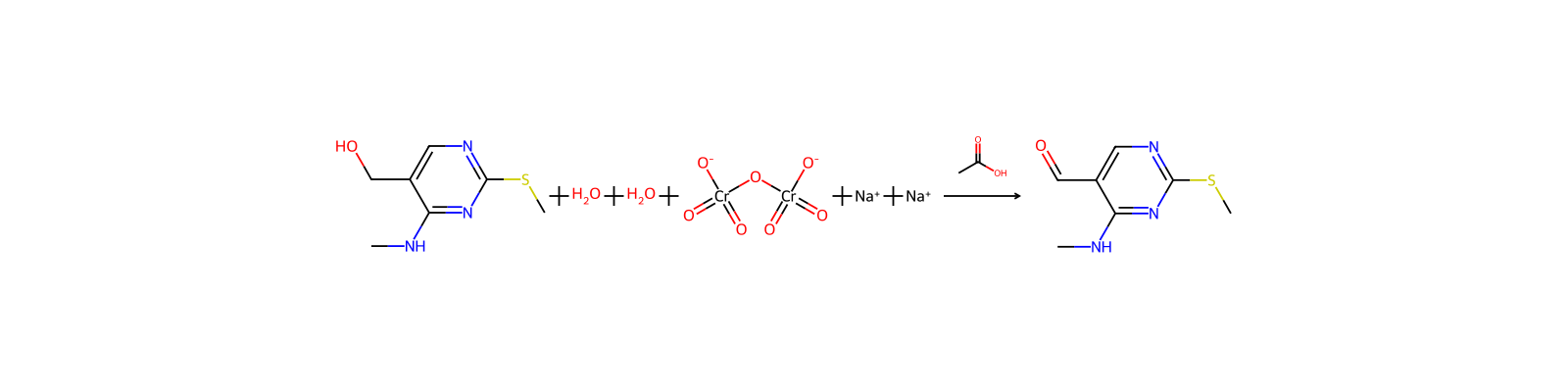
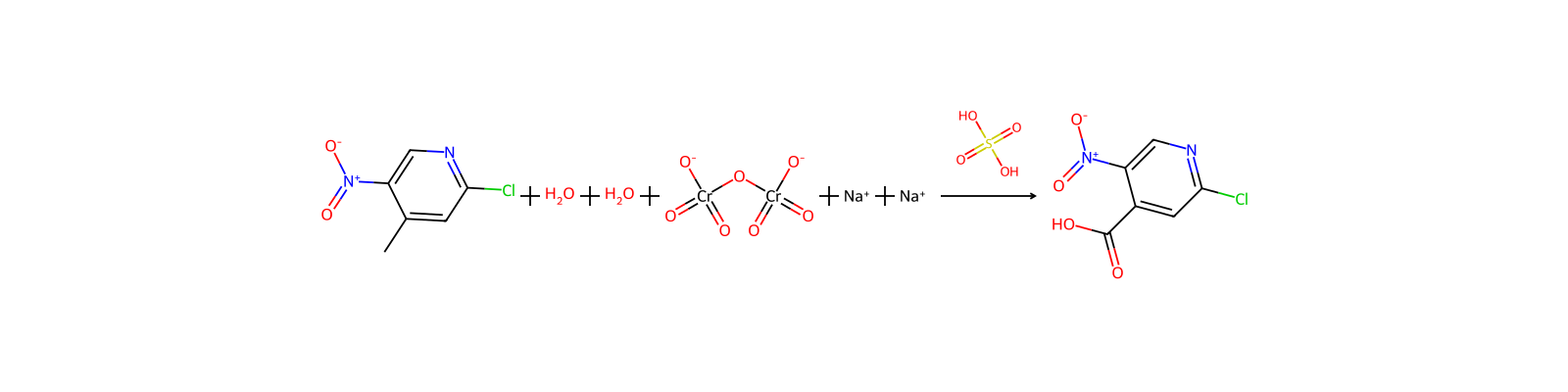
Related reactions
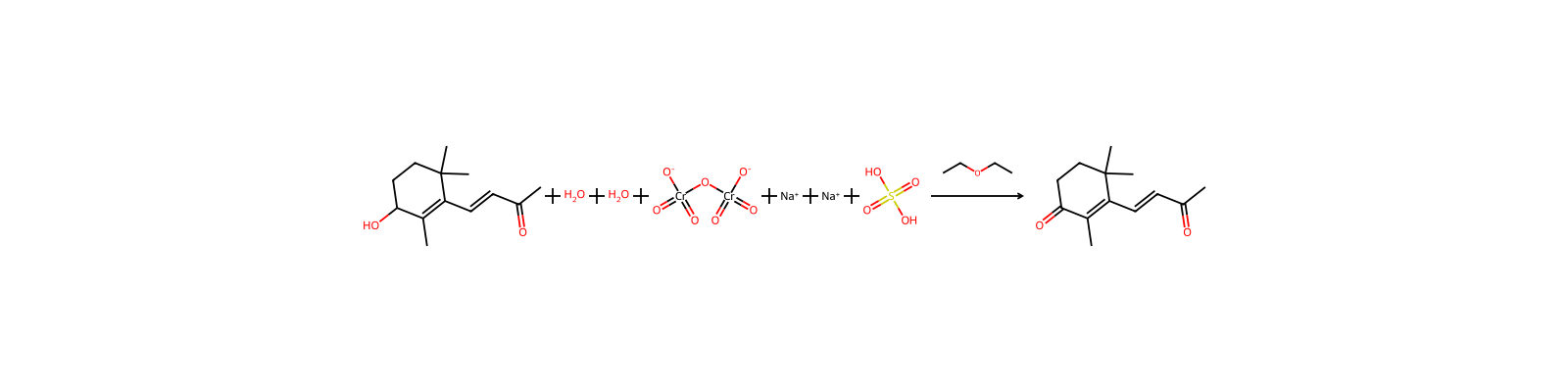
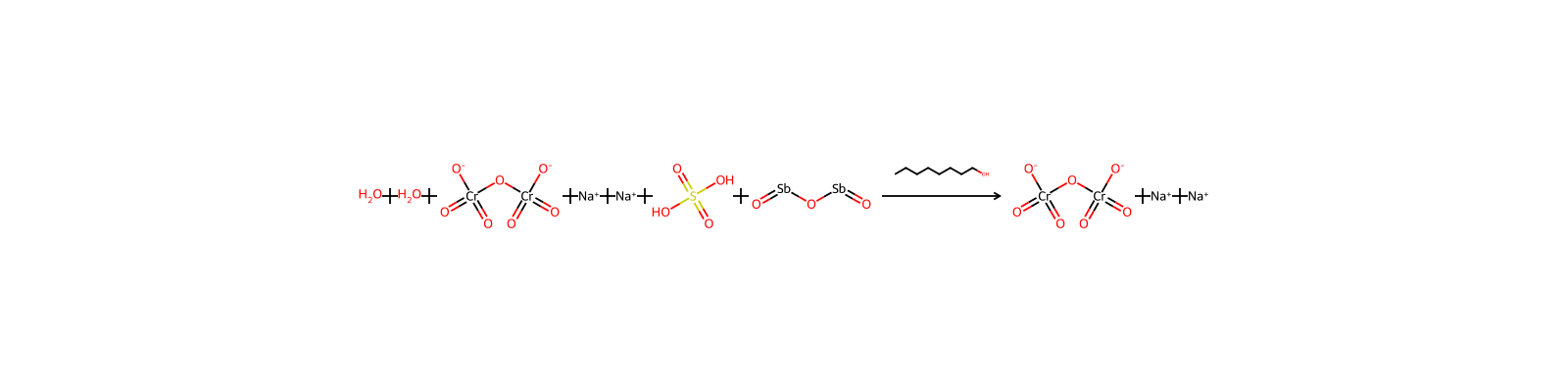
44 records



Linked notes
Loading…