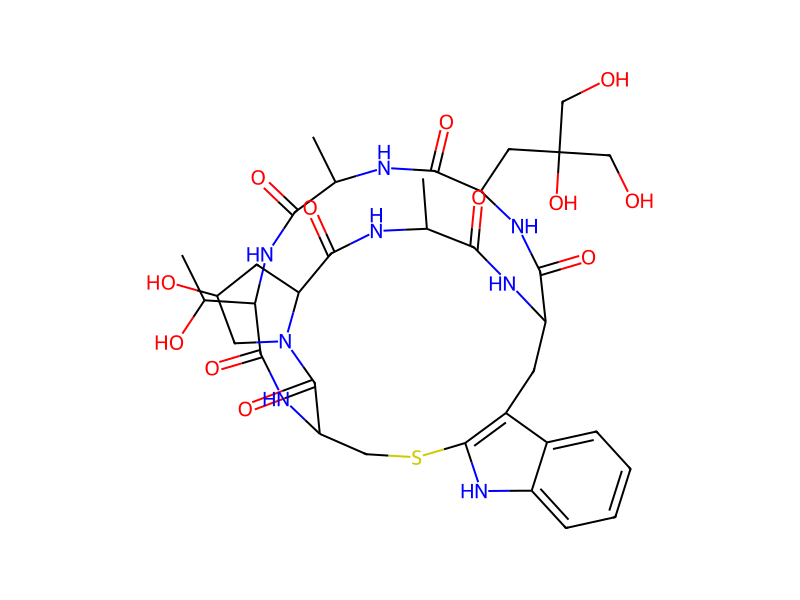
Basic information
- Standard SMILES
CC1NC(=O)C(CC(O)(CO)CO)NC(=O)C2Cc3c([nH]c4ccccc34)SCC(NC(=O)C(C(C)O)NC1=O)C(=O)N1CC(O)CC1C(=O)NC(C)C(=O)N2- InChIKey
SRDQDZSLNAKOIT-UHFFFAOYSA-N- Molecular formula
- C35H48N8O12S
- Average molar mass
- 804.9 g/mol
- Monoisotopic mass
- 804.31123998
Overview
Phallisin has been reported in Amanita phalloides, Amanita bisporigera, and other organisms with data available.
Names & identifiers
- Preferred name
- Phallisin
- IUPAC
- 28-[2,3-dihydroxy-2-(hydroxymethyl)propyl]-18-hydroxy-34-(1-hydroxyethyl)-23,31-dimethyl-12-thia-10,16,22,25,27,30,33,36-octazapentacyclo[12.11.11.03,11.04,9.016,20]hexatriaconta-3(11),4,6,8-tetraene-15,21,24,26,29,32,35-heptone
- English name
- phallisin
- Molecular formula
- C35H48N8O12S
- Molecular weight
- 804.87
Names & synonyms
Show more names
Database identifiers
- CAS
19774-69-7- PubChem CID
- 115286
- DTXSID
DTXSID501046161
Properties
Computed structural properties
- XLogP
- -2.7
- Topological polar surface area
- 337 Ų
- Hydrogen bond donors
- 12
- Hydrogen bond acceptors
- 13
- Rotatable bonds
- 5
- Heavy atoms
- 56
- Formal charge
- 0
- Complexity
- 1,520
Physicochemical properties
- Boiling point
- 1444.1 · 1444.1±65.0 °C(Predicted)
- Density
- 1.55 · 1.55±0.1 g/cm3(Predicted)
- pka
- 12.94 · 12.94±0.70(Predicted)
Safety & regulation
Toxicology
Toxicity Summary
Phallotoxins bind actin, preventing its depolymerization and poisoning the cell. They bind specifically at the interface between F-actin subunits, locking adjacent subunits together. This leads to a decrease in the rate constant for the dissociation of actin subunits from filament ends, which essentially stabilizes actin filaments through the prevention of filament depolymerization. Moreover, they inhibit the ATP hydrolysis activity of F-actin. (L1183, A2465)
Signs and Symptoms
Hypovolemic shock; Gastrointestinal symptoms occur after a latent period and include abdominal pain, vomiting, and watery diarrhea. Neurologic symptoms are related to hepatic failure and may include encephalopathy, somnolence, confusion, coma and seizures (L1160).
Chemistry & industry
Uses & manufacturing
Suppliers2 total
Related reactions
No reaction records under the current filter.
Linked notes
Loading…