
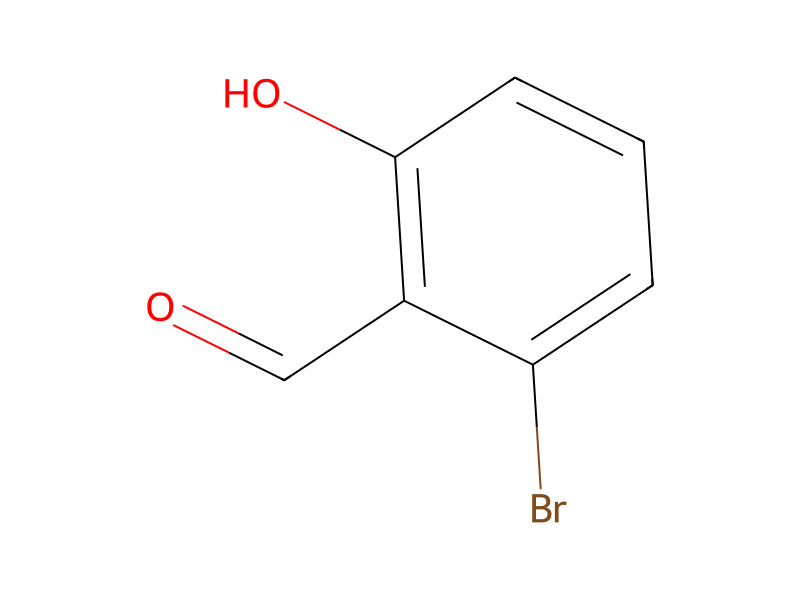
Basic information
- Standard SMILES
O=Cc1c(O)cccc1Br- InChIKey
LQTXMBDCLHZDAM-UHFFFAOYSA-N- Molecular formula
- C7H5BrO2
- Average molar mass
- 201.02 g/mol
- Monoisotopic mass
- 199.94729
Names & identifiers
- Preferred name
- 2-Bromo-6-hydroxybenzaldehyde
- IUPAC
- 2-bromo-6-hydroxybenzaldehyde
- English name
- 2-Bromo-6-hydroxybenzaldehyde
- Molecular formula
- C7H5BrO2
- Molecular weight
- 201.02
Names & synonyms
2-BROMO-6-HYDROXYBENZALDEHYDE22532-61-2DTXSID30474659RefChem:257466DTXCID20425473696-195-0MFCD08234722Benzaldehyde, 2-bromo-6-hydroxy-6-bromo-2-hydroxybenzaldehydeCL8260AKOS005257158CS-W001122
Show more names
2-Bromo-6-hydroxybenzaldehyd3-BroMo-2-forMylphenol2-bromo-hydroxybenzaldehyde2-hydroxy-6-bromobenzaldehydeBenzaldehyde,2-broMo-6-hydroxy-3-Bromo-2-formylphenol, 6-Bromosalicylaldehyde
AB43626PS-5659SY024446EN300-116695Z12691757286-BROMOSALICYLALDEHYDE2-bromo-6-hydroxy-benzaldehyde6-Bromosalicylaldehyde; 2-Bromo-6-hydroxybenzaldehyde; 2-Hydroxy-6-bromobenzaldehyde; 6-Bromo-2-hydroxybenzaldehyde; 6-Bromosalicylaldehyde
Database identifiers
- CAS
22532-61-2- PubChem CID
- 11954768
- DTXSID
DTXSID30474659- EC Number
- 696-195-0
- Nikkaji
- J1.399.370J
Properties
Computed structural properties
- XLogP
- 2.3
- Topological polar surface area
- 37.3 Ų
- Hydrogen bond donors
- 1
- Hydrogen bond acceptors
- 2
- Rotatable bonds
- 1
- Heavy atoms
- 10
- Formal charge
- 0
- Complexity
- 127
Physicochemical properties
- Melting point
- 50 · 50-52 °C
- Boiling point
- 243.4 · 243.4±20.0 °C(Predicted)
- Density
- 1.737 · 1.737±0.06 g/cm3(Predicted)
- storage temp.
- 2 · under inert gas (nitrogen or Argon) at 2-8°C
- solubility
- DMSO (Slightly), Methanol (Slightly)
- form
- Solid
- pka
- 7.21 · 7.21±0.10(Predicted)
- color
- Light Yellow
- InChI
- InChI=1S/C7H5BrO2/c8-6-2-1-3-7(10)5(6)4-9/h1-4,10H
- InChIKey
- LQTXMBDCLHZDAM-UHFFFAOYSA-N
- SMILES
- C(=O)C1=C(O)C=CC=C1Br
- Symbol(GHS)
- 7 · GHS07
- Signal word
- Warning
- Hazard statements
- 302 · H302-H315-H319-H332-H335
- Precautionary statements
- 261 · P261-P280-P305+P351+P338
- HS Code
- 2912210000 · 2912210000
Safety & regulation
GHS classification
GHS Classification
Warning
H302 (100%): Harmful if swallowed [Warning Acute toxicity, oral];H312 (66.7%): Harmful in contact with skin [Warning Acute toxicity, dermal];H315 (33.3%): Causes skin irritation [Warning Skin corrosion/irritation];H319 (33.3%): Causes serious eye irritation [Warning Serious eye damage/eye irritation];H332 (100%): Harmful if inhaled [Warning Acute toxicity, inhalation];H335 (33.3%): May cause respiratory irritation [Warning Specific target organ toxicity, single exposure; Respiratory tract irritation]
P261, P264, P264+P265, P270, P271, P280, P301+P317, P302+P352, P304+P340, P305+P351+P338, P317, P319, P321, P330, P332+P317, P337+P317, P362+P364, P403+P233, P405, and P501 (click each P-code to see the statement)
Aggregated GHS information provided per 3 reports by companies from 2 notifications to the ECHA C&L Inventory. Each notification may be associated with multiple companies.;Information may vary between notifications depending on impurities, additives, and other factors. The percentage value in parenthesis indicates the notified classification ratio from companies that provide hazard codes. Only hazard codes with percentage values above 10% are shown. For more detailed information, please visit ECHA C&L website.
Hazard information
Hazard Classes and CategoriesAcute Tox. 4 (100%);Acute Tox. 4 (66.7%);Skin Irrit. 2 (33.3%);Eye Irrit. 2 (33.3%);Acute Tox. 4 (100%);STOT SE 3 (33.3%)
Safety data
- hs_code
- 2912210000
- Signal word
- Warning
- Symbol(GHS)
- GHS07
- Hazard statements
- H302-H315-H319-H332-H335
- Precautionary statements
- P261-P280-P305+P351+P338
Chemistry & industry
Applications
Uses2-Bromo-6-hydroxybenzaldehyde, is a substituted salicylaldehyde used in the synthesis of BIIB042, a γ-secretase modulator.
Preparation methods
PreparationStep a: 2,6-Dibromobenzaldehyde, toluene, 1,3-propanediol, and concentrated sulfuric acid are heated to reflux and water is removed. After the reaction is complete, the mixture is cooled to room temperature, neutralized with sodium methoxide, and distilled under reduced pressure to obtain intermediate a;Step b: Intermediate a and tetrahydrofuran are cooled to -10℃ to 5℃, isopropyl Grignard reagent is added, Grignard exchange is completed, then trialkyl borate is added and the reaction is maintained at this temperature; hydrochloric acid is used to quench the reaction, organic solvent is used for extraction and separation, and the mixture is evaporated to dryness to obtain intermediate b;Step c: Intermediate b is added to an alcohol/water mixed solvent and a copper catalyst, and hydrogen peroxide is added for reaction; sodium thiosulfate solution is used to quench the reaction, extraction and separation are performed, organic solvent is added for slurrying, and filtration is used to obtain 2-bromo-6-hydroxybenzaldehyde.
Upstream & downstream products
Downstream products
Suppliers50 total
衢州润东化工有限公司0570-8789886 18892685668 · [email protected]
上海阿拉丁生化科技股份有限公司400-6206333 13167063860 · [email protected]
上海麦克林生化科技股份有限公司021-50706066 15221275939 · [email protected]
合肥翰刚医药科技有限公司+8618062405514 · [email protected]
杭州奥得科技有限公司0571-88772972-0 15057128248 · [email protected]
温州共赢化学有限公司+86-0086-577-64498589 +86-15355981851 · [email protected]
宁波季诺化学品有限公司0574-87314919 057487319282 · [email protected]
上海瀚麟生物科技有限公司183-0212-4410 18302124410 · [email protected]
上海赫文斯化工有限公司15721252604 17321035817 · [email protected]
Dayang Chem (Hangzhou) Co.,Ltd.+86-0571-88938639 17705817739 · [email protected]
郑州鸿晟医药科技有限公司0371-55695890 15637198702 · [email protected]
毕佳索(上海毕得医药科技股份有限公司)400-6005915 · [email protected]
北京华威锐科化工有限公司0757-86329057 18934348241 · [email protected]
安耐吉化学&3A(安徽泽升科技有限公司)021-58432009 400-005-6266 · [email protected]
安耐吉化学&3A(安徽泽升科技股份有限公司)400-0056266 · [email protected]
石家庄斯迪亚诺精细化工有限公司0311-89250318 13582355795 · [email protected]
烟台凯博医药科技有限公司0535-6385396 · [email protected]
常州安轩化工有限公司13912302692 · [email protected]
浙江雅辰药物科技股份有限公司13674959855 13674959855 · [email protected]
上海瀚鸿科技股份有限公司021-54306202 13764082696 · [email protected]
上海柯维化学技术有限公司021-64609169 18901607656 · [email protected]
陕西宇鼎卓医药科技有限公司18992018580 18165105898 · [email protected]
上海相辉医药科技有限公司13761987713 · [email protected]
南京诺利斯医药科技有限公司13901585132 · [email protected]
南京代盟化工有限公司02566880956 · [email protected]
上海隆盛化工有限公司58099637 13585536065 · [email protected]
郑州研德生物科技有限公司0371-63682289 15538176268 · [email protected]
Zhejiang J&C Biological Technology Co.,Limited+1-2135480471 · [email protected]
上海常丰生物医药科技有限公司+86-021-61727342 13611721451 · [email protected]
上海特伯化学科技有限公司+86-21-60341587 · [email protected]
南京诺利斯医药科技有限公司13901585132 · [email protected]
江苏艾康生物医药研发有限公司025-66113011 13913916777 · [email protected]
上海贤鼎生物科技有限公司4009209199 · [email protected]
杭州迈世腾药物科技有限公司0571-82896630 18969958410 · [email protected]
上海毕得医药科技股份有限公司400-164-7117 18317119277 · [email protected]
杭州杰恒化工有限公司0571-87396432 · [email protected]
上海寰川实业有限公司021-61478794 · [email protected]
上海纳谦化学科技有限公司13598610367 13598610367 · [email protected]
南京多隆生物科技有限公司18905173768 · [email protected]
上海洽凡生化科技有限公司+86-021-61654350 · [email protected]
上海拓目化工有限公司13391076197 · [email protected]
深圳振强药物研发有限公司+86-0755-66853366 +86-13670046396 · [email protected]
Accela ChemBio Inc.+1(858) 699-3322 · [email protected]
成都赛诺宁科技有限公司28-87999436 02887999436 · [email protected]
诺尔凯立科技有限公司86-(0)21-31261262 373522135 · [email protected]
韶远科技(上海)有限公司021-50795510 4000665055 · [email protected]
湖北创联康成药物化学有限公司027-65388397 18164111589 · [email protected]
Guangzhou Yuheng Pharmaceutical Technology Co., Ltd+8613580539051 · [email protected]
上海源叶生物科技有限公司13636370518 · [email protected]
Yurui (Shanghai) Chemical Co., Ltd.+86-021-50456736 +8613331628239;+8619121032725 · [email protected]
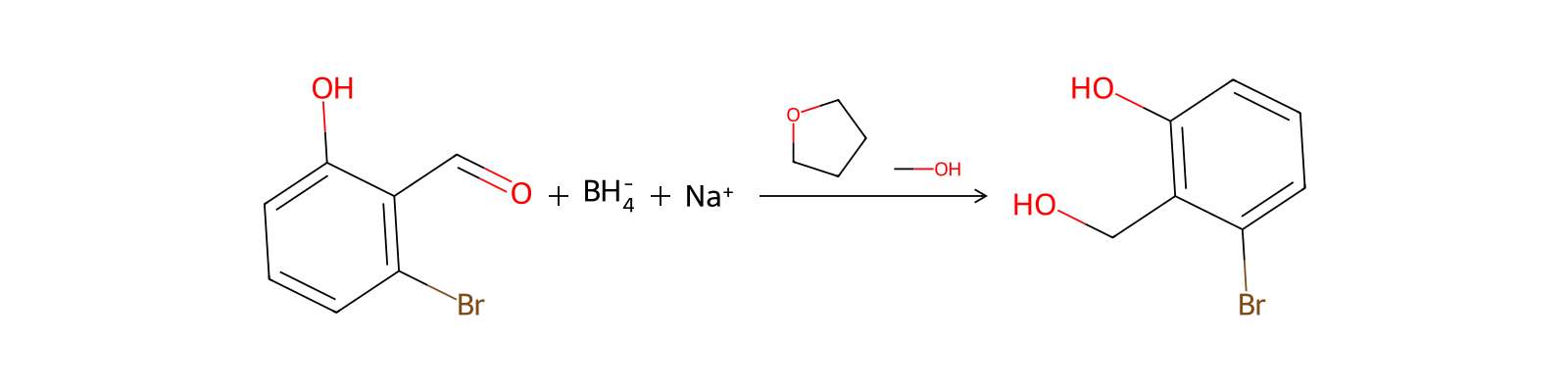
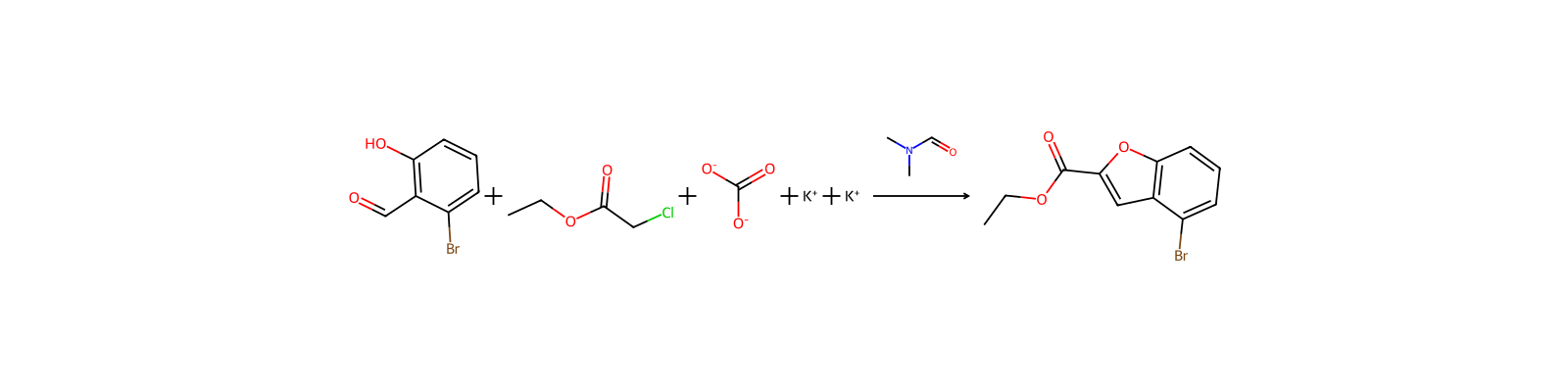
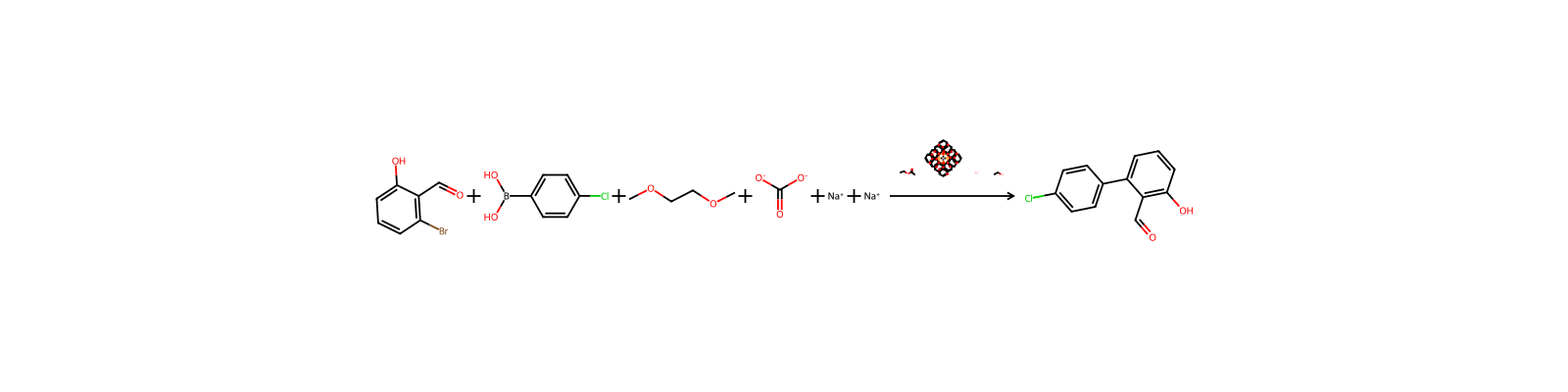
Related reactions
9 records



Linked notes
Loading…