
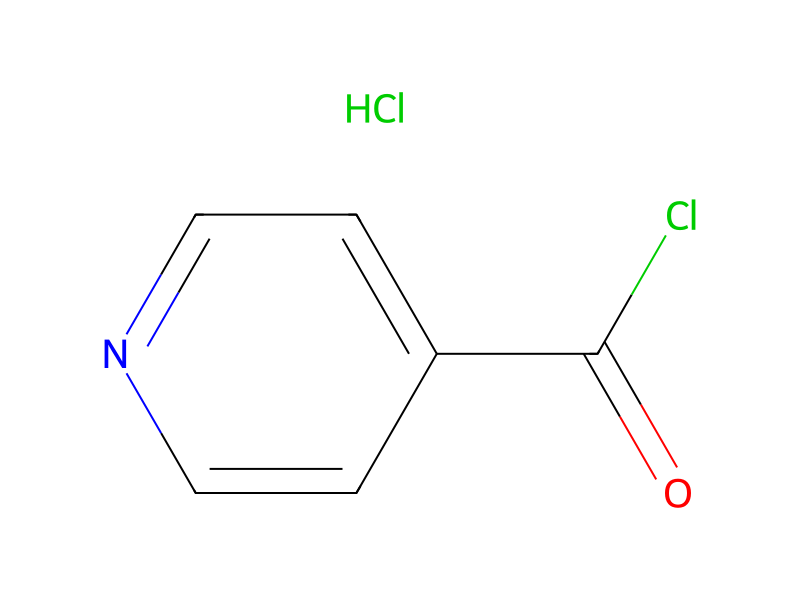
Basic information
- Standard SMILES
Cl.O=C(Cl)c1ccncc1- InChIKey
BNTRVUUJBGBGLZ-UHFFFAOYSA-N- Molecular formula
- C6H5Cl2NO
- Average molar mass
- 178.01 g/mol
- Monoisotopic mass
- 176.97481914
Names & identifiers
- Preferred name
- Isonicotinoyl chloride hydrochloride
- IUPAC
- pyridine-4-carbonyl chloride;hydrochloride
- English name
- ISONICOTINOYL CHLORIDE HYDROCHLORIDE
- Molecular formula
- C6H5Cl2NO
- Molecular weight
- 178.02
Names & synonyms
Isonicotinoyl chloride hydrochloride39178-35-3RefChem:1087625Pyridine-4-carbonyl chloride hydrochlorideisonicotinyl chloride hydrochlorideMFCD000128304-pyridinecarbonyl chloride hydrochlorideisonicotinoyl chloride HClpyridine-4-carbonyl chloride;hydrochlorideisonicotinoylchloride hydrochloride4-Pyridinecarbonyl chloride, hydrochlorideSCHEMBL26328
Show more names
IsonicotinoyLTIMTEC-BB SBB003768IsonicotinylchlorideHClIsonicotinoylchlorideHClpyridine-4-carbonyl chloridePyridine-4-carbonylchlorideHClChloroisocyanate hydrochloridenikethamide crude impurity 104-PYRIDINOYL CHLORIDE HYDROCHLORIDE
4-pyridinecarbonyl chloride-HCl4-Pyridoyl chloride hydrochlorideDTXSID00959963isonicotinoyl chloride-hydrochlorideisonicotinoyl chloride.hydrochlorideNSC91025STR05181NSC-91025
Database identifiers
- CAS
39178-35-3- PubChem CID
- 12262826
- DTXSID
DTXSID00959963- EC Number
- 254-331-2
Properties
Computed structural properties
- Topological polar surface area
- 30 Ų
- Hydrogen bond donors
- 1
- Hydrogen bond acceptors
- 2
- Rotatable bonds
- 1
- Heavy atoms
- 10
- Formal charge
- 0
- Complexity
- 110
Physicochemical properties
- Melting point
- 159 · 159-161 °C(lit.)
- storage temp.
- Inert atmosphere,Room Temperature
- solubility
- 50 mg/mL, · methanol: soluble50mg/mL, clear to hazy, colorless to light yellow
- form
- Crystalline Powder
- color
- Almost white to beige
- Water Solubility
- almost transparency
- Sensitive
- Moisture Sensitive
- BRN
- 3626052 · 3626052
- InChI
- InChI=1S/C6H4ClNO.ClH/c7-6(9)5-1-3-8-4-2-5;/h1-4H;1H
- InChIKey
- BNTRVUUJBGBGLZ-UHFFFAOYSA-N
- SMILES
- C1(C(Cl)=O)=CC=NC=C1.Cl
- CAS DataBase Reference
- 39178 · 39178-35-3(CAS DataBase Reference)
- UNSPSC Code
- 12352100 · 12352100
- NACRES
- 22 · NA.22
- Symbol(GHS)
- 5 · GHS05
- Signal word
- Danger
- Hazard statements
- 314 · H314
- Precautionary statements
- 260 · P260-P280-P303+P361+P353-P304+P340+P310-P305+P351+P338-P363
- PPE
- 3 · Eyeshields, Faceshields, Gloves, type P3 (EN 143) respirator cartridges
- Hazard Codes
- C
- Risk Statements
- 34 · 34
- Safety Statements
- 26 · 26-36/37/39-45
- RIDADR
- 3261 · UN 3261 8/PG 2
- WGK Germany
- 3 · 3
- Hazard Note
- Corrosive
- HazardClass
- 8 · 8
- PackingGroup
- II
- HS Code
- 29333990 · 29333990
- Storage Class
- 8 A · 8A - Combustible corrosive hazardous materials
- Hazard Classifications
- 1 Skin · Eye Dam. 1Skin Corr. 1B
- Limited Quantities
- 1 Kg · 1 Kg (2.2 lbs) (solid)
- Excepted Quantities
- Max Inner Pack (30g or 30ml) and Max Outer Pack (500g or 500ml)
Safety & regulation
GHS classification
GHS Classification
Danger
H314 (100%): Causes severe skin burns and eye damage [Danger Skin corrosion/irritation]
P260, P264, P264+P265, P280, P301+P330+P331, P302+P361+P354, P304+P340, P305+P354+P338, P316, P317, P321, P363, P405, and P501 (click each P-code to see the statement)
Aggregated GHS information provided per 49 reports by companies from 5 notifications to the ECHA C&L Inventory. Each notification may be associated with multiple companies.
Hazard information
Hazard Classes and CategoriesSkin Corr. 1B (100%)
Safety data
- PPE
- Eyeshields, Faceshields, Gloves, type P3 (EN 143) respirator cartridges
- wgk
- 3
- ridadr
- UN 3261 8/PG 2
- hs_code
- 29333990
- risk_code
- 34
- Signal word
- Danger
- Symbol(GHS)
- GHS05
- hazard_code
- C
- hazard_note
- Corrosive
- safety_code
- 26-36/37/39-45
- hazard_class
- 8
- Storage Class
- 8A - Combustible corrosive hazardous materials
- packing_group
- II
- Hazard statements
- H314
- Limited Quantities
- 1 Kg (2.2 lbs) (solid)
- Excepted Quantities
- Max Inner Pack (30g or 30ml) and Max Outer Pack (500g or 500ml)
- Hazard Classifications
- Eye Dam. 1Skin Corr. 1B
- Precautionary statements
- P260-P280-P303+P361+P353-P304+P340+P310-P305+P351+P338-P363
Chemistry & industry
Applications
UsesIsonicotinyl Chloride Hydrochloride, is a heterocyclic building block used for the synthesis of various pharmaceutical and biologically active compounds. It can be used for the preparation of Tetrahydropyrroloquinolinone type dual inhibitors of Aromatase/Aldosterone Synthase, as a novel stagey for breast cancer patients with the risk of cardiovascular diseases.
UsesIsonicotinoyl chloride hydrochloride was used in the synthesis of 7,16-diisonicotinoyltetraaza[14]annulene.
Upstream & downstream products
Upstream raw materials
Downstream products
Suppliers50 total
国药集团化学试剂有限公司86-21-63210123 · [email protected]
北京华美互利生物化工010-56205725 · [email protected]
梯希爱(上海)化成工业发展有限公司021-67121386 · [email protected]
郑州阿尔法化工有限公司+86-18530059196 · [email protected]
上海阿拉丁生化科技股份有限公司400-6206333 13167063860 · [email protected]
湖北金梭生物科技有限公司00123456789 · [email protected]
INTATRADE GmbH+49 3493/605464 · [email protected]
Baoji Guokang Healthchem co.,ltd+8615604608665 15604608665 · [email protected]
Dayang Chem (Hangzhou) Co.,Ltd.+86-0571-88938639 17705817739 · [email protected]
科瑞迪化学400-821-5857 021-64326257 · [email protected]
Syntechem Co.,Ltd[email protected]
上海迈瑞尔生化科技有限公司4006356688 18621169109 · [email protected]
北京华威锐科化工有限公司0757-86329057 18934348241 · [email protected]
上海晶抗生物工程有限公司021-54721350 13524668266 · [email protected]
阿法埃莎(中国)化学有限公司400-6106006 · [email protected]
安耐吉化学&3A(安徽泽升科技股份有限公司)400-0056266 · [email protected]
上海钰康生物科技有限公司+86-18930848214 +86-021-56762820 · [email protected]
嘉兴市艾森化工有限公司0573-85285100 18627885956 · [email protected]
上海隆盛化工有限公司58099637 13585536065 · [email protected]
郑州研德生物科技有限公司0371-63682289 15538176268 · [email protected]
青岛海力诺化工有限公司198 6221 1367 18561921626
孝感深远化工有限公司15527621225; 15527621225 · [email protected]
山东西亚化学有限公司13355009207 13355009207 · [email protected]
玛雅试剂+86 (573) 82222445 (0)18006601000 452520369 · [email protected]
湖南汇百侍生物科技有限公司0731-85526065 13308475853 · [email protected]
河南多贝化工有限公司0370-2785118 17550508557 · [email protected]
艾科试剂4008-755-333 18080918076 · [email protected]
上海思域化工科技有限公司86-21-34053660 · [email protected]
赛默飞世尔科技(中国)有限公司800-810-5118 · [email protected]
上海特伯化学科技有限公司+86-21-60341587 · [email protected]
TCI AMERICA800-4238616 · [email protected]
TOKYO CHEMICAL INDUSTRY CO., LTD.03-36680489 · [email protected]
TCI Europe320-37350700 · [email protected]
深圳振强药物研发有限公司0755-66853366 13670046396 · [email protected]
随州市红旗化工有限公司0722-3257376 13026100080;13235518175 · [email protected]
上海睿升化工科技有限公司+86-021-50935922
上海将来实业股份有限公司400-0066400 13621662912 · [email protected]
上海将来实业股份有限公司021-61552785 · [email protected]
HBCChem, Inc.+1-510-219-6317 · [email protected]
郑州鸿晟医药科技有限公司0371-0371-13526885213 15637198702 · [email protected]
成都零六生物科技有限公司400-1166-196 13458535857 · [email protected]
湖南华腾制药有限公司400-8592883 · [email protected]
上海馨远医药科技有限公司021-24206007 13764915196 · [email protected]
上海鑫圭生物科技有限公司15121041756 · [email protected]
上海麦克林生化科技股份有限公司15221275939 15221275939 · [email protected]
杭州杰恒化工有限公司0571-87396432 · [email protected]
上海嵩爰化工科技有限公司010-1234567 18521000990 · [email protected]
南京恰风和医药科技有限公司025-57018978 18251899859 · [email protected]
上海孚一生物科技有限公司+86 (21) 61124340
凯试(上海)科技有限公司021-50135380 · [email protected]
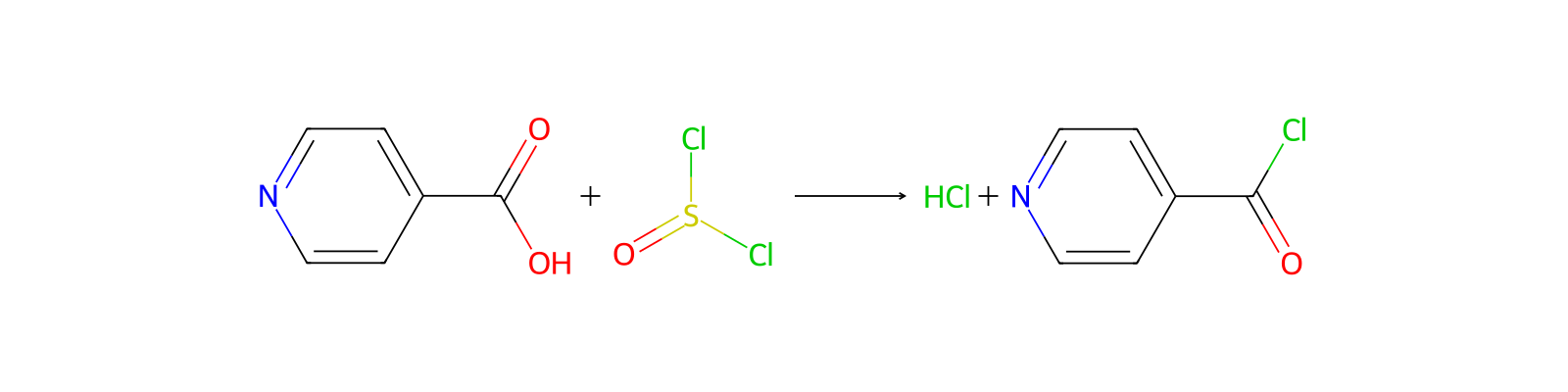
Related reactions
248 records




Linked notes
Loading…