
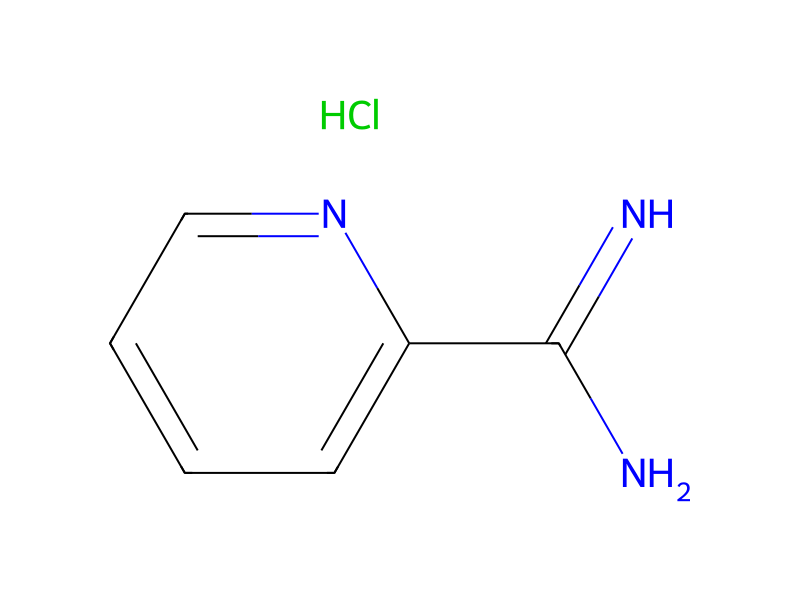
Basic information
- Standard SMILES
Cl.N=C(N)c1ccccn1- InChIKey
GMHCEDDZKAYPLB-UHFFFAOYSA-N- Molecular formula
- C6H8ClN3
- Average molar mass
- 157.6 g/mol
- Monoisotopic mass
- 157.040675
Names & identifiers
- Preferred name
- Pyridine-2-carboximidamide hydrochloride
- IUPAC
- pyridine-2-carboximidamide;hydrochloride
- English name
- Pyridine-2-carboximidamide hydrochloride
- Molecular formula
- C6H8ClN3
- Molecular weight
- 157.6
Names & synonyms
pyridine-2-carboximidamide hydrochlorideRefChem:870733676-441-351285-26-8picolinimidamide hydrochloride2-Amidinopyridine hydrochloridePyridine-2-carboxamidine hydrochlorideMFCD00052271pyridine-2-carboximidamide;hydrochloridePICOLINAMIDINE HYDROCHLORIDE2-AMIDINOPYRIDINIUM CHLORIDE61097-49-2
Show more names
2-AmidinopyridineBUTTPARK 32\03-542-AmidinopyridiniumHClhydratePyridin-2-carboximidamide HClPyridine-2-carboximidamide, HCl
Pyridine-2-carboxamidine HCl2-Pyridinecarboximidamide, monohydrochloride2-PYRIDINECARBOXIMIDAMIDE HYDROCHLORIDEPICOLINAMIDINE HCLPICOLINIMIDAMIDE HCLpicolinimidamidehydrochloridePicolinimidamide xhydrochlorideSCHEMBL857460
Database identifiers
- CAS
51285-26-8- PubChem CID
- 12403615
- DTXSID
DTXSID30496598- EC Number
- 676-441-3
Properties
Computed structural properties
- Topological polar surface area
- 62.8 Ų
- Hydrogen bond donors
- 3
- Hydrogen bond acceptors
- 2
- Rotatable bonds
- 1
- Heavy atoms
- 10
- Formal charge
- 0
- Complexity
- 111
Physicochemical properties
- Melting point
- 150 · 150-152°C
- storage temp.
- Inert atmosphere,Room Temperature
- form
- crystals
- color
- Off-white
- Sensitive
- Hygroscopic
- BRN
- 3562671 · 3562671
- InChI
- InChI=1S/C6H7N3.ClH/c7-6(8)5-3-1-2-4-9-5;/h1-4H,(H3,7,8);1H
- InChIKey
- GMHCEDDZKAYPLB-UHFFFAOYSA-N
- SMILES
- C(C1N=CC=CC=1)(N)=N.Cl
- CAS DataBase Reference
- 51285 · 51285-26-8(CAS DataBase Reference)
- Symbol(GHS)
- 7 · GHS07
- Signal word
- Warning
- Hazard statements
- 315 · H315-H319-H335
- Precautionary statements
- 261 · P261-P280a-P304+P340-P305+P351+P338-P405-P501a
- Hazard Codes
- Xi
- Risk Statements
- 36 · 36/37/38
- Safety Statements
- 26 · 26-36-37/39-37
- HazardClass
- IRRITANT
- HS Code
- 29333990 · 29333990
Safety & regulation
GHS classification
GHS Classification
Warning
H302+H312+H332 (12.5%): Harmful if swallowed, in contact with skin or if inhaled [Warning Acute toxicity, oral; acute toxicity, dermal; acute toxicity, inhalation];H302 (12.5%): Harmful if swallowed [Warning Acute toxicity, oral];H312 (12.5%): Harmful in contact with skin [Warning Acute toxicity, dermal];H315 (100%): Causes skin irritation [Warning Skin corrosion/irritation];H319 (100%): Causes serious eye irritation [Warning Serious eye damage/eye irritation];H332 (12.5%): Harmful if inhaled [Warning Acute toxicity, inhalation];H335 (87.5%): May cause respiratory irritation [Warning Specific target organ toxicity, single exposure; Respiratory tract irritation]
P261, P264, P264+P265, P270, P271, P280, P301+P317, P302+P352, P304+P340, P305+P351+P338, P317, P319, P321, P330, P332+P317, P337+P317, P362+P364, P403+P233, P405, and P501 (click each P-code to see the statement)
Aggregated GHS information provided per 8 reports by companies from 5 notifications to the ECHA C&L Inventory. Each notification may be associated with multiple companies.;Information may vary between notifications depending on impurities, additives, and other factors. The percentage value in parenthesis indicates the notified classification ratio from companies that provide hazard codes. Only hazard codes with percentage values above 10% are shown. For more detailed information, please visit ECHA C&L website.
Hazard information
Hazard Classes and CategoriesAcute Tox. 4 (12.5%);Acute Tox. 4 (12.5%);Skin Irrit. 2 (100%);Eye Irrit. 2 (100%);Acute Tox. 4 (12.5%);STOT SE 3 (87.5%)
Safety data
- hs_code
- 29333990
- risk_code
- 36/37/38
- Signal word
- Warning
- Symbol(GHS)
- GHS07
- hazard_code
- Xi
- safety_code
- 26-36-37/39-37
- hazard_class
- IRRITANT
- Hazard statements
- H315-H319-H335
- Precautionary statements
- P261-P280a-P304+P340-P305+P351+P338-P405-P501a
Chemistry & industry
Applications
UsesPyridine-2-carboximidamide hydrochloride serves as a reactant in the synthesis of 1,4-bis[2,6-bis(2-pyridyl)pyrimidin-4-yl]benzene (L1), reacting with 1,4-bis[3-(pyridine-2-yl)propene-1-one]phenylene in ethanol with potassium hydroxide under reflux[6]. As a monoamidine ligand additive, pyridine-2-carboximidamide hydrochloride is incorporated into perovskite precursor solutions to passivate defect sites in the perovskite film[7].
Upstream & downstream products
Upstream raw materials
Suppliers50 total
国药集团化学试剂有限公司86-21-63210123 · [email protected]
上海阿拉丁生化科技股份有限公司400-6206333 13167063860 · [email protected]
Shandong chuangyingchemical Co., Ltd.18853181302 · [email protected]
温州共赢化学有限公司+86-0086-577-64498589 +86-15355981851 · [email protected]
长春三邦医药科技有限公司0431-81884431 · [email protected]
Dayang Chem (Hangzhou) Co.,Ltd.+86-0571-88938639 17705817739 · [email protected]
Hebei Yanxi Chemical Co., Ltd.+86-17531190177 · [email protected]
上海弘顺生物科技有限公司15901914505 · [email protected]
韶远科技(上海)有限公司021-50795510 4000665055 · [email protected]
Syntechem Co.,Ltd[email protected]
上海迈瑞尔生化科技有限公司4006356688 18621169109 · [email protected]
北京华威锐科化工有限公司0757-86329057 18934348241 · [email protected]
宁波亿诺化学品有限公司86-574-27787657 · [email protected]
阿法埃莎(中国)化学有限公司400-6106006 · [email protected]
安耐吉化学&3A(安徽泽升科技股份有限公司)400-0056266 · [email protected]
武汉凯威斯科技有限公司86-027-67849912 · [email protected]
上海瀚鸿科技股份有限公司021-54306202 13764082696 · [email protected]
上海相辉医药科技有限公司13761987713 · [email protected]
济南腾源化工科技有限公司0531-88062576 13791023792 · [email protected]
嘉兴市艾森化工有限公司0573-85285100 18627885956 · [email protected]
上海隆盛化工有限公司58099637 13585536065 · [email protected]
郑州研德生物科技有限公司0371-63682289 15538176268 · [email protected]
上海攀鸿化工科技有限公司021-56491756 13512199871 · [email protected]
上海常丰生物医药科技有限公司+86-021-61727342 13611721451 · [email protected]
凯美赛尔生物医药有限公司020-13556033878 2965585218 13556033878 · [email protected]
山东西亚化学有限公司13355009207 13355009207 · [email protected]
天津佶品佳化工科技有限公司18622448868 · [email protected]
南京维奥化工有限公司Please Send Email 18652950785 · [email protected]
赛默飞世尔科技(中国)有限公司800-810-5118 · [email protected]
白银承泽化工科技有限公司+86 943-8535351 13389336721 · [email protected]
南京精瑞久安生物技术有限公司025-58196018 800028039 · [email protected]
南京诺利斯医药科技有限公司13901585132 · [email protected]
江苏艾康生物医药研发有限公司025-66113011 13913916777 · [email protected]
上海渤腾医药科技有限公司13524892556 · [email protected]
阜新奥瑞凯精细化工有限公司(沈阳同元素)+86-024-83607930 18640359690 · [email protected]
南京友杰医药科技有限公司18860950986 · [email protected]
越林试剂021-62960152 · [email protected]
湖北鑫源顺医药化工有限公司13971561712, 13995564702, 027-50664929 · [email protected]
上海将来实业股份有限公司021-61552785 · [email protected]
Labnetwork lnc.+86-27-50766799 +86-18062016861 · [email protected]
上海卓因生物科技有限公司021-61317773 · [email protected]
湖南华腾制药有限公司400-8592883 · [email protected]
上海鑫圭生物科技有限公司15121041756 · [email protected]
天津安浩生物科技有限公司[email protected]
杭州杰恒化工有限公司0571-87396432 · [email protected]
上海永叶生物科技有限公司86-021-61559134 15921386130 · [email protected]
上海嵩爰化工科技有限公司010-1234567 18521000990 · [email protected]
上海拓目化工有限公司13391076197 · [email protected]
长沙晨进化工科技有限公司限公司86-0731-84451263 15388951283 2110078799 · [email protected]
厦门康奥克科技有限公司0086-592-7270133 612 · [email protected]
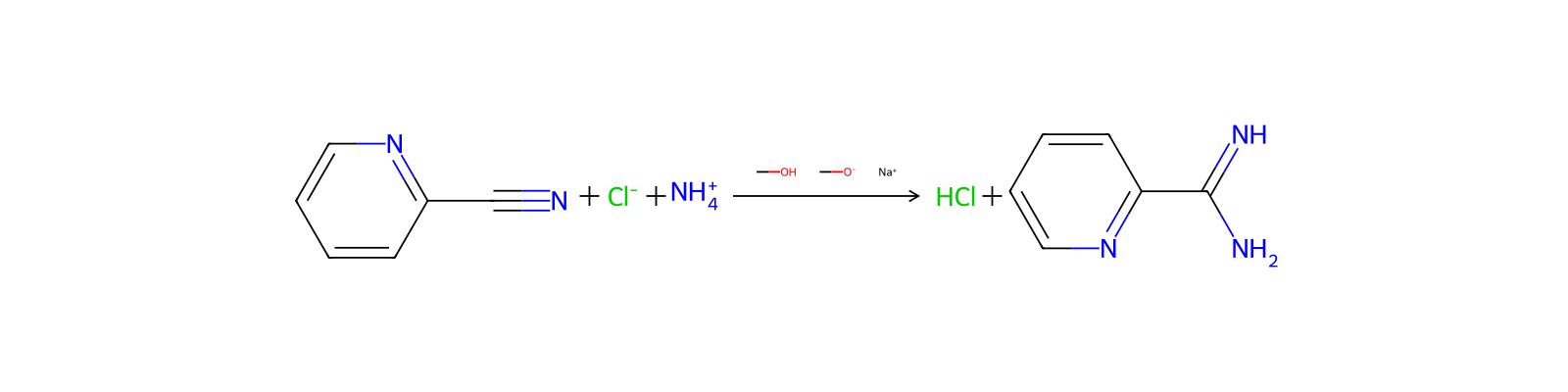
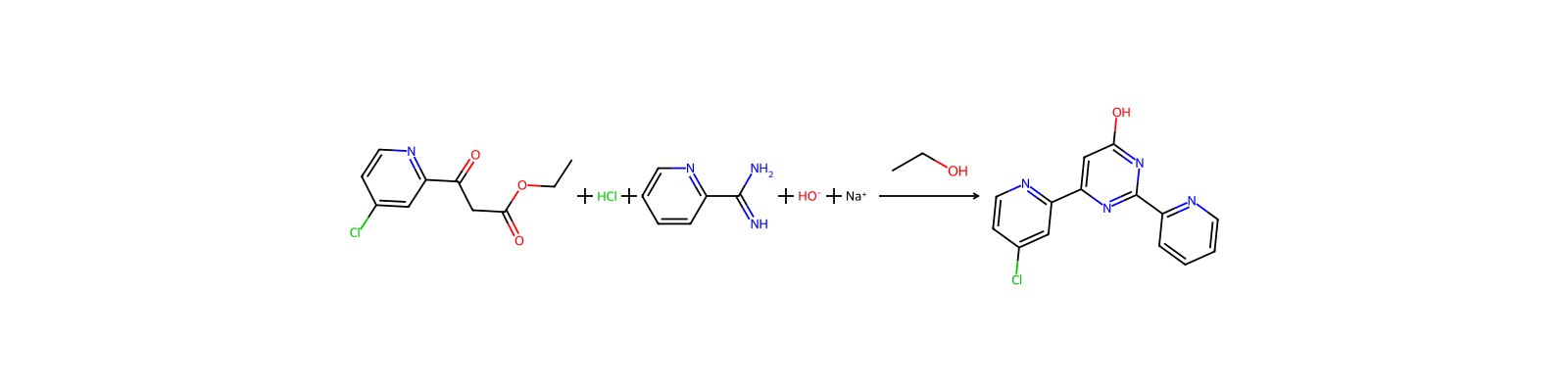
Related reactions
87 records





Linked notes
Loading…