Completing data — usually done within a minute
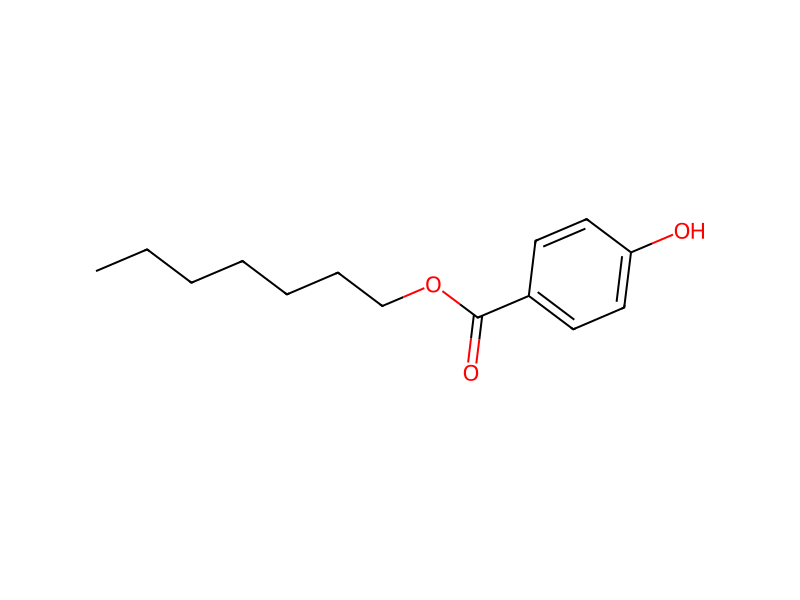
Basic information
- Standard SMILES
CCCCCCCOC(=O)c1ccc(O)cc1- InChIKey
ZTJORNVITHUQJA-UHFFFAOYSA-N- Molecular formula
- C14H20O3
- Average molar mass
- 236.311 g/mol
- Monoisotopic mass
- 236.1412445
Names & identifiers
- Preferred name
- Heptyl p-hydroxybenzoate
- IUPAC
- Heptyl 4-hydroxybenzoate
- English name
- Heptyl 4-hydroxybenzoate
- Molecular formula
- C14H20O3
- Molecular weight
- 236.31
Names & synonyms
Database identifiers
- CAS
1085-12-7- PubChem CID
- 14138
- DTXSID
DTXSID4022523- ChEMBL
CHEMBL3186719- ChEBI
CHEBI:34788- UNII
- K2CIJ448IX
- EC Number
- 214-115-0
- Nikkaji
- J87.217B
Properties
Physicochemical properties
- Melting point
- 46 · 46-51 °C
- Boiling point
- 338.77 °C · 338.77°C (rough estimate)
- Density
- 1.0717 · 1.0717 (rough estimate)
- refractive index
- 1.58 · 1.5800 (estimate)
- storage temp.
- Sealed in dry,Room Temperature
- solubility
- Chloroform (Slightly), Methanol (Slightly)
- form
- Solid
- pka
- 8.23 · 8.23±0.15(Predicted)
- color
- White to Off-White
- Water Solubility
- Soluble in alcohol, phenoxyethanol, propylene glycol. Insoluble in water.
- InChI
- 1S/C14H20O3/c1-2-3-4-5-6-11-17-14(16)12-7-9-13(15)10-8-12/h7-10,15H,2-6,11H2,1H3
- InChIKey
- ZTJORNVITHUQJA-UHFFFAOYSA-N
- SMILES
- CCCCCCCOC(=O)c1ccc(O)cc1
- LogP
- 4.83 · 4.830
- CAS DataBase Reference
- 1085 · 1085-12-7(CAS DataBase Reference)
- Substances Added to Food (formerly EAFUS)
- HEPTYLPARABEN
- FDA 21 CFR
- 172.145 · 172.145
- EWG's Food Scores
- 1 · 1
- FDA UNII
- 2 CIJ448IX · K2CIJ448IX
- NIST Chemistry Reference
- 4 · Benzoic acid, 4-hydroxy-, n-heptyl ester(1085-12-7)
- EPA Substance Registry System
- 4 · Benzoic acid, 4-hydroxy-, heptyl ester (1085-12-7)
- UNSPSC Code
- 12352200 · 12352200
- NACRES
- 21 · NA.21
- Symbol(GHS)
- 7 · GHS07
- Signal word
- Warning
- Hazard statements
- 315 · H315-H319-H335
- Precautionary statements
- 261 · P261-P280a-P304+P340-P305+P351+P338-P405-P501a
- Hazard Codes
- Xi
- Risk Statements
- 36 · 36/37/38
- Safety Statements
- 37 · 37/39-26-37
- WGK Germany
- 3 · WGK 3
- RTECS
- 2202000 · DH2202000
- TSCA
- TSCA listed
- HS Code
- 29182900 · 29182900
- Storage Class
- 11 · 11 - Combustible Solids
Safety & regulation
Safety data
- wgk
- WGK 3
- tsca
- TSCA listed
- rtecs
- DH2202000
- hs_code
- 29182900
- risk_code
- 36/37/38
- Signal word
- Warning
- Symbol(GHS)
- GHS07
- hazard_code
- Xi
- safety_code
- 37/39-26-37
- Storage Class
- 11 - Combustible Solids
- Hazard statements
- H315-H319-H335
- Precautionary statements
- P261-P280a-P304+P340-P305+P351+P338-P405-P501a
Chemistry & industry
Applications
DescriptionHesperidin is one of a large group of bio-flavonoids isolated from citrus fruits. Flavonoids comprise a group of naturally occurring compounds which are among the most ubiquitous in the plant kingdom. The basic flavone structure consists of 1,4-benzopyrone with a phenyl substitution in the 2-position. Flavonoids differ in the number and position of substitutions on the aromatic rings and in the extent and character of oxidation in the pryone portion of the molecule. Hydroxyl groups enable flavonoids to combine with sugars to form glycosides, and it is in this form that the flavonoids are usually found in nature. Glucose is the most common prosthetic group, although other sugars, as well as glucuronic and galacturonic acids, have been identified. Hesperetin is the aglycone remaining following hydrolysis from the prosthetic group.Hesperidin complex is a crude hesperidin preparation obtained by extraction of the albedo of orange peel with calcium hydroxide solution. On acidification with hydrochloric acid to pH about 4.5, hesperidin precipitates as a crystalline material along with other co-precipitated flavonoids. The precipitate is washed to remove non-flavonoid ballast, and then spray dried. Average hesperidin content is 72%; naringenin-7-rutinoside, 4.4%; isosakuranetin- 7-rutinoside, 4.2%; and less than 1% naringenin-7-rutinoside-4’- glucoside, eriocitrin, sinensetin, bobeletin, tangeretin, and several unidentified polymethoxylated flavones. It contains no rutin. The powdered precipitate is nonhygroscopic; its weight loss on drying is 2-5%; sulfated ash, 2-4%; and methoxyl content, 3.3-3.7%.Purified hesperidin is prepared from hesperidin complex by dissolving the crystals in calcium hydroxide solution and precipitating by acidification with hydrochloric acid. More than one cycle of dissolution and precipitation may be needed to achieve the minimum hesperidin content of 80% specified for the purified product. Most purified product is stated to have a hesperidin content of 90%.Hesperidin is practically tasteless. Presumably through its action as an antioxidant, hesperidin has been reported to delay flavor deterioration of milk-based beverages, thereby extending shelf life by 6-12 months. Hesperidin also is used as a reagent in the refining and reclaiming of lead and zinc, and as a raw material in the production of the dihydrochalcone of neohesperidin, a nonnutritive sweetener.
UsesFood additive.
UsesHeptyl 4-hydroxybenzoate is a preservative and antimicrobial agent. It is very slightly soluble in water. It may be used in fermented malt beverages to inhibit microbial spoilage and is permitted in beer. It is also termed n-heptyl-para-hydroxybenzoate.
Usesn-Heptyl 4-hydroxybenzoate is used for inhibiting microbiological spoilage, used as preservatives, skin care, hair care.
Upstream & downstream products
Upstream raw materials
Suppliers50 total
Additional notes
DefinitionChEBI: Heptyl p-hydroxybenzoate is a benzoate ester.
Related reactions
No reaction records under the current filter.
Linked notes
Loading…