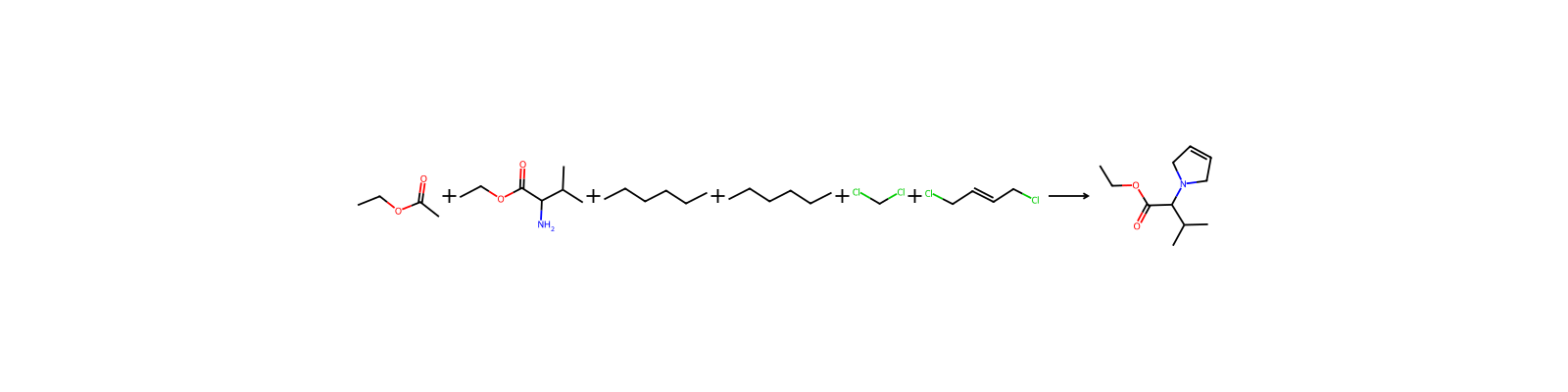
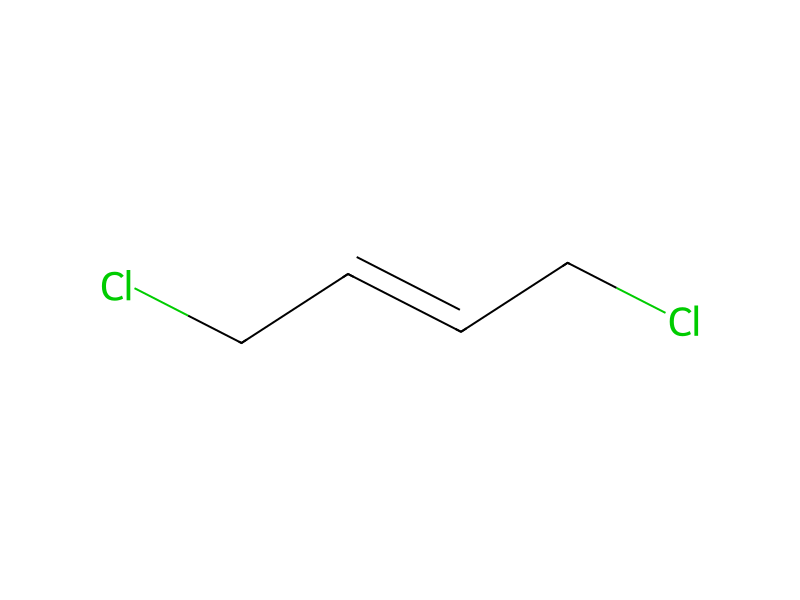
Basic information
- Standard SMILES
ClCC=CCCl- InChIKey
FQDIANVAWVHZIR-UHFFFAOYSA-N- Molecular formula
- C4H6Cl2
- Average molar mass
- 124.99 g/mol
- Monoisotopic mass
- 123.98465555
Overview
1,4-Dichloro-2-butene can cause cancer according to The Environmental Protection Agency (EPA).
Names & identifiers
- Preferred name
- 1,4-Dichloro-2-butene
- IUPAC
- 1,4-dichlorobut-2-ene
Names & synonyms
1,4-Dichlorobut-2-ene1,4-DICHLORO-2-BUTENE764-41-0DTXSID90273102-Butene, 1,4-dichloro-2-Butylene dichloride1,4-Dichloro-2-butyleneDTXCID4028123RefChem:416736212-121-81,4-DCB1,4-Dichlorobutene-2
Show more names
1476-11-51,4-Dichloro-2-butene (cis+trans)ClCH2CH=CHCH2Cl1,4-Dichlorobutene-2 (65% trans-, 35% cis-)1,4-Dichloro-but-2-eneSCHEMBL205123CHEMBL3182125AKOS025243623
Database identifiers
- CAS
1476-11-5、764-41-0- PubChem CID
- 15122
- DTXSID
DTXSID9027310- ChEMBL
CHEMBL3182125- EC Number
- 212-121-8
Properties
Computed structural properties
- XLogP
- 1.7
- Topological polar surface area
- 0 Ų
- Hydrogen bond donors
- 0
- Hydrogen bond acceptors
- 0
- Rotatable bonds
- 2
- Heavy atoms
- 6
- Formal charge
- 0
- Complexity
- 34.8
Experimental & physicochemical properties
Chemical ClassesOther Classes -> Halogenated Aliphatics, Unsaturated
SpringerMaterials PropertiesNuclear quadrupole resonance spectroscopy
OdorSweet, pungent
Density
1.112 at 68 °F (USCG, 1999) - Denser than water; will sink
1.1858
Density: 1.183 (technical grade mixture) of cis and trans isomers.
1.185 No temp
Color/FormColorless liquid
Solubility
Miscible with benzene, alc, carbon tetrachloride; immiscible with ethylene glycol and glycerol.
Soluble in ether.
Water solubility = 580 mg/l at 25 °C
CorrosivityCorrodes metal when wet. /Dichlorobutene/
Boiling Point
313 °F at 760 mmHg (USCG, 1999)
158 °C
158 °C @760 [mm Hg]
DecompositionWhen heated to decomposition it emits toxic fumes of /hydrogen chloride/.
Melting Point
-54 °F (USCG, 1999)
3.5 °C
3.5 °C
Vapor Pressure
3.0 [mmHg]
Vapor pressure: 74-76 deg/40 mm 85% technical grade mixture
3 mm Hg @ 25 °C
3 [mm Hg] @25 °C
Refractive Index
Index of refraction: 1.4874 technical grade 85% of cis and trans isomers.
Index of refraction: 1.4863 @ 25 °C
Safety & regulation
GHS classification
GHS Classification
Danger
H301: Toxic if swallowed [Danger Acute toxicity, oral]
P203, P260, P262, P264, P270, P271, P273, P280, P284, P301+P316, P301+P330+P331, P302+P352, P302+P361+P354, P304+P340, P305+P354+P338, P316, P318, P320, P321, P330, P361+P364, P363, P391, P403+P233, P405, and P501 (click each P-code to see the statement)
Danger
H226 (47.5%): Flammable liquid and vapor [Warning Flammable liquids]
P203, P210, P233, P240, P241, P242, P243, P260, P262, P264, P270, P271, P273, P280, P284, P301+P316, P301+P330+P331, P302+P352, P302+P361+P354, P303+P361+P353, P304+P340, P305+P354+P338, P316, P318, P320, P321, P330, P361+P364, P363, P370+P378, P391, P403+P233, P403+P235, P405, and P501 (click each P-code to see the statement)
Hazard information
Regulatory Information
Chemical: 2-Butene, 1,4-dichloro-
Hazard Traits - Carcinogenicity
2-Butene, 1,4-dichloro- is listed on the EPA's Chemical Data Reporting (CDR) system. Manufacturers and importers of 2-Butene, 1,4-dichloro- are required to report information about their production and use of this chemical to the EPA under the Toxic Substances Control Act (TSCA). (40 eCFR Part 711)
2-Butylene dichloride: HSNO Approval: HSR002956 Approved with controls
The New Jersey Worker and Community Right to Know Act requires public and private employers to provide information about hazardous substances at their workplaces. (N.J.S.A. 34:5A-1 et. seq.)
Other Safety InformationIMAP assessments - 2-Butene, 1,4-dichloro-: Environment tier I assessment
DOT LabelCorrosive Flammable Liquid
Fire HazardsSpecial Hazards of Combustion Products: Decomposition vapors contain phosgene and hydrogen chloride gases; both are toxic and irritating. (USCG, 1999)
Health HazardsInhalation of vapor irritates nose and throat. Contact with eyes causes intense irritation and tears. Contact of liquid with skin causes severe blistering and dermatitis. Ingestion causes severe irritation of mouth and stomach. (USCG, 1999)
Hazards Summary
Highly toxic; [Quick CPC] When heated, decomposes to toxic gases: phosgene and HCl; High inhalation exposure can cause pulmonary edema; [HSDB] Skin contact with liquid causes severe blistering; [CHRIS] Induces genetic damage in germ cells of humans or animals (3A); [MAK] Reacts with water forming hydrochloric acid; Vapor is irritating to nose and throat; Highly irritating to skin (blistering) and eyes (lachrymation); [CAMEO] Generally available in the US as a mixture of 95-98% trans- (CAS# 110-57-6) and 2-5% cis- (CAS#1476-11-5) isomers; [OECD SIDS] Causes burns and lachrymation; Inhalation may cause corrosive injuries to upper respiratory tract and lungs; Highly toxic by inhalation; Toxic by ingestion and skin absorption; [Aldrich MSDS] See 1,4-Dichloro-trans-2-butene.
Reactive GroupHalogenated Organic Compounds
Special Reports
A REVIEW WITH 17 REFERENCES ON ACUTE TOXICITY OF CHLOROPRENE, 1,3-DICHLORO-2-BUTENE, & 1,4-DICHLORO-2-BUTENE. DATA INCL MUTAGENIC, SKIN, EYE & INHALATION TESTING, LETHAL, & TERATOGENIC DOSE VALUES.[CLARY JJ; ENVIRON HEALTH PERSPECT 21: 269-74 (1977)]
RCRA Requirements
U074; As stipulated in 40 CFR 261.33, when 1,4-dichloro-2-butene, as a commercial chemical product or manufacturing chemical intermediate or an off-specification commercial chemical product or a manufacturing chemical intermediate, becomes a waste, it must be managed according to Federal and/or State hazardous waste regulations. Also defined as a hazardous waste is any residue, contaminated soil, water, or other debris resulting from the cleanup of a spill, into water or on dry land, of this waste. Generators of small quantities of this waste may qualify for partial exclusion from hazardous waste regulations (40 CFR 261.5).
Reactivity AlertsHighly Flammable
Reactivity Profile
Halogenated unsaturated aliphatic compounds, such as 1,4-DICHLORO-2-BUTENE, are moderately or very reactive. Halogenated organics generally become less reactive as more of their hydrogen atoms are replaced with halogen atoms. Low molecular weight haloalkanes are highly flammable and can react with some metals to form dangerous products. Materials in this group are incompatible with strong oxidizing and reducing agents. Also, they are incompatible with many amines, nitrides, azo/diazo compounds, alkali metals, and epoxides.
Flammable Limits1.5-4.0% /Dichlorobutene/
Safety & protection
Fire FightingExcerpt from ERG Guide 132 [Flammable Liquids - Corrosive]:
First AidINHALATION: remove from exposure; provide low-pressure oxygen if required; keep under observation until edema is ruled out.
Firefighting HazardsIf fire becomes uncontrollable or container is exposed to direct flame- evacuate for a radius of 1500 ft. If material leaking (not on fire), downwind evacuation must be considered. /Dichlorobutene, flammable liquid, corrosive/
Fire Fighting Procedures
When fighting fires wear goggles and self-contained breathing apparatus. Extinguish with water, dry chemicals, foam, or carbon dioxide. /Dichlorobutene/
If material on fire or involved in fire: Use water in flooding quantities as fog. Cool all affected containers with flooding quantities of water. Apply water from as far a distance as possible. Solid streams of water may be ineffective. Use foam, dry chemical, or carbon dioxide. Use water spray to knock-down vapors. /Dichlorobutene/
Storage ConditionsStorage temperature: ambient /Dichlorobutene/
Nonfire Spill ResponseExcerpt from ERG Guide 132 [Flammable Liquids - Corrosive]:
Disposal MethodsGenerators of waste (equal to or greater than 100 kg/mo) containing this contaminant, EPA hazardous waste number U074, must conform with USEPA regulations in storage, transportation, treatment and disposal of waste.
Preventive Measures
If material not on fire and not involved in fire: Keep sparks, flames, and other sources of ignition away. Keep material out of water sources and sewers. Build dikes to contain flow as necessary. Use water spray to knock-down vapors. /Dichlorobutene/
Personnel protection: Avoid breathing vapors. Keep upwind. Avoid bodily contact with the material. ... Do not handle broken packages unless wearing appropriate personal protective equipment. Wash away any material which may have contacted the body with copious amounts of water or soap and water. Wear positive pressure self-contained breathing apparatus when fighting fires involving this material. If contact with the material anticipated, wear appropriate chemical protective clothing. /Dichlorobutene/
Isolation and EvacuationExcerpt from ERG Guide 132 [Flammable Liquids - Corrosive]:
Threshold Limit Values (TLV)
0.005 [ppm]
8 hr Time Weighted Avg (TWA): 0.005 ppm, skin.
Excursion Limit Recommendation: Excursions in worker exposure levels may exceed 3 times the TLV-TWA for no more than a total of 30 minutes during a work day, and under no circumstances should they exceed 5 times the TLV-TWA, provided that the TLV-TWA is not exceeded.
A2; Suspected human carcinogen.
Protective Action Criteria (PAC)
0.015 [ppm]
0.63 [ppm]
3.8 [ppm]
Personal Protective Equipment (PPE)
Rubber gloves; chemical splash goggles; rubber boots and apron; barrier cream; organic canister mask. (USCG, 1999)
Rubber gloves; chemical splash goggles; rubber boots & apron; barrier cream; organic canister mask. /Dichlorobutene/
Penetration rate for neoprene, or PVC on cotton, ranged between 27-38 ug/min x sq cm. While the rate for NBR rubber was 156 ug/min x sq cm.
Chemical protective clothing composed of polyvinyl alcohol (PVA), Viton (a proprietary fluoroelastomer), or Saranex (a multilayer laminate greater than 0.15 cm in thickness of polyethylene and Saran) is highly recommended, having break through times greater than one hour. Butyl rubber or polyethylene may be used but data suggests break through times of approximately an hour or more. Protective clothing composed of natural rubber, nitrile, chlorinated polyethylene, or polyvinyl chloride (material less than 0.015 cm thick) is not recommended since break through times were found to be significantly less than one hour.
Personnel protection: ... Wear appropriate chemical protective gloves, boots and goggles. /Dichlorobutene/
Toxicology
Ecotoxicity ValuesLD50 Poecilia reticulata (Guppy) << 40 mg/l/7 day
Environmental Fate
TERRESTRIAL FATE: Based on a classification scheme(1), a Koc value of 215(2) indicates that 1,4-dichloro-2-butene is expected to have moderate mobility in soil(SRC). Volatilization of 1,4-dichloro-2-butene from moist soil surfaces is expected to be an important fate process(SRC) given an estimated Henry's Law constant of 5.8X10⁻⁴ atm-cu m/mole(SRC), based upon its vapor pressure, 3 mm Hg(3), and water solubility, 580 mg/l(3). The potential for volatilization of 1,4-dichloro-2-butene from dry soil surfaces may exist(SRC) based upon its vapor pressure(3). In a soil degradation study, approximately 5-15% of initially added 1,4-dichloro-2-butene was recovered in gas-traps after a 7-day period indicating soil volatilization had occurred(2). Soil degradation studies conducted over a week incubation period in a sandy loam and silt loam soils found degradation half-lives of 1.8 to 2.5 days in both sterile and non-sterile soils(2); degradation rates in non-sterile soils were not significantly faster than in sterile soils indicating that abiotic or evaporative processes were more important than biological processes for 1,4-dichloro-2-butene (cis-isomer)(2,4). The hydrolysis half-life of 1,4-dichloro-2-butene was measured as 3.2 days under neutral conditions(5), suggesting hydrolysis may be an important fate process in moist soils.
AQUATIC FATE: Based on a classification scheme(1), a Koc value of 215(SRC), indicates that 1,4-dichloro-2-butene is not expected to adsorb to suspended solids and sediment(SRC). Volatilization from water surfaces is expected(3) based upon an estimated Henry's Law constant of 5.8X10⁻⁴ atm-cu m/mole(SRC), based upon its vapor pressure, 3 mm Hg(4), and water solubility, 580 mg/l(4). Using this Henry's Law constant and an estimation method(3), volatilization half-lives for a model river and model lake are 2 hours and 5 days, respectively(SRC). According to a classification scheme(5), an estimated BCF of 14(SRC), from its water solubility(4) and a regression-derived equation(3), suggests the potential for bioconcentration in aquatic organisms is low. The hydrolysis half-life of 1,4-dichloro-2-butene was measured as 3.2 days under neutral conditions(6). Limited soil data suggest that biodegradation will not be an important fate process in water since volatilization and hydrolysis are expected to occur rapidly(2,7).
ATMOSPHERIC FATE: According to a model of gas/particle partitioning of semivolatile organic compounds in the atmosphere(1), 1,4-dichloro-2-butene, which has a vapor pressure of 3 mm Hg at 25 °C(1) is expected to exist solely as a vapor in the ambient atmosphere. Vapor-phase 1,4-dichloro-2-butene is degraded in the atmosphere by reaction with photochemically-produced hydroxyl radicals and ozone molecules(SRC). The half-life for the reaction in air is estimated to be 12 hours for the cis isomer and about 10 hours for the trans isomer(SRC), calculated from its rate constants of 3.3X10⁻¹¹ cu cm/molecule-sec and 3.7X10⁻¹¹ cu cm/molecule-sec at 25 °C(SRC) for the cis and trans isomers, respectively, using a structure estimation method(3). The half-life for the reaction with ozone is estimated to be 16 days for the cis isomer and about 8 days for the trans isomer(SRC), calculated from its rate constants of 7.1X10⁻¹⁹ cu cm/molecule-sec and 1.4X10⁻¹⁸ cu cm/molecule-sec at 25 °C(SRC) for the cis and trans isomers, respectively, using a structure estimation method(3).
Adverse EffectsDermatotoxin - Skin burns.
Soil Adsorption/Mobility
Using sandy loam and silt loam soils, the Koc of 1,4-dichloro-2-butene (cis-isomer) was experimental determined to be 215(1). According to a classification scheme(2), this Koc value suggests that 1,4-dichloro-2-butene has moderate mobility in soil(SRC).
TSCA Test Submissions
Chronic toxicity and oncogenicity were evaluated in male Crl:CD(SD)BR rats exposed to 1,4-dichloro-2-butene (DCB) via inhalation at concentrations of (number of rats): 0 (160), 0.10 (150), 0.31 (150) or 1.0 ppm (128) for 6 hrs/day, 5 days/week for 3-19 months with rats surviving 19 months of exposure held without treatment for an additional 5 months. All groups exhibited infection by Corynebacterium kutscheri which especially affected the chronic toxicity portion of the tests. After adjusting for effects due to the infection, there was a statistical increase in mortality in the high dose group. There were significant dose-related increases in treated groups relative to controls in various nasal tumors (dose group(ppm)/month first observed): benign tumors in the respiratory region of the nasal cavity (1.0/10 months, 0.31/12 months, 0.10/19 months), and malignant tumors in the olfactory region (1.0/12 months, 0.31/19 months). The increase in tumor incidence was statistically significant at all exposure concentrations for benign tumors, at 1.0 ppm for malignant tumors and at 0.3 and 1.0 ppm for both types of tumors combined. The infection did not appear to affect tumor incidence although the infection reduced the numbers of rats at risk due to an increased mortality.
Chronic toxicity and oncogenicity were evaluated in male and female Charles River Chr:CD rats (140/sex/group) exposed to 1,4-dichloro-2-butene (DCB) via inhalation at concentrations of 0, 0.5 for 6 hrs/day, 5 days/week for 2 yrs or at 5.0 ppm for 7 months followed by 2.5 ppm for 17 months (reduced due to excessive body weight loss and respiratory difficulty). There were significant dose-related differences between high-dose level and control animals of both sexes in the following: body weights and mortality (decreased and increased respectively), poorly differentiated and highly invasive nasal carcinomas and tracheal epithelial metaplasia (increased at 1 yr sacrifice), benign nasal adenomas (at 18 months), and primarily malignant nasal tumors, many of which metastasized to the cervical lymph nodes and lungs, including adenomas/carcinomas, squamous cell carcinomas, mixed carcinomas, rhabdomyosarcomas, and carcinosarcomas and a few benign nasal tumors (at 2 yrs). Pulmonary squamous cell carcinomas were observed in 3 high-dose males. Greater incidences of benign adenomas or hemangiomas and malignant tumors were observed in both sexes at low-dose level. Also observed in high-dose level animals were increases in the following: rhinitis, tracheal luminal exudate, atelectasis, suppurative pneumonia, and hyperplasia of the bone marrow (statistical significance not reported).
Human Toxicity Excerpts
PROTRACTED CONTACT WITH SKIN CAUSES DERMATITIS AND BLISTERING. HIGH CONCN OF VAPOR APPARENTLY HAVE DELAYED TOXIC EFFECT ON EYES, CAUSING ONSET OF IRRITATION AND LACRIMATION SEVERAL HR AFTER THE EXPOSURE, SEEMING SIMILAR TO DIMETHYL SULFATE AND OTHER ALKYLATING AGENTS IN MODE OF ACTION.
IRRITANT TO SKIN ... CAUSES BLISTERS.
HIGH CONCN OF VAPOR APPARENTLY HAVE DELAYED TOXIC EFFECT ON EYES, CAUSING ONSET OF IRRITATION & LACRIMATION SEVERAL HOURS AFTER EXPOSURE ...
... BOTH LIQ AND VAPOR ARE HIGHLY /IRRITATING AND TOXIC/ TO THE SKIN, EYES, LUNG, & INTERNAL ORGANS.
For more Human Toxicity Excerpts (Complete) data for 1,4-DICHLORO-2-BUTENE (6 total), please visit the HSDB record page.
Artificial Pollution Sources
1,4-Dichloro-2-butene's production and use as a starting material in the manufacture of adiponitrile, butane-1,4-diol and tetrahydrofuran(1) may result in its release to the environment through various waste streams (SRC). It also occurs as an intermediate in the production of chloroprene(1).
Environmental Biodegradation
Soil degradation studies conducted over a week incubation period in a sandy loam and silt loam soils found degradation half-lives of 1.8 to 2.5 days in both sterile and non-sterile soils(1); degradation rates in non-sterile soils were not significantly faster than in sterile soils indicating that abiotic or evaporative processes were more important than biological processes for 1,4-dichloro-2-butene (cis-isomer)(1,2).
Environmental Bioconcentration
An estimated BCF of 17 was calculated for 1,4-dichloro-2-butene(SRC), using a water solubility of 580 mg/l(1) and a regression-derived equation(2). According to a classification scheme(3), this BCF suggests the potential for bioconcentration in aquatic organisms is low(SRC).
Volatilization from Water/Soil
The Henry's Law constant for 1,4-dichloro-2-butene is estimated as 5.8X10⁻⁴ atm-cu m/mole(SRC) based upon its vapor pressure, 3 mm Hg(1), and water solubility, 580 mg/l(1). This Henry's Law constant indicates that 1,4-dichloro-2-butene is expected to volatilize from water surfaces(2). Based on this Henry's Law constant, the volatilization half-life from a model river (1 m deep, flowing 1 m/sec, wind velocity of 3 m/sec)(2) is estimated as 2 hours(SRC). The volatilization half-life from a model lake (1 m deep, flowing 0.05 m/sec, wind velocity of 0.5 m/sec)(2) is estimated as 5 days(SRC). 1,4-Dichloro-2-butene's estimated Henry's Law constant(1) indicates that volatilization from moist soil surfaces may occur(SRC). The potential for volatilization of 1,4-dichloro-2-butene from dry soil surfaces may exist(SRC) based upon the vapor pressure of this compound(1). In a soil degradation study, approximately 5-15% of initially added 1,4-dichloro-2-butene (cis-isomer) was recovered in gas-traps after a 7-day period indicating soil volatilization(3).
Non-Human Toxicity Excerpts
INHALATION OF 1.8 MG 1,4-DICHLOROBUTENE/CU M WITHIN 21 DAYS OF PREGNANCY DISTURBED NUCLEIC AND CARBOHYDRATE METABOLISM IN RAT EMBRYOS. GLYCOGEN AND RNA DECR IN THE HEPATOCYTES. RNA ALSO DECR IN THE CEREBRAL GLIA, ALVEOLAR CELLS OF THE LUNGS, AND IN THE EPITHELIUM OF GLOMERULI. POSTIMPLANTATION MORTALITY WAS INCR. HEMORRHAGES OCCURRED IN DIAPHRAGM & STASIS IN LIVER. PLACENTAS SHOWED HYPERVOLEMIA, & THE CANALS & LACUNAE WERE EXTENDED. ACID MUCOPOLYSACCHARIDES INCR IN THE SWOLLEN CONNECTIVE-TISSUE STROMA OF PLACENTAL VILLI. CHORIONIC EPITHELIUM SHOWED DYSTROPHY & RNA WAS DECREASED. THE INCREASED PERMEABILITY OF PLACENTAL VESSELS LED TO DETERIORATION OF THE OXYGEN SUPPLY FOR THE EMBRYOS WHICH IN TURN CAUSED SWELLING, HEMORRHAGES, & THE DECREASE IN RNA. THE SYNDROME WAS AGGRAVATED BY TRANSPLACENTAL TRANSLOCATION OF 1,4-DICHLOROBUTENE. THE SAME ORGANS WHICH WERE AFFECTED IN EMBRYOS WERE ALSO AFFECTED IN THE MOTHERS WHICH SHOWED AN INCREASED VULNERABILITY TO 1,4-DICHLOROBUTENE IN COMPARISON WITH NONPREGNANT RATS.
1,4-DICHLOROBUTENE-2 (76.8% TRANS & 21.6% CIS ISOMER, BP 152 °C) INDUCED RECESSIVE LETHAL MUTATIONS IN DROSOPHILA MELANOGASTER. THE BASIC TECHNIQUE FOR THE DETECTION OF RECESSIVE-LETHAL MUTATIONS ON THE X-CHROMOSOME SERVED TO INDICATE MUTAGENIC ACTIVITY. TEST SUBSTANCE WAS DISSOLVED IN DIMETHYL SULFOXIDE (DMSO) & DIL WITH 5% SUCROSE TO GIVE FINAL DMSO CONTENTS OF 1% & 1,4-DICHLOROBUTENE-2 TEST CONCN OF 2.0, 2.5, 4.0 & 5.0 MMOLAR. ADULT MALES (2-3 DAYS OLD) OF WILD-TYPE STRAIN BERLIN K WERE TREATED AT 25 °C FOR 1-2 DAYS WITH A STD FEEDING TECHNIQUE, THEN INDIVIDUALLY MATED WITH VIRGIN FEMALES AT RATE OF 3-4 FEMALES PER MALE. ALL CULTURES WERE MAINTAINED AT 25 °C & SUSPECTED RECESSIVE LETHALS WERE EXAM IN F3 GENERATION. 1,4-DICHLORO-BUTENE-2 & THE EPOXIDE [1,4-DICHLORO-2,3-EPOXYBUTANE (PURITY 97%, MIXTURE OF CIS & TRANS ISOMERS)] EXERTED ABOUT EQUAL MUTAGENIC ACTIVITIES, FOLLOWED BY 1-CHLOROPRENE WHICH WAS MORE ACTIVE THAN THE LEAST MUTAGENIC CHLOROPRENE. THIS RANKING IS CONSISTENT WITH THE PATTERN OF ACTIVITY OBTAINED FOR THESE CMPD IN THE 4-(4-NITROBENZYL)PYRIDINE (NBP) TEST.
MUTAGENICITY, EXPRESSED AS NUMBER OF HIST+ REVERTANTS PER UMOL OF TEST CMPD PER HR OF EXPOSURE, WAS ESTIMATED IN 2 STRAINS OF SALMONELLA TYPHIMURIUM IN THE PRESENCE OF A POSTMITOCHONDRIAL MOUSE LIVER SUPERNATANT, FOLLOWING EXPOSURE TO 1,4-DICHLOROBUTENE-2 VAPORS. 1,4-DICHLOROBUTENE-2 WAS MUTAGENIC PER SE, & THE ADDITION OF MICROSOMAL FRACTIONS FROM HUMAN OR MOUSE LIVER ENHANCED THE MUTAGENICITY. A SYNTHETIC PUTATIVE METABOLITE, 1,4-DICHLORO-2,3-EPOXYBUTANE WAS LESS MUTAGENIC THAN PARENT OLEFIN IN STRAIN TA100.
Rats were exposed for 6 hr/day on days 6-15 of gestation (sperm-pos vaginal smear considered day 1) to 1,4-dichlorobutene-2 (0.5 and 5.0 ppm). Only effect was reduced rate of wt gain seen at 5.0 ppm level. Exposure did not change either the number of pregnant rats or the number of implantation sites, resorption sites, and fetuses/per female. Treatment did not affect embryonal development. There was a dose-related incr in wavy ribs in the litters and fetuses. However, it was neither embryotoxic nor teratogenic. SRP: In another study, lifetime inhalation studies in rats showed tumors in the nasal turbinate area following exposure to 0.5 or 5 ppm.
For more Non-Human Toxicity Excerpts (Complete) data for 1,4-DICHLORO-2-BUTENE (10 total), please visit the HSDB record page.
Evidence for Carcinogenicity
Classification of carcinogenicity: evidence in animals: inadequate. No epidemiological data relevant to the carcinogenicity of trans-1,4-dichlorobutene were available. Overall summary evaluation of carcinogenic risk to humans is Group 3. The agent is not classifiable as to its carcinogenicity to humans.
A2; Suspected human carcinogen.
Regulatory information
RCRA Requirements
U074; As stipulated in 40 CFR 261.33, when 1,4-dichloro-2-butene, as a commercial chemical product or manufacturing chemical intermediate or an off-specification commercial chemical product or a manufacturing chemical intermediate, becomes a waste, it must be managed according to Federal and/or State hazardous waste regulations. Also defined as a hazardous waste is any residue, contaminated soil, water, or other debris resulting from the cleanup of a spill, into water or on dry land, of this waste. Generators of small quantities of this waste may qualify for partial exclusion from hazardous waste regulations (40 CFR 261.5).
CERCLA Reportable Quantities
Persons in charge of vessels or facilities are required to notify the National Response Center (NRC) immediately, when there is a release of this designated hazardous substance, in an amount equal to or greater than its reportable quantity of 1 lb or .454 kg. The toll free number of the NRC is (800) 424-8802; In the Washington D.C. metropolitan area (202) 426-2675. The rule for determining when notification is required is stated in 40 CFR 302.4 (section IV. D.3.b).
Chemistry & industry
Pharmacology
Metabolism/MetabolitesAN OXIDATION OF THE DOUBLE BOND IN CERTAIN HALO-OLEFINS, WHICH IS DEPENDENT ON MICROSOMAL MONO-OXYGENASES PROBABLY IS A COMMON PATHWAY IN THE FORMATION OF BIOLOGICALLY REACTIVE INTERMEDIATES.
Uses & manufacturing
Uses
Used as an intermediate in chemical manufacturing; [HSDB] Continuously manufactured and processed in closed systems and essentially used 100% as an intermediate; [OECD SIDS]
CHEM INT FOR 3,4-DICHLORO-1-BUTENE (A CHLOROPRENE INT), ADIPONITRILE (A HEXAMETHYLENEDIAMINE INT) & CHEM INT FOR 1,4-BUTANEDIOL (NON-US USE).
1,4-Dichloro-2-butene is used for resolving oil-in-water emulsions.
Used as an intermediate in the production of chloroprene ... is a starting material in the production of adiponitrile, butane-1,4-diol, and tetrahydrofuran.
From 1951 to 1983 DuPont operated a butadiene chlorination process ... the intermediate 1,4-dichloro-2-butene was converted to 3-hexenedinitrile ... and then hydrogenated to adiponitrile.
U.S. Production
2023: 2,700,000 lb
(1977) AT LEAST 4.54X10+9 G
(1982) PROBABLY GREATER THAN 4.54X10+6 G
Consumption PatternsESSENTIALLY 100% AS A CHEM INT FOR 3,4-DICHLORO-1-BUTENE & ADIPONITRILE
Industry UsesMonomers
Methods of Manufacturing
The isomers 3,4-dichlorobutene, cis-1,4-dichlorobutene & trans-1,4-dichlorobutene are produced /by the reaction of chlorine & butadiene/, & when the mixture is heated, an equilibrium results. The residue resulting from removal of the 3,4-isomer ... is normally used without further separation.
Chlorination of butadiene in chloroform or carbon disulfide below 0 °C gives a mixture of 3,4-dichloro-1-butene and 1,4-dichloro-2-butene, in a ratio of about 2:1
Obtained in a yield of 93% by chlorination of butadiene in the vapor phase at 300-350 °C ... dichlorobutene isomers are also formed in the oxychlorination of C4 cracking fractions containing butadiene and isobutene. /Dichlorobutene isomers/
Formulations/Preparations
1,4-DICHLOROBUTENE AVAILABLE IN USA CONTAINS 95-98% TRANS ... & 2-5% CIS ISOMER.
1,4-Dichlorobutene, technical grade, 85%, is a mixture of both cis- and trans- isomers.
General Manufacturing Information
Synthetic Rubber Manufacturing
2-Butene, 1,4-dichloro-: ACTIVE
In the presence of catalyst (at 100 °C), a liquid mixture of dichlorobutenes equilibrates to a composition of 21% 3,4-dichloro-1-butene, and 7% cis-1,4-, and 72% trans-1,4-dichloro-2-butene. The vapor phase above the liquid contains 52, 6, and 42%, respectively, of the isomers.
Related reactions
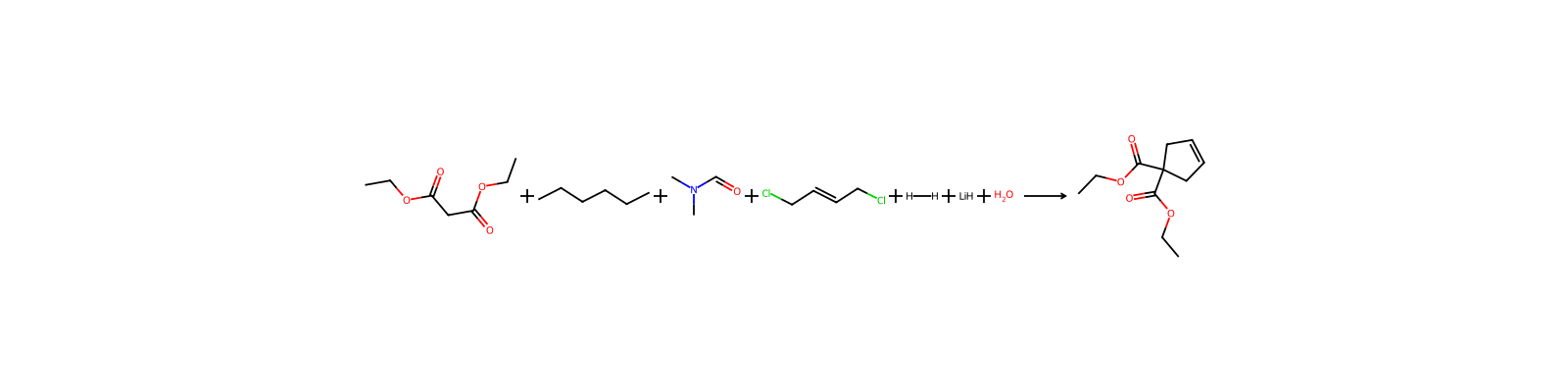
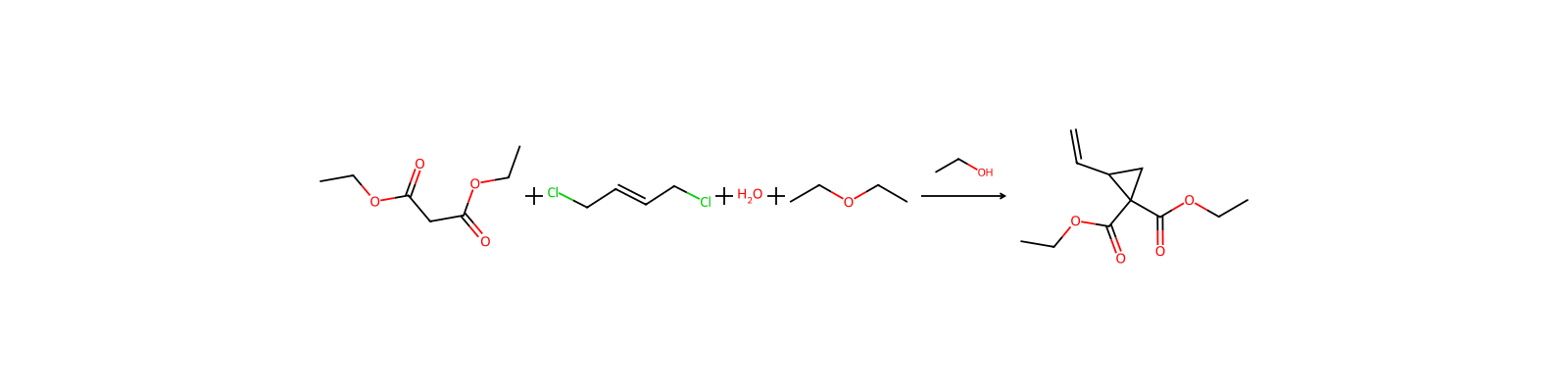
34 records


Linked notes
Loading…