Allylthiourea
ALLYLTHIOUREA · N-ALLYLTHIOUREA · THIOSINAMINE · 1-ALLYL-2-THIOUREA · Tiosinamine · u19571 · U 19571 · AMINOSIN
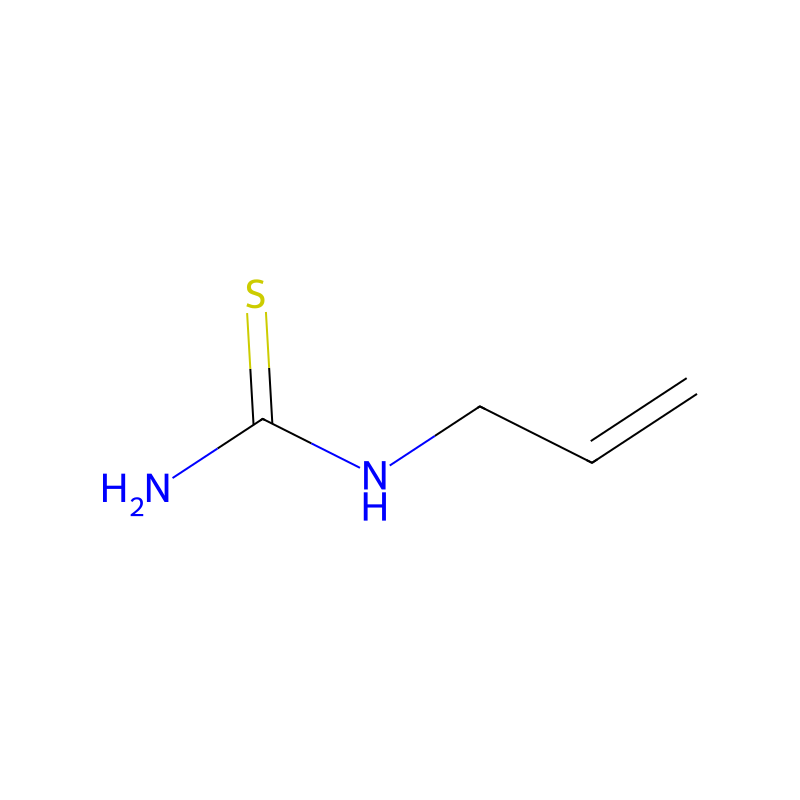
Identifiers & Physical Properties
| CAS No. | 109-57-9 |
|---|---|
| Molecular formula | C4H8N2S |
| Average molar mass | 116.19 g/mol |
| Monoisotopic mass | 116.04081926 g/mol |
| SMILES | C=CCNC(N)=S |
| InChIKey | HTKFORQRBXIQHD-UHFFFAOYSA-N |
| PubChem CID | 1549517 |
| ChEMBL | CHEMBL1451910 |
| ChEBI | CHEBI:74079 |
| EC No. | 203-683-5 |
| DTXSID | DTXSID3024449 |
Chemical & Physical Properties
| XLogP | 0.2 |
|---|---|
| Topological polar surface area | 70.1 |
| Hydrogen bond donors | 2 |
| Hydrogen bond acceptors | 1 |
| Rotatable bonds | 2 |
| Heavy atoms | 7 |
| Formal charge | 0 |
| Complexity | 79.8 |
| SpringerMaterials Properties | Crystal structure |
| Density | 1.11 to 1.22 (NTP, 1992)1.11 g/mL at 25 °C(lit.) |
| Solubility | 10 to 50 mg/mL at 67.1 °F (NTP, 1992)>17.4 [ug/mL] (The mean of the results at pH 7.4)H2O: soluble30 parts67 g/L (20 ºC) |
| Melting point | 158 to 172 °F (NTP, 1992)70-72 °C(lit.) |
| Physical Description | Allylthiourea is a white crystalline solid with a slight garlic odor. (NTP, 1992) |
| Boiling point | 191.3±33.0 °C(Predicted) |
| Bulk density | 550kg/m3 |
| Refractive index | 1.5936 (estimate) |
| Storage conditions | Store below +30°C. |
| Physical state | Powder, Crystals, Granules or Chunks |
| pKa (acidity coefficient) | 14.57±0.70(Predicted) |
| Specific gravity | 1.111.219 (20/20℃) |
| Color | White to light beige |
| Merck | 14,9362 |
| BRN | 1071470 |
| Stability | Stable. Incompatible with strong oxidizing agents. |
| InChI | 1S/C4H8N2S/c1-2-3-6-4(5)7/h2H,1,3H2,(H3,5,6,7) |
| InChIKey | HTKFORQRBXIQHD-UHFFFAOYSA-N |
| SMILES | NC(=S)NCC=C |
| CAS DataBase Reference | 109-57-9(CAS DataBase Reference) |
| EWG's Food Scores | 1 |
| FDA UNII | 706IDJ14B7 |
| NIST Chemistry Reference | Allylthiourea(109-57-9) |
| EPA Substance Registry System | Allylthiourea (109-57-9) |
| UNSPSC Code | 12352111 |
| NACRES | NA.22 |
| GHS pictogram | GHS06 |
| Signal word | Danger |
| GHS hazard statements | H301 |
| GHS precautionary statements | P264-P270-P301+P310-P405-P501 |
| Personal protective equipment (PPE) | Eyeshields, Faceshields, Gloves, type P2 (EN 143) respirator cartridges |
| Hazard symbols | T |
| Risk statements (R) | 25 |
| Safety statements (S) | 45-24/25 |
| UN transport number | UN 2811 6.1/PG 3 |
| Water hazard class (WGK) | 2 |
| RTECS number | YR8050000 |
| TSCA inventory status | TSCA listed |
| Hazard class | 6.1Acute Tox. 3 Oral |
| Packing group | III |
| Customs code | 29309070 |
| Storage class | 6.1C - Combustible acute toxic Cat.3toxic compounds or compounds which causing chronic effects |
| Toxicity | LD50 orally in rats: 200 mg/kg (Dieke) |
Safety & Regulations
| GHS classification | DangerH301 (99.5%): Toxic if swallowed [Danger Acute toxicity, oral]P264, P270, P301+P316, P321, P330, P405, and P501 (click each P-code to see the statement)Aggregated GHS information provided per 197 reports by companies from 6 notifications to the ECHA C&L Inventory. |
|---|---|
| Regulatory information | Chemical: Thiourea, 2-propenyl-Allylthiourea: Does not have an individual approval but may be used under an appropriate group standard |
| DOT label | Poison |
| Fire hazards | Flash point data are not available for this chemical, but it is probably combustible. (NTP, 1992) |
| Health hazards | SYMPTOMS: Contact eczema due to sensitization in humans has been reported. (NTP, 1992) |
| Reactive group | Amides and Imides |
| Reactivity Profile | ALLYLTHIOUREA may react vigorously with strong oxidizing agents. Can react exothermically with reducing agents (such as alkali metals and hydrides) to release gaseous hydrogen. May react exothermically with both acids and bases. May generate flammable gases in combination with aldehydes, nitrides, and hydrides. Incompatible with peroxides and acid halides. |
| Air and Water Reactions | Soluble in water. |
| Hazard Classes and Categories | Acute Tox. 3 (99.5%) |
| Fire fighting | Fires involving this compound should be controlled using a dry chemical, carbon dioxide or Halon extinguisher. (NTP, 1992) |
| First aid | EYES: First check the victim for contact lenses and remove if present. Flush victim's eyes with water or normal saline solution for 20 to 30 minutes while simultaneously calling a hospital or poison control center. Do not put any ointments, oils, or medication in the victim's eyes without specific instructions from a physician. IMMEDIATELY transport the victim after flushing eyes to a hospital even if no symptoms (such as redness or irritation) develop. |
| Nonfire spill response | SMALL SPILLS AND LEAKAGE: If you spill this chemical, you should dampen the solid spill material with water, then transfer the dampened material to a suitable container. Use absorbent paper dampened with water to pick up any remaining material. Seal your contaminated clothing and the absorbent paper in a vapor-tight plastic bag for eventual disposal. Wash all contaminated surfaces with a soap and water solution. Do not reenter the contaminated area until the Safety Officer (or other responsible person) has verified that the area has been properly cleaned. |
| Isolation and Evacuation | Excerpt from ERG Guide 154 [Substances - Toxic and/or Corrosive (Non-Combustible)]: |
| Personal Protective Equipment (PPE) | RECOMMENDED RESPIRATOR: Where the neat test chemical is weighed and diluted, wear a NIOSH-approved half face respirator equipped with an organic vapor/acid gas cartridge (specific for organic vapors, HCl, acid gas and SO2) with a dust/mist filter. (NTP, 1992) |
| Personal protective equipment (PPE) | Eyeshields, Faceshields, Gloves, type P2 (EN 143) respirator cartridges |
| Water hazard class (WGK) | 2 |
| TSCA inventory status | TSCA listed |
| RTECS number | YR8050000 |
| UN transport number | UN 2811 6.1/PG 3 |
| Customs code | 29309070 |
| Toxicity | LD50 orally in rats: 200 mg/kg (Dieke) |
| Risk statements (R) | 25 |
| Signal word | Danger |
| GHS pictogram | GHS06 |
| Hazard symbols | T |
| Safety statements (S) | 45-24/25 |
| Hazard class | 6.1Acute Tox. 3 Oral |
| Storage class | 6.1C - Combustible acute toxic Cat.3toxic compounds or compounds which causing chronic effects |
| Packing group | III |
| GHS hazard statements | H301 |
| GHS precautionary statements | P264-P270-P301+P310-P405-P501 |
Applications & Uses
Uses
N-Allylthiourea is a nitrification inhibitor used in the study on the transformation of diclofenac, naproxen and bisoprolol under aerobic and anaerobic conditions. It is also used in medicine to minimize scar tissue in order to fight against a type of dermatitis. Further, it inhibits the growth of transplanted tumors in mice. It acts as a chelating agent. In addition, it is used in cosmetics, preservative and in organic synthesis.
General Description
White crystalline solid with a slight garlic odor.
Preparation & Synthesis
Preparation
In the presence of potassium iodide, in ethanol solution, chloropropene is reacted with sodium thiocyanide to form allyl isothiocyanate, which is then ammoniated in ammonium hydroxide solution, concentrated, cooled and crystallized, filtered, washed, and recrystallized in ethanol or water to produce Allylthiourea.