HuagongsheHuagongshe Chemistry Print Report · For research reference only
Medronic Acid
MDP · MEDRONIC ACID · methylenediphosphonate · Medronic · medronicaci · MDP~Medronicacid · Medronic acid CRS · Medronic acid - EP
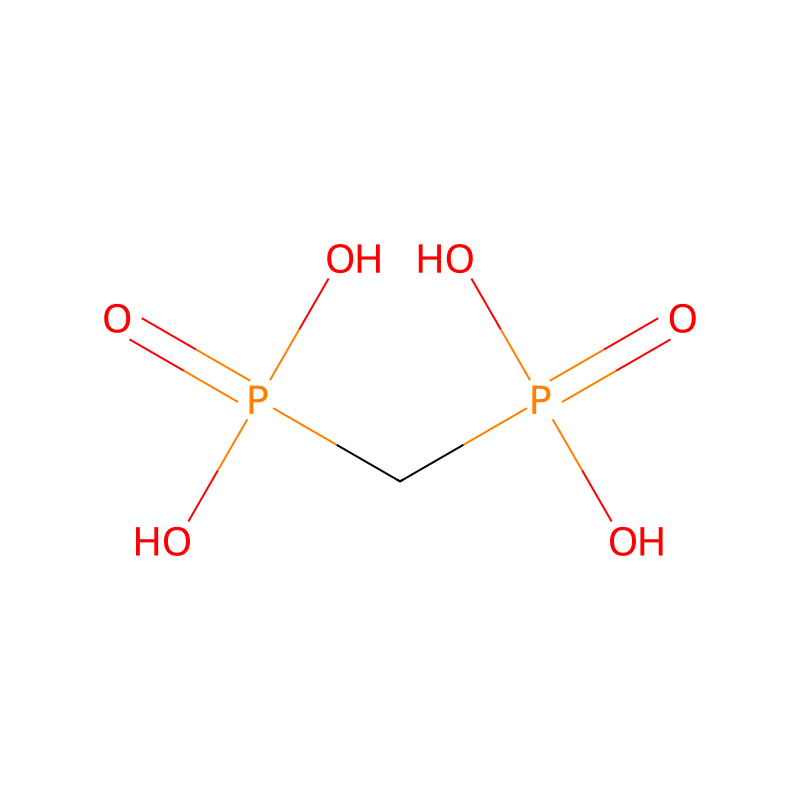
Identifiers & Physical Properties
| CAS No. | 1984-15-2 |
|---|---|
| Molecular formula | CH6O6P2 |
| Average molar mass | 176 g/mol |
| Monoisotopic mass | 175.96396117 g/mol |
| SMILES | O=P(O)(O)CP(=O)(O)O |
| InChIKey | MBKDYNNUVRNNRF-UHFFFAOYSA-N |
| PubChem CID | 16124 |
| ChEMBL | CHEMBL180570 |
| ChEBI | CHEBI:43945 |
| EC No. | 217-851-0 |
| DTXSID | DTXSID8045696 |
Chemical & Physical Properties
| XLogP | -3.3 |
|---|---|
| Topological polar surface area | 115 |
| Hydrogen bond donors | 4 |
| Hydrogen bond acceptors | 6 |
| Rotatable bonds | 2 |
| Heavy atoms | 9 |
| Formal charge | 0 |
| Complexity | 151 |
| Drugs | Pharmaceuticals -> Listed in ZINC15 |
| Human Drugs | Breast FeedingLactationMilk, HumanRadiopharmaceuticalsTechnetium CompoundsDiagnostic Agents |
| Melting point | 197-199 °C(lit.) |
| Boiling point | 583.2±60.0 °C(Predicted) |
| Density | 2.111±0.06 g/cm3(Predicted) |
| Storage conditions | -20°C |
| Solubility | DMSO : 250 mg/mL (1420.45 mMNeed ultrasonic)Soluble in water. |
| pKa (acidity coefficient) | 1.43±0.10(Predicted) |
| Physical state | Moist Crystals or Crystalline Powder |
| Color | Blue |
| Merck | 14,5792 |
| BRN | 1708494 |
| InChI | InChI=1S/CH6O6P2/c2-8(3,4)1-9(5,6)7/h1H2,(H2,2,3,4)(H2,5,6,7) |
| InChIKey | MBKDYNNUVRNNRF-UHFFFAOYSA-N |
| SMILES | C(P(O)(O)=O)P(O)(O)=O |
| CAS DataBase Reference | 1984-15-2(CAS DataBase Reference) |
| FDA UNII | 73OS0QIN3O |
| UNSPSC Code | 41116107 |
| NACRES | NA.52 |
| GHS pictogram | GHS05 |
| Signal word | Danger |
| GHS hazard statements | H314 |
| GHS precautionary statements | P260-P280-P303+P361+P353-P304+P340+P310-P305+P351+P338-P363 |
| Personal protective equipment (PPE) | Eyeshields, Faceshields, Gloves, type P3 (EN 143) respirator cartridges |
| Hazard symbols | C |
| Risk statements (R) | 34 |
| Safety statements (S) | 26-36/37/39-45 |
| UN transport number | UN 3261 8/PG 3 |
| Water hazard class (WGK) | - |
| RTECS number | SZ9138000 |
| F | 3 |
| Hazard class | 8Eye Dam. 1Skin Corr. 1B |
| Packing group | III |
| Customs code | 29319019 |
| Storage class | 8A - Combustible corrosive hazardous materials |
| Toxicity | LD50 in mice, rabbits (mg/kg): 45-50 i.v. (Subramanian, 1975) |
| Limited quantities | 5.0 kg (11 lbs) (solid) |
| Excepted quantities | Max Inner Pack (30g or 30ml) and Max Outer Pack (1Kg or 1L) |
Safety & Regulations
| GHS classification | DangerH314 (100%): Causes severe skin burns and eye damage [Danger Skin corrosion/irritation]P260, P264, P280, P301+P330+P331, P302+P361+P354, P304+P340, P305+P354+P338, P316, P321, P363, P405, and P501 (click each P-code to see the statement)Aggregated GHS information provided per 46 reports by companies from 4 notifications to the ECHA C&L Inventory. |
|---|---|
| Hazard Classes and Categories | Skin Corr. 1B (100%) |
| Effects During Pregnancy and Lactation | ◉ Summary of Use during Lactation |
| F | 3 |
| Personal protective equipment (PPE) | Eyeshields, Faceshields, Gloves, type P3 (EN 143) respirator cartridges |
| Water hazard class (WGK) | - |
| RTECS number | SZ9138000 |
| UN transport number | UN 3261 8/PG 3 |
| Customs code | 29319019 |
| Toxicity | LD50 in mice, rabbits (mg/kg): 45-50 i.v. (Subramanian, 1975) |
| Risk statements (R) | 34 |
| Signal word | Danger |
| GHS pictogram | GHS05 |
| Hazard symbols | C |
| Safety statements (S) | 26-36/37/39-45 |
| Hazard class | 8Eye Dam. 1Skin Corr. 1B |
| Storage class | 8A - Combustible corrosive hazardous materials |
| Packing group | III |
| GHS hazard statements | H314 |
| Limited quantities | 5.0 kg (11 lbs) (solid) |
| Excepted quantities | Max Inner Pack (30g or 30ml) and Max Outer Pack (1Kg or 1L) |
| GHS precautionary statements | P260-P280-P303+P361+P353-P304+P340+P310-P305+P351+P338-P363 |
Applications & Uses
Uses
Radioactive imaging agent
Uses
Methylenediphosphonic acid is a radioactive compound used for skeletal imaging. MDP has been used as a chelating agent to vary calcium levels in cell culture in a study of caffeine storage in bovine chromaffin cells.
Uses
Methylenediphosphonic acid can be used as a precursor in the synthesis of:Mesoporous aluminum organophosphonate in the presence of alkyltrimethylammonium as a surfactant.Tetraester of methylenediphosphonic acids which are used as metal ion extractants for actinides in all oxidation states.
General Description
MDP (Methylenediphosphonic acid) is a phosphonic analog of ATP.