HuagongsheHuagongshe Chemistry Print Report · For research reference only
2,4,6(1H,3H,5H)-Pyrimidinetrione, 5-phenyl-1-(phenylmethyl)-
1-BENZYL-5-PHENYLBARBITURIC ACID · 1-Benzyl-5-phenylpyrimidine-2,4,6(1H,3H,5H)-trione · LABOTEST-BB LT00454619 · Barbituric Acid Impurity 4 · BENZYL-5-PHENYLBARBITURIC ACID · 5-Phenyl-1-benzylbarbituric acid · 1-Benzyl-5-phenyl-1-barbituric acid · 1-Benzyl-5-phenylbarbituric Acid >SODIUM1-BENZYL-5-PHENYLBARBITURICACID
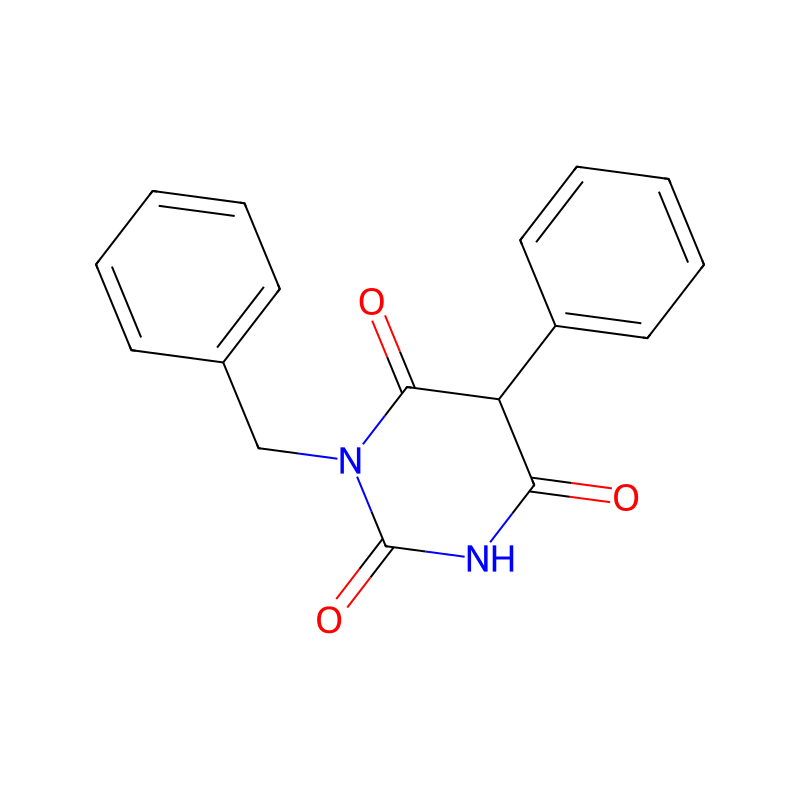
Identifiers & Physical Properties
| CAS No. | 72846-00-5 |
|---|---|
| Molecular formula | C17H14N2O3 |
| Average molar mass | 294.3 g/mol |
| Monoisotopic mass | 294.10044231 g/mol |
| SMILES | O=C1NC(=O)N(Cc2ccccc2)C(=O)C1c1ccccc1 |
| InChIKey | KCWWCWMGJOWTMY-UHFFFAOYSA-N |
| PubChem CID | 166340 |
| EC No. | 276-940-2 |
| DTXSID | DTXSID10888290 |
Chemical & Physical Properties
| XLogP | 2.2 |
|---|---|
| Topological polar surface area | 66.5 |
| Hydrogen bond donors | 1 |
| Hydrogen bond acceptors | 3 |
| Rotatable bonds | 3 |
| Heavy atoms | 22 |
| Formal charge | 0 |
| Complexity | 451 |
| Melting point | 163-165°C |
| Density | 1.304±0.06 g/cm3(Predicted) |
| pKa (acidity coefficient) | 4.29±0.20(Predicted) |
| Solubility | Soluble in acetone. Slightly soluble in water. |
| InChI | InChI=1S/C17H14N2O3/c20-15-14(13-9-5-2-6-10-13)16(21)19(17(22)18-15)11-12-7-3-1-4-8-12/h1-10,14H,11H2,(H,18,20,22) |
| InChIKey | KCWWCWMGJOWTMY-UHFFFAOYSA-N |
| SMILES | C1(=O)N(CC2=CC=CC=C2)C(=O)C(C2=CC=CC=C2)C(=O)N1 |
| LogP (partition coefficient) | 2.3 at 20℃ |
| CAS DataBase Reference | 72846-00-5(CAS DataBase Reference) |
| EPA Substance Registry System | 2,4,6(1H,3H,5H)-Pyrimidinetrione, 5-phenyl-1-(phenylmethyl)- (72846-00-5) |
| GHS pictogram | GHS07 |
| Signal word | Warning |
| GHS hazard statements | H319-H302 |
| GHS precautionary statements | P264-P270-P301+P312-P330-P501-P264-P280-P305+P351+P338-P337+P313P |
| Hazard symbols | T |
| Risk statements (R) | 25 |
| Safety statements (S) | 22-24/25-45 |
| TSCA inventory status | TSCA listed |
| REACH registrations | Active |
Safety & Regulations
| GHS classification | This chemical does not meet GHS hazard criteria for 11.1% (5 of 45) of reports.DangerH301 (84.4%): Toxic if swallowed [Danger Acute toxicity, oral]P264, P270, P301+P316, P321, P330, P405, and P501 (click each P-code to see the statement)Aggregated GHS information provided per 45 reports by companies from 3 notifications to the ECHA C&L Inventory. |
|---|---|
| Regulatory information | Status: Active Update: 08-04-2019 https://echa.europa.eu/registration-dossier/-/registered-dossier/275661-Benzyl-5-phenylbarbituric acid: Does not have an individual approval but may be used as a component in a product covered by a group standard. It is not approved for use as a chemical in its own right. |
| Hazard Classes and Categories | Acute Tox. 3 (84.4%) |
| TSCA inventory status | TSCA listed |
| Risk statements (R) | 25 |
| Signal word | Warning |
| GHS pictogram | GHS07 |
| Hazard symbols | T |
| Safety statements (S) | 22-24/25-45 |
| GHS hazard statements | H319-H302 |
| REACH registrations | Active |
| GHS precautionary statements | P264-P270-P301+P312-P330-P501-P264-P280-P305+P351+P338-P337+P313P |
Applications & Uses
Uses
1-Benzyl-5-phenylbarbituric acid is useful as a pharmaceutical intermediate in organic synthesis.