HuagongsheHuagongshe Chemistry Print Report · For research reference only
Copper(1+) (~13~C)cyanide
Copper Cyanide-13C · 13C]-Copper cyanide · COPPER(I) CYANIDE-13C · CUPROUS CYANIDE (13C) · azanylidynemethane,copper(1+) · COPPER(I) CYANIDE-13C, 99 ATOM % 13C
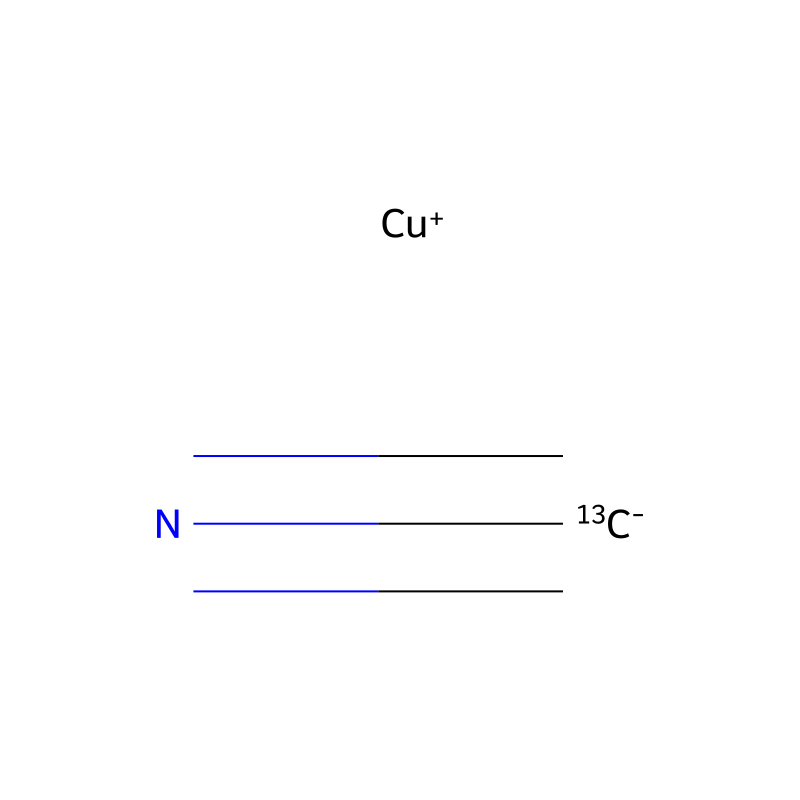
Identifiers & Physical Properties
| CAS No. | 93596-81-7 |
|---|---|
| Molecular formula | CCuN |
| Average molar mass | 90.56 g/mol |
| Monoisotopic mass | 89.93602634 g/mol |
| SMILES | [13C-]#N.[Cu+] |
| InChIKey | DOBRDRYODQBAMW-YTBWXGASSA-N |
| PubChem CID | 17748536 |
| EC No. | 693-121-9 |
| DTXSID | DTXSID50504902 |
Chemical & Physical Properties
| Topological polar surface area | 23.8 |
|---|---|
| Hydrogen bond donors | 0 |
| Hydrogen bond acceptors | 2 |
| Rotatable bonds | 0 |
| Heavy atoms | 3 |
| Formal charge | 0 |
| Complexity | 10 |
| Melting point | 454 °C (lit.) |
| Density | 2.920 g/mL at 25 °C |
| Physical state | Solid |
| Color | White to Off-White |
| InChI | 1S/CN.Cu/c1-2/i1+1 |
| InChIKey | DULSAGLWMRMKCQ-YTBWXGASSA-N |
| SMILES | [Cu][13C]#N |
| UNSPSC Code | 12352101 |
| NACRES | NA.12 |
| CAS Number Unlabeled | 544-92-3 |
| GHS pictogram | GHS06,GHS09 |
| Signal word | Danger |
| GHS hazard statements | H300+H310+H330-H410 |
| GHS precautionary statements | P262-P273-P280-P301+P310+P330-P302+P352+P310-P304+P340+P310 |
| Target organs | Liver,spleen,Bone marrow |
| Hazard symbols | T+,N |
| Risk statements (R) | 26/27/28-32-36/37/38-41-50/53 |
| Safety statements (S) | 22-26-36/37/39-45-61-60-29-28-7 |
| UN transport number | UN 1587 6.1/PG 2 |
| Water hazard class (WGK) | 3 |
| Hazard class | 6.1Acute Tox. 1 DermalAcute Tox. 2 InhalationAcute Tox. 2 OralAquatic Acute 1Aquatic Chronic 1STOT RE 2 Oral |
| Storage class | 6.1B - Non-combustible acute toxic Cat. 1 and 2very toxic hazardous materials |
| Limited quantities | 0.5 Kg (solid) |
| Excepted quantities | Max Inner Pack (1g or 1ml) and Max Outer Pack (500g or 500ml) |
Safety & Regulations
| GHS classification | DangerH300 (100%): Fatal if swallowed [Danger Acute toxicity, oral]P260, P262, P264, P270, P271, P273, P280, P284, P301+P316, P302+P352, P304+P340, P316, P320, P321, P330, P361+P364, P391, P403+P233, P405, and P501 (click each P-code to see the statement)Aggregated GHS information provided per 39 reports by companies from 2 notifications to the ECHA C&L Inventory. Each notification may be associated with multiple companies. |
|---|---|
| Hazard Classes and Categories | Acute Tox. 2 (100%) |
| Water hazard class (WGK) | 3 |
| UN transport number | UN 1587 6.1/PG 2 |
| Risk statements (R) | 26/27/28-32-36/37/38-41-50/53 |
| Signal word | Danger |
| GHS pictogram | GHS06,GHS09 |
| Hazard symbols | T+,N |
| Safety statements (S) | 22-26-36/37/39-45-61-60-29-28-7 |
| Hazard class | 6.1Acute Tox. 1 DermalAcute Tox. 2 InhalationAcute Tox. 2 OralAquatic Acute 1Aquatic Chronic 1STOT RE 2 Oral |
| Storage class | 6.1B - Non-combustible acute toxic Cat. 1 and 2very toxic hazardous materials |
| Target organs | Liver,spleen,Bone marrow |
| GHS hazard statements | H300+H310+H330-H410 |
| Limited quantities | 0.5 Kg (solid) |
| Excepted quantities | Max Inner Pack (1g or 1ml) and Max Outer Pack (500g or 500ml) |
| GHS precautionary statements | P262-P273-P280-P301+P310+P330-P302+P352+P310-P304+P340+P310 |
Applications & Uses
Uses
Copper Cyanide-13C is used in the investigation of the biosynthesis of quinolactacin, a tumor necrosis factor (TNF) production inhibitor that have been implicated in variety of human diseases including Alzheimer's disease, cancer, major depression and inflammatory bowel disease. Unlabelled Copper Cyanide is useful as a catalyst and as a reagent in the preparation of nitriles.