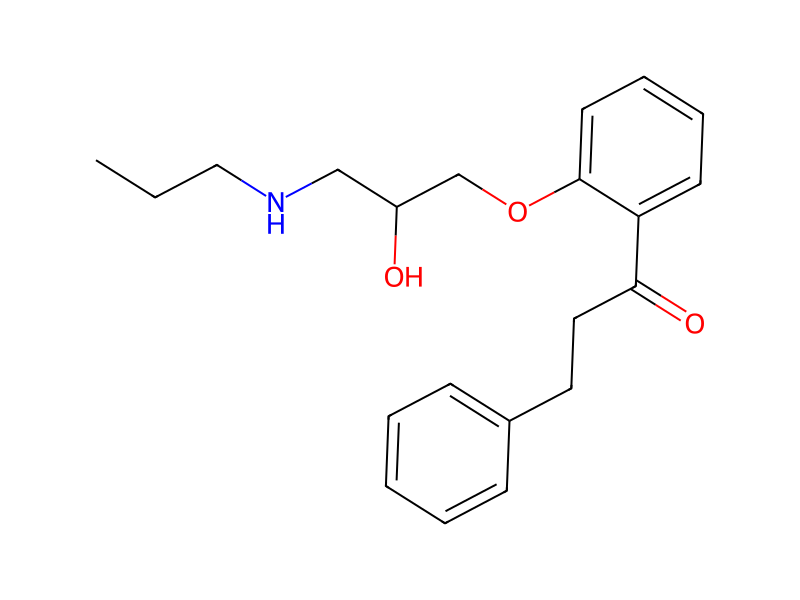
Basic information
- Standard SMILES
CCCNCC(O)COc1ccccc1C(=O)CCc1ccccc1- InChIKey
JWHAUXFOSRPERK-UHFFFAOYSA-N- Molecular formula
- C21H27NO3
- Average molar mass
- 341.444 g/mol
Names & identifiers
- Preferred name
- Paraffin wax
- English name
- Paraffin wax
- Molecular formula
- C21H27NO3
- Molecular weight
- 341.44398
Names & synonyms
Database identifiers
- CAS
8002-74-2
Properties
Physicochemical properties
- Melting point
- 58 · 58-62 °C ((ASTM D 87))
- Boiling point
- 322 °C · 322 °C
- Density
- 0.82 g/mL · 0.82 g/mL at 20 °C
- vapor pressure
- 0.1 hPa · <0.1 hPa ( 20 °C)
- FEMA
- 3216 · 3216 | PARAFFIN WAX
- refractive index
- 20 · n20/D 1.45
- Flash point
- 113 °C · 113 °C
- storage temp.
- 30 °C · Store below +30°C.
- solubility
- Soluble in chloroform, ether, volatile oils, and most warm fixed oils; slightly soluble in ethanol; practically insoluble in acetone, ethanol (95%), and water. Paraffin can be mixed with most waxes if melted and cooled.
- form
- extra-low viscosity oil
- color
- white
- Odor
- odorless
- PH
- 7 · 7
- explosive limit
- 0.6 · 0.6-6.5%(V)
- Odor Type
- odorless
- Viscosity
- 5000 mPa.s · ~5000mPa.s(20°C)
- Exposure limits
- 2 mg/m3; · PC-TWA: 2 mg/m3; PC-STEL: 4 mg/m3
- Dielectric constant
- 2.1 · 2.1-2.5(0.0℃)
- Cosmetics Ingredients Functions
- SKIN CONDITIONINGVISCOSITY CONTROLLINGABRASIVEFRAGRANCEEMULSION STABILISINGBINDINGPERFUMING
- Cosmetic Ingredient Review (CIR)
- Paraffin wax (8002-74-2)
- InChIKey
- JWHAUXFOSRPERK-UHFFFAOYSA-N
- CAS DataBase Reference
- 8002 · 8002-74-2
- Substances Added to Food (formerly EAFUS)
- PARAFFIN WAX
- FDA 21 CFR
- 175.21 · 175.210; 175.300; 178.3800
- EWG's Food Scores
- 1 · 1
- FDA UNII
- 9 O0E3H2ZE · I9O0E3H2ZE
- EPA Substance Registry System
- Paraffin waxes and Hydrocarbon waxes (8002-74-2)
- UNSPSC Code
- 41116107 · 41116107
- NACRES
- 51 · NB.51
- Symbol(GHS)
- 7 · GHS07
- Signal word
- Warning
- Hazard statements
- 319 · H319
- Precautionary statements
- 264 · P264-P280-P305+P351+P338-P337+P313P
- PPE
- 95 · Eyeshields, Gloves, type N95 (US)
- OEB
- B
- OEL
- 2 mg/m3 · TWA: 2 mg/m3
- WGK Germany
- -
- RTECS
- 350000 · RV0350000
- Autoignition Temperature
- 300 °C · >300 °C
- TSCA
- TSCA listed
- HS Code
- 27101999 · 27101999
- Storage Class
- 13 · 13 - Non Combustible Solids
- Toxicity
- 50 orally · LD50 orally in Rabbit: > 5000 mg/kg LD50 dermal Rabbit > 3600 mg/kg
- REACH Registrations
- Active
Safety & regulation
Safety data
- OEB
- B
- OEL
- TWA: 2 mg/m3
- PPE
- Eyeshields, Gloves, type N95 (US)
- wgk
- -
- tsca
- TSCA listed
- rtecs
- RV0350000
- hs_code
- 27101999
- Toxicity
- LD50 orally in Rabbit: > 5000 mg/kg LD50 dermal Rabbit > 3600 mg/kg
- Signal word
- Warning
- Symbol(GHS)
- GHS07
- Storage Class
- 13 - Non Combustible Solids
- Hazard statements
- H319
- REACH Registrations
- Active
- Autoignition Temperature
- >300 °C
- Precautionary statements
- P264-P280-P305+P351+P338-P337+P313P
Chemistry & industry
Applications
DescriptionParaffin wax is mostly found as a white, odorless, tasteless, waxy solid, with a typical melting point between about 46 and 68°C (115 and 154°F) and a density of approximately 900, is insoluble in water, but soluble in ether, benzene, and certain esters. Paraffin wax is often classed as a stable chemical since it is unaffected by most common chemical reagents but burns readily.Paraffin wax is the common name for the mixture of solid higher alkanes, the molecular formula is CnH2n+2, where n=20-40. The excess oil residue in the wax is removed through the process of petroleum refining. It is then deoiled and separated by vacuum distillation. The main component of refined paraffin is saturated normal alkanes with carbon number of about 20-40, containing a small amount of isomers and alkanes.
UsesUsed in the production of candles, crayons, wax paper, rubber, wires, cables, plates, waterproof materials, electrical insulation, food packaging, precision casting, general telecommunications equipment, textiles, printing, metal rust prevention, and other chemicals required by various industrial sectors raw material.Paraffin wax can also be used for oxidation to generate synthetic fatty acids. Paraffin wax can also be made into detergents, emulsifiers, dispersants, plasticizers, greases, etc.As a kind of latent heat storage material, paraffin wax has the advantages of large latent heat of phase change, small volume change during solid-liquid phase change, good thermal stability, no supercooling phenomenon, and low price. It is used in aviation, aerospace, microelectronics, etc. Various fields such as scientific and technological systems and house energy saving have been widely used.
OccurrenceParaffin wax is a hydrocarbon mixture extracted from certain distillates of petroleum, shale oil or other bituminous mineral oils. The main component is solid alkanes, which is odorless and tasteless, and is a white or light yellow translucent solid. Paraffin wax has many uses, mainly used in the manufacture of matches, fiberboard, tarpaulin and so on.
DescriptionParaffin wax, also commonly called ‘paraffin’, is a colourless or white, tasteless, odourless, translucent waxy solid. Paraffin wax has a typical melting point between about 46°C and 68°C. Pure paraffin wax is a combustible substance and insoluble in water but soluble in petroleum solvents and stable under normal conditions of use. Paraffin has been identified as an excellent electrical insulator. It is also used in the manufacturing of paraffin papers, candles, food packaging materials, varnishes, floor polishes, to extract perfumes from flowers, in lubricants, and cosmetics. It is also used in water-proofing wood, and cork.
UsesParaffin wax, or hard wax, is a mixture of solid hydrocarbons, mainly alkanes. Paraffinwaxcan beadded to medicinal agents. Petroleumwax and petrolatum are the only hydrocarbons permitted for use in food products. Paraffin wax is used as a household wax and extensively as a coating for food containers and wrappers.
UsesParaffin Wax is used to embed tissues to be used in research.
UsesParaffin wax can be used as a phase changing material in a wide range of applications which include solar based water heaters, microcapsules and thermal energy devices (TEDs).
General DescriptionWhite translucent tasteless odorless solids. Density 0.88- 0.92 g / cm3. Insoluble in water. Melting range 47-65°C. Used in candles, lubricants, crayons, floor polishes, cosmetics, chewing gum.
Upstream & downstream products
Upstream raw materials
Downstream products
Suppliers50 total
Additional notes
DefinitionA solid mixture of hydrocarbons, obtained from petroleum.
Related reactions
No reaction records under the current filter.
Linked notes
Loading…