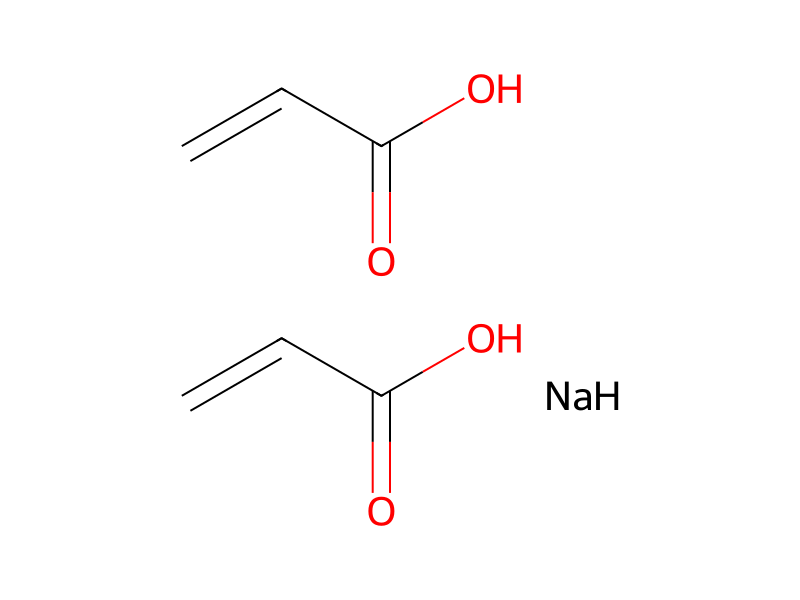
Basic information
- Standard SMILES
C=CC(=O)O.C=CC(=O)O.[NaH]- InChIKey
TZQMDQFENNRYRY-UHFFFAOYSA-N- Molecular formula
- C6H9NaO4
- Average molar mass
- 168.12 g/mol
Names & identifiers
- Preferred name
- POLY(ACRYLIC ACID) PARTIAL NA SALT
- English name
- POLY(ACRYLIC ACID) PARTIAL NA SALT
- Molecular formula
- C6H9NaO4
- Molecular weight
- 168.12
Names & synonyms
Database identifiers
- CAS
9033-79-8
Properties
Physicochemical properties
- Density
- 1.2 g/mL · 1.2 g/mL at 25 °C
- refractive index
- 20 · n20/D 1.442
- color
- White
- FDA UNII
- 4 PPW69Y4H · M4PPW69Y4H
- EPA Substance Registry System
- Acrylic acid sodium acrylate polymer (9033-79-8)
- UNSPSC Code
- 12162002 · 12162002
- NACRES
- 23 · NA.23
- Symbol(GHS)
- 7 · GHS07
- Signal word
- Warning
- Hazard statements
- 319 · H319
- Precautionary statements
- 264 · P264-P280-P305+P351+P338-P337+P313P
- PPE
- Eyeshields, Gloves
- WGK Germany
- 1 · 1
- TSCA
- TSCA listed
- Storage Class
- 10 · 10 - Combustible liquids
Safety & regulation
Safety data
- PPE
- Eyeshields, Gloves
- wgk
- 1
- tsca
- TSCA listed
- Signal word
- Warning
- Symbol(GHS)
- GHS07
- Storage Class
- 10 - Combustible liquids
- Hazard statements
- H319
- Precautionary statements
- P264-P280-P305+P351+P338-P337+P313P
Chemistry & industry
Applications
UsesSodium salt of poly (acrylic acid) may be used as a major component of non glare coatings for headlights.It acts as an antiscaling agents.It′s effect of the salt on the crystal (Cu and MS metals) formation was studied. General applications of these superabsorbents are in many fields such as agriculture and horticulture, sanitary goods, sealing composites, component of moisture barrier tapes and coatings, humidity control, gel actuators. and medicine for drug-delivery systems.
General DescriptionSodium salt of poly(acrylic acid) is a superabsorbent polymer. Superabsorbents are composed of crosslinked networks of hydrophilic polymers. It can absorb and retain a large capacity of water based fluids, the release of the absorbed fluids is tough even under an applied pressure. Absorption capacity is inversely proportional to salt concentration and applied load.They are formed via solution or inverse-suspension polymerization techniques.
Upstream & downstream products
Upstream raw materials
Suppliers14 total
Related reactions
No reaction records under the current filter.
Linked notes
Loading…