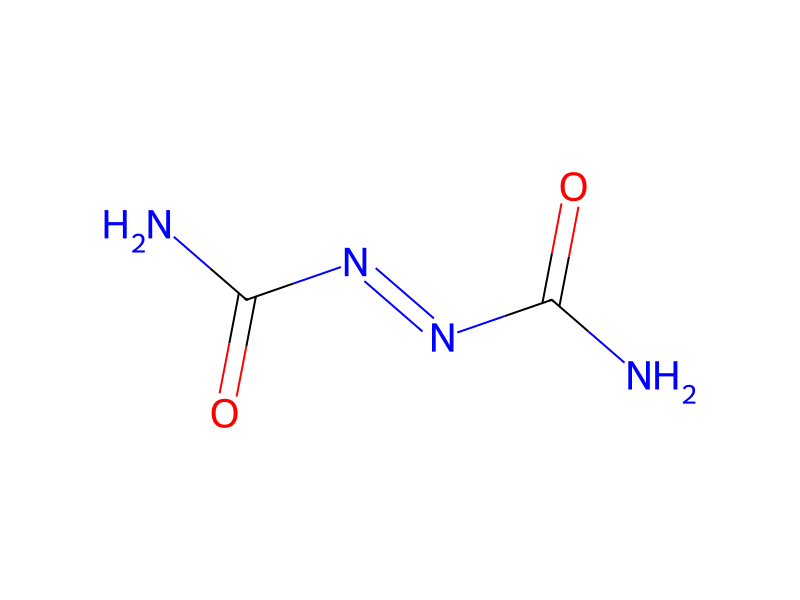
Basic information
- Standard SMILES
NC(=O)/N=N/C(N)=O- InChIKey
XOZUGNYVDXMRKW-AATRIKPKSA-N- Molecular formula
- C2H4N4O2
- Average molar mass
- 116.08 g/mol
Overview
Azodicarbonamide appears as a yellow to orange powder. Insoluble in water and common solvents. Soluble in dimethyl sulfoxide. Nontoxic.
Names & identifiers
- Preferred name
- Azodicarbonamide
- IUPAC
- (E)-carbamoyliminourea
- English name
- (E)-carbamoyliminourea
- Molecular formula
- C2H4N4O2
- Molecular weight
- 0
Names & synonyms
Show more names
Database identifiers
- CAS
97707-96-5- ChEMBL
CHEMBL28517- ChEBI
CHEBI:156571- UNII
- 56Z28B9C8O
- EC Number
- 204-650-8
- Nikkaji
- J3.621H
Properties
Computed structural properties
- XLogP
- -1
- Topological polar surface area
- 111 Ų
- Hydrogen bond donors
- 2
- Hydrogen bond acceptors
- 2
- Rotatable bonds
- 0
- Heavy atoms
- 8
- Formal charge
- 0
- Complexity
- 123
Experimental & physicochemical properties
LogP
log Kow = -1.7
-1.70
Density
1.65 at 68 °F (NTP, 1992) - Denser than water; will sink
1.65 @ 20 °C
Relative density (water = 1): 1.65
1.65 @ 20°C
Color/Form
Orange-red crystals
Yellow powder
Pale yellow crystalline
Solubility
less than 0.1 mg/mL at 70 °F (NTP, 1992)
SLIGHTLY SOL IN ETHER; INSOL IN ORGANIC SOLVENTS
Soluble in dimethyl sulfoxide; insoluble in common solvents
Very slightly soluble in hot water; insoluble in alcohol
In water, 35 mg/liter @ 20 °C
0.035 mg/mL at 20 °C
Flash Point
205 °F (NTP, 1992)
205 °F
Decomposition
When heated to decomposition it emits toxic fumes of /nitrogen oxides/.
... 1,1'-azobisformamide, which like all azo compounds yields nitrogen when heated to decomposition.
/Azoformamide/ shows a high rate of pressure rise on thermal decomposition. Energy of decomposition (in range 160-230 °C) measured as 1.36 kJ/g by /Differential Scanning Calorimeter/, and Tait24 was determined as 120 °C by adiabatic Dewar tests, with an apparent energy of activation of 131 kJ/mol.
225 °C
Melting Point
437 °F (decomposes) (NTP, 1992)
225 °C (decomposes)
225 °C
225 °C
Vapor Pressure
7.1 mmHg at 66.2 °F ; 10.7 mmHg at 79.7 °F (NTP, 1992)
Vapor pressure: 3.2X10⁻⁸ hPa @ 50 °C; 1.3X10⁻⁷ hPa @ 60 °C
1.88X10⁻¹⁰ mm Hg @ 20 °C
Safety & regulation
GHS classification
GHS Classification
Danger
H334: May cause allergy or asthma symptoms or breathing difficulties if inhaled [Danger Sensitization, respiratory]
P233, P260, P271, P284, P304+P340, P342+P316, P403, and P501 (click each P-code to see the statement)
Danger
H334 (100%): May cause allergy or asthma symptoms or breathing difficulties if inhaled [Danger Sensitization, respiratory]
P233, P260, P271, P284, P304+P340, P342+P316, P403, and P501 (click each P-code to see the statement)
Hazard information
Regulatory Information
Chemical: Diazenedicarboxamide
Hazard Traits - Respiratory Toxicity
1,2-Diazenedicarboxamide is listed on the EPA's Chemical Data Reporting (CDR) system. Manufacturers and importers of 1,2-Diazenedicarboxamide are required to report information about their production and use of this chemical to the EPA under the Toxic Substances Control Act (TSCA). (40 eCFR Part 711)
Status: Active Update: 15-11-2022 https://echa.europa.eu/registration-dossier/-/registered-dossier/15242
Substance: Diazene-1,2-dicarboxamide (C,C'-azodi(formamide)) (ADCA)
Diazenedicarboxamide: HSNO Approval: HSR001264 Approved with controls
Fire Hazards
Excerpt from ERG Guide 149 [Substances (Self-Reactive)]:
· Self-decomposition, self-polymerization, or self-ignition may be triggered by heat, chemical reaction, friction or impact.
Flammable. Gives off irritating or toxic fumes (or gases) in a fire.
Health Hazards
Excerpt from ERG Guide 149 [Substances (Self-Reactive)]:
· Inhalation or contact with vapors, substance or decomposition products may cause severe injury or death.
Hazards Summary
Occupational asthma reported in workers manufacturing plastic and rubber products; [Malo] [Yates VM, et al. Contact dermatitis from azodicarbonamide in earplugs. Contact Dermatitis. 1988 Aug;19(2):155-6. No abstract available.] [Allergic contact dermatitis to azodicarbonamide. Bonsall JL. Contact Dermatitis. 1984 Jan;10(1):42. No abstract available.] An eye and respiratory tract irritant; A skin sensitizer; May cause asthma; [ICSC]
FDA Requirements
The food additive azodicarbonamide may be safely used in food in accordance with the following prescribed conditions: (a) It is used or intended for use: (1) As an aging and bleaching ingredient in cereal flour in an amount not to exceed 2.05 grams per 100 pounds of flour (0.0045 percent; 45 parts per million). (2) As a dough conditioner in bread baking in a total amount not to exceed 0.0045 percent (45 parts per million) by weight of the flour used, including any quantity of azodicarbonamide added to flour in accordance with paragraph (a)(1) of this section. (b) To assure safe use of the additive: (1) The label and labeling of the additive and any intermediate premix prepared therefrom shall bear, in addition to the other information required by the Act, the following: (i) The name of the additive. (ii) A statement of the concentration or the strength of the additive in any intermediate premixes. (2) The label or labeling of the food additive shall also bear adequate directions for use.
Safety & protection
Fire Fighting
Excerpt from ERG Guide 149 [Substances (Self-Reactive)]:
Use foam, powder.
First Aid Measures
Fresh air, rest. Refer for medical attention.
Remove contaminated clothes. Rinse and then wash skin with water and soap.
First rinse with plenty of water for several minutes (remove contact lenses if easily possible), then refer for medical attention.
Rinse mouth. Give one or two glasses of water to drink. Rest.
Accidental Release Measures
· CALL 911. Then call emergency response telephone number on shipping paper. If shipping paper not available or no answer, refer to appropriate telephone number listed on the inside back cover.
· ELIMINATE all ignition sources (no smoking, flares, sparks or flames) from immediate area.
First Aid
EYES: First check the victim for contact lenses and remove if present. Flush victim's eyes with water or normal saline solution for 20 to 30 minutes while simultaneously calling a hospital or poison control center. Do not put any ointments, oils, or medication in the victim's eyes without specific instructions from a physician. IMMEDIATELY transport the victim after flushing eyes to a hospital even if no symptoms (such as redness or irritation) develop.
General First Aid:
Exposure Control and Personal Protection
· Wear positive pressure self-contained breathing apparatus (SCBA).
0.02 [mg/m3], inhalable fraction[German Research Foundation (DFG)]
Disposal Methods
SRP: The most favorable course of action is to use an alternative chemical product with less inherent propensity for occupational exposure or environmental contamination. Recycle any unused portion of the material for its approved use or return it to the manufacturer or supplier. Ultimate disposal of the chemical must consider: the material's impact on air quality; potential migration in soil or water; effects on animal, aquatic, and plant life; and conformance with environmental and public health regulations.
Spillage Disposal
Personal protection: particulate filter respirator adapted to the airborne concentration of the substance. Sweep spilled substance into covered sealable containers. If appropriate, moisten first to prevent dusting. Carefully collect remainder. Then store and dispose of according to local regulations.
Isolation and Evacuation
Excerpt from ERG Guide 149 [Substances (Self-Reactive)]:
Immediate precautionary measure
Toxicology
Treatment
After inhalation exposure, first aid treatment includes fresh air and rest. After skin exposure, remove contaminated clothes, then rinse and wash skin with water and soap. After eye exposure, rinse with plenty of water for several minutes (remove contact lenses if easily possible). After ingestion, rinse mouth, give plenty of water to drink, and rest. In all causes medical attention should be sought. (L1216)
Environmental Fate
TERRESTRIAL FATE: Based on a classification scheme(1), an estimated Koc value of 3(SRC), determined from a log Kow of -1.7(2) and a regression-derived equation(3), indicates that 1,1'-azo-bis(formamide) is expected to have very high mobility in soil(SRC). Volatilization of 1,1'-azo-bis(formamide) from moist soil surfaces is not expected to be an important fate process(SRC) given an estimated Henry's Law constant of 8.2X10⁻¹³ atm-cu m/mole(SRC), derived from its vapor pressure, 1.9X10⁻¹⁰ mm Hg(2), and water solubility, 35 mg/liter(2). 1,1'-Azo-bis(formamide) is not expected to volatilize from dry soil surfaces(SRC) based upon its vapor pressure(2).
AQUATIC FATE: Based on a classification scheme(1), an estimated Koc value of 3(SRC), determined from a log Kow of -1.7(2) and a regression-derived equation(3), indicates that 1,1'-azo-bis(formamide) is not expected to adsorb to suspended solids and sediment(SRC). Volatilization from water surfaces is not expected(3) based upon an estimated Henry's Law constant of 8.2X10⁻¹³ atm-cu m/mole(SRC), derived from its vapor pressure, 1.9X10⁻¹⁰ mm Hg(2), and water solubility, 35 mg/liter(2). According to a classification scheme(4), an estimated BCF of 3(SRC), from its log Kow(2) and a regression-derived equation(5), suggests the potential for bioconcentration in aquatic organisms is low(SRC).
ATMOSPHERIC FATE: According to a model of gas/particle partitioning of semivolatile organic compounds in the atmosphere(1), 1,1'-azo-bis(formamide), which has a vapor pressure of 1.9X10⁻¹⁰ mm Hg at 20 °C(2), is expected to exist solely in the particulate phase in the ambient atmosphere(SRC). Particulate-phase 1,1'-azo-bis(formamide) may be removed from the air by wet and dry deposition(SRC).
Exposure Routes
The substance can be absorbed into the body by inhalation of its aerosol.
Dermal (L1216) ; eye contact (L1216) ; inhalation (L1216) ; oral (L1216)
Toxicity Summary
IDENTIFICATION: Azodicarbonamide is a synthetic chemical that exists at ambient temperatures as a yellow orange crystalline soild. It is poorly soluble in water. HUMAN EXPOSURE: Studies in humans have concentrated soley on the ability of this chemical to induce asthma and skin sensitization. Evidence that azodicarbonamide can induce asthma in humans has found from bronchial challenge studies with symptomatic individuals and from health evaluations of employees at workplaces where this cgemical is manufactured or used. On the basis that this chemical is a human asthmagen and the concentrations required to induce asthma in a non-sensitive individual or to provoke a response in a sensitive individual is unknown, it is concluded that there is a risk to human health under present occupational exposure conditions. Exposure of the general public to this chemical could notbe evaluated because of the lack of data. ANIMAL STUDIES: Toxicokinetic data on azodicarbonamide are limited, but the chemical appears to be well absorbed by the inhalation and oral routes of in rodents. Substantial quantities of the substance remain unabsorbed from the gastrointestinal tract and are passed out in the feces. The compound is readily converted to biurea (hydrazocarbonamide), the only breakdown product identified, and it is likely that systemic exposure is principally to this derivative rather than to the parent compound. Elimination of this compound and hydrazocarbonamide is rapid, occurring predominantly via the urine, and there is very little systemic retention of hydrazocarbonamide. Azodicarbonamide is of low acute toxicity and does not cause skin, eye or respiratory tract irritation in experimental animals. Results from a poorly conducted skin sensitization study were negative, and there was no evidence of an asthmatic type response in guinea pigs in one study. Repeated oral exposures resulted in the appearance of pyelonephritis with casts and crystalline deposits in renal tubuli in several species. The dose levels required to induce these effects were high. This compound was found to be a mutagen in bacterial systems, there was no evidence this effect would be expressed in vivo. The carcinogenicity and reproductive toxicity of azodicarboxamide have not been examined in detail, but no tumorigenic or antifertility effects were observed in early studies in which animals were treated wit the breakdown product hydrazocarbonamide. Developmental toxicity has not been studied. No observed effect concentrations (NOECs) for fish and the water flea have been reported.
Azodicarbonamide prevents the progression of human CD4+ T lymphocytes into the G1 phase of the cell cycle, inhibits their blastogenesis, down-regulates their membrane expression of CD25 and CD69, and decreases their transcription of cytokine genes (A337).
Signs and Symptoms
Cough. Headache. Shortness of breath. Sore throat. Wheezing. Fatigue. Muscle cramps.
Redness.
Redness. Pain.
Symptoms and signs include shortness of breath, chest tightness, wheezing, cough, rhinitis, conjunctivitis, and rash (L1214).
Ongoing Test Status
The following link will take the user to the National Toxicology Program (NTP) Test Agent Search Results page, which tabulates all of the "Standard Toxicology & Carcinogenesis Studies", "Developmental Studies", and "Genetic Toxicity Studies" performed with this chemical. Clicking on the "Testing Status" link will take the user to the status (i.e., in review, in progress, in preparation, on test, completed, etc.) and results of all the studies that the NTP has done on this chemical. [http://ntp-apps.niehs.nih.gov/ntp_tox/index.cfm?fuseaction=ntpsearch.searchresults&searchterm=123-77-3]
Soil Adsorption/Mobility
The Koc of 1,1'-azo-bis(formamide) is estimated as 3(SRC), using a log Kow of -1.7(1) and a regression-derived equation(2). According to a classification scheme(3), this estimated Koc value suggests that 1,1'-azo-bis(formamide) is expected to have very high mobility in soil(SRC).
Human Toxicity Excerpts
/HUMAN EXPOSURE STUDIES/ /1,1'-Azobisformamide/ was shown to cause pulmonary sensitization and dermatitis in people.
/CASE REPORTS/ ...A male textile worker exposed to azodicarbonamide in foam ear-plugs was patch tested to discover the cause of a recurrent dermatitis of the ear. No response was elicited with a number of standard (International Contact Dermatitis Research Group standard series) allergens. However, the individual gave a strong positive reaction to the ear-plugs at 48 and 96 hr and also to azodicarbonamide (a component of the ear-plugs) at a concentration of 1 and 5% in petrolatum but not at 0.1% in petrolatum. Ten control subjects patch tested with 1 and 5% azodicarbonamide in petrolatum did not respond, and the individual reported no further symptoms upon discarding the ear-plugs.
/CASE REPORTS/ A number of reports have been published of individual azodicarbonamide workers alleging asthma induced by exposure to azodicarbonamide. The strongest evidence comes from a study of two individuals (one atopic and one non-atopic) who worked at the same plastics factory for about 4 years. Both were intermittently exposed (1-2 weeks' duration, 3-4 times/yr) to azodicarbonamide at work. A few months after their first encounter with azodicarbonamide, both developed symptoms described as "eye/nose irritation" at work, followed a few hours later by nocturnal asthmatic symptoms. After a 1-month period free from exposure, both subjects underwent lung provocation studies. Baseline values for forced expiratory volume in 1 s (FEV1), forced vital capacity (FVC), and the concentration of histamine required to produce a 20% drop in FEV1 (PC20H) were obtained by spirometry. Both subjects performed a control challenge using lactose and then a 50:50 mixture of lactose and azodicarbonamide for 15 s on the next day. On both days, lung function was monitored to follow the time course of any response. It was reported that the trial was not carried out blind. No effects on lung function were observed following challenge with lactose alone. After the azodicarbonamide challenge, however, the atopic individual developed a late respiratory response starting 3 hr after challenge and reaching a maximum 24% drop in FEV1 6 hr after challenge. A drop in PC20H was also reported, demonstrating increased airway hyperreactivity, and this parameter did not return to the baseline value until 6 weeks after challenge. The non-atopic individual showed a dual response to azodicarbonamide. Peak reductions in FEV1 of >20% were recorded 30 min and 5-6 hr after exposure. No significant reduction in PC20H was reported for the second individual. A control atopic subject with underlying asthma who worked in the same industry but did not experience work-related respiratory effects was also tested. His baseline PC20H was similar to that of the atopic subject, but no change in lung function was observed following a 15-min exposure to azodicarbonamide under similar conditions (as this subject had less reactive airways, a much longer exposure duration was utilized). Owing to the insolubility of azodicarbonamide, skin prick tests were not performed.
/EPIDEMIOLOGY STUDIES/ A prevalence study of occupational asthma was carried out among a group of 151 workers at a factory manufacturing azodicarbonamide. Diagnosis of asthma was made on the basis of an administered questionnaire and a detailed occupational history... . The population was divided into three groups: those classified as potentially sensitized, on the basis of questionnaire results; those with daily exposure but without symptoms; and those with no exposure to azodicarbonamide or any other known sensitizer. On one day, pre- and post-shift spirometry was performed, and FEV1, FVC, and the FEV1/FVC ratio were determined. Skin prick tests were also attempted using both common allergens to determine atopic status and azodicarbonamide at concentrations of 0.1, 1, and 5% in dimethyl sulfoxide. Concurrent personal sampling measurements were made to determine the levels of airborne azodicarbonamide to which individuals were exposed. Personal sampling indicated that, at the time of the investigation, airborne concentrations of azodicarbonamide ranged between 2 and 5 mg/cu m, as 8-hr time-weighted averages. From the questionnaires and occupational histories, 28 individuals (18.5%) were diagnosed as having asthma apparently related to azodicarbonamide exposure. Twelve further cases of occupational asthma were identified from company records of past employees. Skin prick tests with azodicarbonamide could not be adequately performed owing to the insolubility of the substance. Of the 28 current workers classified as sensitized, over half developed symptoms within 3 months of first exposure and 21/28 (75%) within 1 year. Symptoms and signs included shortness of breath, chest tightness, wheezing, cough, rhinitis, conjunctivitis, and rash. Reactions were of an immediate type for 6/28 (21%) individuals, late onset for 16/28 (57%), and dual onset for 6/28 workers. Of those showing a dual response, all but one had initially shown a late onset pattern. A total of 13/28 (46%) workers reported worsening of symptoms with continuing exposure to azodicarbonamide and a shortening of the time between returning to work and reappearance of symptoms. Eight out of 13 workers exposed to azodicarbonamide for more than 3 months after development of symptoms also developed sensitivity to previously well-tolerated irritants (e.g., sulfur dioxide and tobacco smoke), which persisted for over a month after removal from exposure to azodicarbonamide. In five individuals, this airway hyperreactivity persisted for over 3 years. There were no changes in FEV1 or FVC over the work shift in any group. In view of the latency in development of effects, late or dual onset of symptoms in 12/28 (43%) symptomatic workers, increase in sensitivity with repeated exposure, and the persisting lung hyperreactivity in workers with prolonged exposure after developing symptoms, it seems likely that these individuals had become sensitized to azodicarbonamide.
/EPIDEMIOLOGY STUDIES/ Respiratory health variables were studied cross-sectionally in 227 employees of a plastics molding facility. ... A strong association was observed for injection molding workers for eye/nose/throat irritation, cough, and wheezing.
Regulatory information
FDA Requirements
The food additive azodicarbonamide may be safely used in food in accordance with the following prescribed conditions: (a) It is used or intended for use: (1) As an aging and bleaching ingredient in cereal flour in an amount not to exceed 2.05 grams per 100 pounds of flour (0.0045 percent; 45 parts per million). (2) As a dough conditioner in bread baking in a total amount not to exceed 0.0045 percent (45 parts per million) by weight of the flour used, including any quantity of azodicarbonamide added to flour in accordance with paragraph (a)(1) of this section. (b) To assure safe use of the additive: (1) The label and labeling of the additive and any intermediate premix prepared therefrom shall bear, in addition to the other information required by the Act, the following: (i) The name of the additive. (ii) A statement of the concentration or the strength of the additive in any intermediate premixes. (2) The label or labeling of the food additive shall also bear adequate directions for use.
Chemistry & industry
Pharmacology
Mechanism of Action
... Two hours exposure of SUP-T1 cells to 100 microM azodicarbonamide induced a 50% reduction of each deoxyribonucleotide triphosphate.
... azodicarbonamide prevents the progression of human CD4+ T lymphocytes into the G1 phase of the cell cycle, inhibits their blastogenesis, down-regulates their membrane expression of CD25 and CD69, and decreases their transcription of cytokine genes. Addition of the calcium ionophore A23187 completely restores T cell proliferation in the presence of azodicarbonamide. Furthermore, azodicarbonamide synergizes with cyclosporin A to inhibit CD4+ T cell proliferation.
... azodicarbonamide inhibits in a dose-dependent manner the responses of purified human CD4+ T lymphocytes stimulated either by monoclonal antibodies against CD3 and CD28 or by allogeneic dendritic cells. These suppressive effects involve a direct action on the calcium mobilization machinery,
... azodicarbonamide (ADA) represents a new compound that inhibits HIV-1 and a broad range of retroviruses by targeting the the nucleocapsid CCHC domains.
Metabolism/Metabolites
Azodicarbonamide is readily converted to biurea, the only breakdown product identified, and it is likely that systemic exposure is principally to this derivative rather than to the parent compound.
... ADA is rapidly converted to biurea and that biurea is then eliminated rapidly from all tissues with the majority of the elimination via the urine.
Azodicarbonamide is readily converted to biurea, the only breakdown product identified, and it is likely that systemic exposure is principally to this derivative rather than to the parent compound. Biurea is then eliminated rapidly from all tissues with the majority of the elimination via the urine (L1214, A336).
MeSH Pharmacological Classification
Agents that suppress immune function by one of several mechanisms of action. Classical cytotoxic immunosuppressants act by inhibiting DNA synthesis. Others may act through activation of T-CELLS or by inhibiting the activation of HELPER CELLS. While immunosuppression has been brought about in the past primarily to prevent rejection of transplanted organs, new applications involving mediation of the effects of INTERLEUKINS and other CYTOKINES are emerging.
Agents used to treat AIDS and/or stop the spread of the HIV infection. These do not include drugs used to treat symptoms or opportunistic infections associated with AIDS.
Absorption, Distribution and Excretion
30% of the dose given by gavage to F344 rats was found to be absorbed in 72 hr after administration. Upon inhalation, /1,1-azobisformamide/ is readily converted into biurea under physiological conditions, and biurea was the only 14C-labeled compound present in excreta. Excretion occurs predominantly via the urine.
Absorption of azodicarbonamide has been demonstrated following both a single inhalation exposure of up to 6 hr (34% of dose) and a single oral administration (10-33% of dose) of radiolabelled azodicarbonamide to rats. In contrast, approximately 90% of a single intratracheally instilled dose was apparently absorbed. The difference in absorption between inhaled and intratracheally instilled azodicarbonamide could be related to the fact that much of the inhaled azodicarbonamide did not reach the lower respiratory tract. Half an hour after a 6-hr nose-only exposure of rats to 25 mg/cu m of a dry aerosol (average mass aerodynamic diameter 3.4 um), 78% of the calculated total intake was located in the gastrointestinal tract. Following exposure by both inhalation and oral routes, substantial quantities of the substance remain unabsorbed from the gastrointestinal tract and are passed out in the feces. ...Elimination of absorbed azodicarbonamide/biurea is rapid, occurring predominantly via the urine, and there is very little systemic retention of biurea.
Uses & manufacturing
Uses
A blowing or foaming agent, added to increase porosity, used in the manufacturing of plastics and rubbers; Also used as a bleaching and maturing agent in cereal flour (commercial baking) and to produce auto exhaust catalysts; [HSDB]
Plastic Composites Manufacturing [Category: Industry]
Blowing agent for synthetic and natural rubber & ethylene-vinyl acetate copolymers; for Poly(vinylchloride) compounds and thermoplastic urethane elastomers; for polyolefin resins; acrylic & acetal polymers & polyethylene; for acrylonitrile-butadiene-styrene resins and high impact polystyrene sheeting.
Aging & bleaching ingredient in cereal flour, up to 45 ppm.
Foaming agents may be added to increase porosity of plastics which normally foam or to create foamed structures from plastics which have no inherent foaming properties. ... Most common commercial chemical foaming agent is azobisformamide.
Azodicarbonamide and cystine are used in impregnation solution for catalyst production for auto exhaust gas purging.
U.S. Production
2023: 1,000,000 - <2,500,000 lb
(1972) PROBABLY GREATER THAN 1.36X10+6 G
(1976) PROBABLY GREATER THAN 4.54X10+6 G
Methods of Manufacturing
... Readily produced from urea and hydrazine.
REACTION OF HYDRAZINE & AN ALKALI CYANATE (OR UREA) FOLLOWED BY OXIDATION USING EITHER CHLORINE, CHROMIC ACID, A NITRATE IN THE PRESENCE OF A CATALYST, OR SODIUM CHLORATE IN THE PRESENCE OF AMMONIUM METAVANADATE
Use Classification
Food Additives -> FLOUR_TREATMENT_AGENT -> JECFA Functional Classes
Food Additives -> FLOUR_TREATMENT_AGENT -> JECFA Functional Classes
General Manufacturing Information
Rubber Product Manufacturing
1,2-Diazenedicarboxamide: ACTIVE
Among blowing agents (substances evolving nitrogen or carbon dioxide & causing swelling) ... azodicarbonamide (porofor-lk 1074, bayer) evolves nitrogen from 190 °C upwards.
A formulation with pynamin 1 and azodicarbonamide 5 g in container of 100 g calcium oxide and 40 g water gave 86.7% volatilization of insecticide; 6.3% without the foaming agent.
Beta-whitlockite for dental and surgical prosthetic materials: sediment is mixed with egg albumin and azodicarboxamide, left overnight, then sintered. The ceramic when implanted in dogs was resorbed in 2 mo, replaced by dense bone tissue.
In France azodicarbonamide is on authorized lists of products which may come in contact with foodstuffs & in USA it may be used as a food additive.
Related reactions
No reaction records under the current filter.
Linked notes
Loading…