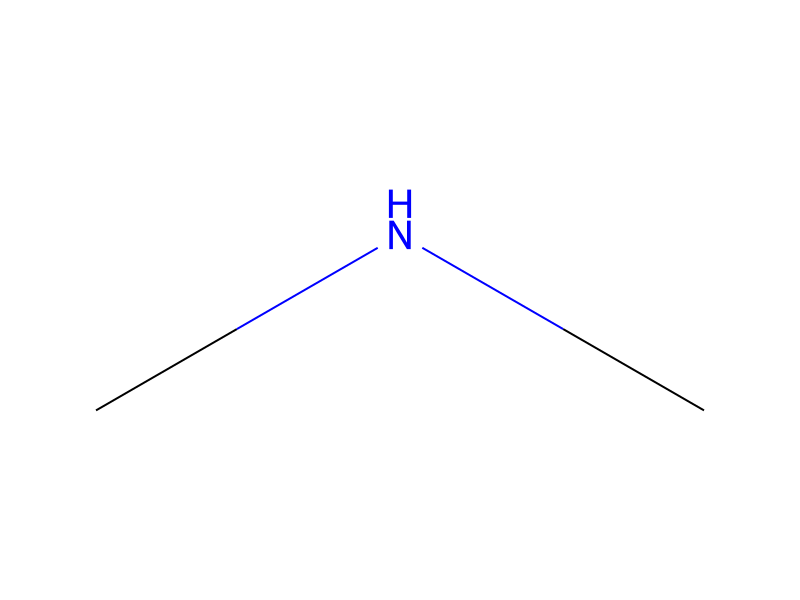
Basic information
- Standard SMILES
CNC- InChIKey
ROSDSFDQCJNGOL-UHFFFAOYSA-N- Molecular formula
- C2H7N
- Average molar mass
- 45.08 g/mol
Overview
Dimethylamine, anhydrous appears as a colorless gas smelling of fish at low concentrations and of ammonia at higher concentrations. Shipped as a liquid under its vapor pressure. Contact with the unconfined liquid can cause frostbite by evaporative cooling and chemical type burns. The gas, which is corrosive, dissolves readily in water to form flammable corrosive solutions. The gas is heavier than air and can asphyxiate by the displacement of air. Gas is easily ignited and produces toxic oxides of nitrogen when burned. Long-term inhalation of low concentrations or short-term inhalation of low concentrations has adverse health effects. Under prolonged exposure to fire or intense heat the containers may rupture violently and rocket. Used to make other chemicals and as a solvent.
Names & identifiers
- Preferred name
- Dimethylamine
- IUPAC
- N-methylmethanamine
- English name
- N-methylmethanamine
- Molecular formula
- C2H7BN
- Molecular weight
- 45.08
Names & synonyms
Show more names
Database identifiers
- CAS
93803-04-4- ChEMBL
CHEMBL120433- ChEBI
CHEBI:17170- UNII
- ARQ8157E0Q
- EC Number
- 204-697-4
- Nikkaji
- J1.943.801E、J2.933E
Properties
Computed structural properties
- XLogP
- -0.2
- Topological polar surface area
- 12 Ų
- Hydrogen bond donors
- 1
- Hydrogen bond acceptors
- 1
- Rotatable bonds
- 0
- Heavy atoms
- 3
- Formal charge
- 0
- Complexity
- 2.8
Experimental & physicochemical properties
Chemical Classes
Nitrogen Compounds -> Amines, Aliphatic
Flammable agents - 4th degree
LogP
log Kow = -0.38
-0.38
-0.2
-0.38
Density
0.671 at 44.4 °F (USCG, 1999) - Less dense than water; will float
0.6804 g/cu cm at 0 °C
Bulk density approximately 7.8 lb/gal
Saturated liquid density: 42.110 lb/cu ft; liquid heat capacity: 0.731 Btu/lb-F (all at 40 °F)
Saturated vapor pressure: 29.990 lb/sq in; saturated vapor density: 0.23550 lb/cu ft; ideal gas heat capacity: 0.364 Btu/lb-F (all at 75 °F)
Relative density (water = 1): 0.7
Viscosity
1.7 mPa.s at 15.5 °C /40% Dimethylamine aqueous solution/
1.7 mPa*s at 20 °C
Solubility
24 % at 140 °F (NIOSH, 2024)
In water, 163 g/100g water at 40 °C
Very soluble in water forming a very strong alkaline solution
Soluble in ethanol, ethyl ether
Solubilities in various solvents at 1 atm and 20 °C.[Table#2482]
1630 mg/mL at 40 °C
Safety & regulation
GHS classification
GHS Classification
Danger
H220: Extremely flammable gas [Danger Flammable gases]
P203, P210, P222, P261, P264, P264+P265, P271, P280, P302+P352, P304+P340, P305+P354+P338, P317, P319, P321, P332+P317, P362+P364, P377, P381, P403, P403+P233, P405, and P501 (click each P-code to see the statement)
Danger
H224: Extremely flammable liquid and vapor [Danger Flammable liquids]
P210, P233, P240, P241, P242, P243, P260, P261, P264, P270, P271, P280, P301+P317, P301+P330+P331, P302+P361+P354, P303+P361+P353, P304+P340, P305+P354+P338, P316, P317, P321, P330, P363, P370+P378, P403+P235, P405, and P501 (click each P-code to see the statement)
Hazard information
Regulatory Information
Chemical: Methanamine, N-methyl-
Methanamine, N-methyl- is listed on the EPA's Chemical Data Reporting (CDR) system. Manufacturers and importers of Methanamine, N-methyl- are required to report information about their production and use of this chemical to the EPA under the Toxic Substances Control Act (TSCA). (40 eCFR Part 711)
Status: Active Update: 13-12-2022 https://echa.europa.eu/registration-dossier/-/registered-dossier/14794
Methanamine, N-methyl-, anhydrous (dimethylamine): HSNO Approval: HSR000996 Approved with controls
The New Jersey Worker and Community Right to Know Act requires public and private employers to provide information about hazardous substances at their workplaces. (N.J.S.A. 34:5A-1 et. seq.)
DOT Label
Flammable Gas
Flammable Liquid Corrosive
Fire Hazards
FLAMMABLE. Flashback along vapor trail may occur. May explode if ignited in an enclosed area. Vapors are eye, skin and respiratory irritants. (USCG, 1999)
Excerpt from ERG Guide 132 [Flammable Liquids - Corrosive]:
· Flammable/combustible material.
· EXTREMELY FLAMMABLE.
Extremely flammable. Gives off irritating or toxic fumes (or gases) in a fire. Cylinder may explode in heat of fire. Gas/air mixtures are explosive. Risk of fire and explosion on contact with strong oxidizing agents.
Highly flammable. Gives off irritating or toxic fumes (or gases) in a fire. Many reactions may cause fire or explosion. See Chemical dangers Vapour/air mixtures are explosive.
Fire Potential
Aqueous solutions are flammable unless diluted extensively.
A flammable gas.
Contact with strong oxidizers, chlorine, and mercury may cause fires ... .
Health Hazards
VAPOR: Irritating to eyes, nose and throat. If inhaled, will cause difficult breathing. LIQUID. Will burn skin and eyes. Harmful if swallowed. (USCG, 1999)
Excerpt from ERG Guide 132 [Flammable Liquids - Corrosive]:
· May cause toxic effects if inhaled or ingested.
· May cause toxic effects if inhaled.
Hazards Summary
Liquid causes first degree burns on short exposure; [CHRIS] Corrosive to skin; [Quick CPC] Concentrations above 5420 ppm are lethal to mice with pulmonary hemorrhages and peripheral emphysema on pathological examination. Dermal sensitizer; [ACGIH] Pulmonary edema may result from inhalation of high concentrations. [NJ-HSFS] May cause permanent eye injury; Transient visual effects (blue haze or halo vision) occur at low concentrations; [CHEMINFO] Animals suffer liver injury in high-dose experiments. [HSDB]
DOT ID and Guide
1160 132
1032 118
1032 118(anhydrous)
1160 132(solution)
Reactive Group
Amines, Phosphines, and Pyridines
Amines, Phosphines, and Pyridines
UN Classification
UN Hazard Class: 2.1
UN Hazard Class: 3; UN Subsidiary Risks: 8; UN Pack Group: II
RCRA Requirements
U092; As stipulated in 40 CFR 261.33, when dimethylamine, as a commercial chemical product or manufacturing chemical intermediate or an off-specification commercial chemical product or a manufacturing chemical intermediate, becomes a waste, it must be managed according to Federal and/or State hazardous waste regulations. Also defined as a hazardous waste is any residue, contaminated soil, water, or other debris resulting from the cleanup of a spill, into water or on dry land, of this waste. Generators of small quantities of this waste may qualify for partial exclusion from hazardous waste regulations (40 CFR 261.5).
Reactivity Alerts
Highly Flammable
Highly Flammable
Safety & protection
Fire Fighting
Excerpt from ERG Guide 118 [Gases - Flammable - Corrosive]:
Excerpt from ERG Guide 132 [Flammable Liquids - Corrosive]:
Shut off supply; if not possible and no risk to surroundings, let the fire burn itself out. In other cases extinguish with water spray. In case of fire: keep cylinder cool by spraying with water. Combat fire from a sheltered position.
Use water in large amounts, alcohol-resistant foam, dry powder, carbon dioxide. In case of fire: keep drums, etc., cool by spraying with water.
First Aid Measures
Fresh air, rest. Half-upright position. Artificial respiration may be needed. Refer immediately for medical attention.
Wear protective gloves when administering first aid. ON FROSTBITE: rinse with plenty of water, do NOT remove clothes. Refer immediately for medical attention.
Rinse with plenty of water for several minutes (remove contact lenses if easily possible). Refer immediately for medical attention.
Fresh air, rest. Half-upright position. Artificial respiration may be needed. Refer immediately for medical attention.
Remove contaminated clothes. Rinse skin with plenty of water or shower. Refer immediately for medical attention .
Rinse with plenty of water for several minutes (remove contact lenses if easily possible). Refer immediately for medical attention.
Accidental Release Measures
· CALL 911. Then call emergency response telephone number on shipping paper. If shipping paper not available or no answer, refer to appropriate telephone number listed on the inside back cover.
· ELIMINATE all ignition sources (no smoking, flares, sparks or flames) from immediate area.
· CALL 911. Then call emergency response telephone number on shipping paper. If shipping paper not available or no answer, refer to appropriate telephone number listed on the inside back cover.
· ELIMINATE all ignition sources (no smoking, flares, sparks or flames) from immediate area.
First Aid
EYES: First check the victim for contact lenses and remove if present. Flush victim's eyes with water or normal saline solution for 20 to 30 minutes while simultaneously calling a hospital or poison control center. Do not put any ointments, oils, or medication in the victim's eyes without specific instructions from a physician. IMMEDIATELY transport the victim after flushing eyes to a hospital even if no symptoms (such as redness or irritation) develop.
Excerpt from ERG Guide 132 [Flammable Liquids - Corrosive]:
General First Aid:
General First Aid:
(General first aid procedures)
Safe Storage
Cool. Fireproof. Separated from : see Chemical Dangers. Store in an area without drain or sewer access.
Fireproof. Cool. Ventilation along the floor. Separated from strong acids, oxidants, aluminium, copper, copper alloys, mercury, zinc and food and feedstuffs. Store only in original container. Well closed. Store in an area without drain or sewer access.
Firefighting Hazards
Vapors are heavier than air and may travel to a source of ignition and flash back.
.... dimethylamine ... incandesce on contact with fluorine.
Exposure Control and Personal Protection
· Wear positive pressure self-contained breathing apparatus (SCBA).
· Wear positive pressure self-contained breathing apparatus (SCBA).
511.0 [ppm]
2.0 [ppm]
Fire Fighting Procedures
Suitable extinguishing media: Use water spray, alcohol-resistant foam, dry chemical or carbon dioxide.
Advice for firefighters: Wear self-contained breathing apparatus for firefighting if necessary.
Use water spray to cool unopened containers.
Stop flow of gas before extinguishing fire. Use water spray to keep fire-exposed containers cool. Use water spray, dry chemical, or "alcohol resistant" foam on fires involving aqueous solutions.
For more Fire Fighting Procedures (Complete) data for Dimethylamine (7 total), please visit the HSDB record page.
Storage Conditions
Keep container tightly closed in a dry and well-ventilated place. Contents under pressure. Storage class (TRGS 510): 2A: Gases
They are extremely flammable products that should be stored in a well-ventilated area and protected from fire risk. /Methylamines/
Avoid oxidizing materials, acids, and sources of halogens. Store in cool, dry, well-ventilated, noncombustible location.
Protect containers against physical damage. Outdoor or detached storage is preferable. Indoor storage of gas should be in a cool, well-ventilated, noncombustible location, away from all possible sources of ignition. Insure against accidental contact with mercury.
Cleanup Methods
ACCIDENTAL RELEASE MEASURES: Personal precautions, protective equipment and emergency procedures: Use personal protective equipment. Avoid breathing vapors, mist or gas. Ensure adequate ventilation. Remove all sources of ignition. Evacuate personnel to safe areas. Beware of vapors accumulating to form explosive concentrations. Vapors can accumulate in low areas. Environmental precautions: Prevent further leakage or spillage if safe to do so. Do not let product enter drains. Discharge into the environment must be avoided. Methods and materials for containment and cleaning up: Clean up promptly by sweeping or vacuum.
Environmental considerations-land spill: Dig a pit, pond, lagoon, holding area to contain liquid or solid material. /SRP: If time permits, pits, ponds, lagoons, soak holes, or holding areas should be sealed with an impermeable flexible membrane liner./ Dike surface flow using soil, sand bags, foamed polyurethane, or foamed concrete. Absorb bulk liquid with fly ash, cement powder, or commercial sorbents. Apply "universal" gelling agent to immobilize spill. Neutralize with sodium bisulfate (NaHSO4). /Dimethylamine, Solution/
Environmental considerations-land spill: Dig a pit, pond, lagoon, holding area to contain liquid or solid material. /SRP: If time permits, pits, ponds, lagoons, soak holes, or holding areas should be sealed with an impermeable flexible membrane liner./ Dike surface flow using soil, sand bags, foamed polyurethane, or foamed concrete. Absorb bulk liquid with fly ash, cement powder, or commercial sorbents. Neutralize with sodium bisulfate (NaHSO4). /Dimethylamine, Anhydrous/
Environmental considerations-water spill: Add sodium bisulfate (NaHSO4). If dissolved, in region of 10 ppm or greater concentration, apply activated carbon at ten times the spilled amount. Use mechanical dredges or lifts to remove immobilized masses of pollutants and precipitates. /Dimethylamine, Solution/
For more Cleanup Methods (Complete) data for Dimethylamine (7 total), please visit the HSDB record page.
Nonfire Spill Response
Excerpt from ERG Guide 118 [Gases - Flammable - Corrosive]:
Excerpt from ERG Guide 132 [Flammable Liquids - Corrosive]:
Disposal Methods
Generators of waste (equal to or greater than 100 kg/mo) containing this contaminant, EPA hazardous waste number U092, must conform with USEPA regulations in storage, transportation, treatment and disposal of waste.
SRP: Wastewater from contaminant suppression, cleaning of protective clothing/equipment, or contaminated sites should be contained and evaluated for subject chemical or decomposition product concentrations. Concentrations shall be lower than applicable environmental discharge or disposal criteria. Alternatively, pretreatment and/or discharge to a permitted wastewater treatment facility is acceptable only after review by the governing authority and assurance that "pass through" violations will not occur. Due consideration shall be given to remediation worker exposure (inhalation, dermal and ingestion) as well as fate during treatment, transfer and disposal. If it is not practicable to manage the chemical in this fashion, it must be evaluated in accordance with EPA 40 CFR Part 261, specifically Subpart B, in order to determine the appropriate local, state and federal requirements for disposal.
Product: Burn in a chemical incinerator equipped with an afterburner and scrubber but exert extra care in igniting as this material is highly flammable. Offer surplus and non-recyclable solutions to a licensed disposal company. Contact a licensed professional waste disposal service to dispose of this material. Contaminated packaging: Dispose of as unused product.
In a batch experiment with activated sludge from a large-scale plant, the hydrolytic and biochemical degradation of dimethylformamide (DMF) and its reaction product dimethylamine (DMA) were investigated under aerobic and anaerobic conditions. Parallel to the hydrolysis of dimethylformamide, the biochemical degradation of DMA occurs. The extensive conversion of these substrates is followed by the nitrification of the ammonium ion formed. Under subsequent anaerobic conditions with methanol as the carbon source, denitrification can also be achieved. If the oxygen supply of the activated sludge is insufficient, however, DMA can be used as a carbon source for denitrification, ammonium ion being released from DMA.
For more Disposal Methods (Complete) data for Dimethylamine (8 total), please visit the HSDB record page.
Toxicology
Interactions
The possibility of formation of nitrosamine was investigated in animals exposed to a combination of dimethylamine (DMA) and NO2. First, the distribution and covalent binding of DMA and dimethylnitrosamine (DMN) in rats and guinea pigs were determined. The apparent volume of distribution and biological half-life for [(14)C]-DMA or [(14)C]DMN did not reveal any species difference. In general, there were no marked differences in accumulation of radioactivity in tissues of guinea pigs and rats 4 hr after the administration of DMA, while the guinea pig tissues showed higher accumulation after DMN administration. Nucleic acid fractions prepared from liver and lungs of both species following administration of DMN or DMA in vivo showed much higher covalent binding with DMN than with DMA. Furthermore, the covalent binding of DMN was found to be due to bioactivation, whereas the DMA binding was nonspecific. Since guinea pig liver showed a higher degree of covalent binding than rat liver, this species was used to investigate the possible increase in covalent binding in the presence of NO2 and DMA as a reflection of DMN formation. There was no evidence of enhancement of covalent binding when animals pretreated with [(14)C]-DMA were exposed for various lengths of time to different concentrations of NO2.
It is known that sodium nitrite and dimethylamine are toxic compounds, which may react to form dimethylnitrosamine in the gastro-intestinal tract, a much more toxic compound and a powerful cancerogenic. The aim of the present work is the investigation of toxicity in young rats, caused by daily intake of sodium nitrite, administered together with dimethylamine during 30 days. The indicators examined were: histopathological analysis of the liver and kidney, transaminase in blood serum, variations in body weight and relation of weight liver/body weight ... The statistical method employed was the test of multiple comparisons based on the total ranges of Cruskal-Wallis. The results show that either significant differences were found (alpha = 0,05) among the groups (including the control), nor was necrosis observed or forming of tumors in the organs under investigation. Therefore, the doses administered does not seem to be toxic under the conditions of the experiment. Some signs of toxicity found in the group which was severely treated (10 mg of sodium nitrite and 20 mg of dimethylamine) appeared only in a few animals and it is necessary to verify the same in experiments with more animals and over a longer period of treatment.
These studies demonstrate the nitrosating potential of NO2 in vivo in ICR mice. Groups of mice were gavaged with 2 mg dimethylamine (DMA) and exposed to NO2 at levels from 0.04 to 44.5 ppm for periods up to 4 hours. Mice were individually frozen and blended to a powder, aliquots of which were homogenized in ice-cold dicholoromethane and 35% aqueous methanol. Concentrates of organic extracts were analyzed or dimethylnitrosamine (DMN) by a Thermal Energy Analyzer with a gas chromatograph interface. Biosynthesis of DMN was dose- and time-dependent with relation to NO2 exposure, reaching a maximum yield of 60-70 ng/mouse (0.0035% DMA conversion) at 2 hours. DMN biosynthesis was inhibited by sodium ascorbate and, more effectively, by ammonium sulfamate.
The urinary excretion of the DNA alkylation product, 3-methyladenine (3-MeAde), was measured in human volunteers who were on controlled diets and consumed fresh fish, or frozen-stored fish that contained 50-fold higher levels of dimethylamine (DMA), with or without ingested nitrate. DMA potentially could react with nitrosating agents in the diet or within the body, and produce the potent carcinogen N-nitrosodimethylamine (NDMA), which can then react with DNA to form several adducts including 3-MeAde. Our findings show that there was no increase in urinary levels of 3-MeAde after consumption of fish preserved by frozen storage relative to levels after consumption of fresh fish. Furthermore, consumption of 225 mg sodium nitrate (equal to the nitrate content in a large glass of beet juice) at 1 hr prior to consumption of the frozen-stored fish did not increase urinary 3-MeAde levels as would be expected if nitrate enhanced endogenous nitrosation of DMA. In contrast, urinary excretion of 3-MeAde from a volunteer who was a moderate cigarette smoker (11 cigarettes per day) was approximately 3- to 8-fold higher than dietary 3-MeAde intake. These findings indicate that consumption of high levels of DMA in fish does not result in detectable levels of NDMA formation and genetic damage as measured by the urinary biomarker 3-MeAde.
For more Interactions (Complete) data for Dimethylamine (6 total), please visit the HSDB record page.
Ecotoxicity Values
EC50; Species: Anabaena subcylindrica (Blue-green algae) axenic, 1-3x 10+7 cells/mL; Conditions: freshwater, static, 25 °C, pH 7.2; Concentration: 3.3x10⁻⁸ ug/cell for <3 hr; Effect: decreased nitrogen fixation
EC50; Species: Anabaena subcylindrica (Blue-green algae) axenic, 1-3x 10+7 cells/mL; Conditions: freshwater, static, 25 °C, pH 7.2; Concentration: 3.5x10⁻⁸ ug/cell for <3 hr; Effect: decreased photosynthesis, oxygen production
EC50; Species: Chlorella ellipsoidea (Green algae) axenic; Conditions: freshwater, static, 25 °C, pH 7.2; Concentration: 0.8x10⁻⁸ ug/cell for 90 min; Effect: decreased photosynthesis, oxygen production
EC50; Species: Chlorella pyrenoidosa (Green algae) 10x10+8 cells/100 mL; Conditions: freshwater, static, 20 °C; Concentration: 30 mg/L for 96 hr; Effect: general growth /98% purity/
For more Ecotoxicity Values (Complete) data for Dimethylamine (14 total), please visit the HSDB record page.
Environmental Fate
TERRESTRIAL FATE: Based on a classification scheme(1), a mean Koc value of 434.9 measured in 5 soils(2), indicates that dimethylamine is expected to have moderate mobility in soil(SRC). The pKa of dimethylamine is 10.73(3), indicating that this compound will exist almost entirely in cation form in the environment and cations generally adsorb more strongly to soils containing organic carbon and clay than their neutral counterparts(4). Volatilization of the cation from moist soil is not expected because cations do not volatilize(SRC). Dimethylamine is expected to volatilize from dry soil surfaces(SRC) based upon a vapor pressure of 1520 mm Hg at 25 °C(5). Dimethylamine was biodegraded 69-89% in three Saskatchewan soils during a 7 day incubation period(6), suggesting that biodegradation may be an important environmental fate process in soil(SRC).
AQUATIC FATE: Based on a classification scheme(1), a measured Koc value of 508 in lake sediment(2), indicates that dimethylamine is expected to adsorb to suspended solids and sediment(SRC). A pKa of 10.73(3) indicates dimethylamine will exist almost entirely in the cation form at pH values of 5 to 9 and, therefore, volatilization from water surfaces is not expected to be an important fate process(SRC). Dimethylamine is not expected to undergo hydrolysis in the environment due to the lack of functional groups that hydrolyze under environmental conditions(4). According to a classification scheme(5), an estimated BCF of 3(SRC), from its log Kow of -0.38(6) and a regression-derived equation(7), suggests the potential for bioconcentration in aquatic organisms is low. Dimethylamine is expected to biodegrade in water based on a half-life of 1.6 days in Vistula River water (Warsaw, Poland) following a 0.3 day lag period(8).
ATMOSPHERIC FATE: According to a model of gas/particle partitioning of semivolatile organic compounds in the atmosphere(1), dimethylamine, which has a vapor pressure of 1520 mm Hg at 25 °C(2), is expected to exist solely as a gas in the ambient atmosphere. Gas-phase dimethylamine is degraded in the atmosphere by reaction with photochemically-produced hydroxyl radicals(SRC); the half-life for this reaction in air is estimated to be 6 hours(SRC), calculated from its rate constant of 6.54X10⁻¹¹ cu cm/molecule-sec at 25 °C(3). Dimethylamine does not contain chromophores that absorb at wavelengths >290 nm(4) and, therefore, is not expected to be susceptible to direct photolysis by sunlight(SRC).
Food Survey Values
Dimethylamine has been found in the following fresh food (concentration in ppm): red cabbage (2.8), cabbage (2), cauliflower (14), kale (5.5), red radish (1.1), celery (5.1), maize (3.5), green salad (7.2)(1). Concentrations in preserved food items are: broken beans (0.6), broken butterbeans (<0.1), shelled peas (2.2), bean salad (0.2), kale (4.5), red cabbage (0.1), paprika (1), cornichons (0.5)(1). Dimethylamine has detected in various samples of pickled vegetables at 0-15.4 ppm(1). Some other food products contained the following amounts of dimethylamine (ppm): cheese (not detected), brown bread (3.1), coffee (3-6), barley (1.6), hops (1.4), malt (0.5)(1). Dimethylamine was found in cod roe at 6.3 ppm(1), and in herring at 3.4-45 ppm(1) and 54.76 ppm(2). Average levels of dimethylamine are (food item (ppm)): fish sausage (0.902), baked ham (1.310), spinach (0.120), miso (0.055)(2). Dimethylamine was detected at 4.6-31.6 ppm in Nigerian fermented beverages (palm-wine, nono, burukutu, pito and ogogoro)(3) Dimethylamine has been identified as a volatile component of boiled beef(4). The interest for the presence of amines in food arises in part because they are regarded as possible precursors of carcinogenic N-nitroso compounds(4).
Exposure Routes
The substance can be absorbed into the body by inhalation.
The substance can be absorbed into the body by inhalation of its aerosol and by ingestion.
inhalation, skin and/or eye contact (liquid)
Endogenous, Ingestion, Dermal (contact)
Toxicity Summary
IDENTIFICATION AND USE: Dimethylamine (DMA) is a colorless gas. It is used as acid-gas absorbent, solvent antioxidants, manufacture of dimethylformamide and dimethylacetamide, dyes, flotation agent, gasoline stabilizers, pharmaceuticals, textile chemicals, rubber accelerators, electroplating, dehairing agent, missile fuels, pesticide propellant, rocket propellants, surfactants, reagent for magnesium. HUMAN STUDIES: Workers in a foundry complaining of breathlessness and choking were found to be exposed to 1-46 mg/cu m DMA in the air. Vision has become misty and halos have appeared several hours after workmen have been exposed to the vapors of DMA at concentration too low to cause discomfort or disability during several hours of exposure. The edema of the corneal epithelium, which is principally responsible for the disturbance of vision, clears spontaneously by the next day, but after exceptionally intense exposures the edema and blurring have taken several days to clear and have been accompanied by photophobia and discomfort from roughness of the corneal surface. ANIMAL STUDIES: A 6% solution of DMA, when applied to the skin of rabbits, caused reddening, then thickening and ulceration after a single treatment. A 3% solution produced similar effects after five treatments. A 5% DMA solution dropped once on rabbit eye caused hemorrhages in conjunctiva, corneal edema, and superficial opacities. A drop of undiluted DMA placed on rabbit's cornea, with the lids then closed and no irrigation performed, caused the cornea to become whitish blue and translucent within few sec, then white as sclera in a min. DMA was a skin sensitizer in the guinea pig closed epicutaneous test. Histopathologic evaluation of the respiratory tract of rats exposed by inhalation at single concentrations ranging from 600 to 6000 ppm for 6 hr revealed concentration-related changes ranging from ulceration and necrosis to rhinitis, tracheitis, and emphysema. Mice exposed at 813 to 1626 ppm DMA had ocular and respiratory irritation and that cyanosis, convulsions, and death occurred above 5420 ppm. Pathologic evaluation revealed massive hemorrhages near the periphery of the lungs and peripheral emphysema in those mice that died during exposure. Small hemorrhages were found in the lungs of mice sacrificed 20 days postexposure. In a repeated exposure study, mice were exposed by inhalation 6 hours/day for 5 days at 511 ppm of DMA. Body weight decreased by 10% to 25% in all animals, and 3 of 24 mice died during exposure. Nasal lesions were observed in these animals. DMA was not carcinogenic by the inhalation in mice and rats. DMA was weakly mutagenic in Salmonella typhimurium strain TA 1530 in the presence of metabolic activation. No mutagenic activity occurred without activation, and no activity was found in a host-mediated assay in mice.
Uremic toxins such as dimethylamine are actively transported into the kidneys via organic ion transporters (especially OAT3). Increased levels of uremic toxins can stimulate the production of reactive oxygen species. This seems to be mediated by the direct binding or inhibition by uremic toxins of the enzyme NADPH oxidase (especially NOX4 which is abundant in the kidneys and heart) (A7868). Reactive oxygen species can induce several different DNA methyltransferases (DNMTs) which are involved in the silencing of a protein known as KLOTHO. KLOTHO has been identified as having important roles in anti-aging, mineral metabolism, and vitamin D metabolism. A number of studies have indicated that KLOTHO mRNA and protein levels are reduced during acute or chronic kidney diseases in response to high local levels of reactive oxygen species (A7869)
Plant Concentrations
Dimethylamine was detected in 2 (Desmarestia aculeata, Desmarestia viridis) of 28 marine algae from three classes: Chlorophyceae, Phaeophyceae, Rhodophyceae(1). Dimethylamine was identified, not quantified, in various medicinal plants and roots from Africa(2). Dimethylamine has been identified in tobacco leaf (4-75 ppm)(3).
Regulatory information
RCRA Requirements
U092; As stipulated in 40 CFR 261.33, when dimethylamine, as a commercial chemical product or manufacturing chemical intermediate or an off-specification commercial chemical product or a manufacturing chemical intermediate, becomes a waste, it must be managed according to Federal and/or State hazardous waste regulations. Also defined as a hazardous waste is any residue, contaminated soil, water, or other debris resulting from the cleanup of a spill, into water or on dry land, of this waste. Generators of small quantities of this waste may qualify for partial exclusion from hazardous waste regulations (40 CFR 261.5).
Atmospheric Standards
This action promulgates standards of performance for equipment leaks of Volatile Organic Compounds (VOC) in the Synthetic Organic Chemical Manufacturing Industry (SOCMI). The intended effect of these standards is to require all newly constructed, modified, and reconstructed SOCMI process units to use the best demonstrated system of continuous emission reduction for equipment leaks of VOC, considering costs, non air quality health and environmental impact and energy requirements. Dimethylamine is produced, as an intermediate or a final product, by process units covered under this subpart.
CERCLA Reportable Quantities
Persons in charge of vessels or facilities are required to notify the National Response Center (NRC) immediately, when there is a release of this designated hazardous substance, in an amount equal to or greater than its reportable quantity of 1000 lb or 454 kg. The toll free number of the NRC is (800) 424-8802. The rule for determining when notification is required is stated in 40 CFR 302.4 (section IV. D.3.b).
Clean Water Act Requirements
Dimethylamine is designated as a hazardous substance under section 311(b)(2)(A) of the Federal Water Pollution Control Act and further regulated by the Clean Water Act Amendments of 1977 and 1978. These regulations apply to discharges of this substance. This designation includes any isomers and hydrates, as well as any solutions and mixtures containing this substance.
DHS Chemicals of Interest (COI)
Dimethylamine
1
10000
Flammable chemical that can be released at a facility.
Chemistry & industry
Pharmacology
Metabolism/Metabolites
It is extensively absorbed (bioavailability 72%); 5% is demethylated to methylene, but 95% is secreted unchanged in the urine.
The intragastric formation of nitrosodimethylamine (NDA) by bacteria existing in the gastrointestinal tract of monkey was examined by determining the in vitro formation of nitrosodimethylamine from nitrite and dimethylamine in the brain-heart-infusion (BHI) medium, adjusted to pH 6 with gastric juice containing 5000 ppm sodium nitrate and 1000 ppm dimethylamine. Nitrosodimethylamine formation depended on the activity of the nitrate-reducing bacteria in the stomach contents of the monkey, and the concn of nitrite was clearly related to the amount of nitrosodimethylamine. NDA was formed in the brain-heart-infusion medium alone at pH 5 and 6. The addition of gastric juice to the medium increased the formation of nitrosodimethylamine.
The extent of nitrosamine formation and the metabolism of the resultant nitrosamines in vivo were investigated by using (15)N-stable isotope labeling and by the determination of the isotope ratio in the expired N. (15)N-labeled dimethylamine (1.1 mmol/kg) and various doses of nonlabeled nitrile (0.55-2.2 mmol/kg) or labeled nitrile without dimethylamine administered to male rats, which were placed in an enclosed respiratory system. The system was flushed with a mixture containing 80% He and 20% O, and N content of the recirculating atmosphere was determined. When labeled dimethylamine and nonlabeled nitrile were administered, nitrile reacted with secondary amines, followed by enzymic alpha-hydroxylation and decomposition of the ensuing alkyldiazohydroxide to molecular N and an alkyl cation as ultimate carcinogen. When (15)N nitrile was administered, N was released (nitrile reacted with primary amines to release molecular N and formation of the corresponding alcohol or olefin).
Dimethylamine is the immediate precursor of dimethylnitrosamine, a known potent carcinogen in a wide variety of animal species. Although small amounts of dimethylamine are ingested directly, the major dietary source is believed to be via choline and related materials. Owing to quantitative recoveries following oral administration, urinary dimethylamine levels provide good overall measures of body exposure. The oral administration of equimolar amounts (1 mmol/kg body weight) of potential amine precursors to male Wistar rats produced only small increases in urinary dimethylamine after choline (+ 11%; 0.60 +/- 0.36% dose), dimethylaminopropanol (+ 32%; 1.49 +/- 0.30% dose), dimethylaminoethyl chloride (+ 110% 5.38 +/- 1.72% dose) and trimethylamine (+ 51%; 1.6 +/- 0.80% dose) input, whereas significantly larger increases were found following trimethylamine N-oxide ingestion (+ 355%; 12.93 +/- 1.13% dose; t-test, P < 0.001). These data suggest that trimethylamine N-oxide is a major dietary source of dimethylamine, by direct conversion and not by sequential reduction (to trimethylamine) and demethylation, and that in this respect it is of greater importance, on a molar basis, than choline.
Uremic toxins tend to accumulate in the blood either through dietary excess or through poor filtration by the kidneys. Most uremic toxins are metabolic waste products and are normally excreted in the urine or feces.
Absorption, Distribution and Excretion
The disposition and pharmacokinetics of [(14)C]dimethylamine [(14)C] DMA) following 6-hr inhalation of either 10 or 175 ppm were determined in male Fischer 344 rats. Seventy-two hours after termination of exposure, the disposition of recovered radioactivity was similar for each airborne concentration, with more than 90% in the urine and feces, 7 to 8% in selected tissues and the carcass, and 1.5% exhaled as (14)CO2. Over 98% of the radioactivity in the urine was unmetabolized DMA. Analysis of tissue radioactivity immediately after exposure to [(14)C]DMA showed that the respiratory nasal mucosa contained the highest concentration of (14)C, followed by the olfactory nasal mucosa; concentrations of (14)C in liver, lung, kidney, brain, and testes were approximately 2 orders of magnitude less than in the nasal mucosal tissues. Radioactivity in plasma of rats exposed by inhalation to 175 ppm of [(14)C]DMA decayed in a biphasic manner. The terminal half-life for plasma radioactivity was similar to the half-lives of some plasma proteins, suggesting incorporation of (14)C into proteins subsequent to metabolism of [(14)C]DMA. The results indicate that, while most of the inhaled DMA is excreted unchanged, a small amount of oxidative metabolism of DMA occurs.
1. The fate of [(14)C]-dimethylamine was investigated following oral administration to four male volunteers. 2. The major route of excretion was urine, with 94% of the administered radioactivity being voided over 3 days (87% during the first 24 hr). Small amounts (1-3%) of radioactivity were found in the faeces and expired air. 3. Metabolism was limited with only 5% being demethylated to methylamine. The remainder of the dose was excreted unchanged. 4. Pharmacokinetic studies indicated rapid (t1/2ab = 8 min) and extensive absorption (bioavailability = 82%) from the gastrointestinal tract followed by widespread distribution and a fairly prompt excretion (t1/2el = 6-7 hr) with a plasma clearance of 190 mL/min.
The urinary excretion of dimethylamine has been measured in 203 unrelated healthy volunteers (102 male) who maintained their normal diets. ... The average daily output was 17.43 +/- 11.80 mg (mean +/- SD) (21.21 +/- 14.78 male; 13.74 +/- 5.65 female) with values for the majority of the population lying within the 0.68-35.72 mg range. Four male outliers excreted up to 109.2 mg; these large amounts of dimethylamine were presumed to be of dietary origin. ...
In the gastro-intestinal tract of male Wistar rats fed a commercial diet containing 23.6 ppm dimethylamine (DMA), the concentration of DMA was highest (11.2 +/- 2.1 ppm) in the stomach and declined towards the lower regions. In contrast, the highest DMA concentration (6.6 +/- 2.5 ppm) was observed in the upper small intestine in rats fed a diet containing only 1.0 ppm DMA. DMA was absorbed in the intestines, and the disappearance curves were monoexponential. The t1/2 values for DMA in the ligated stomach, upper and lower small intestine, caecum and large intestine were 198, 8.3, 11.6, 31.5 and 11.0 min, respectively. The DMA concentration in the blood had increased to 3.0 +/- 1.0 ppm (from a pre-injection level of 0.28 +/- 0.06 ppm) 5 min after the injection of 250 micrograms DMA into the ligated upper small intestine. The disappearance curve for DMA in the blood was monoexponential and the t1/2 for the initial 15 min was 12.5 min when 250 micrograms DMA was injected into a femoral vein. The peak concentrations of DMA in the intestine and bile, respectively, were 15.6 +/- 12.6 ppm (at 15 min) and 3.7 +/- 1.9 ppm (at 30 min after the iv injection of DMA). In this 30-min period, urinary DMA increased from 17.3 +/- 9.4 to 139 +/- 23 ppm. These results show that, following ingestion, DMA is absorbed from the intestine into the blood, from which it disappears rapidly, the major part being excreted in the urine while a small proportion is excreted in the bile or secreted into the intestine, where it may be reabsorbed.
For more Absorption, Distribution and Excretion (Complete) data for Dimethylamine (12 total), please visit the HSDB record page.
Uses & manufacturing
Uses
Used as an accelerator in the manufacturing of rubber, detergents, and pesticides; Used in leather tanning; Urinary excretion in humans increased after eating certain fish, meat, dairy, and grains containing DMA; [ACGIH] Used in electroplating, epoxy resin curing, textile manufacturing, photographic processing, hide dehairing, and pharmaceutical production; [HSDB]
Electroplating [Category: Plate]
It is used ... for the production of the solvents dimethylformamide (DMF) and dimethylacetamide (DMAC), for water-treating agents, surfactants, rubber-processing compounds, and a range of agrochemicals.
As accelerator in vulcanizing rubber, tanning, manufacturing detergent soaps, or attracting boll weevils to exterminate them /former use/. As reagent for magnesium.
Acid-gas absorbent, solvent antioxidants, manufacture of dimethylformamide and dimethylacetamide, dyes, flotation agent, gasoline stabilizers, pharmaceuticals, textile chemicals, rubber accelerators, electroplating, dehairing agent, missile fuels, pesticide propellant, rocket propellants, surfactants, reagent for magnesium.
Use as an antiknock agent in fuels.
Impurities
Typical commercial specifications.
Typical commercial specifications.
U.S. Exports
(1972) 2.39X10+9 G
(1975) 3.68X10+7 G (TOTAL METHYLAMINES)
Exports of methylamines, which had been declining since their 1993 peak of 34 million pounds to 8 million in 2002 as overseas capacity has grown, were revived with the closure of the Chinook Group's methylamine plant at Sombra, Canada, in 2004. US methylamine exports increased to 15 million pounds that year and have continued climbing to 31 million pounds in 2005.
U.S. Production
2023: 250,000,000 - <400,000,000 lb
(1972) 4.36X10+10 G
(1974) 5.30X10+10 G
(1981) 77,538X10+3 lb
(1984) 3.22X10+10 g
For more U.S. Production (Complete) data for Dimethylamine (9 total), please visit the HSDB record page.
Consumption Patterns
50% IS USED AS AN INT FOR DIMETHYLFORMAMIDE AND DIMETHYLACETAMIDE (SPINNING SOLVENTS FOR ACRYLIC FIBERS); 15% AS AN INT FOR LAURYL DIMETHYLAMINE OXIDE (SURFACTANT); 15% AS AN INT FOR RUBBER CHEM INCL THIURAM ACCELERATORS; AND 20% FOR OTHER APPLICATIONS INCL USE AS AN INT FOR THE DIMETHYLAMINE SALT OF 2,4-DICHLOROPHENOXYACETIC ACID AND UNSYMMETRICAL DIMETHYLHYDRAZINE (1972)
CHEMICAL PROFILE: Methylamines. Di: dimethylformamide and acetamide, 55%; water treatment, 10%; pesticides, 10%; surfactants, 10%; other, 15%.
CHEMICAL PROFILE: Methylamines. Demand: 1987: 190 million lb; 1988: 195 million lb; 1992 /projected/: 205 million lb (Foreign trade is small). /Methylamines/
Chemical Profile: Methylamines. Demand: 2004: 442 million pounds of mono-, di- and trimethylamines; 2005: 450 million pounds; 2009: 500 million pounds, projected. Market demand in 2005 was apparently split between the different products as: monomethylamine, 89 million pounds (20%); dimethylamine, 288 million pounds (64%); trimethylamine, 74 million pounds (16%).
Chemical Profile: Methylamines. Uses: Dimethylamine: water treatment, 28%; solvents, including dimethylformamide (DMF) and dimethylacetamide, 26%; dimethylaminoethanol (DMAE), 19%; dimethylaminopropylamine, 10%; fatty tertiary amines, 8%; pesticides, 3%; miscellaneous, including rubber processing chemicals, 6%.
Methods of Manufacturing
Methylamines are prepared commercially by the exothermic reaction of methanol with ammonia over an amorphous silica-alumina catalyst at 350 - 450 °C. All three methylamines are produced. The reaction proceeds to thermodynamic equilibrium, the position of which is governed by the temperature and the nitrogen/ carbon (NH3/MeOH) ratio. ... In a typical commercial methylamine process ... methanol reacts with ammonia in the gas phase in one or more fixed-bed reactors. The crude reaction mixture contains essentially excess ammonia; mono-, di-, and trimethylamines; reaction water; and unconverted methanol. Purification is generally effected in a train of four to five distillation columns.
Preparation from methanol plus ammonia; ... by catalytic hydrogenation of nitrosodimethylamine.
Formulations/Preparations
Grade: Technical (anhydrous; 25%, and 40% aqueous solutions); 99%.
Has been marketed in compressed liquid form in tubes or as a 33% aqueous solution.
General Manufacturing Information
Plastics Product Manufacturing
Methanamine, N-methyl-: ACTIVE
Suppliers1 total
Related reactions
No reaction records under the current filter.
Linked notes
Loading…