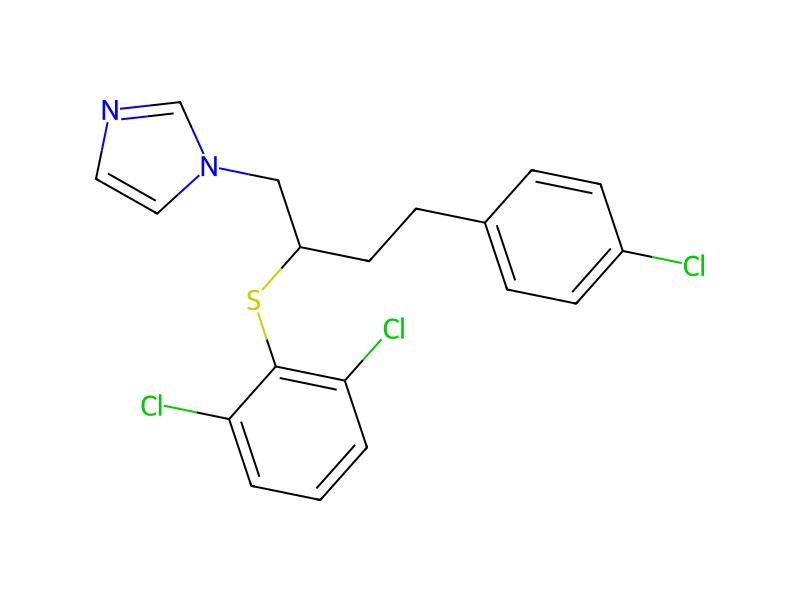
Basic information
- Standard SMILES
Clc1ccc(CCC(Cn2ccnc2)Sc2c(Cl)cccc2Cl)cc1- InChIKey
SWLMUYACZKCSHZ-UHFFFAOYSA-N- Molecular formula
- C19H17Cl3N2S
- Average molar mass
- 411.8 g/mol
Overview
Butoconazole is a member of the class of imidazoles that is 1H-imidazole in which the hydrogen attached to the nitrogen is substituted by a 4-(4-chlorophenyl)-2-[(2,6-dichlorophenyl)sulfanyl]butyl group. An antifungal agent, it is used as its nitrate salt in gynaecology for treatment of vulvovaginal infections caused by Candida species, particularly Candida albicans. It is a dichlorobenzene, a member of imidazoles, an aryl sulfide, a member of monochlorobenzenes, an imidazole antifungal drug and a conazole antifungal drug. It is a conjugate base of a butoconazole(1+).
Names & identifiers
- Preferred name
- Butoconazole
- IUPAC
- 1-[4-(4-chlorophenyl)-2-(2,6-dichlorophenyl)sulfanylbutyl]imidazole
- English name
- Butoconazole
- Molecular formula
- C19H17Cl3N2S
- Molecular weight
- 411.77568
Names & synonyms
Show more names
Database identifiers
- CAS
67085-13-6- ChEMBL
CHEMBL1295- ChEBI
CHEBI:3240- UNII
- 0Q771797PH
- Nikkaji
- J418.220K
Properties
Computed structural properties
- XLogP
- 6.4
- Topological polar surface area
- 43.1 Ų
- Hydrogen bond donors
- 0
- Hydrogen bond acceptors
- 2
- Rotatable bonds
- 7
- Heavy atoms
- 25
- Formal charge
- 0
- Complexity
- 383
Experimental & physicochemical properties
Solubility
Nitrate salt: 0.26 mg/ml (practically insoluble)
8.18e-04 g/L
Melting Point
~159°C with decomposition (nitrate salt)
159 °C (decomposition)
Collision Cross Section
185.55 Ų [M+H]+ [CCS Type: TW; Method: calibrated with polyalanine and drug standards]
186.5 Ų [M+H]+ [CCS Type: TW; Method: calibrated with polyalanine and drug standards]
Safety & regulation
Toxicology
Drug Induced Liver Injury
Drug-Induced Liver Injury Severity and Toxicity (DILIst)
butoconazole
DILI Negative
Vaginal
DOI:10.1016/j.drudis.2019.09.022
Chemistry & industry
Pharmacology
ATC Code
G01AF15
G - Genito urinary system and sex hormones
QG - Genito urinary system and sex hormones
Pharmacodynamics
Butoconazole is an imidazole derivative that has fungicidal activity <i>in vitro</i> against <i>Candida</i> spp. and has been demonstrated to be clinically effective against vaginal infections due to <i>Candida albicans</i>. <i>Candida albicans</i> has been identified as the predominant species responsible for vulvovaginal candidasis.
Mechanism of Action
The exact mechanism of the antifungal action of butoconazole is unknown, however, it is presumed to function as other imidazole derivatives via inhibition of steroid synthesis. Imidazoles generally inhibit the conversion of lanosterol to ergosterol via the inhibition of the enzyme cytochrome P450 14α-demethylase, resulting in a change in fungal cell membrane lipid composition. This structural change alters cell permeability and, ultimately, results in the osmotic disruption or growth inhibition of the fungal cell.
FDA Pharmacological Classification
0Q771797PH
BUTOCONAZOLE
Established Pharmacologic Class [EPC] - Azole Antifungal
Chemical Structure [CS] - Azoles
Butoconazole is an Azole Antifungal.
Suppliers3 total
Additional notes
DefinitionChEBI: Butoconazole is a member of the class of imidazoles that is 1H-imidazole in which the hydrogen attached to the nitrogen is substituted by a 4-(4-chlorophenyl)-2-[(2,6-dichlorophenyl)sulfanyl]butyl group. An antifungal agent, it is used as its nitrate salt in gynaecology for treatment of vulvovaginal infections caused by Candida species, particularly Candida albicans. It is a member of imidazoles, an aryl sulfide, a dichlorobenzene, a member of monochlorobenzenes, an imidazole antifungal drug and a conazole antifungal drug. It is a conjugate base of a butoconazole(1+).
Related reactions
No reaction records under the current filter.
Linked notes
Loading…