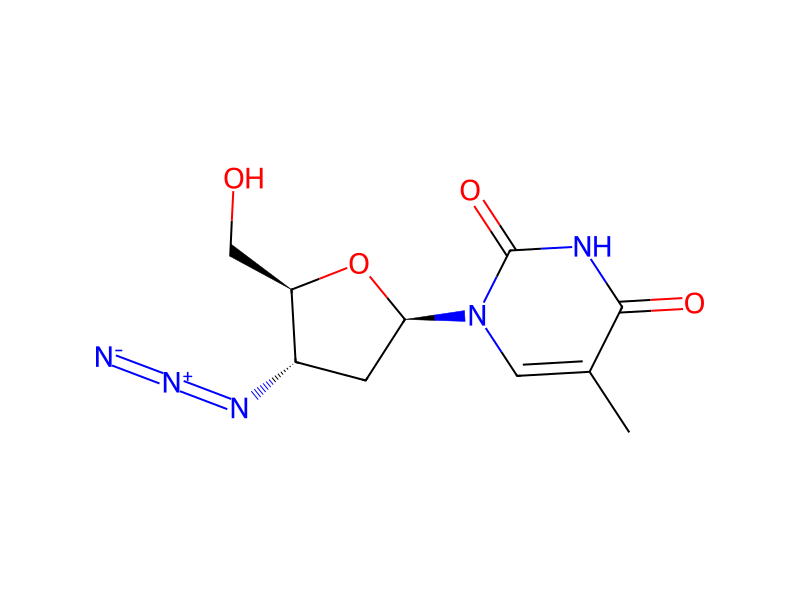
Basic information
- Standard SMILES
Cc1cn([C@H]2C[C@H](N=[N+]=[N-])[C@@H](CO)O2)c(=O)[nH]c1=O- InChIKey
HBOMLICNUCNMMY-XLPZGREQSA-N- Molecular formula
- C10H13N5O4
- Average molar mass
- 267.24 g/mol
Overview
Zidovudine (AZT) can cause cancer according to California Labor Code.
Names & identifiers
- Preferred name
- Zidovudine
- IUPAC
- 1-[(2R,4S,5S)-4-azido-5-(hydroxymethyl)oxolan-2-yl]-5-methylpyrimidine-2,4-dione
- English name
- 1-[(2R,4S,5S)-4-azido-5-(hydroxymethyl)oxolan-2-yl]-5-methyl-pyrimidine-2,4-dione
- Molecular formula
- C10H13N5O4
- Molecular weight
- 0
Names & synonyms
Show more names
Database identifiers
- CAS
399024-19-2- ChEMBL
CHEMBL129- ChEBI
CHEBI:10110- UNII
- 4B9XT59T7S
- EC Number
- 623-849-4
- Nikkaji
- J20.566D
Properties
Computed structural properties
- XLogP
- 0
- Topological polar surface area
- 93.2 Ų
- Hydrogen bond donors
- 2
- Hydrogen bond acceptors
- 6
- Rotatable bonds
- 3
- Heavy atoms
- 19
- Formal charge
- 0
- Complexity
- 484
Experimental & physicochemical properties
Drugs
Pharmaceuticals -> Used in Switzerland
Pharmaceuticals -> Listed in ZINC15
LogP
log Kow = 0.05
0.05
-0.09
Color/Form
White to beige, crystalline solid
Needles from petroleum ether
Solubility
10 to 50 mg/mL at 63 °F (NTP, 1992)
71 mg/ml in alc @ 25 °C
In water, 20,000 mg/l @ 25 °C
1.63e+01 g/L
Water 15 (mg/mL)
Human Drugs
Breast Feeding; Lactation; Milk, Human; Anti-Infective Agents; Antiviral Agents; Anti-HIV Agents; Anti-Retroviral Agents; Reverse Transcriptase Inhibitors
FDA approved drugs -> Active ingredient
EMA approved medicines: Human medicine
FDA approved drugs -> Active ingredient
Antiretrovirals > Nucleoside/Nucleotide reverse transcriptase inhibitors
Melting Point
223 to 234 °F (NTP, 1992)
113-115 °C
106-112 °C
106 - 112 °C
Physical Description
3'-azido-3'-deoxythymidine is a slightly off-white odorless powdery solid. (NTP, 1992)
Solid
Safety & regulation
GHS classification
GHS Classification
Danger
H341 (54.5%): Suspected of causing genetic defects [Warning Germ cell mutagenicity]
P203, P260, P264, P270, P280, P318, P319, P405, and P501 (click each P-code to see the statement)
Aggregated GHS information provided per 99 reports by companies from 8 notifications to the ECHA C&L Inventory. Each notification may be associated with multiple companies.
Danger
H341: Suspected of causing genetic defects [Warning Germ cell mutagenicity]
Hazard information
Regulatory Information
Hazard Traits - Carcinogenicity
Zidovudine: Does not have an individual approval but may be used under an appropriate group standard
FDA Requirements
Manufacturers, packers, and distributors of drug and drug products for human use are responsible for complying with the labeling, certification, and usage requirements as prescribed by the Federal Food, Drug, and Cosmetic Act, as amended (secs 201-902, 52 Stat. 1040 et seq., as amended; 21 U.S.C. 321-392).
Zidovudine, used as a anti-infective agent, was approved by FDA for marketing in the United States on 3/19/87.
Zidovudine is designated an orphan drug by the US Food and Drug Administration (FDA) for use in the management of human immunodeficiency virus (HIV; formerly HTLV-III/LAV) infections. Zidovudine currently is labeled by the FDA for the management of HIV infections in certain adults with an absolute helper/inducer (CD4+, T4+) T-cell count from peripheral blood of 500/cu mm or less at the time therapy with the drug is initiated and who are asymptomatic, have early symptomatic HIV infections, or have advanced symptomatic infections (eg, acquired immunodeficiency syndrome AIDS or advanced AIDS related complex ARC). Zidovudine also is labeled by the FDA for the management of HIV infections in children 3 months of age or older who have HIV related symptoms or who are asymptomatic but have abnormal laboratory values indicating substantial HIV related immunosuppression.
The Approved Drug Products with Therapeutic Equivalence Evaluations List identifies currently marketed prescription drug products, incl zidovudine, approved on the basis of safety and effectiveness by FDA under sections 505 of the Federal Food, Drug, and Cosmetic Act.
Special Reports
Toxicology & Carcinogenesis Studies of AZT and AZT/a-Interferon A/D in B6C3F1 Mice Technical Report Series No. 469 (1999) NIH Publication No. 99-3959 U.S. Department of Health and Human Services, National Toxicology Program, National Institute of Environmental Health Sciences, Research Triangle Park, NC 27709
Reactivity Profile
3'-AZIDO-3'-DEOXYTHYMIDINE is a azido compound. Azo, diazo, azido compounds can detonate. This applies in particular to organic azides that have been sensitized by the addition of metal salts or strong acids. Toxic gases are formed by mixing materials of this class with acids, aldehydes, amides, carbamates, cyanides, inorganic fluorides, halogenated organics, isocyanates, ketones, metals, nitrides, peroxides, phenols, epoxides, acyl halides, and strong oxidizing or reducing agents. Flammable gases are formed by mixing materials in this group with alkali metals. Explosive combination can occur with strong oxidizing agents, metal salts, peroxides, and sulfides.
Hazard Classes and Categories
Muta. 2 (54.5%)
Germ cell mutagenicity - Category 2
Shipment Methods and Regulations
PRECAUTIONS FOR "CARCINOGENS": Procurement ... of unduly large amt ... should be avoided. To avoid spilling, carcinogens should be transported in securely sealed glass bottles or ampoules, which should themselves be placed inside strong screw-cap or snap-top container that will not open when dropped & will resist attack from the carcinogen. Both bottle & the outside container should be appropriately labelled. ... National post offices, railway companies, road haulage companies & airlines have regulations governing transport of hazardous materials. These authorities should be consulted before ... material is shipped. /Chemical Carcinogens/
PRECAUTIONS FOR "CARCINOGENS": When no regulations exist, the following procedure must be adopted. The carcinogen should be enclosed in a securely sealed, watertight container (primary container), which should be enclosed in a second, unbreakable, leakproof container that will withstand chem attack from the carcinogen (secondary container). The space between primary & secondary container should be filled with absorbent material, which would withstand chem attack from the carcinogen & is sufficient to absorb the entire contents of the primary container in the event of breakage or leakage. Each secondary container should then be enclosed in a strong outer box. The space between the secondary container & the outer box should be filled with an appropriate quantity of shock-absorbent material. Sender should use fastest & most secure form of transport & notify recipient of its departure. If parcel is not received when expected, carrier should be informed so that immediate effort can be made to find it. Traffic schedules should be consulted to avoid ... arrival on weekend or holiday ... /Chemical Carcinogens/
Safety & protection
First Aid
EYES: First check the victim for contact lenses and remove if present. Flush victim's eyes with water or normal saline solution for 20 to 30 minutes while simultaneously calling a hospital or poison control center. Do not put any ointments, oils, or medication in the victim's eyes without specific instructions from a physician. IMMEDIATELY transport the victim after flushing eyes to a hospital even if no symptoms (such as redness or irritation) develop.
Storage Conditions
Commercially available zidovudine ... Should be stored @ 15-25 °C. Zidovudine may not be adversely affected by short-term exposure to heat and sunlight, but capsules of the drug may become discolored or brittle as a result of such exposure and should be protected from light, heat, and moisture.
PRECAUTIONS FOR "CARCINOGENS": Storage site should be as close as practical to lab in which carcinogens are to be used, so that only small quantities required for ... expt need to be carried. Carcinogens should be kept in only one section of cupboard, an explosion-proof refrigerator or freezer (depending on chemicophysical properties ...) that bears appropriate label. An inventory ... should be kept, showing quantity of carcinogen & date it was acquired ... Facilities for dispensing ... should be contiguous to storage area. /Chemical Carcinogens/
Cleanup Methods
PRECAUTIONS FOR "CARCINOGENS": A high-efficiency particulate arrestor (HEPA) or charcoal filters can be used to minimize amt of carcinogen in exhausted air ventilated safety cabinets, lab hoods, glove boxes or animal rooms ... Filter housing that is designed so that used filters can be transferred into plastic bag without contaminating maintenance staff is avail commercially. Filters should be placed in plastic bags immediately after removal ... The plastic bag should be sealed immediately ... The sealed bag should be labelled properly ... Waste liquids ... should be placed or collected in proper containers for disposal. The lid should be secured & the bottles properly labelled. Once filled, bottles should be placed in plastic bag, so that outer surface ... is not contaminated ... The plastic bag should also be sealed & labelled. ... Broken glassware ... should be decontaminated by solvent extraction, by chemical destruction, or in specially designed incinerators. /Chemical Carcinogens/
Nonfire Spill Response
SMALL SPILLS AND LEAKAGE: If you spill this chemical, you should dampen the solid spill material with water, then transfer the dampened material to a suitable container. Use absorbent paper dampened with water to pick up any remaining material. Seal your contaminated clothing and the absorbent paper in a vapor-tight plastic bag for eventual disposal. Wash all contaminated surfaces with a soap and water solution. Do not reenter the contaminated area until the Safety Officer (or other responsible person) has verified that the area has been properly cleaned.
Disposal Methods
SRP: The most favorable course of action is to use an alternative chemical product with less inherent propensity for occupational exposure or environmental contamination. Recycle any unused portion of the material for its approved use or return it to the manufacturer or supplier. Ultimate disposal of the chemical must consider: the material's impact on air quality; potential migration in soil or water; effects on animal, aquatic, and plant life; and conformance with environmental and public health regulations.
PRECAUTIONS FOR "CARCINOGENS": There is no universal method of disposal that has been proved satisfactory for all carcinogenic compounds & specific methods of chem destruction ... published have not been tested on all kinds of carcinogen-containing waste. ... summary of avail methods & recommendations ... /given/ must be treated as guide only. /Chemical Carcinogens/
PRECAUTIONS FOR "CARCINOGENS": ... Incineration may be only feasible method for disposal of contaminated laboratory waste from biological expt. However, not all incinerators are suitable for this purpose. The most efficient type ... is probably the gas-fired type, in which a first-stage combustion with a less than stoichiometric air:fuel ratio is followed by a second stage with excess air. Some ... are designed to accept ... aqueous & organic-solvent solutions, otherwise it is necessary ... to absorb soln onto suitable combustible material, such as sawdust. Alternatively, chem destruction may be used, esp when small quantities ... are to be destroyed in laboratory. /Chemical Carcinogens/
PRECAUTIONS FOR "CARCINOGENS": HEPA (high-efficiency particulate arrestor) filters ... can be disposed of by incineration. For spent charcoal filters, the adsorbed material can be stripped off at high temp & carcinogenic wastes generated by this treatment conducted to & burned in an incinerator. ... LIQUID WASTE: ... Disposal should be carried out by incineration at temp that ... ensure complete combustion. SOLID WASTE: Carcasses of lab animals, cage litter & misc solid wastes ... should be disposed of by incineration at temp high enough to ensure destruction of chem carcinogens or their metabolites. /Chemical Carcinogens/
For more Disposal Methods (Complete) data for ZIDOVUDINE (6 total), please visit the HSDB record page.
Preventive Measures
PRECAUTIONS FOR "CARCINOGENS": Smoking, drinking, eating, storage of food or of food & beverage containers or utensils, & the application of cosmetics should be prohibited in any laboratory. All personnel should remove gloves, if worn, after completion of procedures in which carcinogens have been used. They should ... wash ... hands, preferably using dispensers of liq detergent, & rinse ... thoroughly. Consideration should be given to appropriate methods for cleaning the skin, depending on nature of the contaminant. No standard procedure can be recommended, but the use of organic solvents should be avoided. Safety pipettes should be used for all pipetting. /Chemical Carcinogens/
PRECAUTIONS FOR "CARCINOGENS": In animal laboratory, personnel should remove their outdoor clothes & wear protective suits (preferably disposable, one-piece & close-fitting at ankles & wrists), gloves, hair covering & overshoes. ... Clothing should be changed daily but ... discarded immediately if obvious contamination occurs ... /also,/ workers should shower immediately. In chemical laboratory, gloves & gowns should always be worn ... however, gloves should not be assumed to provide full protection. Carefully fitted masks or respirators may be necessary when working with particulates or gases, & disposable plastic aprons might provide addnl protection. If gowns are of distinctive color, this is a reminder that they should not be worn outside of lab. /Chemical Carcinogens/
PRECAUTIONS FOR "CARCINOGENS": ... Operations connected with synth & purification ... should be carried out under well-ventilated hood. Analytical procedures ... should be carried out with care & vapors evolved during ... procedures should be removed. ... Expert advice should be obtained before existing fume cupboards are used ... & when new fume cupboards are installed. It is desirable that there be means for decreasing the rate of air extraction, so that carcinogenic powders can be handled without ... powder being blown around the hood. Glove boxes should be kept under negative air pressure. Air changes should be adequate, so that concn of vapors of volatile carcinogens will not occur. /Chemical Carcinogens/
PRECAUTIONS FOR "CARCINOGENS": Vertical laminar-flow biological safety cabinets may be used for containment of in vitro procedures ... provided that the exhaust air flow is sufficient to provide an inward air flow at the face opening of the cabinet, & contaminated air plenums that are under positive pressure are leak-tight. Horizontal laminar-flow hoods or safety cabinets, where filtered air is blown across the working area towards the operator, should never be used ... Each cabinet or fume cupboard to be used ... should be tested before work is begun (eg, with fume bomb) & label fixed to it, giving date of test & avg air-flow measured. This test should be repeated periodically & after any structural changes. /Chemical Carcinogens/
For more Preventive Measures (Complete) data for ZIDOVUDINE (9 total), please visit the HSDB record page.
Personal Protective Equipment (PPE)
RECOMMENDED RESPIRATOR: Where the neat test chemical is weighed and diluted, wear a NIOSH-approved half face respirator equipped with an organic vapor/acid gas cartridge (specific for organic vapors, HCl, acid gas and SO2) with a dust/mist filter.
PRECAUTIONS FOR "CARCINOGENS": ... Dispensers of liq detergent /should be available./ ... Safety pipettes should be used for all pipetting. ... In animal laboratory, personnel should ... wear protective suits (preferably disposable, one-piece & close-fitting at ankles & wrists), gloves, hair covering & overshoes. ... In chemical laboratory, gloves & gowns should always be worn ... however, gloves should not be assumed to provide full protection. Carefully fitted masks or respirators may be necessary when working with particulates or gases, & disposable plastic aprons might provide addnl protection. ... Gowns ... /should be/ of distinctive color, this is a reminder that they are not to be worn outside the laboratory. /Chemical Carcinogens/
Toxicology
Interactions
Concomitant use of probenecid may produce substantially higher and prolonged serum concentrations of zidovudine.
In at least one study, concomitant use of acetaminophen reportedly resulted in an increased risk of granulocytopenia in patients receiving zidovudine; this potentiation of hematologic toxicity appeared to correlate with the duration of acetaminophen use.
Neurotoxicity (profound drowsiness and lethargy), which recurred on rechallenge, has been reported in at least one HIV-infected patient who received acyclovir and zidovudine concomitantly. Neurotoxicity was evident within 30-60 days after initiation of IV acyclovir therapy, persisted with some improvement when acyclovir was administered orally, and resolved following discontinuance of acyclovir in this patient. Acyclovir and zidovudine have been used concomitantly in other HIV-infected patients without evidence of increased toxicity. Although the clinical importance is unclear, there is some evidence that acyclovir may potentiate the antiretroviral effect of zidovudine in vitro; acyclovir alone has only minimal antiretroviral activity.
Both ganciclovir and zidovudine alone produce direct, dose-dependent inhibitory effects on myeloid and erythroid progenitor cells, and combined use of the drugs increases the risk of hematologic toxicity and may result in additive or synergistic myelotoxic effects. In several studies in patients with AIDS and cytomegalovirus infections, profound, intolerable myelosuppression, evidenced principally as severe neutropenia, occurred in all patients receiving ganciclovir (5 mg/kg iv 1-4 times daily) concomitantly with zidovudine (200 mg orally every 4 hours); anemia also occurred in many of these patients. Severe hematologic toxicity, which required a reduction in zidovudine dosage, also occurred in more than 80% of patients receiving ganciclovir (5 mg/kg iv 1-2 times daily) concomitantly with zidovudine (100 mg orally every 4 hours).
For more Interactions (Complete) data for ZIDOVUDINE (18 total), please visit the HSDB record page.
Hepatotoxicity
Chronic therapy with zidovudine is associated with modest serum enzyme elevations that are generally transient and asymptomatic and do not require dose modification. In prospective studies, 1 to 3% of recipients have developed ALT elevations above 5 times the upper limit of normal. The abnormalities, however, may be related to other underlying conditions such as hepatitis B or C and triggered by reconstitution syndrome.
Exposure Routes
Rapid and nearly complete absorption from the gastrointestinal tract following oral administration; however, because of first-pass metabolism, systemic bioavailability of zidovudine capsules and solution is approximately 65% (range, 52 to 75%). Bioavailability in neonates up to 14 days of age is approximately 89%, and it decreases to approximately 61% and 65% in neonates over 14 days of age and children 3 months to 12 years, respectively. Administration with a high-fat meal may decrease the rate and extent of absorption.
Toxicity Summary
There is not a known antidote for zidovudine. Therefore, zidovudine should be stopped in cases of overdose or toxicity suspected from the use of zidovudine.
Zidovudine, a structural analog of thymidine, is a prodrug that must be phosphorylated to its active 5ду_-triphosphate metabolite, zidovudine triphosphate (ZDV-TP). It inhibits the activity of HIV-1 reverse transcriptase (RT) via DNA chain termination after incorporation of the nucleotide analogue. It competes with the natural substrate dGTP and incorporates itself into viral DNA. It is also a weak inhibitor of cellular DNA polymerase ‘± and ‘_.
Ongoing Test Status
The following link will take the user to the National Toxicology Program (NTP) Test Agent Search Results page, which tabulates all of the "Standard Toxicology & Carcinogenesis Studies", "Developmental Studies", and "Genetic Toxicity Studies" performed with this chemical. Clicking on the "Testing Status" link will take the user to the status (i.e., in review, in progress, in preparation, on test, completed, etc.) and results of all the studies that the NTP has done on this chemical. [http://ntp-apps.niehs.nih.gov/ntp_tox/index.cfm?fuseaction=ntpsearch.searchresults&searchterm=30516-87-1]
Medical Surveillance
PRECAUTIONS FOR "CARCINOGENS": Whenever medical surveillance is indicated, in particular when exposure to a carcinogen has occurred, ad hoc decisions should be taken concerning ... /cytogenetic and/or other/ tests that might become useful or mandatory. /Chemical Carcinogens/
Human Toxicity Excerpts
/HUMAN EXPOSURE STUDIES/ Lymphadenopathy has been reported in <5% of patients receiving zidovudine, but has not been directly attributed to the drug. Non-Hodgkins lymphoma has been reported in patients with symptomatic HIV infection who have received long-term therapy with zidovudine either alone or in conjunction with other drugs (e.g., acyclovir, zalcitabine). In one study in patients with AIDS or severe ARC, the incidence of non-Hodgkins lymphoma was 14.5% in those who had received 13-35 months of regimens containing zidovudine. In this study, the estimated probabilities of developing non-Hodgkins lymphoma were about 10, 29, and 46% by 24, 30, and 36 months of therapy, respectively.
/HUMAN EXPOSURE STUDIES/ Zidovudine therapy has been used throughout pregnancy in several women with HIV infections without evidence of teratogenicity or harm to the fetus. ...
/HUMAN EXPOSURE STUDIES/ ...The combination of zidovudine and ganciclovir is poorly tolerated in patients with acquired immunodeficiency syndrome and serious cytomegalovirus disease, with 82% developing severe to life-threatening hematologic toxicity. Such toxicity is not a result of pharmacologic interactions, drug metabolism, or excretion.
/HUMAN EXPOSURE STUDIES/ In /a/ study in patients with AIDS or ARC receiving zidovudine, the probabilities of developing non-Hodgkins lymphoma with continued therapy were substantially lower; the reasons for these differences are not known but may involve differences in antiretroviral therapy and severity of immunodeficiency at the start of therapy. In this study, the risk of developing non-Hodgkins lymphoma appeared to be increased in patients with a history of Kaposis sarcoma, cytomegalovirus infection, oral hairy leukoplakia, and possible herpes simplex infection. There also is some evidence that the risk of developing non-Hodgkins lymphoma is increased by the degree of immunodeficiency (e.g., being increased substantially at CD4+ T-cell counts less than 50/cu mm).
For more Human Toxicity Excerpts (Complete) data for ZIDOVUDINE (8 total), please visit the HSDB record page.
Carcinogen Classification
Zidovudine (AZT)
Group 2B: Possibly carcinogenic to humans
Volume 76: (2000) Some Antiviral and Antineoplastic Drugs, and Other Pharmaceutical Agents
2000
1999
3â²-Azido-3â²-Deoxythymidine (AZT)
Drug Induced Liver Injury
Drug Induced Liver Injury Rank (DILIrank 2.0)
Zidovudine
vMost-DILI-concern
8
Box warning
DOI:10.1016/j.drudis.2016.02.015
Regulatory information
FDA Requirements
Manufacturers, packers, and distributors of drug and drug products for human use are responsible for complying with the labeling, certification, and usage requirements as prescribed by the Federal Food, Drug, and Cosmetic Act, as amended (secs 201-902, 52 Stat. 1040 et seq., as amended; 21 U.S.C. 321-392).
Zidovudine, used as a anti-infective agent, was approved by FDA for marketing in the United States on 3/19/87.
Zidovudine is designated an orphan drug by the US Food and Drug Administration (FDA) for use in the management of human immunodeficiency virus (HIV; formerly HTLV-III/LAV) infections. Zidovudine currently is labeled by the FDA for the management of HIV infections in certain adults with an absolute helper/inducer (CD4+, T4+) T-cell count from peripheral blood of 500/cu mm or less at the time therapy with the drug is initiated and who are asymptomatic, have early symptomatic HIV infections, or have advanced symptomatic infections (eg, acquired immunodeficiency syndrome AIDS or advanced AIDS related complex ARC). Zidovudine also is labeled by the FDA for the management of HIV infections in children 3 months of age or older who have HIV related symptoms or who are asymptomatic but have abnormal laboratory values indicating substantial HIV related immunosuppression.
The Approved Drug Products with Therapeutic Equivalence Evaluations List identifies currently marketed prescription drug products, incl zidovudine, approved on the basis of safety and effectiveness by FDA under sections 505 of the Federal Food, Drug, and Cosmetic Act.
Chemistry & industry
Pharmacology
ATC Code
J05AF01
J - Antiinfectives for systemic use
QJ - Antiinfectives for systemic use
J05AF01
Pharmacodynamics
Zidovudine is a nucleoside reverse transcriptase inhibitor (NRTI) with activity against Human Immunodeficiency Virus Type 1 (HIV-1). Zidovudine is phosphorylated to active metabolites that compete for incorporation into viral DNA. They inhibit the HIV reverse transcriptase enzyme competitively and act as a chain terminator of DNA synthesis. The lack of a 3'-OH group in the incorporated nucleoside analogue prevents the formation of the 5' to 3' phosphodiester linkage essential for DNA chain elongation, and therefore, the viral DNA growth is terminated.
Mechanism of Action
Zidovudine, a structural analog of thymidine, is a prodrug that must be phosphorylated to its active 5′-triphosphate metabolite, zidovudine triphosphate (ZDV-TP). It inhibits the activity of HIV-1 reverse transcriptase (RT) via DNA chain termination after incorporation of the nucleotide analogue. It competes with the natural substrate dGTP and incorporates itself into viral DNA. It is also a weak inhibitor of cellular DNA polymerase α and γ.
Zidovudine triphosphate can bind to and inhibit some mammalian cellular DNA polymerases, particularly beta- and gamma- polymerases, in vitro. However, zidovudine triphosphate appears to have a much greater affinity for viral RNA-directed DNA polymerase than for mammalian DNA polymerases. /Zidovudine triphosphate/
... The antiretroviral activity of zidovudine appears to depend on intracellular conversion of the drug to a triphosphate metabolite; thus zidovudine triphosphate and not unchanged zidovudine appears to be the pharmacologically active form of the drug. Zidovudine is converted to zidovudine monophosphate by cellular thymidine kinase; the monophosphate is phosphorylated to zidovudine diphosphate via cellular thymidylate kinase and then to the triphosphate via other cellular enzymes. ... Conversion of the drug to the active triphosphate derivative occurs in both virus infected and uninfected cells. ... Zidovudine triphosphate appears to compete with thymidine triphosphate for viral RNA-directed DNA polymerase and incorporation into viral DNA. Following incorporation of zidovudine triphosphate into the viral DNA chain instead of thymidine triphosphate, DNA synthesis is prematurely terminated because the 3'-azido group of zidovudine prevents further 5' to 3' phosphodiester linkages. In addition, zidovudine monophosphate competitively inhibits thymidylate kinase, resulting in decreased formation of thymidine triphosphate; thus, the drug can decrease concentrations of this natural substrate for RNA-directed DNA polyerase and facilitate binding of zidovudine triphosphate to the enzyme. The drug also appears to decrease 2'-deoxycytidine triphosphate concentrations, but the mechanism of this effect is not known.
... Antibacterial action of zidovudine appears to result from premature termination of bacterial DNA synthesis secondary to incorporation of phosphorylated zidovudine in the bacterial DNA chain. In vitro exposure of susceptible bacteria to the drug results in bacterial elongation and death secondary to cell lysis. ... The antibacterial action appears to depend on conversion of zidovudine to the active phosphorylated form via bacterial enzymes rather than via host enzymes. Zidovudine monophosphate, diphosphate, and triphosphate exhibit antibacterial activity in vitro with the triphosphate being most active and the monophosphate being least active. Susceptibility of bacteria to zidovudine appears to depend in large part on the presence of bacterial thymidine kinase. ... Organisms lacking thymidine kinase ... have been resistant to zidovudine, while those with relatively high concentrations of the enzyme ... have been highly susceptible to the drug; in addition, mutants resistant to the drug have had relatively low concentrations of the enzyme. The antibacterial activity of zidovudine also appears to depend in part on other factors such as permeability of the organism to the drug.
Zidovudine appears to alter nucleoside metabolism within host cells, resulting in decreased levels of thymidine triphosphate, 2'-deoxycytidine triphosphate, and several other deoxynucleoside triphosphates.
Biological Half-Life
Elimination half life, HIV-infected patients, IV administration = 1.1 hours (range of 0.5 - 2.9 hours)
The plasma half-life of zidovudine in adults averages approximately 0.53 hours following oral or IV administration. Following IV administration of zidovudine in adults or children, plasma concentrations of the drug appear to decline in a biphasic manner. Half-life in adults is less than 10 minutes in the initial phase and 1 hour in the terminal phase. Following IV administration over 1 hour of a single 80-, 120-, or 160-mg/sq m , dose in children 1-13 years of age with symptomatic HIV infection, the alpha half-life of zidovudine averaged 0.16-0.25 hours and the beta half-life averaged 1-1.7 hours. Plasma half-life of zidovudine generally is longer in neonates than in older children and adults but decreases with neonatal maturity. In one limited study in neonates and infants younger than 3 months of age, plasma half-life of zidovudine averaged 3.1 hours in those 14 days of age or younger and 1.9 hours in those older than 14 days of age. In a study in premature neonates (26-32 weeks gestation; birthweight 0.7-1.9 kg), the serum half-life of zidovudine averaged 7.3 hours at an average postnatal age of 6.3 days and averaged 4.4 hours at an average postnatal age of 17.7 days.
The value for half-life of zidovudine is 1-2 hr.
Metabolism/Metabolites
Hepatic. Metabolized by glucuronide conjugation to major, inactive metabolite, 3′-azido-3′-deoxy-5′- O-beta-D-glucopyranuronosylthymidine (GZDV). UGT2B7 is the primary UGT isoform that is responsible for glucuronidation. Compared to zidovudine, GZDV's area under the curve is approximately 3-fold greater. The cytochrome P450 isozymes are responsible for the reduction of the azido moiety to form 3'-amino-3'- deoxythymidine (AMT).
Zidovudine is rapidly metabolized via glucuronidation in the liver principally to 3-azido-3-deoxy-5-O-beta-d-glucopyranuronosylthymidine (GZDV; formerly GAZT); zidovudine is also metabolized to GZDV in renal microsomes. GZDV has an apparent elimination half-life of 1 hour (range: 0.6-1.7 hours) and does not appear to have antiviral activity against HIV. In addition, two other hepatic metabolites of zidovudine have been identified as 3-amino-3-deoxythymidine (AMT) and its glucuronide derivative (GAMT). Intracellularly, in both virus-infected and uninfected cells, zidovudine is converted to zidovudine monophosphate by cellular thymidine kinase; the monophosphate derivative is phosphorylated to zidovudine diphosphate via cellular dTMP kinase (thymidylate kinase) and then to zidovudine triphosphate via other cellular enzymes. Intracellular (host cell) conversion of zidovudine to the triphosphate derivative is necessary for the antiviral activity of the drug. Activation for antibacterial action, however, does not depend on phosphorylation within host cells but rather depends on conversion within bacterial cells.
The mechanisms of intestinal mucosal transport and metabolism of zidovudine and other thymidine analogs were studied. No zidovudine metabolites appeared in any part of the gastrointestinal tract. Other thymidine analogs were rapidly metabolized in the upper gastrointestinal tract, but not in the colon.
Hepatic. Metabolized by glucuronide conjugation to major, inactive metabolite, 3′-azido-3′-deoxy-5′- O-beta-D-glucopyranuronosylthymidine (GZDV). UGT2B7 is the primary UGT isoform that is responsible for glucuronidation. Compared to zidovudine, GZDV's area under the curve is approximately 3-fold greater. The cytochrome P450 isozymes are responsible for the reduction of the azido moiety to form 3'-amino-3'- deoxythymidine (AMT). Route of Elimination: As in adult patients, the major route of elimination was by metabolism to GZDV. After intravenous dosing, about 29% of the dose was excreted in the urine unchanged and about 45% of the dose was excreted as GZDV. Half Life: Elimination half life, HIV-infected patients, IV administration = 1.1 hours (range of 0.5 - 2.9 hours)
FDA Pharmacological Classification
4B9XT59T7S
ZIDOVUDINE
Established Pharmacologic Class [EPC] - Human Immunodeficiency Virus Nucleoside Analog Reverse Transcriptase Inhibitor
Mechanisms of Action [MoA] - Nucleoside Reverse Transcriptase Inhibitors
Zidovudine is a Human Immunodeficiency Virus Nucleoside Analog Reverse Transcriptase Inhibitor. The mechanism of action of zidovudine is as a Nucleoside Reverse Transcriptase Inhibitor.
ZIDOVUDINE
MeSH Pharmacological Classification
Drugs that are chemically similar to naturally occurring metabolites, but differ enough to interfere with normal metabolic pathways. (From AMA Drug Evaluations Annual, 1994, p2033)
Inhibitors of reverse transcriptase (RNA-DIRECTED DNA POLYMERASE), an enzyme that synthesizes DNA on an RNA template.
Agents used to treat AIDS and/or stop the spread of the HIV infection. These do not include drugs used to treat symptoms or opportunistic infections associated with AIDS.
Absorption, Distribution and Excretion
Rapid and nearly complete absorption from the gastrointestinal tract following oral administration; however, because of first-pass metabolism, systemic bioavailability of zidovudine capsules and solution is approximately 65% (range, 52 to 75%). Bioavailability in neonates up to 14 days of age is approximately 89%, and it decreases to approximately 61% and 65% in neonates over 14 days of age and children 3 months to 12 years, respectively. Administration with a high-fat meal may decrease the rate and extent of absorption.
As in adult patients, the major route of elimination was by metabolism to GZDV. After intravenous dosing, about 29% of the dose was excreted in the urine unchanged and about 45% of the dose was excreted as GZDV.
Apparent volume of distribution, HIV-infected patients, IV administration = 1.6 ± 0.6 L/kg
0.65 +/- 0.29 L/hr/kg [HIV-infected, Birth to 14 Days of Age]
In patients with impaired renal function, plasma concentrations of zidovudine may be increased and the half-life prolonged. In one study in adults with impaired renal function (creatinine clearances ranging from 6-31 ml/minute) without HIV infections beta half life of zidovudine averaged 1.4 hours and was similar to that reported for adults with HIV infections who had normal renal function. However, the beta half life of glucuronide in these adults with impaired renal function averaged 8 hours and was considerably prolonged compared with that reported for adults with HIV infections who had normal renal function. In one study in adults with hemophilia and HIV infections who had elevated serum concentrations of aspartate aminotransferase (serum glutamic-oxaloacetic transaminase), alanine aminotransferase (serum glutamic-pyruvic transaminase), pharmacokinetics of zidovudine after a single 300 mg oral dose showed considerable interindividual variation.
Following oral administration of zidovudine in patients with HIV infections, 63-95% of the dose is excreted in urine; approximately 14-18% of the dose is excreted as unchanged zidovudine and 72-74% is excreted as zidovudine 5'-O-glucuronide within 6 hours. Following iv administration of the drug in adults or children with HIV infections, approximately 18-29% of the dose is excreted in urine as unchanged drug and 45-60% is excreted as zidovudine 5'-O-glucuronide within 6 hours.
Uses & manufacturing
Uses
MEDICATION
Antiviral
Use (kg) in Switzerland (2009): >250
Used in combination with other antiretroviral agents for the treatment of human immunovirus (HIV) infections.
Formulations/Preparations
Oral capsules, 100 mg, Retrovir; GlaxoSmithKline; solution, 50 mg/5 ml, Retrovir syrup, GlaxoSmithKline; tablets, film-coated, 300 mg, Retrovir, GlaxoSmithKline; parenteral injection for iv infusion, 10 mg/ml, Retrovir iv Infusion, GlaxoSmithKline
Suppliers1 total
Additional notes
DefinitionChEBI: Zidovudine is a pyrimidine 2',3'-dideoxyribonucleoside compound having a 3'-azido substituent and thymine as the nucleobase. It has a role as an antiviral drug, an antimetabolite and a HIV-1 reverse transcriptase inhibitor. It is a pyrimidine 2',3'-dideoxyribonucleoside and an azide.
Related reactions
No reaction records under the current filter.
Linked notes
Loading…