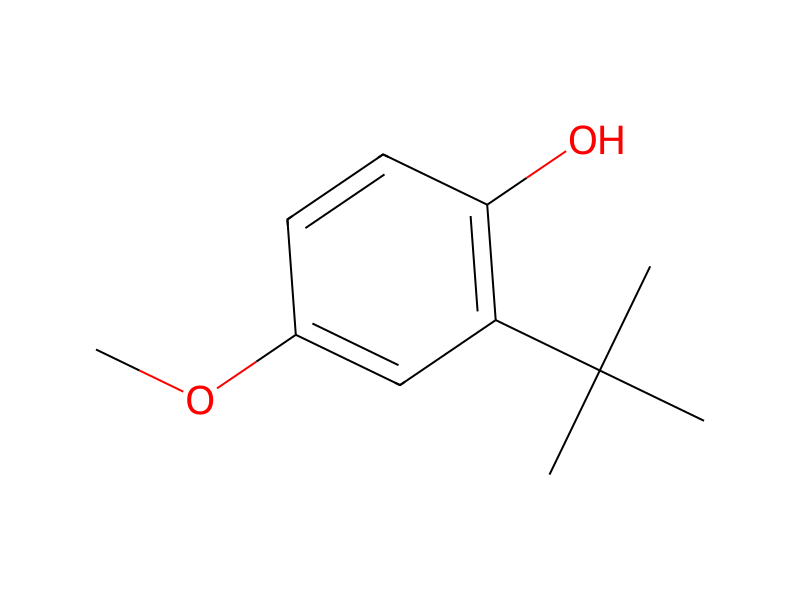
Basic information
- Standard SMILES
COc1ccc(O)c(C(C)(C)C)c1- InChIKey
MRBKEAMVRSLQPH-UHFFFAOYSA-N- Molecular formula
- C11H16O2
- Average molar mass
- 180.24 g/mol
Overview
Butylated hydroxyanisole appears as white, beige or slightly yellow waxy solid with an aromatic odor and a slightly bitter burning taste. (NTP, 1992)
Names & identifiers
- Preferred name
- Butylated Hydroxyanisole
- IUPAC
- 2-tert-butyl-4-methoxyphenol
- English name
- 4-methoxy-2-tert-butyl-phenol
- Molecular formula
- C11H16O2
- Molecular weight
- 0
Names & synonyms
Show more names
Database identifiers
- CAS
1341-82-8- ChEMBL
CHEMBL192451、CHEMBL4296740- ChEBI
CHEBI:76358- UNII
- 62RAC24292
- EC Number
- 204-442-7、246-563-8
- Nikkaji
- J2.483J
Properties
Computed structural properties
- XLogP
- 3.2
- Topological polar surface area
- 29.5 Ų
- Hydrogen bond donors
- 1
- Hydrogen bond acceptors
- 2
- Rotatable bonds
- 2
- Heavy atoms
- 13
- Formal charge
- 0
- Complexity
- 160
Experimental & physicochemical properties
Chemical Classes
Other Uses -> Preservatives
Other Uses -> Preservatives
Carcinogens
Antioxidant
Waste-water effluent contaminant
Cosmetics
Cosmetics ingredient -> Antioxidant; Fragrance; Other (Specify); Preservative/Stabilizer
Cosmetic ingredients (Butylated Hydroxyanisole) -> CIR (Cosmetic Ingredient Review)
Antioxidant
Fragrances
Fragrance Ingredient (2-tert-Butyl-4-methoxyphenol) -> IFRA transparency List
Fragrance Ingredient (Butylated hydroxyanisole) -> IFRA transparency List
Solubility
less than 1 mg/mL at 65.3 °F (NTP, 1992)
Insoluble in water, freely soluble in ethanol
Insoluble in water
Soluble in petroleum ether, ethanol
Freely soluble in alcohol, propylene glycol, chloroform, ether; soluble in petroleum ether (Shellysolve H), fats, oils.
1% in glycerine at 100 °C
Flash Point
313 °F (NTP, 1992)
156 °C
113 °C (235 °F) - closed cup
156 °C
Boiling Point
507 to 518 °F at 733 mmHg (NTP, 1992)
268 °C
Decomposition
When heated to decomposition it emits acrid smoke and irritating fumes.
Hazardous decomposition products formed under fire conditions - Carbon oxides.
It degrades after prolonged exposure to sunlight.
When heated to decomposition it emits acrid and irritating fumes.
Melting Point
118 to 131 °F (NTP, 1992)
Between 48 °C and 63 °C
51 °C
Safety & regulation
GHS classification
GHS Classification
This chemical does not meet GHS hazard criteria for 5.5% (47 of 847) of reports.
Warning
H302 (34%): Harmful if swallowed [Warning Acute toxicity, oral]
P203, P261, P264, P264+P265, P270, P271, P273, P280, P301+P317, P302+P352, P304+P340, P305+P351+P338, P318, P319, P321, P330, P332+P317, P337+P317, P362+P364, P391, P403+P233, P405, and P501 (click each P-code to see the statement)
Aggregated GHS information provided per 847 reports by companies from 52 notifications to the ECHA C&L Inventory. Each notification may be associated with multiple companies.
This chemical does not meet GHS hazard criteria for 84.4% (151 of 179) of all reports.
Hazard information
Regulatory Information
Chemical: Phenol, 2-(1,1-dimethylethyl)-4-methoxy-
Chemical: Phenol, (1,1-dimethylethyl)-4-methoxy-
Hazard Traits - Carcinogenicity
Regulation (EC) No 1831/2003 (amended)
Phenol, (1,1-dimethylethyl)-4-methoxy- is listed on the EPA's Chemical Data Reporting (CDR) system. Manufacturers and importers of Phenol, (1,1-dimethylethyl)-4-methoxy- are required to report information about their production and use of this chemical to the EPA under the Toxic Substances Control Act (TSCA). (40 eCFR Part 711)
Status: Active Update: 14-12-2022 https://echa.europa.eu/registration-dossier/-/registered-dossier/32941
Other Safety Information
IMAP assessments - Phenol, (1,1-dimethylethyl)-4-methoxy-: Human health tier I assessment
Evaluation - Butylated hydroxyanisole and related antioxidants
Health Hazards
SYMPTOMS: Symptoms of exposure to this compound may include allergic contact dermatitis, exacerbation of vasomotor rhinitis, conjunctival irritation and redness, asthma, facial flushing, marked diaphoresis, headaches, dull retrosternal pain and somnolence. It may also cause hypersensitivity reactions after skin contact.
Hazards Summary
Allergic contact dermatitis reported in caterers; [Kanerva, p. 1758] May cause allergic contact dermatitis and asthma; [CAMEO]
Permitted in food at levels up to 200 ppm; Despite widespread use, allergic contact dermatitis is rare. Percent positive patch test responses were 0.2% in a US series in 1992-4; Contact urticaria has been reported; [Marks, p. 138-9] Commercial BHA is usually an 85:15 mixture of 3-t-butyl- and 2-t-butyl-isomers; [HSDB] May cause skin sensitization; [eChemPortal: ERMA] May cause irritation; [MSDSonline]
FDA Requirements
Substances classified as antioxidants, when migrating from food-packaging material (limit of addition to food, 0.005 percent) include butylated hydroxyanisole.
Butylated hydroxyanisole used as a chemical preservative in food for human consumption is generally recognized as safe when the total content of antioxidants is not over 0.02 percent of fat or oil content, including essential (volatile) oil content of food, provided the substance is used in accordance with good manufacturing practice.
Butylated hydroxyanisole used as a chemical preservative in animal drugs, feeds, and related products is generally recognized as safe when the total content of antioxidants is not over 0.02 percent of fat or oil content, including essential (volatile) oil content of food, provided the substance is used in accordance with good manufacturing or feeding practice.
The food additive BHA (butylated hydroxyanisole) alone or in combination with other antioxidants permitted in food for human consumption in this subpart B may be safely used in or on specified foods, as follows: (a) The BHA meets the following specification: Assay (total BHA), 98.5 percent minimum. Melting point 48 °C minimum. (b) The BHA is used alone or in combination with BHT, as an antioxidant in foods, as follows:[Table#4663]
Butylated hydroxyanisole is an indirect food additive for use as a component of adhesives.
BHA (butylated hydroxyanisole) may be used as an antioxidant in flavoring substances whereby the additive does not exceed 0.5 percent of the essential (volatile) oil content of the flavoring substance.
Special Reports
Kahl R; Anti Oxidants and Carcinogen Metabolism; Trends Pharmacol Sci 3 (2): 72 (1982). Review on BHA as food additive and its metabolism.
National Toxicology Program. Fourteenth Report on Carcinogens (2016). The Report on Carcinogens is an informational scientific and public health document that identifies and discusses substances (including agents, mixtures, or exposure circumstances) that may pose a carcinogenic hazard to human health. Butylated Hydroxyanisole (25013-16-5) is listed as reasonably anticipated to be a human carcinogen.[Available from, as of November 22, 2016: http://ntp.niehs.nih.gov/pubhealth/roc/index-1.html]
Clayson DB et al; Annu Rev Pharmacol Toxicol 30: 441-63 (1990). The significance of induced forestomach tumors.
FIFRA Requirements
Butylated hydroxyanisole is exempted from the requirement of a tolerance when used as a antioxidant in accordance with good agricultural practice as inert (or occasionally active) ingredients in pesticide formulations applied to animals.
Residues of butylated hydroxyanisole are exempted from the requirement of a tolerance when used as an antioxidant in accordance with good agricultural practice as inert (or occasionally active) ingredients in pesticide formulations applied to growing crops or to raw agricultural commodities after harvest.
Residues of butylated hydroxyanisole are exempted from the requirement of a tolerance when used as an antioxidant in accordance with good agricultural practice as inert (or occasionally active) ingredients in pesticide formulations applied to animals.
Reactivity Profile
BUTYLATED HYDROXYANISOLE degrades with prolonged exposure to sunlight. Exhibits antioxidant properties and synergism with acids, BHT, propyl gallate, hydroquinone, methionine, lecithin and thiodipropionic acid. It exhibits antioxidant properties as a scavenger of free radicals. It is incompatible with oxidizing agents and ferric salts. (NTP, 1992)
Hazard Classes and Categories
Skin Irrit. 2 (14%)
Acute Tox. 4 (34%)
Skin sensitization - Category 1
Skin sensitization - Category 1
Acute toxicity (Oral) - Category 5
Carcinogens
Safety & protection
First Aid
EYES: First check the victim for contact lenses and remove if present. Flush victim's eyes with water or normal saline solution for 20 to 30 minutes while simultaneously calling a hospital or poison control center. Do not put any ointments, oils, or medication in the victim's eyes without specific instructions from a physician. IMMEDIATELY transport the victim after flushing eyes to a hospital even if no symptoms (such as redness or irritation) develop.
Fire Fighting Procedures
Suitable extinguishing media: Use water spray, alcohol-resistant foam, dry chemical or carbon dioxide.
Advice for firefighters: Wear self-contained breathing apparatus for firefighting if necessary.
Cleanup Methods
ACCIDENTAL RELEASE MEASURES: Personal precautions, protective equipment and emergency procedures: Use personal protective equipment. Avoid dust formation. Avoid breathing vapors, mist or gas. Ensure adequate ventilation. Evacuate personnel to safe areas. Avoid breathing dust. Environmental precautions: Prevent further leakage or spillage if safe to do so. Do not let product enter drains. Methods and materials for containment and cleaning up: Pick up and arrange disposal without creating dust. Sweep up and shovel. Keep in suitable, closed containers for disposal.
Nonfire Spill Response
SMALL SPILLS AND LEAKAGE: Should a spill occur while you are handling this chemical, FIRST REMOVE ALL SOURCES OF IGNITION, then you should dampen the solid spill material with 60-70% ethanol and transfer the dampened material to a suitable container. Use absorbent paper dampened with 60-70% ethanol to pick up any remaining material. Seal the absorbent paper, and any of your clothes, which may be contaminated, in a vapor-tight plastic bag for eventual disposal. Solvent wash all contaminated surfaces with 60-70% ethanol followed by washing with a soap and water solution. Do not reenter the contaminated area until the Safety Officer (or other responsible person) has verified that the area has been properly cleaned.
Disposal Methods
SRP: Recycle any unused portion of the material for its approved use or return it to the manufacturer or supplier. Ultimate disposal of the chemical must consider: the material's impact on air quality; potential migration in air, soil or water; effects on animal, aquatic and plant life; and conformance with environmental and public health regulations. If it is possible or reasonable use an alternative chemical product with less inherent propensity for occupational harm/injury/toxicity or environmental contamination.
SRP: Wastewater from contaminant suppression, cleaning of protective clothing/equipment, or contaminated sites should be contained and evaluated for subject chemical or decomposition product concentrations. Concentrations shall be lower than applicable environmental discharge or disposal criteria. Alternatively, pretreatment and/or discharge to a permitted wastewater treatment facility is acceptable only after review by the governing authority and assurance that "pass through" violations will not occur. Due consideration shall be given to remediation worker exposure (inhalation, dermal and ingestion) as well as fate during treatment, transfer and disposal. If it is not practicable to manage the chemical in this fashion, it must be evaluated in accordance with EPA 40 CFR Part 261, specifically Subpart B, in order to determine the appropriate local, state and federal requirements for disposal.
Product: Offer surplus and non-recyclable solutions to a licensed disposal company. Contact a licensed professional waste disposal service to dispose of this material. Dissolve or mix the material with a combustible solvent and burn in a chemical incinerator equipped with an afterburner and scrubber; Contaminated packaging: Dispose of as unused product.
Preventive Measures
ACCIDENTAL RELEASE MEASURES: Personal precautions, protective equipment and emergency procedures: Use personal protective equipment. Avoid dust formation. Avoid breathing vapors, mist or gas. Ensure adequate ventilation. Evacuate personnel to safe areas. Avoid breathing dust. Environmental precautions: Prevent further leakage or spillage if safe to do so. Do not let product enter drains.
Precautions for safe handling: Avoid contact with skin and eyes. Avoid formation of dust and aerosols. Provide appropriate exhaust ventilation at places where dust is formed. Normal measures for preventive fire protection.
Appropriate engineering controls: Handle in accordance with good industrial hygiene and safety practice. Wash hands before breaks and at the end of workday.
Gloves must be inspected prior to use. Use proper glove removal technique (without touching glove's outer surface) to avoid skin contact with this product. Dispose of contaminated gloves after use in accordance with applicable laws and good laboratory practices. Wash and dry hands.
For more Preventive Measures (Complete) data for Butylated hydroxyanisole (6 total), please visit the HSDB record page.
Allowable Tolerances
Butylated hydroxyanisole is exempted from the requirement of a tolerance when used as a antioxidant in accordance with good agricultural practice as inert (or occasionally active) ingredients in pesticide formulations applied to animals.
Residues of butylated hydroxyanisole are exempted from the requirement of a tolerance when used as an antioxidant in accordance with good agricultural practice as inert (or occasionally active) ingredients in pesticide formulations applied to growing crops or to raw agricultural commodities after harvest.
Residues of butylated hydroxyanisole are exempted from the requirement of a tolerance when used as an antioxidant in accordance with good agricultural practice as inert (or occasionally active) ingredients in pesticide formulations applied to animals.
Personal Protective Equipment (PPE)
MINIMUM PROTECTIVE CLOTHING: If Tyvek-type disposable protective clothing is not worn during handling of this chemical, wear disposable Tyvek-type sleeves taped to your gloves.
Eye/face protection: Safety glasses with side-shields conforming to EN166. Use equipment for eye protection tested and approved under appropriate government standards such as NIOSH (US) or EN 166(EU).
Skin protection: Handle with gloves.
Body Protection: Complete suit protecting against chemicals. The type of protective equipment must be selected according to the concentration and amount of the dangerous substance at the specific workplace.
Respiratory protection: Where risk assessment shows air-purifying respirators are appropriate use a full-face particle respirator type N100 (US) or type P3 (EN 143) respirator cartridges as a backup to engineering controls. If the respirator is the sole means of protection, use a full-face supplied air respirator. Use respirators and components tested and approved under appropriate government standards such as NIOSH (US) or CEN (EU).
Toxicology
Interactions
IN TESTS ON BENZO(A)PYRENE-INDUCED NEOPLASIA OF FORESTOMACH OF ICR/HA MOUSE, ADDN OF 3-TERT-BUTYL-4-HYDROXYANISOLE DECR NUMBER & INCIDENCE OF TUMOR FORMATION.
MICE MAINTAINED ON DIET CONTAINING 0.75% 2(3)-TERT-BUTYL-4-HYDROXYANISOLE (BHA) FOR 8 DAYS SHOWED 50% REDUCTION IN MAXIMAL ORNITHINE DECARBOXYLASE (ODC) INDUCTION FOLLOWING TREATMENT WITH TPA (12-O-TETRADECANOYLPHORBOL-13-ACETATE) WHEN COMPARED TO MICE FED CONTROL DIET. TOPICAL APPLICATION OF BHA (55 UMOLE) 30 MIN PRIOR TO TPA TREATMENT (17 NMOL) ELICITED 80% INHIBITION OF PROMOTER-INDUCED ODC ACTIVITY. BHA WAS INEFFECTIVE AS INHIBITOR WHEN ADMIN 16 HR BEFORE OR 2 HR AFTER THE PROMOTER. INHIBITION WAS DOSE DEPENDENT WITH A DOSE PRODUCING 50% INHIBITION OF ODC INDUCTION OF 6 UMOLE. A STRUCTURE-ACTIVITY STUDY SHOWED THAT HYDROXYL & TERT-BUTYL SUBSTITUENTS WERE IMPORTANT DETERMINANTS OF INHIBITORY ACTIVITY.
RATS WERE FED 2(3)-TERT-BUTYL-4-HYDROXYANISOLE (0.5% WT/WT) IN DIET WITH OR WITHOUT CIPROFIBRATE (10 MG/KG BODY WT) FOR 60 WK. 2(3)-TERT-BUTYL-4-HYDROXYANISOLE CAUSED SIGNIFICANT DECR IN INCIDENCE & NUMBER OF HEPATOCELLULAR CARCINOMAS THAT WERE LARGER THAN 5 MM. DATA SUGGEST THAT INHIBITORY EFFECT ON CIPROFIBRATE-INDUCED HEPATIC TUMORIGENESIS MAY BE DUE TO H2O2 & FREE RADICAL-SCAVENGING PROPERTY, SINCE IT DOES NOT PREVENT PEROXISOMES PROLIFERATION & INDUCTION OF H2O2-GENERATING PEROXISOMAL ENZYMES IN LIVERS OF RATS FED CIPROFIBRATE.
BHA LD50 was determined in mice and rats following ip or oral admin, using dimethylsulfoxide or olive oil as vehicle. When dimethylsulfoxide was used, BHA ip LD50 was about two orders of magnitude lower as compared to oral LD50. This difference was not so marked when BHA was administered in olive oil. /BHA/
/Both BHA and BHT have chemopreventive action when/ administered together with several carcinogens affecting diverse target organs. The antioxidants increase detoxifying enzymes for carcinogens, and many act as free radical trapping agents. The structure of these agents does not suggest a likely electrophile and tests for genotoxicity have been uniformly negative. Both BHA and BHT have been shown to inhibit cell-to-cell communication in culture. /BHA/
Drinking water disinfection by-products (DBPs) are generated by the chemical disinfection of water and may pose hazards to public health. Two major classes of DBPs are found in finished drinking water: haloacetic acids (HAAs) and trihalomethanes (THMs). HAAs are formed following disinfection with chlorine, which reacts with iodide and bromide in the water. Previously the HAAs were shown to be cytotoxic, genotoxic, mutagenic, teratogenic and carcinogenic. /The objective of the study was/ to determine the effect of HAAs in human somatic and germ cells and whether oxidative stress is involved in genotoxic action. In the present study both somatic and germ cells have been examined as peripheral blood lymphocytes and sperm. The effects of three HAA compounds: iodoacetic acid (IAA), bromoacetic acid (BAA) and chloroacetic acid (CAA) were investigated. After determining appropriate concentration responses, oxygen radical involvement with the antioxidants, butylated hydroxanisole (BHA) and the enzyme catalase, were investigated in the single cell gel electrophoresis (Comet) assay under alkaline conditions, >pH 13 and the micronucleus assay. In the Comet assay, BHA and catalase were able to reduce DNA damage in each cell type compared to HAA alone. In the micronucleus assay, micronuclei (MNi) were found in peripheral lymphocytes exposed to all three HAAs and catalase and BHA were in general, able to reduce MNi induction, suggesting oxygen radicals play a role in both assays. These observations are of concern to public health since both human somatic and germ cells show similar genotoxic responses.
Ecotoxicity Values
LC50; Species: Oryzias latipes (Japanese Medaka); Conditions: freshwater, static, 20 °C; Concentration: 5600 ug/L for 24 hr /formulation/
LC50; Species: Oryzias latipes (Japanese Medaka); Conditions: freshwater, static, 10 °C; Concentration: 5500 ug/L for 24 hr /formulation/
LC50; Species: Oryzias latipes (Japanese Medaka); Conditions: freshwater, static, 20 °C; Concentration: 5000 ug/L for 48 hr /formulation/
LC50; Species: Oryzias latipes (Japanese Medaka); Conditions: freshwater, static, 10 °C; Concentration: 5300 ug/L for 48 hr /formulation/
For more Ecotoxicity Values (Complete) data for Butylated hydroxyanisole (11 total), please visit the HSDB record page.
Environmental Fate
TERRESTRIAL FATE: Based on a classification scheme(1), an estimated Koc value of 840(SRC), determined from a structure estimation method(2), indicates that butylated hydroxyanisole is expected to have very low mobility in soil(SRC). Volatilization of butylated hydroxyanisole from moist soil surfaces is expected to be a slow environmental fate process(SRC) given an estimated Henry's Law constant of 1.2X10⁻⁶ atm-cu m/mole(SRC), using a fragment constant estimation method(3). Butylated hydroxyanisole is not expected to volatilize from dry soil surfaces(SRC) based upon an estimated vapor pressure of 2.3X10⁻³ mm Hg at 25 °C(SRC), determined from a fragment constant method(2). A calculated 0% Theoretical BOD using a model based on the Japanese MITI test(6) suggests that biodegradation is not an important environmental fate process in soil(SRC).
AQUATIC FATE: Based on a classification scheme(1), an estimated Koc value of 840(SRC), determined from a structure estimation method(2), indicates that butylated hydroxyanisole is expected to adsorb to suspended solids and sediment(SRC). Volatilization from water surfaces is expected(3) based upon an estimated Henry's Law constant of 1.2X10⁻⁶ atm-cu m/mole(SRC), developed using a fragment constant estimation method(4). Using this Henry's Law constant and an estimation method(3), volatilization half-lives for a model river and model lake are 42 and 310 days, respectively(SRC). According to a classification scheme(5), an estimated BCF of 57(SRC), from an estimated log Kow of 3.50(2) and a regression-derived equation(2), suggests the potential for bioconcentration in aquatic organisms is moderate(SRC). A calculated 0% Theoretical BOD using a model based on the Japanese MITI test(6) suggests that biodegradation is not an important environmental fate process in water(SRC).
ATMOSPHERIC FATE: According to a model of gas/particle partitioning of semivolatile organic compounds in the atmosphere(1), butylated hydroxyanisole, which has an estimated vapor pressure of 2.34X10⁻³ mm Hg at 25 °C(SRC), determined from a fragment constant method(2), is expected to exist solely as a vapor in the ambient atmosphere. Vapor-phase butylated hydroxyanisole is degraded in the atmosphere by reaction with photochemically-produced hydroxyl radicals(SRC); the half-life for this reaction in air is estimated to be 0.3 days(SRC), calculated from its rate constant of 3.6X10⁻¹¹ cu cm/molecule-sec at 25 °C(SRC) that was derived using a structure estimation method(3). Butylated hydroxyanisole does not contain chromophores that absorb at wavelengths >290 nm(4) and, therefore, is not expected to be susceptible to direct photolysis by sunlight(SRC).
Food Survey Values
Butylated hydroxyanisole comprised 0.77 percent of a volatile fraction of a raw beef extract(1).
BHA has been detected at 7-22 mg/kg in flour mixes and cereals, and vegetable and animal fats and oil have been reported to contain levels of 19-91 mg/kg. ... Analysis of chewing-gum samples gave values of 92 and 121 mg/kg in two of nine samples ... .
Adverse Effects
Skin Sensitizer - An agent that can induce an allergic reaction in the skin.
Skin Sensitizer - An agent that can induce an allergic reaction in the skin.
Toxicity Summary
IDENTIFICATION AND USE: 3-tert-Butyl-4-hydroxyanisole is a component of Butylated Hydroxyanisole which is a commonly used food preservative. This material is an oxidation inhibitor and has been accepted for the use in foods where Butylated hydroxytoluene is restricted. This chemical is used as a food preservative for human consumption. HUMAN EXPOSURE AND TOXICITY: There is no human studies concerning.3-tert-Butyl-4-hydroxyanisole ANIMAL STUDIES: The mutagenicity of 3-tert-butyl-4-hydroxyanisole and its metabolites was determined in the reverse mutation assay using Salmonella typhimurium, strains and in the chromosomal aberration test in vitro using the Chinese hamster fibroblast cell line, the chemical did not show any mutagenic activity. 3-tert-Butyl-4-hydroxyanisole induced chromosomal aberrations only in the presence of S9 mix.
IDENTIFICATION AND USE: Butylated hydroxyanisole (BHA) is white or slightly yellow, waxy solid. The primary use for BHA is as an antioxidant and preservative in food, food packaging, animal feed, and cosmetics, and rubber and petroleum products as well. BHA is particularly useful in protecting the flavors and color of essential oils and is considered the most effective of all food-approved antioxidants for this application. BHA is effective in controlling the oxidation of short-chain fatty acids, such as those found in coconut and palm kernel oils that are used typically in cereal and confectionary products. HUMAN EXPOSURE AND TOXICITY: BHA produced allergic contact dermatitis. Although BHA is not an irritant, it can cause skin reactions owing to its weak allergic sensitization potential. BHA was able to reduce DNA damage and micronucleus formed in peripheral lymphocytes exposed to other genotoxic agents. ANIMAL STUDIES: Dietary exposure to BHA caused benign and malignant tumors of the forestomach (papilloma and squamous-cell carcinoma) in rats of both sexes and in male mice and hamsters due to increased lifespan of the animals compared to control. Rats could tolerate BHA up to 1200 ppm in their diet for a period of 21 months. No histopathological or carcinogenic effects were found to be associated with the ingestion, nor were there any affects on reproduction. BHA was evaluated in rats and mice in dose levels up to 1000 and 500 mg/kg, respectively, for teratological effects. No abnormal findings attributable to the exposure were noted. In another study the teratological effect of BHA were evaluated in rabbits at dose levels ranging from 50 to 400 mg/kg. No abnormal findings were reported. Dietary administration of BHA to fish (hermaphroditic Rivulus marmoratus) as larvae caused liver cancer (hepatocellular carcinoma) in the adult fish. BHA at levels ranging from 5 to 500 mg/kg produced neurological changes in mice by increasing serotonin utilization in the central nervous system. ECOTOXICITY STUDIES: Dietary BHA produced alterations in the enzyme activities of the mixed-function oxidase system, changes in the ethyl isocyanide binding ratio and decreases in cytochrome P-450 content in the hepatic microsomes of rainbow trout.
Ecotoxicity Excerpts
/AQUATIC SPECIES/ Rainbow trout (Salmo gairdneri) were fed a control diet with or without an antioxidant--3,5-di-tert-butyl-4-hydroxytoluene (BHT), 2(3)-tert-butyl-4-hydroxyanisole (BHA), mono-tert-butylhydroquinone (TBHQ) or ethoxyquin (EQ)--at a level of 5.56 mmol in 100 g oil/kg diet for 6 wk. The treated trout had reduced liver weight/body weight ratios. In comparison with trout fed control diet, microsomal protein content was lowered by 13% in TBQH-fed trout and elevated by 28% in EQ-fed trout, cytochrome P-450 content was 21% lower in BHA- and TBHQ-fed and 18% lower in EQ-fed trout and cytochrome b5 content was 46% lower in EQ-fed trout. Activities of benzo[a]pyrene hydroxylase, epoxide hydratase and ethoxycoumarin-O-deethylase were, respectively, 3.2-4.8, 1.2-1.7 and 1.3-5.5 times higher in antioxidant-fed trout. NADPH-cytochrome c reductase was elevated 1.2-1.3 times over the control value with dietary BHA, TBHQ and BHT, but was lowered with EQ. p-Nitroanisole-O-demethylase activity was completely suppressed in antioxidant-fed trout. The content of post-mitochondrial acid-soluble sulfydryl groups was 42% lower in BHA- and BHT-fed trout. Alterations in the enzyme activities of the mixed-function oxidase system, changes in the ethyl isocyanide binding ratio and decreases in cytochrome P-450 content suggest that dietary antioxidants could alter carcinogen activation and/or detoxification mechanisms in the hepatic microsomes of rainbow trout.
/AQUATIC SPECIES/ The occurrence and fate of additives in the aquatic environment is an emerging issue in environmental chemistry. This paper describes the ecotoxicological effects of the commonly used additive butylated hydroxyanisole (BHA) using a test battery, comprising of several different organisms and in vitro test systems, representing a proportion of the different trophic levels. The most sensitive system to BHA was the inhibition of bioluminescence in Vibrio fischeri bacteria, which resulted in an acute low observed adverse effect concentration (LOAEC) of 0.28 uM. The next most sensitive system was the immobilization of the cladoceran Daphnia magna followed by: the inhibition of the growth of the unicellular alga Chlorella vulgaris; the endpoints evaluated in Vero (mammalian) cells (total protein content, LDH activity, neutral red uptake and MTT metabolization), mitotic index and root growth inhibition in the terrestrial plant Allium cepa, and finally, the endpoints used on the RTG-2 salmonid fish cell line (neutral red uptake, total protein content, MTS metabolization, lactate dehydrogenase leakage and activity, and glucose-6-phosphate dehydrogenase activity). Morphological alterations in RTG-2 cells were also assessed and these included loss of cells, induction of cellular pleomorphism, hydropic degeneration and induction of apoptosis at high concentrations. The results from this study also indicated that micronuclei were not induced in A.cepa exposed to BHA. The differences in sensitivity for the diverse systems that were used (EC50 ranged from 1.2 to >500 uM) suggest the importance for a test battery approach in the evaluation of the ecological consequences of chemicals. According to the results, the levels of BHA reported in industrial wastewater would elicit adverse effects in the environment. This, coupled with its potential to bioaccumulate, makes BHA a pollutant of concern not only for acute exposures, but also for the long-term.
/AQUATIC SPECIES/ Sewage, a complex mixture of organic and inorganic chemicals, is considered to be a major source of environmental pollution. A random screen of 20 organic man-made chemicals present in liquid effluents revealed that half appeared able to interact with the estradiol receptor. This was demonstrated by their ability to inhibit binding of 17 beta-estradiol to the fish estrogen receptor. Further studies, using mammalian estrogen screens in vitro, revealed that the two phthalate esters butylbenzyl phthalate (BBP) and di-n-butylphthalate (DBP) and a food antioxidant, butylated hydroxyanisole (BHA) were estrogenic; however, they were all less estrogenic than the environmental estrogen octylphenol. Phthalate esters, used in the production of various plastics (including PVC), are among the most common industrial chemicals. Their ubiquity in the environment and tendency to bioconcentrate in animal fat are well known. Neither BBP nor DBP were able to act as antagonists, indicating that, in the presence of endogenous estrogens, their overall effect would be cumulative. Recently, it has been suggested that environmental estrogens may be etiological agents in several human diseases, including disorders of the male reproductive tract and breast and testicular cancers. The current finding that some phthalate compounds and some food additives are weakly estrogenic in vitro, needs to be supported by further studies on their effects in vivo before any conclusions can be made regarding their possible role in the development of these conditions.
Ongoing Test Status
EPA has released the Interactive Chemical Safety for Sustainability (iCSS) Dashboard. The iCSS Dashboard provides an interactive tool to explore rapid, automated (or in vitro high-throughput) chemical screening data generated by the Toxicity Forecaster (ToxCast) project and the federal Toxicity Testing in the 21st century (Tox21) collaboration. /The title compound was tested by ToxCast and/or Tox21 assays/[USEPA; ICSS Dashboard Application; Available from, as of September 8, 2016: http://actor.epa.gov/dashboard/]
Effluent Concentrations
In industrial wastewater survey sample extracts, butylated hydroxyanisole was detected at 7 ng/uL(1). In organic constituents of mutagenically active secondary effluents from industrial plants and publicly-owned treatment works in Illinois, butylated hydroxyanisole was qualitatively detected in 3 out of 10 samples(2). Butylated hydroxyanisole was qualitatively found at an advanced waste treatment facility in Orange County, California on January 27, 1976(3) and in Pomona, California on September 25, 1974(4).
Soil Adsorption/Mobility
Using a structure estimation method based on molecular connectivity indices(1), the Koc of butylated hydroxyanisole can be estimated to be 840(SRC). According to a classification scheme(2), this estimated Koc value suggests that butylated hydroxyanisole is expected to have low mobility in soil.
Human Toxicity Excerpts
/SIGNS AND SYMPTOMS/ /Researchers/ described human sensitization to BHA plus BHT (butylated hydroxytoluene) in patients fed 125 mg of each chemical. After challenge, acute symptoms consisted of exacerbation of vasomotor rhinitis, headaches, asthma, flushing, suffusion of conjunctiva, occasional dull retrosternal pain, marked diaphoresis and somnolence.
/SIGNS AND SYMPTOMS/ Patch test studies ... report that BHA produces allergic contact dermatitis ... Although BHA is not an irritant, it can cause skin reactions owing to its weak allergic sensitization potential.
/GENOTOXICITY/ Butylated hydroxyanisole (BHA) is a synthetic phenolic food additive that is used to prevent oils, fats, and shortenings from oxidative deterioration and rancidity. It was tested for potential cytotoxicity and genotoxicity upon A549 lung cancer cells. MTT assay and flow cytometry analysis were used for cytotoxicity assessment, whereas genotoxicity was evaluated in vitro by DAPI staining, alkaline comet, and DNA fragmentation assays. BHA dose- and time-dependently decreased the growth of A549 cells with an IC50 of approx. 0.55, 0.4, and 0.3 mM BHA at 24, 48, and 72 hr, respectively. Primary and late apoptosis in the treated cells was determined using the flow cytometry analyses. In addition, single-strand DNA breakage has been observed through the comet assay technique. In addition, the morphology of DAPI-stained cells and DNA fragmentation assay using gel electrophoresis showed clear fragmentation in the chromatin and DNA rings within the nucleus of cells treated with BHA.
/ALTERNATIVE and IN VITRO TESTS/ Butylated hydroxyanisole (BHA), a synthetic antioxidant is commonly used as a preservative in food and pharmaceutical agents. Despite the assumed low toxicity of BHA, it exerts a variety of effects on tissues and cell functions. In this study, the authors investigated the effects of BHA on the growth inhibition and death of HeLa cervical cancer cells. Dose-dependent inhibition of cell growth was observed with an IC(50) of approximately 150 uM BHA at 24 hr. In addition, this agent-induced apoptosis, which was accompanied by the loss of mitochondrial membrane potential (delta-psi(m)) and caspase activation. Caspase-3 and -8 inhibitors markedly rescued HeLa cells from BHA-induced cell death. In addition, BHA decreased intracellular ROS levels in HeLa cells whereas it increased superoxide anion levels among ROS. The number of glutathione (GSH)-depleted cells was increased in 150 uM BHA-treated cells, which was attenuated by caspase inhibitors. In conclusion, BHA inhibited the growth of HeLa cells via caspase-dependent apoptosis, which seemed to be related to increase in GSH depletion and superoxide anion level.
/ALTERNATIVE and IN VITRO TESTS/ Butylated hydroxyanisole (BHA) is a widely used antioxidant for food preservation. 11beta-hydroxysteroid dehydrogenases, isoforms 1 (HSD11B1) and 2 (HSD11B2) have been demonstrated to be the regulators of the local level of active glucocorticoid, which has a broad range of physiological actions. In this study, the potency of BHA was tested for the inhibition of HSD11B1 and HSD11B2 in rat and human tissues. BHA showed potent inhibition of HSD11B2 with the half maximal inhibitory concentration calculated at 13.99 and 69.25 umol/L for the rat and human, respectively. Results showed that BHA competitively inhibited HSD11B2 when a steroid substrate was used. However, it served as a mixed inhibition factor when the cofactor NAD+ was used. In contrast, the potency of BHA to inhibit both rat and human HSD11B1 was diminished, with the concentration of 100 umol/L causing no inhibitory effect on the isoform. In conclusion, we observed that BHA is a selective inhibitor of HSD11B2, implying that this agent may cause excessive glucocorticoid action in local tissues such as kidney and placentas.
Regulatory information
FDA Requirements
Substances classified as antioxidants, when migrating from food-packaging material (limit of addition to food, 0.005 percent) include butylated hydroxyanisole.
Butylated hydroxyanisole used as a chemical preservative in food for human consumption is generally recognized as safe when the total content of antioxidants is not over 0.02 percent of fat or oil content, including essential (volatile) oil content of food, provided the substance is used in accordance with good manufacturing practice.
Butylated hydroxyanisole used as a chemical preservative in animal drugs, feeds, and related products is generally recognized as safe when the total content of antioxidants is not over 0.02 percent of fat or oil content, including essential (volatile) oil content of food, provided the substance is used in accordance with good manufacturing or feeding practice.
The food additive BHA (butylated hydroxyanisole) alone or in combination with other antioxidants permitted in food for human consumption in this subpart B may be safely used in or on specified foods, as follows: (a) The BHA meets the following specification: Assay (total BHA), 98.5 percent minimum. Melting point 48 °C minimum. (b) The BHA is used alone or in combination with BHT, as an antioxidant in foods, as follows:[Table#4663]
Butylated hydroxyanisole is an indirect food additive for use as a component of adhesives.
BHA (butylated hydroxyanisole) may be used as an antioxidant in flavoring substances whereby the additive does not exceed 0.5 percent of the essential (volatile) oil content of the flavoring substance.
FIFRA Requirements
Butylated hydroxyanisole is exempted from the requirement of a tolerance when used as a antioxidant in accordance with good agricultural practice as inert (or occasionally active) ingredients in pesticide formulations applied to animals.
Residues of butylated hydroxyanisole are exempted from the requirement of a tolerance when used as an antioxidant in accordance with good agricultural practice as inert (or occasionally active) ingredients in pesticide formulations applied to growing crops or to raw agricultural commodities after harvest.
Residues of butylated hydroxyanisole are exempted from the requirement of a tolerance when used as an antioxidant in accordance with good agricultural practice as inert (or occasionally active) ingredients in pesticide formulations applied to animals.
Chemistry & industry
Pharmacology
Mechanism of Action
ADMIN OF 2(3)-TERT-BUTYL-4-HYDROXYANISOLE (BHA) TO RODENTS PROTECTS A VARIETY OF TARGET TISSUES AGAINST PRODUCTION OF TUMORS BY WIDE RANGE OF CHEMICAL CARCINOGENS. BHA REDUCES LEVELS OF MUTAGENIC METABOLITES PRODUCED FROM BENZO(A)PYRENE & NUMEROUS THERAPEUTIC AGENTS IN VIVO; IT ELEVATES HEPATIC ACTIVITIES OF MICROSOMAL EPOXIDE HYDRATASE & CYTOSOL GLUTATHIONE S-TRANSFERASE; IT ALTERS ACTIVITIES OF OTHER HEPATIC ENZYMES & AFFECTS LEVELS OF SOME HEPATIC CATALYTIC CONSTITUENTS; & IT INCREASES CONCN OF NONPROTEIN THIOL COMPOUNDS IN LIVER & SEVERAL OTHER TISSUES. /BHA/
EFFECTS OF BUTYLATED HYDROXYANISOLE (BHA) ON ARYL HYDROCARBON HYDROXYLASE (AHH) ACTIVITES IN LIVER, LUNG & SKIN OF RATS & MICE WERE STUDIED TO EXAMINE POSSIBLE MECHANISMS OF ANTICARCINOGENIC ACTIONS. AHH INDUCERS, 3-METHYLCHOLANTHRENE, PHENOBARBITAL &2,3,7,8-TETRACHLORODIBENZO-P-DIOXIN WERE USED. IT WAS OBSERVED THAT 2-TERT-BUTYL-4-HYDROXYANISOLE, 3-TERT-BUTYL-4-HYDROXYANISOLE & BHA COMMERCIAL MIXTURE (85% 3-BHA & 15% 2-BHA) HAD ABOUT THE SAME POTENCY IN INHIBITING MICROSOMAL AHH, ALTHOUGH THE 2-ISOMER APPEARED TO BE SLIGHTLY MORE INHIBITORY. DATA SUGGEST THAT INHIBITORY ACTION OBSERVED IN COMMERCIAL BHA IS DUE TO THE COMBINED ACTION OF BOTH ISOMERS & IS DEPENDENT ON SPECIES OF ANIMAL, TISSUE TYPES & TREATMENT WITH INDUCERS.
/Both BHA and BHT have chemopreventive action when/ administered together with several carcinogens affecting diverse target organs. The antioxidants increase detoxifying enzymes for carcinogens, and many act as free radical trapping agents. The structure of these agents does not suggest a likely electrophile and tests for genotoxicity have been uniformly negative. Both BHA and BHT have been shown to inhibit cell-to-cell communication in culture. /BHA/
Estrogen metabolism-mediated oxidative stress is suggested to play an important role in estrogen-induced breast carcinogenesis. We have earlier demonstrated that antioxidants, vitamin C (Vit C) and butylated hydroxyanisole (BHA) inhibit 17beta-estradiol (E2)-mediated oxidative stress and oxidative DNA damage, and breast carcinogenesis in female August Copenhagen Irish (ACI) rats. The objective of the present study was to characterize the mechanism by which above antioxidants prevent DNA damage during breast carcinogenesis. Female ACI rats were treated with E2; Vit C; Vit C+E2; BHA; and BHA+E2 for up to 240 days. mRNA and protein levels of a DNA repair enzyme 8-Oxoguanine DNA glycosylase (OGG1) and a transcription factor NRF2 were quantified in the mammary and mammary tumor tissues of rats after treatment with E2 and compared with that of rats treated with antioxidants either alone or in combination with E2. The expression of OGG1 was suppressed in mammary tissues and in mammary tumors of rats treated with E2. Expression of NRF2 was also significantly suppressed in E2-treated mammary tissues and in mammary tumors. Vitamin C or BHA treatment prevented E2-mediated decrease in OGG1 and NRF2 levels in the mammary tissues. Chromatin immunoprecipitation analysis confirmed that antioxidant-mediated induction of OGG1 was through increased direct binding of NRF2 to the promoter region of OGG1. Studies using silencer RNA confirmed the role of OGG1 in inhibition of oxidative DNA damage. Our studies suggest that antioxidants Vit C and BHA provide protection against oxidative DNA damage and E2-induced mammary carcinogenesis, at least in part, through NRF2-mediated induction of OGG1.
Metabolism/Metabolites
FOLLOWING ORAL ADMIN OF 2 G/KG OF 2-TERT-BUTYL-4-METHOXYPHENOL TO RATS, THE METABOLITE 2,2'-DIHYDROXY-3,3'-DI-TERT-BUTYL-5,5'-DIMETHOXYDIPHENYL WAS DETECTED IN PLASMA & TISSUE 0.15-24 HR AFTER ADMIN.
DI-BHA (2,2'-DIHYDROXY-3,3'-DI-TERT-BUTYL-5,5'-DIMETHOXYDIPHENYL) WAS ISOLATED AS REACTION PRODUCT OF EITHER COMMERCIAL HORSERADISH PEROXIDASE OR PARTIALLY PURIFIED RAT INTESTINE PEROXIDASE & HYDROGEN PEROXIDE WITH 2-TERT-BUTYL-4-METHOXYPHENOL. CYCLIC COMPOUNDS (SUCH AS DI-BHA) POSSESSING A HYDROXY GROUP IN THE RING ARE COMPETITIVE INHIBITORS WITH RESPECT TO GUAIACOL & NON-COMPETITIVE INHIBITORS WITH RESPECT TO HYDROGEN PEROXIDASE IN A SYSTEM CONTAINING GUAIACOL, HYDROGEN PEROXIDASE & PEROXIDASE.
In rat, oral doses (0.4 g/kg) are excreted largely in urine, as glucuronide conjugate (72% of dose) with smaller ammounts of ethereal sulfate (14%) and of unchanged BHA (5%). Similar pattern of metabolism is ... seen in rabbit and human ...
... Dogs excrete only small amounts of BHA glucuronide in urine (5.5%) and most of dose is excreted as unchanged BHA in feces. Dogs also excrete greater proportion as ethereal sulfate (23% of dose), and ... form hydroxylated and demethylated metabolites ... not detected in human urine.
In male and female Sprague-Dawley rats, BHA was absorbed rapidly after oral administration and metabolized. The main metabolites were 4-O-conjugates: the O-sulfate and the O-glucuronide ... (No data on absorption via the skin were available to the Working Group.)
After administration of a single oral dose of 1000 mg BHA to New Zealand white rabbits, 46% of the dose was excreted in the urine as glucuronides, 9% as ethereal sulfates and 6% as free phenols. Excretion of glucuronides was inversely dose dependent: 60% was recovered as glucuronides after a dose of 500 mg and 84% after 250 mg. Recovery of BHA as glucuronide after repeated dosing (three or four doses) was lower than that after a single dose ... .
MeSH Pharmacological Classification
Naturally occurring or synthetic substances that inhibit or retard oxidation reactions. They counteract the damaging effects of oxidation in animal tissues.
Substances that increase the risk of NEOPLASMS in humans or animals. Both genotoxic chemicals, which affect DNA directly, and nongenotoxic chemicals, which induce neoplasms by other mechanism, are included.
Absorption, Distribution and Excretion
CONCENTRATIONS OF 2-TERT-BUTYL-4-METHOXYPHENOL & 2,2'-DIHYDROXY-3,3'-DI-TERT-BUTYL-5,5'DIMETHOXY-DIPHENYL (DI-BHA) APPEARED AT DIFFERENT TIMES (0.15-24 HR) IN RAT PLASMA & INTESTINE FOLLOWING 2 G/KG SINGLE ORAL ADMIN OF 2-TERT-BUTYL-4-METHOXYPHENOL. PEAK CONCN IN ALL TISSUES ANALYZED WERE OBSERVED WITHIN 1 HR OF ADMIN. IN INTESTINE 2-TERT-BUTYL-4-METHOXYPHENOL LEVELS WERE APPROX 10 TIMES HIGHER THAN DI-BHA; IN PLASMA THEY WERE BETWEEN 100 & 15 TIMES HIGHER. THE RAT INTESTINE IS CAPABLE OF TRANSFORMING IN VIVO 2-TERT-BUTYL-4-METHOXYPHENOL INTO DI-BHA & MAY BE MAJOR SITE WHERE THIS TRANSFORMATION OCCURS.
Absorption of BHA from the digestive tract is by passive diffusion.
BHA was fed to groups of three beagle dogs at dose levels of 0, 0.3, 3, 30 and 100 mg/kg bw for 1 yr. All animals survived; no pathological lesion was seen, and there was not demonstrable storage of BHA ... .
In male and female Sprague-Dawley rats, BHA was absorbed rapidly after oral administration and metabolized.
When male volunteers were given an oral dose of 50 mg BHA, 27-77% was excreted in the urine as the glucuronide and urinary metabolites. ... Urinary excretion of BHA was maximal within 17 hr and complete by 48 hr. ... When human volunteers were given a single oral dose of 14(C)-labelled BHA (approx 0.5 mg/kg bw), 60-70% of the radioactivity was excreted in the urine within 2 days and 80-86.5% by day 11. ... Four male volunteers were given 30 mg BHA orally and 10 days later
Uses & manufacturing
Uses
CIR ingredient: Butylated Hydroxyanisole
Used as a food and cosmetic preservative; [Kanerva, p. 1758] Used as an antioxidant in many foods since 1947; Also used in cosmetics such as lipstick and eye shadow; [IARC]
Using Disinfectants or Biocides [Category: Clean]
Used as a food additive (oxidation inhibitor); [HSDB] Used as preservative in foods, cosmetics, topical medications, animal feeds, rubber, plastics, pints, and glues; [Marks, p. 139]
Farming (Feed Additives) [Category: Industry]
COMPONENT OF BHA (A COMMONLY USED FOOD ADDITIVE)
Impurities
Arsenic, less than 3 ppm; heavy metal (as lead), less than 10 ppm; residual on ignition, less than 0.01% /BHA/
Arsenic, less than 3 ppm; heavy metal (as lead), less than 10 ppm; residual on ignition, less than 0.01%
4-Hydroxyanisole, max 0.5%; 1-tert-butyl-2,5-dimethoxybenzene, max 0.5%; 2,5-Di-tert-butyl-hydroxyanisole, max 0.2%; hydroquinone dimethyl ether, max 0.1%; sulfated ash, max 0.01%; lead (as Pb), max 20 ppm; arsenic (as As) max 3 ppm
U.S. Production
2023: <50,000 lb
(1986) No Data
Non-confidential 2012 Chemical Data Reporting (CDR) information on the production and use of chemicals manufactured or imported into the United States. Chemical: Phenol, (1,1-dimethylethyl)-4-methoxy-. National Production Volume: Withheld.
Consumption Patterns
The estimated US consumption of BHA in food increased to 660,000 lb/yr during 1970-1982, up from 374 lb/yr in 1960. ... Reported annual consumption for BHA in the mid-1970s was 990,000 lb compared with 3.1 million lb for butylated hydroxytoluene (BHT) ... .
Methods of Manufacturing
Alkylation of 4-hydroxyanisole with isobutylene which yields the mixture of 2- and 3-tert-butyl isomers used as product
Methylation of hydroquinone yields an intermediate that gives a mixture of 3-BHA and 2-BHA upon treatment with tert-butyl alcohol and phosphoric acid. Butylation of hydroquinone and subsequent methylation with dimethyl sulfate and sodium hydroxide can also be used to produce a mixture of the two BHA isomers. In addition, BHA can be synthesized by the tert-butylation of 4-methoxyphenol over silica or alumina at 150 °C.
It is manufactured by the alkylation of 4-hydroxyanisole with isobutylene that yields a mixture of 2- and 3-tert-butyl isomers as products.
Butylated hydroxyanisole is prepared from 4-methoxyphenol and tert-butyl alcohol over silica or alumina at 150 °C or from hydroquinone and tert-butyl alcohol or isobutene, using an acid catalyst and then methylating.
Formulations/Preparations
THE COMMERCIAL PREPN /OF BHA/ SOLD UNDER NAME OF TENOX BHA (EASTMAN CHEM INC) CONTAINS ABOUT 85% OF ... 3-TERT-BUTYL-4-HYDROXYANISOLE & 15% OF ... /2-TERT-BUTYL-4-HYDROXYANISOLE/.
Food Grade, 98.5+%.
Chemically, BHA is a mixture of two isomers, 3-tert-butyl-4-hydroxyanisole (90%) and 2-tert-butyl-4-hydroxyanisole (10%).
Commercial preparation sold under name of Tenox BHA (Eastman Chem Inc) contains about 85% of /3-tert-butyl-4-hydroxyanisole/ & 15% of ... /2-tert-butyl-4-hydroxyanisole/.
FCC /Food Chemical Codex/; water soluble.
Food grade, 98+%
Household Products
Cosmetics product ingredient: Butylated hydroxyanisole (BHA)
Information on 58 consumer products that contain Butylated hydroxyanisole (BHA) in the following categories is provided:
Use Classification
Food additives
Fragrance Ingredients
Fragrance Ingredients
Food Additives -> ANTIOXIDANT -> JECFA Functional Classes
Food Additives -> ANTIOXIDANT -> JECFA Functional Classes
Cosmetics -> Antioxidant
Suppliers1 total
Additional notes
DefinitionChEBI: 3-tert-butyl-4-hydroxyanisole is an aromatic ether that is 4-methoxyphenol in which one of the hydrogens ortho- to the phenolic hydroxy group is replaced by a tert-butyl group. It has a role as an antioxidant and a human xenobiotic metabolite. It is a member of phenols and an aromatic ether.
Related reactions
No reaction records under the current filter.
Linked notes
Loading…