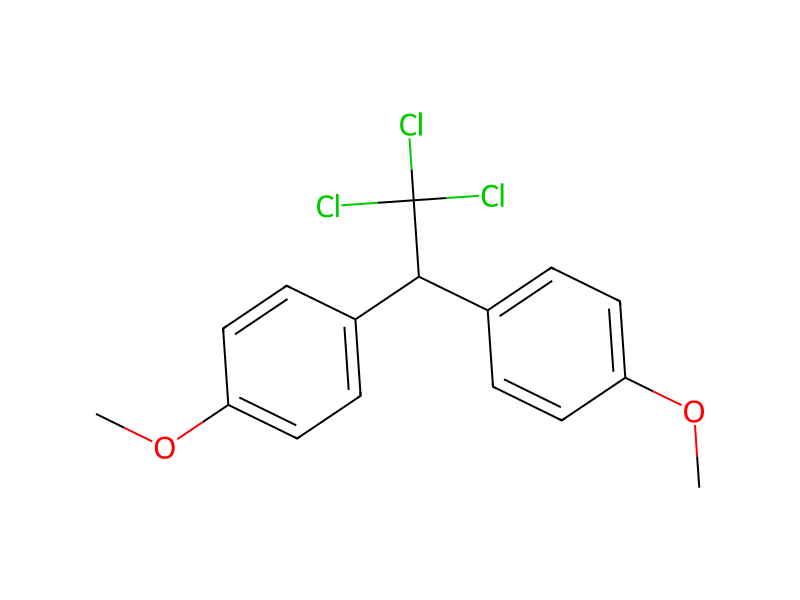
Basic information
- Standard SMILES
COc1ccc(C(c2ccc(OC)cc2)C(Cl)(Cl)Cl)cc1- InChIKey
IAKOZHOLGAGEJT-UHFFFAOYSA-N- Molecular formula
- C16H15Cl3O2
- Average molar mass
- 345.6 g/mol
Overview
Methoxychlor is a manufactured chemical that does not occur naturally in the environment. Pure methoxychlor is a pale-yellow powder with a slight fruity or musty odor. Methoxychlor is used as an insecticide against flies, mosquitoes, cockroaches, chiggers, and a wide variety of other insects. It is used on agricultural crops and livestock, and in animal feed, barns, grain storage bins, home gardens, and on pets. Methoxychlor is also known as DMDT, Marlate®, or Metox®.
Names & identifiers
- Preferred name
- Methoxychlor
- IUPAC
- 1-methoxy-4-[2,2,2-trichloro-1-(4-methoxyphenyl)ethyl]benzene
- English name
- Methoxychlor-d6
- Molecular formula
- C16H15Cl3O2
- Molecular weight
- 345.64
Names & synonyms
Show more names
Database identifiers
- CAS
106031-79-2- ChEMBL
CHEMBL362919- ChEBI
CHEBI:6842- UNII
- RIA79UD69L
- EC Number
- 108-349-1、200-779-9
- Nikkaji
- J2.377I
Properties
Computed structural properties
- XLogP
- 5.1
- Topological polar surface area
- 18.5 Ų
- Hydrogen bond donors
- 0
- Hydrogen bond acceptors
- 2
- Rotatable bonds
- 4
- Heavy atoms
- 21
- Formal charge
- 0
- Complexity
- 279
Experimental & physicochemical properties
Pesticides
Pesticide -> EPA IRIS
Insecticides
Active substance -> EU Pesticides database: Not approved
Pesticides -> Organochlorine Pesticides
Pesticide
LogP
log Kow = 5.08
4.68/5.08
3.82
Density
1.41 at 77 °F (USCG, 1999) - Denser than water; will sink
1.41 g/cu cm at 25 °C
Grey-flaky powder; setting point 77 °C; density 1.41; sol 0.1 mg/Lwater at 25 °C; 440 g/kg chloroform & xylene, & 50 g/kg methanol at 22 °C /Technical grade/
1.4 g/cm³
1.41
1.41 @25 °C
Color/Form
Colorless crystals (technical, grey powder)
Dimorphic crystals
Crystals from dilute alcohol
White to light yellow solid
For more Color/Form (Complete) data for METHOXYCHLOR (7 total), please visit the HSDB record page.
Solubility
less than 1 mg/mL at 73 °F (NTP, 1992)
Soluble in alcohol
Moderately sol in alcohol and petroleum oils; readily sol in most aromatic solvents
Methylene dichloride: 60 g/100 g at 22 °C; dichlorobenzene: 40 g/100 g at 22 °C; cyclohexanone: 50 g/100 g at 22 °C; methylated naphthalenes: 30 g/100 g at 22 °C; carbon tetrachloride: 16 g/100 g at 22 °C; odorless kerosene: 2 g/100 g at 22 °C. /Data from table/
Readily soluble in aromatic, chlorinated, and ketonic solvents, and vegetable oils. In chloroform and xylene 440, methanol 50 (all in g/kg, 22 °C).
For more Solubility (Complete) data for METHOXYCHLOR (9 total), please visit the HSDB record page.
Corrosivity
Methoxychlor will attack some forms of plastics, rubbers, and coatings.
Slightly corrosive to iron and aluminum
Boiling Point
Decomposes (NTP, 1992)
decomposes
Decomposes
Decomposition
... When heated to decomp, it emits highly toxic fumes of /hydrogen chloride/ .
Toxic gases and vapors (such as hydrogen chloride and carbon monoxide) may be released when methoxychlor decomposes.
Physicochemical properties
- solubility
- Chloroform (Slightly), Methanol (Slightly)
- form
- Solid
- color
- White to Off-White
Safety & regulation
GHS classification
GHS Classification
This chemical does not meet GHS hazard criteria for 5.4% (3 of 56) of reports.
Danger
H302+H312+H332 (30.4%): Harmful if swallowed, in contact with skin or if inhaled [Warning Acute toxicity, oral; acute toxicity, dermal; acute toxicity, inhalation]
P203, P260, P261, P264, P270, P271, P273, P280, P301+P317, P302+P352, P304+P340, P308+P316, P317, P318, P319, P321, P330, P362+P364, P391, P405, and P501 (click each P-code to see the statement)
Aggregated GHS information provided per 56 reports by companies from 7 notifications to the ECHA C&L Inventory. Each notification may be associated with multiple companies.
Warning
Hazard information
Regulatory Information
Hazard Traits - Bioaccumulation; Endocrine Toxicity; Environmental Persistence; Hepatotoxicity and Digestive System Toxicity; Neurotoxicity
2002/2076
Substance: Methoxychlor
The New Jersey Worker and Community Right to Know Act requires public and private employers to provide information about hazardous substances at their workplaces. (N.J.S.A. 34:5A-1 et. seq.)
Fire Hazards
Special Hazards of Combustion Products: Irritating and toxic hydrogen chloride gas may be formed in fire. (USCG, 1999)
Combustible. Liquid formulations containing organic solvents may be flammable. Gives off irritating or toxic fumes (or gases) in a fire.
Hazards Summary
Methoxychlor is a manufactured chemical that does not occur naturally in the environment. Pure methoxychlor is a pale-yellow powder with a slight fruity or musty odor. Methoxychlor is used as an insecticide against flies, mosquitoes, cockroaches, chiggers, and a wide variety of other insects. It is used on agricultural crops and livestock, and in animal feed, barns, grain storage bins, home gardens, and on pets. Methoxychlor is also known as DMDT, Marlate®, or Metox®.
Exposure to methoxychlor may occur during its manufacture or use as a pesticide. Information on the acute (short-term) and chronic (long-term) effects of methoxychlor in humans is not available. In an acute oral study in animals, changes in the liver were reported. Dermal contact with methoxychlor is slightly irritating to skin. Chronic oral exposure of animals to methoxychlor has resulted in effects to the liver, kidneys, and nervous system. Reproductive and developmental effects are the primary concern from methoxychlor exposure. Animal studies have reported developmental and reproductive effects, such as abortions, reduced fertility, reduced litter size, and skeletal effects from oral exposure to methoxychlor. EPA has classified methoxychlor as a Group D, not classifiable as to human carcinogenicity. Inhalation studies are not available for methoxychlor. However, oral studies are available and a risk management decision can be made to assume that the hazards resulting from oral exposure may be indicative of that resulting from inhalation exposure.
Methoxychlor is classified as practically nontoxic with an LD50 of 5-6 gm/kg in rats. It does not accumulate in tissues of mammals, but is highly toxic to fish. It persists in the soil with a half-life estimate of 120 days. [EXTOXNET] High-dose animal studies show that organochlorine insecticides can cause liver injury. [LaDou, p. 593] No evidence of hepatic injury in humans as the result of environmental contamination. [Zimmerman, p. 414]
Special Reports
Nat'l Research Council Canada; Methoxychlor: Its Effects on Environmental Quality (1975) NRCC No. 14102
DHEW/NCI; Bioassay of Methoxychlor for Possible Carcinogenicity (1978) Technical Rpt Series No. 35 DHEW Pub No. (NIH) 78-835
DHHS/ATSDR; Toxicological Profile for Methoxychlor (PB/2003/100140) (September 2002). The ATSDR toxicological profile identifies and reviews the key literature that describes a hazardous substance's toxicologic properties. Other pertinent literature is presented in less detail.
U.S. Environmental Protection Agency's Integrated Risk Information System (IRIS) on Methoxychlor (72-43-5).[Available from the Substance File List, as of May 11, 2009: http://www.epa.gov/iris/index.html]
For more Special Reports (Complete) data for METHOXYCHLOR (6 total), please visit the HSDB record page.
RCRA Requirements
U247; As stipulated in 40 CFR 261.33, when methoxychlor, as a commercial chemical product or manufacturing chemical intermediate or an off-specification commercial chemical product or a manufacturing chemical intermediate, becomes a waste, it must be managed according to Federal and/or State hazardous waste regulations. Also defined as a hazardous waste is any residue, contaminated soil, water, or other debris resulting from the cleanup of a spill, into water or on dry land, of this waste. Generators of small quantities of this waste may qualify for partial exclusion from hazardous waste regulations (40 CFR 261.5).
D014; A solid waste containing methoxychlor may or may not become characterized as a hazardous waste when subjected to the Toxicity Characteristic Leaching Procedure listed in 40 CFR 261.24, and if so characterized, must be managed as a hazardous waste.
FIFRA Requirements
The Agency has determined that methoxychlor is not eligible for reregistration. Kincaid Enterprises was the source for all technical product for methoxychlor and its last product was canceled in 2003 for non-payment of the annual registration fee. Three registrants hold the remaining end-use product registrations, all of which are suspended. Of these registrants, two with suspended end-use registrations have submitted voluntary cancellation requests, and another registrant's methoxychlor products are being canceled for non-payment of the annual registration maintenance fee.
As the federal pesticide law FIFRA directs, EPA is conducting a comprehensive review of older pesticides to consider their health and environmental effects and make decisions about their continued use. Under this pesticide reregistration program, EPA examines newer health and safety data for pesticide active ingredients initially registered before November 1, 1984, and determines whether the use of the pesticide does not pose unreasonable risk in accordance to newer saftey standards, such as those described in the Food Quality Protection Act of 1996. Methoxychlor is found on List A, which contains most pesticides that are used on foods and, hence, have a high potential for human exposure. List A consists of the 194 chemical cases (or 350 individual active ingredients) for which EPA issued registration standards prior to FIFRA '88. Case No: 0249; Pesticide type: Insecticide (Acaricide); Registration Standard Date: 12/88; Case Status: OPP is reviewing data from the pesticide's producers regarding its human health and/or environmental effects, or OPP is determining the pesticide's eligibility for reregistration and developing the Reregistration Eligibility Decision (RED) document.; Active ingredient (AI): methoxychlor; Data Call-in (DCI) Date(s): 03/03/95, 10/13/95; AI Status: The producers of the pesticide has made commitments to conduct the studies and pay the fees required for reregistration, and are meeting those commitments in a timely manner.
Safety & protection
Fire Fighting
Excerpt from ERG Guide 171 [Substances (Low to Moderate Hazard)]:
Use water spray, powder, alcohol-resistant foam, carbon dioxide.
First Aid Measures
Fresh air, rest.
Remove contaminated clothes. Rinse and then wash skin with water and soap.
First rinse with plenty of water for several minutes (remove contact lenses if easily possible), then refer for medical attention.
Induce vomiting (ONLY IN CONSCIOUS PERSONS!). Give one or two glasses of water to drink. Refer for medical attention .
First Aid
EYES: First check the victim for contact lenses and remove if present. Flush victim's eyes with water or normal saline solution for 20 to 30 minutes while simultaneously calling a hospital or poison control center. Do not put any ointments, oils, or medication in the victim's eyes without specific instructions from a physician. IMMEDIATELY transport the victim after flushing eyes to a hospital even if no symptoms (such as redness or irritation) develop.
(General first aid procedures)
Exposure Control and Personal Protection
TIH (Toxic Inhalation Hazard) - Term used to describe gases and volatile liquids that are toxic when inhaled. Some are TIH materials themselves, e.g., chlorine, and some release TIH gases when spilled in water, e.g., chlorosilanes. [ERG 2016].
1.0 [mg/m3], inhalable fraction[German Research Foundation (DFG)]
Fire Fighting Procedures
Water, foam, dry chemical, or carbon dioxide.
If material is involved in fire: Extinguish fire using agent suitable for type of surrounding fire. (Material itself does not burn or burns with difficulty.)
Fire Fighting: Use self-contained breathing apparatus with a full facepiece operated in pressure-demand or other positive pressure mode.
Storage Conditions
Storage temperature: ambient
Store in cool, dry area away from fire hazard and out of direct sunlight.
Cleanup Methods
SRP: Wastewater from contaminant suppression, cleaning of protective clothing/equipment, or contaminated sites should be contained and evaluated for subject chemical or decomposition product concentrations. Concentrations shall be lower than applicable environmental discharge or disposal criteria. Alternatively, pretreatment and/or discharge to a POTW is acceptable only after review by the governing authority. Due consideration shall be given to remediation worker exposure (inhalation, dermal and ingestion) as well as fate during treatment, transfer and disposal. If it is not practicable to manage the chemical in this fashion, it must meet Hazardous Material Criteria for disposal.
Environmental considerations: Land spill: Dig a pit, pond, lagoon, holding area to contain liquid or solid material. /SRP: If time permits, pits, ponds, lagoons, soak holes, or holding areas should be sealed with an impermeable flexible membrane liner./ Dike surface flow using soil, sand bags, foamed polyurethane, or foamed concrete. Absorb bulk liquid with fly ash or cement powder.
Environmental considerations: Water spill: Use natural barriers or oil spill control booms to limit spill travel. If dissolved, in region of 10 ppm or greater concentration, apply activated carbon at ten times the spilled ammount. Remove trapped material with suction hoses. Use mechanical dredges or lifts to remove immobilized masses of pollutants and precipitates.
If methoxychlor is spilled ... ventilate area of spill. Collect spilled material in the most convenient and safe manner and deposit in sealed containers for reclamation. ... Liquid containing methoxychlor should be absorbed in vermiculite, dry sand, earth, or a similar material.
Evacuate persons not wearing protective equipment from area of spill or leak until clean-up is complete. Remove all ignition sources. Use HEPA vacuum or wet method to reduce dust during clean-up. Do not dry sweep. Collect powdered material in the most convenient and safe manner and deposit in sealed containers ...
Disposal Methods
Generators of waste (equal to or greater than 100 kg/mo) containing this contaminant, EPA hazardous waste number U247 and D014, must conform with USEPA regulations in storage, transportation, treatment and disposal of waste.
DDD is a potential candidate for incineration by rotary kiln with a temperature range of 820-1600 °C and a residence time of seconds for liquid or gas and hours for solid. /SRP: Control acid mist from exhaust gases./
Incineration with scrubbing is the disposal method for methoxychlor. For the disposal of small quantities of methoxychlor and empty bags, burial in non-crop land away from water supplies is the only practical and recommended method. Recommendable methods: Incineration & landfill.
Spillage Disposal
Personal protection: particulate filter respirator adapted to the airborne concentration of the substance. Sweep spilled substance into sealable containers. If appropriate, moisten first to prevent dusting. Carefully collect remainder. Then store and dispose of according to local regulations. Do NOT let this chemical enter the environment.
Preventive Measures
SRP: Contaminated protective clothing should be segregated in such a manner so that there is no direct personal contact by personnel who handle, dispose, or clean the clothing. Quality assurance to ascertain the completeness of the cleaning procedures should be implemented before the decontaminated protective clothing is returned for reuse by the workers. Contaminated clothing should not be taken home at end of shift, but should remain at employee's place of work for cleaning.
SRP: The scientific literature for the use of contact lenses in industry is conflicting. The benefit or detrimental effects of wearing contact lenses depend not only upon the substance, but also on factors including the form of the substance, characteristics and duration of the exposure, the uses of other eye protection equipment, and the hygiene of the lenses. However, there may be individual substances whose irritating or corrosive properties are such that the wearing of contact lenses would be harmful to the eye. In those specific cases, contact lenses should not be worn. In any event, the usual eye protection equipment should be worn even when contact lenses are in place.
Do not contaminate feed, water, or utensils used in handling them. Avoid using it within 2 wk of freshening or during lactation on any animal whose milk is used for human consumption. Do not use on very young animals.
Personnel protection: Keep upwind. ... Avoid breathing vapors or dusts. Wash away any material which may have contacted the body with copious amounts of water or soap and water.
For more Preventive Measures (Complete) data for METHOXYCHLOR (9 total), please visit the HSDB record page.
Toxicology
Body Burden
Methoxychlor was detected in human maternal blood taken from pregnant women in the Jackson and Mississippi Delta areas, 122 samples, 0-2.5 ppb concn range, 0.70 ppb mean concn(1). Serum methoxychlor levels in 15 subjects living in agricultural areas in Honduras ranged from <0.24 - <4.07 mg/L(2). Methoxychlor was detected in 26.9% of human breast milk samples collected from mothers of 62 boys with cryptorchidism, and 68 healthy boys in Finland and Denmark from 1997 to 2001, with one sample <LOD, and 94 samples <LOQ(3).
Interactions
Genistein (GE) is a prevalent phytoestrogen whose presence in human and animal foods may affect biological actions of synthetic endocrine active compounds. We have previously reported that in utero and lactational exposure to high doses of GE or the endocrine active pesticide methoxychlor (MXC) caused mammary epithelial proliferation in 21-day-old male rats. Combined exposure to GE and MXC resulted in significant feminization of the male mammary glands. The goals of the current study were to evaluate mammary responses to GE and MXC at the adult stage and investigate relevant mechanisms. Following in utero, lactational exposure (through maternal diet), and direct dietary exposure, the inguinal mammary gland of male rats (90 days of age) was found to exhibit significant morphological alterations in the groups treated with GE and/or MXC compared to the control. GE exposure (at 300 and 800 ppm concentrations) caused lobular enlargement and epithelial proliferation, whereas MXC exposure (800 ppm) led to ductal elongation and lobular enlargement. Combining the two treatments caused prominent proliferation of both ducts and alveoli; secretory material was seen in readily recognizable alveolar lumens, which are absent in untreated male mammary. We also surveyed gene expression in the mammary tissue using a cDNA microarray and evaluated relevant protein factors. The results indicated that the treatment effects are likely due to interactions between steroid hormone receptor-mediated signals and growth factor-driven cellular pathways. The distinctive responses associated with the GE+MXC combination were likely linked to enhanced actions of insulin-like growth factor 1 and related downstream pathways.
A case of combined poisoning due to exposure to an aerosol containing both malathion and methoxychlor is presented. The following unusual features occurred in the course and outcome of the poisoning: slow onset of symptoms and signs, bilateral profound and permanent sensorineural hearing loss, and residual peripheral neuropathies in the extremities. The possible potentiation of the unusually low toxicity of malathion is suggested and discussed.
Exposure of rainbow trout orally to 2 levels of dieldrin (0.04 & 0.2 mg), DDT (0.2 & 1 mg), & methoxychlor (0.6 & 3 mg), on alternate days for 14 days, resulted in increased storage of DDT & methoxychlor in the presence of dieldrin. Storage of dieldrin was decreased in the presence of either DDT or methoxychlor. The storage of methoxychlor was decreased in the presence of DDT.
When methoxychlor was administered orally to rats previously treated with carbon tetrachloride, DDT-like neurological symptoms were observed. In addition, methoxychlor was found to accumulate in the fat and liver in amounts approximately 15-19 times the levels observed in control animals. Carbon tetrachloride is known to inactivate certain hepatic enzymes (CYPs or cytochrome P450s) which metabolize xenobiotics, thereby increasing their retention. These data suggest that carbon tetrachloride and other chemicals which inhibit the metabolism of methoxychlor may increase the risk of neurotoxicity.
In mice receiving 25 mg/kg/day methoxychlor along with 12 mg/kg/day bromfenvinphos for 6 weeks, inflammatory infiltrations of the liver were larger and denser than observed in animals receiving bromfenvinphos alone. Small changes were observed in the kidneys at similar frequencies and severities in both treatment groups. Although it was not investigated in this study, methoxychlor usually does not produce effects of the liver by itself at such low doses. Thus, the results of this study suggest that there may be an interaction between methoxychlor and bromfenvinphos in producing hepatic effects.
Target Organs
Developmental (effects while organs are developing), Neurological (Nervous System), Neurological (Nervous System), Reproductive (Producing Children)
Developmental
central nervous system, liver, kidneys
Health Effects
Animal studies show that methoxychlor may affect the reproductive system, causing harm to the ovaries, uterus, and mating cycle in females, and the testes and prostate in males, as well as decreased fertility in both sexes. Methoxychlor exposure may also cause EEG pattern changes. (T10. L167)
Ecotoxicity Values
LD50; Species: Anas platyrhynchos (Mallard, female, 3-4 months old) oral >2000 mg/kg /Technical grade/
LD50; Species: Anas platyrhynchos (Mallard duck, male, 3 months old) oral >2000 mg/kg /Technical grade, 88% & 12% related cmpd/
LC50; Species: Anas platyrhynchos (Mallard, 16 days old) oral greater than 5000 ppm for 5 days (no mortality to 5000 ppm) /Technical grade/
LC50; Species: Colinus virginianus (Bobwhite quail, 23 days old) oral greater than 5000 ppm for 5 days (no mortality to 5000 ppm) /Technical grade/
For more Ecotoxicity Values (Complete) data for METHOXYCHLOR (99 total), please visit the HSDB record page.
Environmental Fate
TERRESTRIAL FATE: Based on a classification scheme(1), Koc values from 23,000 to 93,000(2) measured in pond and river sediments, indicate that methoxychlor is expected to be immobile in soil(SRC). Volatilization of methoxychlor from moist soil surfaces is not expected to be an important fate process(SRC) given a Henry's Law constant of 2.03X10⁻⁷ atm-cu m/mole(3). Methoxychlor is not expected to volatilize from dry soil surfaces(SRC) based upon an estimated vapor pressure of 4.2X10⁻⁵ mm Hg(4), determined from a fragment constant method. After 100 days incubation in soil, negligible degradation of methoxychlor was observed under aerobic conditions and 73% degradation was observed under anaerobic conditions(5).
TERRESTRIAL FATE: The persistence and disappearance (washoff or dryfall) of methoxychlor from mature soybean foliage was investigated in a small field plot study under natural rainfall conditions in 1977 and 1978. Methoxychlor washoff rate was 8 + or - 4% of the amount on plants (prior to rain) per cm of rainfall, regardless of time after application. Total seasonal washoff for 1978 accounted for 33.5% of the applied pesticide; however, 30.5% of the total loss was removed by washoff on the second day after application. Dryfall or dislodgeable residue accounted for less than 1% of the amt applied. The amt of dryfall was greater in plots entered by workers than in those where entry was avoided.
TERRESTRIAL FATE: Methoxychlor is a moderately persistent compound. Residues have been demonstrated to remain in the soil for up to 14 months.
AQUATIC FATE: Based on a classification scheme(1), Koc values measured in sediment ranging from 23,000 to 93,000(2), indicate that methoxychlor is expected to adsorb to suspended solids and sediment(SRC). Mass balances in pond, river and wet sand (25% moisture) systems spiked with methoxychlor indicate that 98.6, 97.0, and 92.1%, respectively, of all methoxychlor was retained in the sediment(3). Volatilization from water surfaces is not expected(4) based upon a Henry's Law constant of 2.03X10⁻⁷ atm-cu m/mole(5). According to a classification scheme(6), measured BCF values of 138(7) and 8,300(8) in sheepshead minnows and fathead minnows, respectively, suggest the potential for bioconcentration in aquatic organisms is high to very high. Methoxychlor added to sediment-water mixtures was slowly biodegraded under aerobic conditions (half-lives of 115 and 206 days) and rapidly degraded anaerobically with half-lives of <28 days(9). The effect of hydrolysis(10,11) and oxidation(12,13) on the persistence of methoxychlor in the environment is expected to be negligible.
For more Environmental Fate (Complete) data for METHOXYCHLOR (7 total), please visit the HSDB record page.
Food Survey Values
Methoxychlor was detected in US Food and Drug Administration (FDA) Total Diet Studies during Oct 1980 to March 1982 in the following amounts: in the adult diet, 1.5% of 324 food composites; 2 of 27 dairy product samples at a concn of 0.001-0.004 ppm; 1 of 27 grain and cereal product samples at a concn of 0.002 ppm; 2 of 27 legume and vegetable samples at a concn of 0.008-0.022 ppm(1). Methoxychlor was detected in an infant diet at 1.8% of 143 composites, 1 of 13 whole milk samples in a trace amount, 2 of 13 other dairy and dairy substitute samples at a concn of 0.014 ppm; in a toddler diet, methoxychlor was detected at 2.1% of 143 composites, 1 of 13 whole milk samples in a trace amount, 1 of 13 other dairy and dairy substitutes at a concn of 0.004 ppm, and in 1 of 13 grain and cereal products at a concn of 0.003 ppm(2). In an adult diet, methoxychlor was detected in 2.1% of 240 composite samples taken during Oct 1979 to Sept 1980 (methoxychlor detected in dairy products, meat, fish and poultry)(3). In an infant diet, methoxychlor was detected in 1.8% of 110 food composites (methoxychlor detected in whole milk, other dairy and dairy substitutes); in a toddler diet, methoxychlor was detected in 3.6% of 110 food composites (methoxychlor detected in whole milk, other dairy and dairy substitutes, fruit and fruit juices)(4). In an adult diet, methoxychlor was detected in 0.42% of 240 composite samples taken during Oct 1978 to 1979(5). In an infant diet, methoxychlor was detected in 0.91% of 110 food composites; in a toddler diet, 2.7% of 110 food composites were positive(6).
Methoxychlor was detected 50 times in 24 food samples collected from 37 market basket surveys between 1982 and 1991 at an average concn of 0.0162 ug/g(1). Data contributed from 10 state food laboratories (CA, FL, IN, MA, MI, NC, NY, OR, VA, WI) for the FOODCONTAM database indicated that methoxychlor was detected 5 (0.035%) and 13 (0.099%) times in 13,980 food samples collected in fiscal years 1988 and 1989, respectively(2). Methoxychlor was detected in less than 1% of 598 domestic rice samples at a maximum concn of 0.18 ppm; rice samples were collected by the US FDA between 1993 and 1994(3). Methoxychlor was detected in strawberries grown in Ontario, Canada, 1983-84(4). During 1971, methoxychlor was detected in 0.4 of 1,803 poultry samples at a concn of 0.01-0.5 ppm (fat basis)(5). Methoxychlor was detected in 38% of food samples in six out of nine collection sites from farms in Gambia and Senegal between May-June 2002 in the following foods (mean concentration in ng/g fresh weight): cabbage (0.4) from BHG; carrot (0.31) from Mboro; turnip (2.43), eggplant (10.6), cabbage (9.3), onion (8.61) and tomato (0.07) from Niaga; lettuce (1.52) and cabbage (0.56) from SGH; sweet pepper (0.77), and cabbage (2.37) from Mbao; sweet pepper (0.7), tomato (2.96), cabbage (6.85) and eggplant (3.9) from LHG(6).
Exposure Routes
The substance can be absorbed into the body by inhalation of its aerosol, through the skin and by ingestion.
inhalation, ingestion
Oral (L167) ; dermal (L167)
Milk Concentrations
ENVIRONMENTAL: Methoxychlor was detected in 6 of 2739 plain milk samples collected by FDA between 1985 and 1991 at a maximum residue of 0.38 ppm(1). Methoxychlor was detected in 26.9% of human breast milk samples collected from mothers of 62 boys with cryptorchidism, and 68 healthy boys in Finland and Denmark from 1997 to 2001, with one sample less than the limit of detection, and 94 samples below the limit of quantification(2).
The concentration of methoxychlor in cow milk and plasma were determined following a cutaneous application of a non-commercial emulsion and an iv injection of a solution containing 5 and 1 g methoxychlor, respectively. The max concentration of methoxychlor in milk, found 2 days after dermal administration, was 0.052 ppm, decreased to around 0.005 ppm 30 days later. A distribution volume greater than 200 times the body volume and a dermal absorption of around 1/5 of the topically applied dose were established.
Nine lactating Holstein cattle were treated twice at an interval of 14 days with methoxychlor as a 0, 0.25, or 0.5% dermal spray, with 2 quarts of spray mix applied to each animal. Residues of methoxychlor in whole milk were as high as 2.0 and 3.0 ppm in samples from the low and high dosage sprays. Residues dropped rapidly after the first few days so that after 14 days, residues were at most only slightly above the sensitivity limit (0.005 ppm in whole milk) of the analytical method. Transformation of the residue data on whole milk into equiv concn in milk fat indicates that max residues may be expected to be greater than 2.0 and greater than 3.0 ppm in milk fat from cows sprayed with 0.25 and 0.50% methoxychlor.
... Residues /were found/ in milk shortly after cows were sprayed with aq suspensions of methoxychlor. Max level of 0.1 mg/L was found 1 day after treatment, and detectable levels persisted for 1 wk.
Regulatory information
RCRA Requirements
U247; As stipulated in 40 CFR 261.33, when methoxychlor, as a commercial chemical product or manufacturing chemical intermediate or an off-specification commercial chemical product or a manufacturing chemical intermediate, becomes a waste, it must be managed according to Federal and/or State hazardous waste regulations. Also defined as a hazardous waste is any residue, contaminated soil, water, or other debris resulting from the cleanup of a spill, into water or on dry land, of this waste. Generators of small quantities of this waste may qualify for partial exclusion from hazardous waste regulations (40 CFR 261.5).
D014; A solid waste containing methoxychlor may or may not become characterized as a hazardous waste when subjected to the Toxicity Characteristic Leaching Procedure listed in 40 CFR 261.24, and if so characterized, must be managed as a hazardous waste.
FIFRA Requirements
The Agency has determined that methoxychlor is not eligible for reregistration. Kincaid Enterprises was the source for all technical product for methoxychlor and its last product was canceled in 2003 for non-payment of the annual registration fee. Three registrants hold the remaining end-use product registrations, all of which are suspended. Of these registrants, two with suspended end-use registrations have submitted voluntary cancellation requests, and another registrant's methoxychlor products are being canceled for non-payment of the annual registration maintenance fee.
As the federal pesticide law FIFRA directs, EPA is conducting a comprehensive review of older pesticides to consider their health and environmental effects and make decisions about their continued use. Under this pesticide reregistration program, EPA examines newer health and safety data for pesticide active ingredients initially registered before November 1, 1984, and determines whether the use of the pesticide does not pose unreasonable risk in accordance to newer saftey standards, such as those described in the Food Quality Protection Act of 1996. Methoxychlor is found on List A, which contains most pesticides that are used on foods and, hence, have a high potential for human exposure. List A consists of the 194 chemical cases (or 350 individual active ingredients) for which EPA issued registration standards prior to FIFRA '88. Case No: 0249; Pesticide type: Insecticide (Acaricide); Registration Standard Date: 12/88; Case Status: OPP is reviewing data from the pesticide's producers regarding its human health and/or environmental effects, or OPP is determining the pesticide's eligibility for reregistration and developing the Reregistration Eligibility Decision (RED) document.; Active ingredient (AI): methoxychlor; Data Call-in (DCI) Date(s): 03/03/95, 10/13/95; AI Status: The producers of the pesticide has made commitments to conduct the studies and pay the fees required for reregistration, and are meeting those commitments in a timely manner.
Atmospheric Standards
Listed as a hazardous air pollutant (HAP) generally known or suspected to cause serious health problems. The Clean Air Act, as amended in 1990, directs EPA to set standards requiring major sources to sharply reduce routine emissions of toxic pollutants. EPA is required to establish and phase in specific performance based standards for all air emission sources that emit one or more of the listed pollutants. Methoxychlor is included on this list.
CERCLA Reportable Quantities
Persons in charge of vessels or facilities are required to notify the National Response Center (NRC) immediately, when there is a release of this designated hazardous substance, in an amount equal to or greater than its reportable quantity of 1 lb or 0.454 kg. The toll free number of the NRC is (800) 424-8802. The rule for determining when notification is required is stated in 40 CFR 302.4 (section IV. D.3.b).
Clean Water Act Requirements
Methoxychlor is designated as a hazardous substance under section 311(b)(2)(A) of the Federal Water Pollution Control Act and further regulated by the Clean Water Act Amendments of 1977 and 1978. These regulations apply to discharges of this substance. This designation includes any isomers and hydrates, as well as any solutions and mixtures containing this substance.
State Drinking Water Guidelines
(AZ) ARIZONA 340 ug/l
(ME) MAINE 35 ug/L
Chemistry & industry
Pharmacology
Mechanism of Action
Within the reproductive system, estrogenic stimulation of uterine and pituitary tissue typically causes a proliferative response accompanied by an angiogenic induction of new blood vessels from existing ones, thereby providing nutrients and oxygen to the growing tissue. The prooestrogenic pesticide methoxychlor (MXC), however, has shown a differential effect on proliferative activity. An increase in uterine growth is present, while the pituitary undergoes a decrease in size, even though the effect is accompanied by a characteristic estrogen-induced elevation in pituitary prolactin concentration. The focus of the current study was whether the observed differences in tissue growth between uterus and pituitary in response to MXC administration were paralleled by a corresponding disparity in the expression of those growth factors (members of the vascular endothelial growth factor (VEGF) and angiopoietin families and their receptors) that are involved in the angiogenic cascade. Ovariectomized adult Sprague-Dawley female rats were administered MXC (0-200 mg/kg, oral) for 1 or 3 weeks. Immunohistochemical staining of uteri and pituitaries was performed under strictly controlled conditions for VEGF and its receptor VEGFR2, Angiopoietin-1 (Ang1) and angiopoietin-2 and their tyrosine kinase receptor Tie2, and platelet endothelial adhesion factor (as an index of vascularity). Image acquisition and densitometric assessments of staining intensity were conducted under blind conditions. The results showed uterine MXC-induced increases in the expression of VEGFR2 and Ang1, changes consistent with a normal proliferative response to oestrogenic stimulation. For VEGF, staining tended to be most pronounced in the stromal region, although there did not appear to be a progressive increase with dose. VEGFR2 expression showed significant dose-related trends in luminal and glandular epithelia by 1 week. Similar effects at 1 week were evident for Ang1 in glandular epithelium. In the anterior pituitary, a dose-related increase in VEGF was present for the 1 and 3 week treatments, and the number of pituitary vessels per unit area was also increased after 3 weeks. The effects indicate that even though the insecticide has not been found to cause an augmentation in pituitary growth, a dose-related rise in the expression of at least one principal angiogenic factor is present that may be associated with an increase in vascular density.
Methoxychlor (MXC) is an organochlorine pesticide that increases the rate of ovarian atresia. ... Because Bcl-2 (an antiapoptotic factor), Bax (a proapoptotic factor), gonadotropins, and estradiol are important regulators of atresia in the ovary, the purpose of this study was first to examine whether MXC-induced atresia occurred through alterations in Bcl-2 or Bax, and second, to examine the effect of MXC on gonadotropins, estradiol, and their receptors. CD-1 mice were dosed with 8-64 mg kg(-1) day(-1) MXC or vehicle (sesame oil). Ovaries were subjected to analysis of antral follicle numbers, Bcl-2, Bax, estrogen receptor, and follicle-stimulating hormone receptor levels. Blood was used to measure gonadotropins and estradiol. In some experiments, mice that overexpressed Bcl-2 or mice that were deficient in Bax were dosed with MXC or vehicle and their ovaries were analyzed for atresia. MXC caused a dose-dependent increase in the percentage of atretic antral follicles compared with controls at the 32 and 64 mg kg(-1) day(-1) doses of MXC. MXC treatment did not result in changes in Bcl-2 levels, but it did result in an increase in Bax levels in antral follicles. MXC treatment did not affect gonadotropin or estradiol levels, nor did it affect the levels of follicle-stimulating hormone or estrogen receptors. Mice that overexpressed Bcl-2 or mice that were deficient in Bax were protected from MXC-induced atresia. These data suggest that MXC induces atresia through direct effects on the Bax and Bcl-2 signaling pathways in the ovary.
Methoxychlor (MXC) is a pesticide that has adverse effects on reproductive capability in mice. MXC and its metabolites bind the estrogen receptor and function as endocrine disruptors. MXC diminishes the uterine decidual cell response, necessary for the support of pregnancy. Hoxa10 is an estrogen-regulated gene that is an essential mediator of the decidual response and necessary for pregnancy. ... A mechanism by which MXC disrupts uterine function is by suppressing Hoxa10 expression. MXC treatment of mice produced a mild uterotropic response as measured by increased uterine weight and epithelial height. MXC treatment of uterine Ishikawa cells in vitro induced Hoxa10 expression. Estrogen receptor (ER) binding to the HOXA10 estrogen response element (ERE) was promoted by treatment with estradiol (E2); however, MXC disrupted E2/ER/ERE complex formation and gel shift. MXC alone allowed weak ER/ERE binding. In vivo MXC blocked the effect of E2 on Hoxa10 expression. Neonatal MXC treatment resulted in an immediate suppression and cellular restriction of Hoxa10 expression as well as a permanent generalized decrease in expression that persisted in the adult. MXC inhibited the expression of Hoxa10, a gene necessary for uterine development and function. One common mechanism by which endocrine disrupting chemicals produce lasting reproductive tract defects is through permanent alteration of developmental gene expression.
While in vivo studies indicate that methoxychlor (MXC) exposure increases antral follicle atresia, in part by altering apoptotic regulators (Bcl-2 and Bax), they do not distinguish whether MXC does so via direct or indirect mechanisms. ... An in vitro follicle culture system /was used/ to test the hypothesis that MXC is directly toxic to antral follicles, and that overexpression of anti-apoptotic Bcl-2, or deletion of pro-apoptotic Bax, protects antral follicles from MXC-induced toxicity. Antral follicles were isolated from wild-type (WT), Bcl-2 overexpressing (Bcl-2 OE), or Bax deficient (BaxKO) mice, and exposed to dimethylsulfoxide (control) or MXC (1-100 ug/mL) for 96 hr. Follicle diameters were measured every 24 hr to assess growth. After 96 hr, follicles were histologically evaluated for atresia or collected for quantitative PCR analysis of Bcl-2 and Bax mRNA levels. MXC (10-100 ug/mL) significantly inhibited antral follicle growth at 72 and 96 hr, and increased atresia (100 ug/mL) compared to controls at 96 hr. Furthermore, MXC increased Bax mRNA levels between 48-96 hr and decreased Bcl-2 mRNA levels at 96 hr. While MXC inhibited growth of WT antral follicles beginning at 72 h, it did not inhibit growth of Bcl-2 OE or BaxKO follicles until 96 h. MXC also increased atresia of small and large WT and BaxKO antral follicles over controls, but it did not increase atresia of large Bcl-2 OE antral follicles over controls. These data suggest that MXC directly inhibits follicle growth partly by Bcl-2 and Bax pathways, and increases atresia partly through Bcl-2 pathways.
For more Mechanism of Action (Complete) data for METHOXYCHLOR (9 total), please visit the HSDB record page.
Biological Half-Life
Animal studies: most of dose eliminated within a few days;; [TDR, p. 837]
Following cutaneous application of a non-commercial emulsion of 5 g methoxychlor or an iv injection of 1 g to cows, a half-life of 8-10 days was established.
The t/2 of elimination of methoxychlor in sheep was calculated to be 10 days; /while the values for/ DDT, DDD, & DDE ... were 90, 26, & 223 days, /respectively/.
Metabolism/Metabolites
Although methoxychlor is slowly metabolized to small extent by pathways similar to those of DDT. ... the major ... pathway ... is by o-demethylation and subsequent conjugation. ... These pathways are catalyzed by microsomal enzymes in mammals and by enzymes in soil organisms ... .
In mice, 98% of labeled methoxychlor given orally was eliminated within 24 hr. Main metabolic pathway ... o-dealkylation to 2-(para-hydroxyphenyl)-2-(para-methoxyphenyl)-1,1,1-trichloroethane, 2,2-bis(para-hydroxyphenyl)-1,1,1-trichloroethane and its ethylene, and 4,4'-dihydroxybenzophenone which were excreted mainly as conjugates.
(14)C-labeled methoxychlor was given orally to intact, colostomized, and bile-fistulated chickens. Recovery of (14)C was greater in carcasses of hens compared to roosters for comparable dosages and time. (14)C in eggs varied with dose and time and was predominantly in yolk. 26 metabolites were either identified or characterized: 22 metabolites in feces, 14 in urine, and 6 in bile. Metabolism incl demethylation, ring hydroxylation, conjugation with glucuronic acid, dechlorination, dehydrochlorination, and formation of substituted benzophenones. Chem structures of some metabolites are provided in the article.
(14)C-labeled methoxychlor was given orally to a bile-cannulated goat and via skin surface to 2 other goats. At the end of 3 days, seven metabolites plus methoxychlor were isolated from the bile. These were 1,1-dichloro-2,2-bis(4-methoxyphenyl)ethene, 1,1-dichloro-2,2-bis(4-methoxyphenyl)ethane, 1,1,1-trichloro-2-(4-hydroxyphenyl)-2-(4-methoxyphenyl)ethane, 1,1-dichloro-2-(4-hydroxyphenyl)-2-(4-methoxyphenyl)ethene, 1,1-dichloro-2-(4-hydroxyphenyl)-2-(4-methoxyphenyl)ethane, 1,1-dichloro-2,2-bis(4-hydroxyphenyl)ethene, and 1,1-dichloro-2,2-bis-(4-hydroxyphenyl)ethane.
For more Metabolism/Metabolites (Complete) data for METHOXYCHLOR (10 total), please visit the HSDB record page.
Methoxychlor has known human metabolites that include Mono-hydroxy-methoxychlor.
Absorption, Distribution and Excretion
When dissolved in oil or other lipid, they are all readily absorbed by the skin and alimentary canal. /All chlorinated hydrocarbon insecticides/
Urine and feces were collected from mice fed labeled methoxychlor. Of recovered radioactivity, 90% was in feces and 10% in urine.
(14C-1-Phenyl)-methoxychlor in oil emulsion given iv to rats at dose of 1 mg in 0.5 mL emulsion was metabolized rapidly by liver to unidentified hydrophilic products, which were excreted mainly in feces, by secretion from liver into bile, and to lesser extent in urine. Very little reabsorption occurred from GI tract.
Weanling rats fed 500 mg/kg diet methoxychlor for 4-18 wk stored 14-36 mg/kg in fat. Equilibrium was reached within 4 wk & methoxychlor disappeared from fatty tissue within 2 wk after end of exposure. Rats fed 100 mg/kg stored 1-7 mg/kg. No methoxychlor ... stored in animals given 25 mg/kg diet, & no sex differences in storage ... .
For more Absorption, Distribution and Excretion (Complete) data for METHOXYCHLOR (16 total), please visit the HSDB record page.
Uses & manufacturing
Uses
Methoxychlor was used as an insecticide effective against a wide range of pests including biting flies, houseflies, mosquito larvae, cockroaches, and chiggers. It was used on field crops, vegetables, fruits, stored grains, livestock, pests, homes, gardens, lakes, and marshes. Methoxychlor was also used against the elm bark-beetle vectors of Dutch elm disease. All pesticide uses of methoxychlor were suspended in 2000, and all products are expected to be voluntarily canceled by the end of 2004.
Used to kill insects on fruits, vegetables, and forest crops; used to kill parasites on cattle; [EXTOXNET]
Farming (Pesticides) [Category: Industry]
For methoxychlor (USEPA/OPP PC Code: 034001) there are 0 labels match. /SRP: Registered for use in the U.S. but approved pesticide uses may change periodically and so federal, state and local authorities must be consulted for currently approved uses./
Insecticide
Theraputic Category (Vet): Ectoparasiticide
Impurities
3,6,11,14-tetramethoxydibenzo(g,p)chrysene is one of the impurities present in commercial samples.
Both reverse and normal phase high-performance liq chromatography techniques were applied to the analysis of tech methoxychlor. The following constituents were identified: 1,1,1,2-tetrachloro-2-(p-methoxyphenyl)ethane, o,p'-DMDT, o,p'-DMDE, methoxychlor olefin (DMDE), o,o'-DMDT, condensation product of p,p'-DMDT, condensation product of o,p'-DMDT, two unresolved components, chlorotrianisene, 1,2,2-tris(p-methoxyphenyl)ethene, 2,2,2-trichloro-1-(p-methoxyphenyl)ethanol, 3,6-dimethoxy-9-(o-methoxyphenyl)-10-(p-methoxyphenyl)phenanthrene, 3,6-dimethyl-9,10-bis(p-methoxyphenyl)phenanthrene, 1,1,2,2-tetrakis(p-methoxyphenyl)ethene, 1-(o-methoxyphenyl)-1,2,2-tris(p-methoxyphenyl)ethene, and 1,1,1-trichloro-2-(p-hydroxyphenyl)-2-(p-methoxyphenyl)ethane.
U.S. Production
(1978) 1.68X10+9 G (CONSUMPTION-INCL IMPORTS)
(1982) 3.18X10+8 G (CONSUMPTION)
Consumption Patterns
Insecticide for livestock & poultry, 43%; alfalfa, 29%; citrus, 29% (1982)
USGS maps based on pesticide use rates compiled by the National Center for Food and Agricultural Policy (NCFAP) from pesticide use information collected by state and federal agencies over a four year period (1990-1993 and 1995), listed the following applications: apples, 73,866 lbs; squash, 4,764 lbs; field and grass seed, 4,284 lbs; grapes, 2,738 lbs; green peas, 1,181 lbs; strawberries, 489 lbs; dry peas, 235; blueberries, 98 lbs.
Methods of Manufacturing
Reaction of anisole with chloral in the presence of aluminum chloride or sulfuric acid
Condensation of trichloroacetaldehyde with anisole produces the technical product ...
Commercial preparation by the condensation of anisole with chloral in the presence of sulfuric acid.
Derivation: Reaction of methyl phenyl ether and chloral hydrate.
Formulations/Preparations
USEPA/OPP PC Code 034001; Trade Names: Marlate, ENT 1716, Chemform Methoxychlor, NCI-C00497, OMS-466.
Methoxychlor is available commercially in US as technical grade containing 88% of pure chemical and 12% of isomer and other reaction products.
... It is frequently formulated with other insecticides such as organophosphates.
Technical grade contains >/= 88% methoxychlor and </= 12% related isomers.
For more Formulations/Preparations (Complete) data for METHOXYCHLOR (39 total), please visit the HSDB record page.
Use Classification
Chemical Classes -> Pesticides (chemicals used for killing pests, such as rodents, insects, or plants)
INSECTICIDES
General Manufacturing Information
The WHO Recommended Classification of Pesticides by Hazard identifies Methoxychlor (technical grade) as unlikely to present an acute hazard in normal use; Main Use: insecticide.
Methoxychlor is the p,p'-methoxy analog of DDT.
... Methoxychlor is preferred to DDT for use on animals, in animal feed, and in barns. Since methoxychlor is more unstable than DDT, it has less residual effect. Compared to DDT, methoxychlor, is more toxic to some insects and less toxic to others. It has a faster knockdown of houseflies than DDT.
Patent CH 226180; GB 547871 to Ciba-Geigy; US 2420928; US 2477655; GB 624561 to Du Pont.
On July 17, 2002, EPA announced the revocation of all 79 tolerances for residues of methoxychlor... All registered technical sources of methoxychlor were canceled in 2003, and all tolerances have been revoked. Voluntary cancellation of remaining products is in process. The products remain suspended until the voluntary cancellations are effective... This order was issued because of substantive data gaps, resulting in significant uncertainties regarding the environmental fate and effects of methoxychlor, the absence of necessary tolerances, and the absence of a registered source of methoxychlor manufacturing use product.
Applications
UsesMethoxychlor-d6 (dimethoxy-d6) (CAS# 106031-79-2) is a useful isotopically labeled research compound.
Suppliers8 total
Related reactions
No reaction records under the current filter.
Linked notes
Loading…