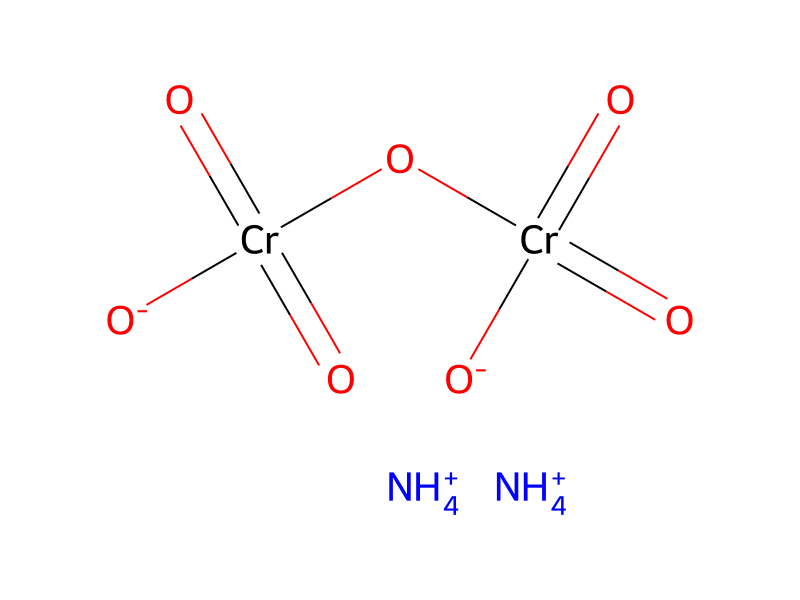
Basic information
- Standard SMILES
[NH4+].[NH4+].[O]=[Cr](=[O])([O-])[O][Cr](=[O])(=[O])[O-]- InChIKey
JOSWYUNQBRPBDN-UHFFFAOYSA-P- Molecular formula
- Cr2H2O7.2H3N
- Average molar mass
- 252.07 g/mol
Overview
Ammonium dichromate is a bright orange red crystalline solid. It is readily ignited and burns producing a voluminous green residue. If heated in a closed container, the container may rupture due to the decomposition of the material. It may also act as a strong oxidizing agent if mixed with or contaminated with combustible material. It is soluble in water.
Names & identifiers
- Preferred name
- Ammonium dichromate
- IUPAC
- diazanium;oxido-(oxido(dioxo)chromio)oxy-dioxochromium
- English name
- Ammoniumdichromat
- Molecular weight
- 0
Names & synonyms
Show more names
Database identifiers
- CAS
77890-90-5- UNII
- 5J18BP595G
- EC Number
- 232-143-1
Properties
Computed structural properties
- Topological polar surface area
- 126 Ų
- Hydrogen bond donors
- 2
- Hydrogen bond acceptors
- 7
- Rotatable bonds
- 0
- Heavy atoms
- 11
- Formal charge
- 0
- Complexity
- 194
Experimental & physicochemical properties
Chemical Classes
Metals -> Chromium Compounds, Inorganic
Carcinogens
Density
2.15 at 77 °F (USCG, 1999) - Denser than water; will sink
2.155 g/cu cm at 25 °C
Non-hygroscopic; bulk density: 82 lb/cu ft; decomposes at about 180 °C; decomposes becomes self-sustaining at about 225 °C with spectacular swelling and evolution of heat and nitrogen, leaving Cr2O3. Heat of solution: -23.0 cal/g
2.15 g/cm³
2.155 @25 °C
Color/Form
Bright orange-red monoclinic prisms
Solid at 15 °C and 1 atm
Orange needles
Solubility
35.6 g/100 g water at 20 °C
In water (wt/wt): 15.16% at 0 °C; 26.67% at 20 °C; 36.99% at 40 °C; 46.14% at 60 °C; 54.20% at 80 °C; 60.89% at 100 °C
In water: 30.8 g/100 mL at 15 °C; 89 g/100 mL at 30 °C
Solubility in water, g/100ml at 20 °C: 36 (good)
Decomposition
Thermal decomposition is initiated by locally heating to 190 °C, and flame spreads rapidly through the mass.
Ammonium dichromate can undergo thermal decomposition and produce a violent conflagration. It is a strong oxidizing agent and flammable solid.
180 °C
Melting Point
Decomposes 180 °C
170 °C
Physical Description
Ammonium dichromate is a bright orange red crystalline solid. It is readily ignited and burns producing a voluminous green residue. If heated in a closed container, the container may rupture due to the decomposition of the material. It may also act as a strong oxidizing agent if mixed with or contaminated with combustible material. It is soluble in water.
Bright orange-red odorless solid; Very soluble in water; [Merck Index] Orange solid; Soluble in water; [ACGIH]
ORANGE-TO-RED CRYSTALS.
Stability/Shelf Life
Stable under recommended storage conditions.
Stable during transport.
Autoignition Temperature
437 °F (USCG, 1999)
225 °C
Other Experimental Properties
Decomposes vigorously with luminescence around 200 °C
Air-stable
Safety & regulation
GHS classification
GHS Classification
Danger
H272: May intensify fire; oxidizer [Danger Oxidizing liquids; Oxidizing solids]
P203, P210, P220, P233, P260, P261, P264, P270, P271, P272, P273, P280, P284, P301+P316, P301+P330+P331, P302+P352, P302+P361+P354, P304+P340, P305+P354+P338, P316, P317, P318, P319, P320, P321, P330, P333+P317, P342+P316, P362+P364, P363, P370+P378, P391, P403, P403+P233, P405, and P501 (click each P-code to see the statement)
Danger
H272 (99.5%): May intensify fire; oxidizer [Danger Oxidizing liquids; Oxidizing solids]
P203, P210, P220, P233, P260, P261, P264, P264+P265, P270, P271, P272, P273, P280, P284, P301+P316, P301+P330+P331, P302+P352, P302+P361+P354, P304+P340, P305+P354+P338, P316, P317, P318, P319, P320, P321, P330, P333+P317, P342+P316, P362+P364, P363, P370+P378, P391, P403, P403+P233, P405, and P501 (click each P-code to see the statement)
Hazard information
Regulatory Information
Chemical: Chromic acid (H2Cr2O7), diammonium salt
Hazard Traits - Carcinogenicity; Genotoxicity; Reproductive Toxicity; Respiratory Toxicity
Status: Cease Manufacture Update: 25-11-2010 https://echa.europa.eu/registration-dossier/-/registered-dossier/11854
Restricted substance: Ammonium dichromate
Substance: Ammonium dichromate
Chromic acid, diammonium salt: HSNO Approval: HSR001309 Approved with controls
Fire Hazards
Special Hazards of Combustion Products: Greenish chromic oxide smoke may cause irritation of lungs and mucous membranes.
· These substances will accelerate burning when involved in a fire.
Not combustible but enhances combustion of other substances. Risk of fire and explosion on contact with combustible substances.
Health Hazards
Inhalation causes irritation or ulceration of the mucous membranes of the nose, throat or respiratory tract. Respiratory irritation can produce symptoms resembling those of asthma. Continuing irritation of the nose may lead to perforation of the nasal septum. External contact can cause eye irritation and conjunctivitis, irritation and ulceration of skin wounds, and rash or external ulcers. If ingested, irritates mucous membrane and causes vomiting. (USCG, 1999)
· Toxic by ingestion.
Hazards Summary
A strong oxidizing agent that is a skin and eye irritant, a dangerous fire risk, and potentially explosive if in contact with organic substances; [Hawley] A skin, eye, nose, and throat irritant; [HSDB] May cause asthma, perforation of the nasal septum, and skin ulcers; [CAMEO] Explosion hazard; An irritant; May cause serious eye injury; May cause skin and respiratory sensitization after prolonged contact; [MSDSonline] See Chromium and linked occupational diseases.
Safety & protection
Fire Fighting
Excerpt from ERG Guide 141 [Oxidizers - Toxic]:
In case of fire in the surroundings, use appropriate extinguishing media. In case of fire: keep drums, etc., cool by spraying with water. Combat fire from a sheltered position.
First Aid Measures
Fresh air, rest. Half-upright position. Artificial respiration may be needed. Refer for medical attention.
First rinse with plenty of water for at least 15 minutes, then remove contaminated clothes and rinse again. Refer for medical attention .
First rinse with plenty of water for several minutes (remove contact lenses if easily possible), then refer for medical attention.
Rinse mouth. Do NOT induce vomiting. Give one or two glasses of water to drink. Refer for medical attention .
Accidental Release Measures
· CALL 911. Then call emergency response telephone number on shipping paper. If shipping paper not available or no answer, refer to appropriate telephone number listed on the inside back cover.
· Keep combustibles (wood, paper, oil, etc.) away from spilled material.
First Aid
INHALATION: remove to clean air and summon medical attention.
General First Aid:
Fire Fighting Procedures
Suitable extinguishing media: Use water spray, alcohol-resistant foam, dry chemical or carbon dioxide.
Advice for firefighters: Wear self-contained breathing apparatus for firefighting if necessary.
Use water spray to cool unopened containers.
Fire fighting phases: Use flooding amount of water.
For more Fire Fighting Procedures (Complete) data for AMMONIUM DICHROMATE (7 total), please visit the HSDB record page.
Storage Conditions
Keep container tightly closed in a dry and well-ventilated place.
Separate from acids, combustibles, alcohols, and reducing agents.
Cleanup Methods
ACCIDENTAL RELEASE MEASURES: Personal precautions, protective equipment and emergency procedures: Wear respiratory protection. Avoid dust formation. Avoid breathing vapors, mist or gas. Ensure adequate ventilation. Evacuate personnel to safe areas. Avoid breathing dust; Environmental precautions: Prevent further leakage or spillage if safe to do so. Do not let product enter drains. Discharge into the environment must be avoided; Methods and materials for containment and cleaning up: Sweep up and shovel. Contain spillage, and then collect with an electrically protected vacuum cleaner or by wetbrushing and place in container for disposal according to local regulations. Keep in suitable, closed containers for disposal.
Environmental considerations: Land Spill: Dig a pit, pond, lagoon, holding area to contain liquid or solid material. /SRP: If time permits, pits, ponds, lagoons, soak holes, or holding areas should be sealed with an impermeable flexible membrane liner./ Cover solids with a plastic sheet to prevent dissolving in rain or fire fighting water.
Environmental considerations: Water Spill: Add sodium bisulfite (NaHSO3). Neutralize with agricultural lime (CaO), crushed limestone (CaCO3), or sodium bicarbonate (NaHCO3).
Spill or leak procedures: Blanket spill with dry sand, clay, or ground limestone. Place material in noncombustible containers. Immediately remove and properly dispose of any spilled material.
For more Cleanup Methods (Complete) data for AMMONIUM DICHROMATE (6 total), please visit the HSDB record page.
Disposal Methods
Generators of waste (equal to or greater than 100 kg/mo) containing this contaminant, EPA hazardous waste number D007, must conform with USEPA regulations in storage, transportation, treatment and disposal of waste. /Chromium/
Product: Burn in a chemical incinerator equipped with an afterburner and scrubber but exert extra care in igniting as this material is highly flammable. Offer surplus and non-recyclable solutions to a licensed disposal company. Contact a licensed professional waste disposal service to dispose of this material. Dissolve or mix the material with a combustible solvent and burn in a chemical incinerator equipped with an afterburner and scrubber; Contaminated packaging: Dispose of as unused product.
SRP: Wastewater from contaminant suppression, cleaning of protective clothing/equipment, or contaminated sites should be contained and evaluated for subject chemical or decomposition product concentrations. Concentrations shall be lower than applicable environmental discharge or disposal criteria. Alternatively, pretreatment and/or discharge to a permitted wastewater treatment facility is acceptable only after review by the governing authority and assurance that "pass through" violations will not occur. Due consideration shall be given to remediation worker exposure (inhalation, dermal and ingestion) as well as fate during treatment, transfer and disposal. If it is not practicable to manage the chemical in this fashion, it must be evaluated in accordance with EPA 40 CFR Part 261, specifically Subpart B, in order to determine the appropriate local, state and federal requirements for disposal.
The following wastewater treatment technology has been investigated for chromium: Concentration process: Biological Treatment. /Chromium/
For more Disposal Methods (Complete) data for AMMONIUM DICHROMATE (10 total), please visit the HSDB record page.
Spillage Disposal
Personal protection: complete protective clothing including self-contained breathing apparatus. Sweep spilled substance into covered non-combustible containers. If appropriate, moisten first to prevent dusting. Carefully collect remainder. Then store and dispose of according to local regulations. Do NOT absorb in saw-dust or other combustible absorbents. Do NOT let this chemical enter the environment.
Toxicology
Ecotoxicity Values
IL50 /Inhibitory Level/ Eurasian Watermilfoil 1.9, 2.6, 8.0 and 9.5 ppm chromate for root weight, stem weight, root length, and stem length, respectively.
LC50; Species: Gambusia affinis (Western Mosquitofish); Conditions: freshwater, static, 18-20 °C, pH 5.7-7.4; Concentration: 223000 ug/L for 24 hr
LC50; Species: Gambusia affinis (Western Mosquitofish); Conditions: freshwater, static, 18-20 °C, pH 5.7-7.4; Concentration: 212000 ug/L for 48 hr
LC50; Species: Gambusia affinis (Western Mosquitofish); Conditions: freshwater, static, 18-20 °C, pH 5.7-7.4; Concentration: 136000 ug/L for 96 hr
Exposure Routes
The substance can be absorbed into the body by inhalation of its aerosol, through the skin and by ingestion.
Inhalation (L16) ; oral (L16) ; dermal (L16)
Toxicity Summary
IDENTIFICATION AND USE: Ammonium dichromate is a solid at 15 °C and 1 atm, forming orange needles. It is not registered for current pesticide use in the U.S., but approved pesticide uses may change periodically and so federal, state and local authorities must be consulted for currently approved uses. It is used as a source of pure nitrogen (especially in the laboratory); in pyrotechnics (Vesuvius fire); in lithography and photo engraving; in special mordant, catalysts, and porcelain finished; intermediate in the manufacturing of pigments; of magnetic recording materials. It is also used as an oxidimentric standard in analytical chemistry. HUMAN EXPOSURE AND TOXICITY: Highly corrosive to skin and mucous membranes. If ingested, violent gastroenteritis with cholera-like stools, peripheral vascular collapse, vertigo, muscle cramps, coma, hemorrhagic diathesis, fever, liver damage & acute renal failure. Methemoglobinemia is probably secondary to intravascular hemolysis. It has been reported in the literature that the ingestion of ammonium dichromate by a child resulted in multiple-organ-system failure and death. Exchange transfusion and hemodialysis were ineffective in removing significant amounts of chromium or causing sustained clinical improvement. In an industrial setting, workers exposed to ammonium dichromate were clinically examined, and 9 of 18 showed dermatitis on the back of the hands and forearms. Three of these workers were transferred and were cured of their dermatitis. ANIMAL STUDIES: Experiments on rats showed inhalation of dust caused edema in perivascular and peribronchial tissue. Ammonium dichromate caused more pronounced changes than did sodium dichromate. ECOTOXICITY STUDIES: Strong irritant. Ammonium toxicity stems from unionized fraction. Chromium will usually be the allergen and limiting factor of the two; Highly toxic by ingestion or inhalation. Threshold concentration for fresh and saltwater fish: 0.05 ppm Cr(VI). Threshold concentration for free ammonia to fish: 0.5 ppm Cr(VI). Toxic to plants.
Hexavalent chromium's carcinogenic effects are caused by its metabolites, pentavalent and trivalent chromium. The DNA damage may be caused by hydroxyl radicals produced during reoxidation of pentavalent chromium by hydrogen peroxide molecules present in the cell. Trivalent chromium may also form complexes with peptides, proteins, and DNA, resulting in DNA-protein crosslinks, DNA strand breaks, DNA-DNA interstrand crosslinks, chromium-DNA adducts, chromosomal aberrations and alterations in cellular signaling pathways. It has been shown to induce carcinogenesis by overstimulating cellular regulatory pathways and increasing peroxide levels by activating certain mitogen-activated protein kinases. It can also cause transcriptional repression by cross-linking histone deacetylase 1-DNA methyltransferase 1 complexes to CYP1A1 promoter chromatin, inhibiting histone modification. Chromium may increase its own toxicity by modifying metal regulatory transcription factor 1, causing the inhibition of zinc-induced metallothionein transcription. (A12, L16, A34, A35, A36)
Ecotoxicity Excerpts
/AQUATIC SPECIES/ Acute Hazard Level: Strong irritant. Ammonium toxicity stems from unionized fraction. Chromium will usually be the allergen and limiting factor of the two; Highly toxic by ingestion or inhalation. Threshold concentration for fresh and saltwater fish: 0.05 ppm Cr(VI). Threshold concentration for free ammonia to fish: 0.5 ppm Cr(VI). Toxic to plants.
Signs and Symptoms
Burning sensation. Sore throat. Cough. Wheezing. Laboured breathing.
Redness. Pain. Skin burns.
Redness. Pain. Blurred vision. Severe deep burns.
Nausea. Vomiting. Abdominal pain. Burning sensation. Diarrhoea. Shock or collapse.
Breathing hexavalent chromium can cause irritation to the lining of the nose, nose ulcers, runny nose, and breathing problems, such as asthma, cough, shortness of breath, or wheezing. Ingestion of hexavalent chromium causes irritation and ulcers in the stomach and small intestine, as well as anemia. Skin contact can cause skin ulcers. (L16)
Human Toxicity Excerpts
/HUMAN EXPOSURE STUDIES/ An outbreak of dermatitis occurred in the Flow Coat sector of a large and modern color television factory. After investigating the working procedures in this area, a risk of contamination of the skin and clothing with ammonium dichromate was found when ammonium dichromate was weighed and mixed with polyvinyl alcohol (PVA). All of the workers involved in this process were clinically examined; 9 of 18 showed dermatitis to the back of the hands and forearms. Three of these workers were transferred from the sector and were cured of their dermatitis. Patch tests were carried out using 40 allergens, including those used in the Flow Coat process. The tests for PVA and for the phosphorescent blue, green, and red pigments gave negative results at the three concentrations tested. A high incidence of sensitization was found; 9 of 18 (50%) of the workers were found to be sensitized to ammonium dichromate, which is used as a fixer. The preventive measures adopted consisted of improving the quality of the personal protective equipment (PPE) and transferring the weighing and mixing of dichromate to the company laboratory. During the next 18 months, there were no new cases of dermatitis in the Flow Coat sector.
/SIGNS AND SYMPTOMS/ Symptomatology (after ingestion or skin contact): 1) Corrosion of mucous membranes of mouth, throat, and esophagus, with immediate pain and dysphagia. The necrotic areas are at first grayish white but soon acquire a blackish discoloration and sometimes a shrunken or wrinkled texture; The process is described as a "coagulation necrosis." 2) Epigastric pain, which may be associated with nausea and the vomiting of mucoid and "coffee-ground" material. At times, gastric hemorrhage may be intense, and the vomitus then contains fresh blood. Profound thirst. 3) Ulceration of all membranes and tissues with which the acid comes in contact ... 4) Circulatory collapse with clammy skin, weak and rapid pulse, shallow respirations, and scanty urine. Circulatory shock is often the immediate cause of death. 5) Asphyxial death due to glottic edema. 6) Late esophageal, gastric and pyloric strictures and stenoses, which may require major surgical repair, should be anticipated. Signs of obstruction commonly appear within a few weeks but may be delayed for months and even years. Permanent scars may also appear in the cornea, skin and oropharynx. 7) Uncorrected circulatory collapse of several hours' duration may lead to renal failure and ischemic lesions in the liver and heart. /Acids/
/SIGNS AND SYMPTOMS/ Highly corrosive to skin & mucous membranes ... if ingested, violent gastroenteritis with cholera-like stools, peripheral vascular collapse, vertigo, muscle cramps, coma, hemorrhagic diathesis, fever, liver damage & acute renal failure. Methemoglobinemia is probably secondary to intravascular hemolysis.
/SIGNS AND SYMPTOMS/ Eye contact can cause severe damage with possible loss of vision.
For more Human Toxicity Excerpts (Complete) data for AMMONIUM DICHROMATE (6 total), please visit the HSDB record page.
Artificial Pollution Sources
Ammonium dichromate's production and use in dyeing, pigments, manufacturing of alizarin, chrome alum, oil purification, pickling, manufacture of catalysts, leather tanning, synthetic perfumes, photography, process engraving and lithography, chromic oxide and pyrotechnics(1) may result in its release to the environment through various waste streams(SRC). Its use in pyrotechnics will result in its direct release to the environment(SRC). Its former use as a pesticide(2) resulted in its direct release to the environment(SRC).
Regulatory information
RCRA Requirements
D007; A solid waste containing chromium may or may not become characterized as a hazardous waste when subjected to the Toxicity Characteristic Leaching Procedure listed in 40 CFR 261.24, and if so characterized, must be managed as a hazardous waste. /Chromium/
Atmospheric Standards
... Substances for which a Federal Register notice has been published that included consideration of the serious health effects, including cancer, from ambient air exposure to the substance. Chromium is included on this list. /Chromium/
Listed as a hazardous air pollutant (HAP) generally known or suspected to cause serious health problems. The Clean Air Act, as amended in 1990, directs EPA to set standards requiring major sources to sharply reduce routine emissions of toxic pollutants. EPA is required to establish and phase in specific performance based standards for all air emission sources that emit one or more of the listed pollutants. Chromium compounds is included on this list. /Chromium compounds/
CERCLA Reportable Quantities
Persons in charge of vessels or facilities are required to notify the National Response Center (NRC) immediately, when there is a release of this designated hazardous substance, in an amount equal to or greater than its reportable quantity of 10 lb or 4.54 kg. The toll free number of the NRC is (800) 424-8802. The rule for determining when notification is required is stated in 40 CFR 302.4 (section IV.D.3.b).
Clean Water Act Requirements
Ammonium bichromate is designated as a hazardous substance under section 311(b)(2)(A) of the Federal Water Pollution Control Act and further regulated by the Clean Water Act Amendments of 1977 and 1978. These regulations apply to discharges of this substance. This designation includes any isomers and hydrates, as well as any solutions and mixtures containing this substance.
Toxic pollutant designated pursuant to section 307(a)(1) of the Federal Water Pollution Control Act and is subject to effluent limitations. /Chromium and compounds/
Chemistry & industry
Pharmacology
Metabolism/Metabolites
Chromium is absorbed from oral, inhalation, or dermal exposure and distributes to nearly all tissues, with the highest concentrations found in kidney and liver. Bone is also a major storage site and may contribute to long-term retention. Hexavalent chromium's similarity to sulfate and chromate allow it to be transported into cells via sulfate transport mechanisms. Inside the cell, hexavalent chromium is reduced first to pentavalent chromium, then to trivalent chromium by many substances including ascorbate, glutathione, and nicotinamide adenine dinucleotide. Chromium is almost entirely excreted with the urine. (A12, L16)
Uses & manufacturing
Uses
Used in photo engraving, dye mordants, pigments, oil purification, pickling, leather tanning, photography, process engraving, lithography, pyrotechnics, and glazes for porcelain and chinawares; [HSDB] Used as a nitrogen source and to make magnetic recording materials; [Merck Index] Used in pyrotechnics, wood preserving, and lithography; Regulated in Germany as an explosive, and it is distributed moist; [Ullmann]
Petroleum Production and Refining [Category: Industry]
Lithography printing [Category: Hobbies]
For Ammonium dichromate (USEPA/OPP Pesticide Code: 068305) there are 0 labels match. /SRP: Not registered for current use in the U.S., but approved pesticide uses may change periodically and so federal, state and local authorities must be consulted for currently approved uses./
Source of pure nitrogen (especially in the laboratory); in pyrotechnics (Vesuvius fire); in lithography and photo engraving; in special mordant, catalysts, and porcelain finishes; intermediate in the manufacture of pigments; of magnetic recording materials. Oxidimentric standard in analytical chemistry.
Mordant for dyeing, pigments, manufacturing of alizarin, chrome alum, oil purification, pickling, manufacture of catalysts, leather tanning, synthetic perfumes, photography, process engraving and lithography (sensitizer for photo- chemical insolubilization of albumin, etc.), chromic oxide, pyrotechnics.
Methods of Manufacturing
Prepared from ammonium sulfate and sodium dichromate or by interaction of ammonia gas and chromic acid in solution.
Action of chromic acid on ammonium hydroxide with subsequent crystallization
Ammonium dichromate is prepared by reaction of sodium dichromate with ammonium chloride or, less frequently, ammonium sulfate.
Formulations/Preparations
USEPA/OPP Pesticide Code 068305; Trade Names: Ammonio.
Crystal: Reagent, photolitho grades
Ammonium dichromate is available as analytical reagent-grade crystals (99.5%) and as purified-grade crystals and granules with the following impurities: chloride, 0.005% max; fixed alkalis (as sulfate), 0.1-0.2% max; insoluble matter, 0.005% max; and sulfate, 0.005% max.
Related reactions
No reaction records under the current filter.
Linked notes
Loading…