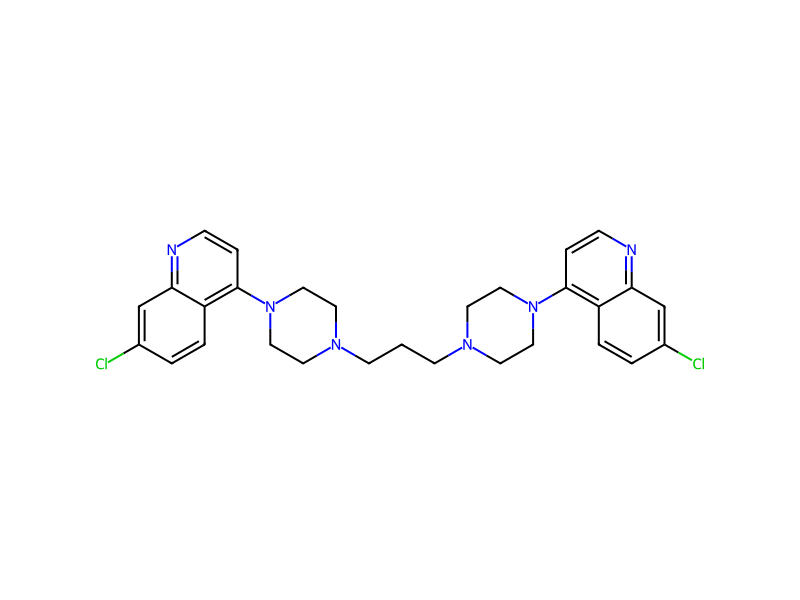
Basic information
- Standard SMILES
Clc1ccc2c(N3CCN(CCCN4CCN(c5ccnc6cc(Cl)ccc56)CC4)CC3)ccnc2c1- InChIKey
UCRHFBCYFMIWHC-UHFFFAOYSA-N- Molecular formula
- C29H32Cl2N6
- Average molar mass
- 535.5 g/mol
Overview
Piperaquine is an aminoquinoline that is 1,3-di(piperazin-1-yl)propane in which the nitrogen at position 4 of each of the piperazine moieties is replaced by a 7-chloroquinolin-4-yl group. It has a role as an antimalarial. It is an organochlorine compound, an aminoquinoline and a N-arylpiperazine.
Names & identifiers
- Preferred name
- Piperaquine
- IUPAC
- 7-chloro-4-[4-[3-[4-(7-chloroquinolin-4-yl)piperazin-1-yl]propyl]piperazin-1-yl]quinoline
- English name
- Piperaquine
- Molecular formula
- C29H32Cl2N6
- Molecular weight
- 535.51058
Names & synonyms
Show more names
Database identifiers
- CAS
83764-65-2- ChEMBL
CHEMBL303933- ChEBI
CHEBI:91231- UNII
- A0HV2Q956Y
- Nikkaji
- J126.229G
Properties
Computed structural properties
- XLogP
- 5.6
- Topological polar surface area
- 38.7 Ų
- Hydrogen bond donors
- 0
- Hydrogen bond acceptors
- 6
- Rotatable bonds
- 6
- Heavy atoms
- 37
- Formal charge
- 0
- Complexity
- 655
Experimental & physicochemical properties
Physicochemical properties
- InChIKey
- UCRHFBCYFMIWHC-UHFFFAOYSA-N
- SMILES
- N1=C2C(C=CC(Cl)=C2)=C(N2CCN(CCCN3CCN(C4=C5C(=NC=C4)C=C(Cl)C=C5)CC3)CC2)C=C1
- EWG's Food Scores
- 1 · 1
- FDA UNII
- 0 HV2Q956Y · A0HV2Q956Y
Safety & regulation
Toxicology
Chemistry & industry
Pharmacology
Metabolism/Metabolites
Piperaquine undergoes N-dealkylation, separating its aliphatic bridge from one of the nitrogen-containing rings. The resulting aldehyde is then oxidized to a carboxylic acid to form metabolite 1 (M1). The same nitrogen-containing rings can also undergo hydroxylation at one of two sites to form M3 or M4. M2 is formed via N-oxidation of one of the nitrogens in the quinoline groups at either side of the molecule. M5 results when both of these nitrogens are oxidized. M1 and M2 are the major metabolism products. Each of these metabolites were observed in the urine.
Absorption, Distribution and Excretion
Piperaquine is slowly absorbed and exhibits multiple peaks in its plasma concentration curve suggestive of enterohepatic recycling occurring alongside the absorption process. Due to this complication there is no discreet value for bioavailability but piperaquine is highly absorbed into systemic circulation. When taken with food, Cmax increases by 217% and mean exposure increases by 177%. Tmax is not affected by food and remains around 5 h. Piperaquine has been observed to accumulate more in females to a degree of 30-50% more than males. It also collects in red blood cells similar to [DB11638].
Piperaquine is mainly excreted in the feces with a negligible amount in the urine.
Piperaquine is thought to distribute into a central compartment with an apparent volume of 26.7 L/kg, and two peripheral compartments with apparent volumes of 76.8 L/kg and 617 L/kg. These combine for a total volume of distribution of 720.5 L/kg.
The mean apparent total clearance has been observed to be 1.12 L/h/kg in adult malaria patients.
Suppliers13 total
Related reactions
No reaction records under the current filter.
Linked notes
Loading…