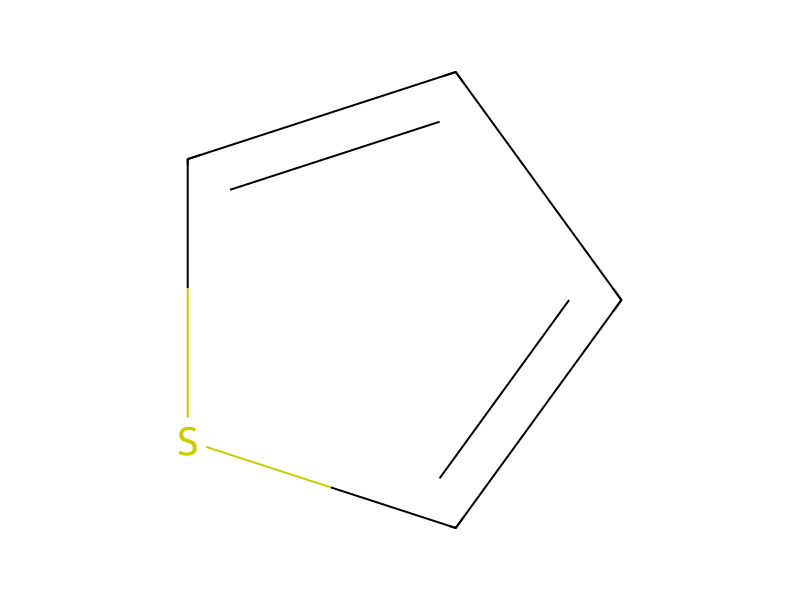
Basic information
- Standard SMILES
c1ccsc1- InChIKey
YTPLMLYBLZKORZ-UHFFFAOYSA-N- Molecular formula
- C4H4S
- Average molar mass
- 84.14 g/mol
Overview
Thiophene appears as a colorless liquid with an unpleasant odor. Insoluble in water and slightly denser than water. Flash point 30 °F. Vapors heavier than air. Irritates the skin, eyes, and mucous membranes. Used to make pharmaceuticals and dyes.
Names & identifiers
- Preferred name
- Thiophene
- IUPAC
- thiophene
- English name
- Poly(thiophene-2,5-diyl), br terminated
- Molecular formula
- C4H4S
- Molecular weight
- 84.13956
Names & synonyms
Show more names
Database identifiers
- CAS
25233-34-5- ChEMBL
CHEMBL278958- ChEBI
CHEBI:30856- UNII
- SMB37IQ40B
- EC Number
- 203-729-4
- Nikkaji
- J1.162.593B、J2.445G
Properties
Computed structural properties
- XLogP
- 1.8
- Topological polar surface area
- 28.2 Ų
- Hydrogen bond donors
- 0
- Hydrogen bond acceptors
- 1
- Rotatable bonds
- 0
- Heavy atoms
- 5
- Formal charge
- 0
- Complexity
- 22.8
Experimental & physicochemical properties
Chemical Classes
Other Classes -> Thiophenes
Flammable agents - 3rd degree
LogP
log Kow = 1.81
1.81
1.81
1.89
Density
1.0649 at 68 °F (NTP, 1992) - Denser than water; will sink
1.06494 @ 20 °C/4 °C
Relative density (water = 1): 1.06
Solubility
less than 1 mg/mL at 75 °F (NTP, 1992)
MISCIBLE IN ETHANOL, ETHER, ACETONE, AND BENZENE.
SOL IN ALL PROPORTIONS IN ORDINARY ORG SOLVENTS, CARBON TETRACHLORIDE, DIOXANE, PYRIMIDINE, TOLUENE
water solubility = 3,020 mg/l @ 25 °C
3.01 mg/mL at 25 °C
Solubility in water: none
Flash Point
30 °F (NTP, 1992)
30 °F (-1 °C) (CLOSED CUP)
-1 °C
Boiling Point
183.9 °F at 760 mmHg (NTP, 1992)
84.0 °C @ 760 MM HG
84.00 °C. @ 760.00 mm Hg
84 °C
Decomposition
WHEN HEATED TO DECOMPOSITION IT EMITS HIGHLY TOXIC FUMES OF SULFUR OXIDES.
May be heated to 850 °C without decomposition.
Melting Point
-36.8 °F (NTP, 1992)
-39.4 °C
-38.3 °C
-38 °C
Physicochemical properties
- Melting point
- 350 °C · >350 °C
- Density
- 1.18 g/cm3 · 1.18 g/cm3
- form
- powder
- InChI
- 1S/C4H4S/c1-2-4-5-3-1/h1-4H
- InChIKey
- YTPLMLYBLZKORZ-UHFFFAOYSA-N
- SMILES
- [s]1cccc1
- UNSPSC Code
- 12352103 · 12352103
- NACRES
- 23 · NA.23
- PPE
- 95 · Eyeshields, Gloves, type N95 (US)
- WGK Germany
- 3 · 3
- Storage Class
- 11 · 11 - Combustible Solids
Safety & regulation
GHS classification
GHS Classification
This chemical does not meet GHS hazard criteria for 1.5% (6 of 391) of reports.
Danger
H225 (98.5%): Highly Flammable liquid and vapor [Danger Flammable liquids]
P210, P233, P240, P241, P242, P243, P261, P264, P264+P265, P270, P271, P273, P280, P301+P317, P302+P352, P303+P361+P353, P304+P340, P305+P351+P338, P305+P354+P338, P316, P317, P319, P321, P330, P332+P317, P337+P317, P362+P364, P370+P378, P403+P233, P403+P235, P405, and P501 (click each P-code to see the statement)
Aggregated GHS information provided per 391 reports by companies from 18 notifications to the ECHA C&L Inventory. Each notification may be associated with multiple companies.
H402: Harmful to aquatic life [Hazardous to the aquatic environment, acute hazard]
Hazard information
Regulatory Information
Chemical: Thiophene
Commission Regulation (EC) No 1565/2000 (Repealed by Com. Implementing Reg. (EU) No 872/2012)
Status: Active Update: 07-02-2022 https://echa.europa.eu/registration-dossier/-/registered-dossier/12099
Thiophene: HSNO Approval: HSR001226 Approved with controls
The New Jersey Worker and Community Right to Know Act requires public and private employers to provide information about hazardous substances at their workplaces. (N.J.S.A. 34:5A-1 et. seq.)
Fire Hazards
Excerpt from ERG Guide 130 [Flammable Liquids (Water-Immiscible / Noxious)]:
· HIGHLY FLAMMABLE: Will be easily ignited by heat, sparks or flames.
Highly flammable. Gives off irritating or toxic fumes (or gases) in a fire. Vapour/air mixtures are explosive.
Health Hazards
Excerpt from ERG Guide 130 [Flammable Liquids (Water-Immiscible / Noxious)]:
· May cause toxic effects if inhaled or absorbed through skin.
Reactivity Profile
THIOPHENE reacts violently with strong oxidizing agents and concentrated nitric acid causing fire and explosion hazards [Handling Chemicals Safely 1980. p. 899]. A mixture of thiophene and N-nitrosoacetanilide exploded at 0 °C [Ber., 1887, 30, 367].
Safety & protection
Fire Fighting
Excerpt from ERG Guide 130 [Flammable Liquids (Water-Immiscible / Noxious)]:
Use foam, powder, carbon dioxide. In case of fire: keep drums, etc., cool by spraying with water.
First Aid Measures
Fresh air, rest. Refer for medical attention.
Remove contaminated clothes. Rinse and then wash skin with water and soap.
First rinse with plenty of water for several minutes (remove contact lenses if easily possible), then refer for medical attention.
Rinse mouth. Rest.
Accidental Release Measures
· CALL 911. Then call emergency response telephone number on shipping paper. If shipping paper not available or no answer, refer to appropriate telephone number listed on the inside back cover.
· ELIMINATE all ignition sources (no smoking, flares, sparks or flames) from immediate area.
First Aid
EYES: First check the victim for contact lenses and remove if present. Flush victim's eyes with water or normal saline solution for 20 to 30 minutes while simultaneously calling a hospital or poison control center. Do not put any ointments, oils, or medication in the victim's eyes without specific instructions from a physician. IMMEDIATELY transport the victim after flushing eyes to a hospital even if no symptoms (such as redness or irritation) develop.
General First Aid:
Disposal Methods
SRP: At the time of review, criteria for land treatment or burial (sanitary landfill) disposal practices are subject to significant revision. Prior to implementing land disposal of waste residue (including waste sludge), consult with environmental regulatory agencies for guidance on acceptable disposal practices.
Spillage Disposal
Personal protection: filter respirator for organic gases and vapours adapted to the airborne concentration of the substance. Collect leaking liquid in sealable containers. Absorb remaining liquid in sand or inert absorbent. Then store and dispose of according to local regulations. Do NOT wash away into sewer.
Isolation and Evacuation
Excerpt from ERG Guide 130 [Flammable Liquids (Water-Immiscible / Noxious)]:
Immediate precautionary measure
Toxicology
Environmental Fate
TERRESTRIAL FATE: Based on a recommended classification scheme(1), an estimated Koc value of 230(SRC), determined from an experimental log Kow of 1.81(2) and a recommended regression-derived equation(3), indicates that thiophene is expected to have moderate mobility in soil(SRC). Volatilization of thiophene is expected from moist soil surfaces(SRC) given an estimated Henry's Law constant of 2.9X10⁻³ atm-cu m/mole(SRC), determined from an experimental vapor pressure of 79.7 mm Hg at 25 °C(4) and water solubility of 3,020 mg/l at 25 °C(5). Volatilization from dry soil surfaces is expected based upon the vapor pressure of this compound(SRC).
AQUATIC FATE: Based on a recommended classification scheme(1), an estimated Koc value of 230, determined from an experimental log Kow of 1.81(2) and a recommended regression-derived equation(3), indicates that thiophene may adsorb to suspended solids and sediment in water(SRC). Thiophene is expected to volatilize from water surfaces(3,SRC) based on an estimated Henry's Law constant of 2.9X10⁻³ atm-cu m/mole(SRC),determined from an experimental vapor pressure of 79.7 mm Hg at 25 °C(4) and water solubility of 3,020 mg/l at 25 °C(5). Estimated half-lives for a model river and model lake are 3 and 89, hours respectively(6,SRC). According to a classification scheme(7), experimental BCF values in the range of 2-7 measured for carp(8), suggests that bioconcentration in aquatic organisms is low(SRC). Biodegradation is not expected to be an important fate process for this compound(SRC). Using a standard BOD dilution technique and an activated sludge inoculum, a theoretical BOD of 0% was observed during a 2 week incubation period(8). No biodegradation was observed when thiophene was incubated in an aquifer slurry for a period of 1 year(9).
ATMOSPHERIC FATE: According to a model of gas/particle partitioning of semivolatile organic compounds in the atmosphere(1), thiophene, which has an experimental vapor pressure of 79.7 mm Hg at 25 °C(2), will exist solely as a vapor in the ambient atmosphere. Vapor-phase thiophene is degraded in the atmosphere by reaction with photochemically-produced hydroxyl radicals and nitrate radicals with experimental atmospheric half-life of about 40 hours and 2.5 nighttime hours, respectively(SRC).
Signs and Symptoms
Cough. Dizziness. Sore throat.
Redness.
Redness. Pain.
Ongoing Test Status
The following link will take the user to the National Toxicology Program (NTP) Test Agent Search Results page, which tabulates all of the "Standard Toxicology & Carcinogenesis Studies", "Developmental Studies", and "Genetic Toxicity Studies" performed with this chemical. Clicking on the "Testing Status" link will take the user to the status (i.e., in review, in progress, in preparation, on test, completed, etc.) and results of all the studies that the NTP has done on this chemical. [http://ntp-apps.niehs.nih.gov/ntp_tox/index.cfm?fuseaction=ntpsearch.searchresults&searchterm=110-02-1]
Effluent Concentrations
Thiophene was detected, not quantified, in the gas emissions of a Norwegian waste incinerator(1). Thiophene was detected at concentrations of 20-620 ppb in the leachate of a shale oil processing facility(2). Thiophene was detected in air samples above wastewater from shale oil processing facilities in Colorado and Utah at concentrations of 1-10 ng/l(3).
Soil Adsorption/Mobility
The Koc of thiophene is estimated as approximately 230(SRC), using a measured log Kow of 1.81(1) and a regression-derived equation(2,SRC). According to a recommended classification scheme(3), this estimated Koc value suggests that thiophene is expected to have moderate mobility in soil(SRC).
Environmental Biodegradation
Biodegradation is not expected to be an important environmental fate process for thiophene(SRC). No biodegradation was observed when thiophene was incubated in an anoxic aquifer slurry for a period of 3 months(1). Using a standard BOD dilution technique and an activated sludge inoculum, a theoretical BOD of 0% was observed during a 2 week incubation period(2). No biodegradation was observed when thiophene was incubated in an aquifer slurry for a period of 1 year(3).
Safety data
- PPE
- Eyeshields, Gloves, type N95 (US)
- wgk
- 3
- Storage Class
- 11 - Combustible Solids
Chemistry & industry
Pharmacology
Metabolism/Metabolites
THIOPHEN IS METABOLIZED IN VIVO TO PREMERCAPTURIC ACID AND 2-THIENYL-MERCAPTURIC ACID.
RABBITS FED THIOPHEN 150 MG/KG EXCRETED 40% OF DOSE IN URINE IN FORM OF 2 MERCAPTURIC ACIDS, BELIEVED TO BE THIENYL 3-MERCAPTURIC ACID & THIENYL 2-MERCAPTURIC ACID.
MAJOR METABOLITE OF THIOPHENE (200-300 MG/KG, ORALLY) IN RATS & RABBITS WAS 3-HYDROXY-2,3-DIHYDRO-2-THIENYLMERCAPTURIC ACID & 2-THIENYLMERCAPTURIC ACID WAS MINOR METABOLITE. IN RAT 32% OF THIOPHENE EXCRETED UNCHANGED IN EXPIRED AIR & 40% EXCRETED IN URINE AS MERCAPTURIC ACIDS.
Absorption, Distribution and Excretion
RABBITS FED THIOPHEN 150 MG/KG EXCRETED ABOUT 35% OF DOSE UNCHANGED IN EXPIRED AIR & 0.5% IN FECES.
(35)S-LABELED THIOPHENE APPLIED TO RABBIT SKIN OR INJECTED IP INTO RATS WAS IMMEDIATELY INCORPORATED INTO SKIN.
(35)S-LABELED THIOPHENE (250 MUCI) ADMIN ONCE SC TO RATS WAS RAPIDLY ABSORBED INTO BLOOD STREAM, DEPOSITED IN MAJOR ORGANS, & EXCRETED WITH URINE. URINE ANAL SHOWED 61.1% OF ISOTOPE WAS EXCRETED WITHIN 34 HR & 74.4% WITHIN 3 DAYS.
FOLLOWING RECTAL & ORAL ADMIN OF (14)C-LABELED THIOPHENE (33 MG/KG), PULMONARY EXCRETION WAS 40% & 5%, RESPECTIVELY.
Uses & manufacturing
Uses
Used as a solvent, chemical intermediate, and monomer to make copolymers; [HSDB]
ORGANIC SYNTHESIS; COPOLYMERIZES WITH MALEIC ANHYDRIDE
SOLVENT; INT FOR PHARMACEUTICALS, THIOPHENE-PHENOL/FORMALDEHYDE RESINS, AND NEMATOCIDE TETRACHLOROTHIOPHENE
U.S. Production
(1972) PROBABLY GREATER THAN 4.54X10+5 GRAMS
(1975) GREATER THAN 4.54X10+5 GRAMS
Methods of Manufacturing
MADE AVAILABLE IN COMMERCIAL QUANTITIES BY PROCESS UTILIZING DEHYDROGENATION OF BUTANE WITH SULFUR AS DEHYDROGENATING AGENT, FOLLOWED BY CYCLIZATION WITH SULFUR TO FORM THIOPHENE RING. LAB PREPN BY HEATING SODIUM SUCCINATE WITH PHOSPHORUS TRISULFIDE. ALSO PREPARED BY PASSING ETHYLENE OR ACETYLENE INTO BOILING SULFUR; OR BY PASSING ACETYLENE AND HYDROGEN SULFIDE OVER HOT BAUXITE OR NICKEL HYDROXIDE.
FROM...PETROLEUM; SYNTHETICALLY FROM HEATING SODIUM SUCCINATE WITH PHOSPHORUS TRISULFIDE.
General Manufacturing Information
Thiophene: ACTIVE
THIOPHENE IS A SULFUR-CONTAINING FLAVOR COMPOUND FORMED BY MAILLARD REACTIONS IN HEAT-PROCESSED COFFEE AND BEEF. /FROM TABLE/
/THIOPHENE IS A/ SOLVENT SIMILAR TO BENZENE, BUT SUITABLE FOR LOWER & HIGHER TEMPERATURES...
STUDIES WERE CONDUCTED ON DEODORIZATION CATALYSTS. THIOPHENE WAS USED AS MODEL IN LOW CONCN RANGE.
MILK XANTHINE OXIDASE CATALYZED THE OXIDATION OF CROTONALDEHYDE WHEN PRESENT AS A SUSPENSION IN THIOPHENE OR IN OTHER NONPOLAR SOLVENTS.
FOUND IN COAL TAR, IN COAL GAS & TECHNICAL BENZENE.
Applications
General DescriptionConducting polymer.
Suppliers11 total
Additional notes
DefinitionChEBI: Thiophene is a monocyclic heteroarene that is furan in which the oxygen atom is replaced by a sulfur. It has a role as a non-polar solvent. It is a mancude organic heteromonocyclic parent, a member of thiophenes, a monocyclic heteroarene and a volatile organic compound.
Related reactions
No reaction records under the current filter.
Linked notes
Loading…