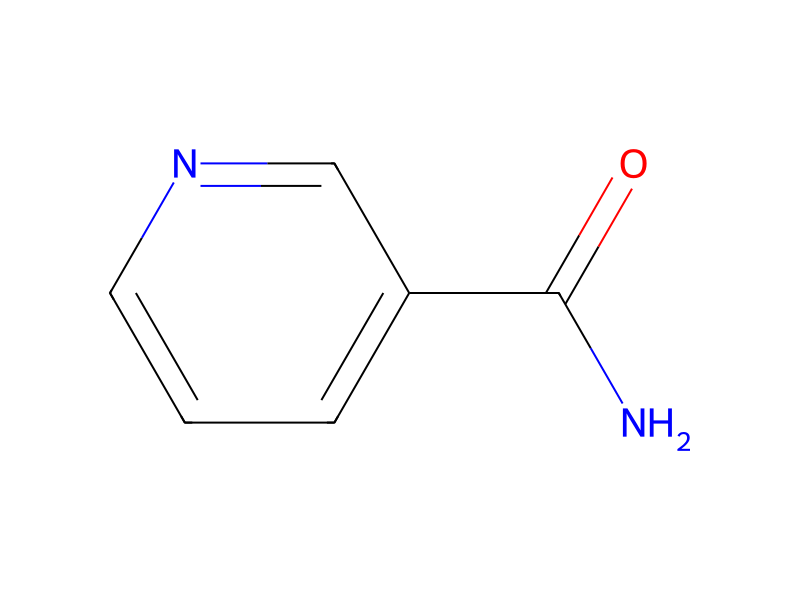
Basic information
- Standard SMILES
NC(=O)c1cccnc1- InChIKey
DFPAKSUCGFBDDF-UHFFFAOYSA-N- Molecular formula
- C6H6N2O
- Average molar mass
- 122.12 g/mol
Overview
Nicotinamide is a white powder. (NTP, 1992)
Names & identifiers
- Preferred name
- Nicotinamide
- IUPAC
- pyridine-3-carboxamide
- English name
- pyridine-3-carboxamide
- Molecular formula
- C6H6N2O
- Molecular weight
- 122.13
Names & synonyms
Show more names
Database identifiers
- CAS
1255150-40-3- ChEMBL
CHEMBL1140- ChEBI
CHEBI:17154- UNII
- 25X51I8RD4
- EC Number
- 202-713-4、234-265-0
- Nikkaji
- J3.988H
Properties
Computed structural properties
- XLogP
- -0.4
- Topological polar surface area
- 56 Ų
- Hydrogen bond donors
- 1
- Hydrogen bond acceptors
- 2
- Rotatable bonds
- 1
- Heavy atoms
- 9
- Formal charge
- 0
- Complexity
- 114
Experimental & physicochemical properties
Drugs
Pharmaceuticals -> Metabolite of Nikethamide
Pharmaceuticals -> Listed in ZINC15
Pharmaceuticals
Cosmetics
Cosmetic ingredients (Niacinamide) -> CIR (Cosmetic Ingredient Review)
Personal care product -> emollient -> amide
Smoothing
LogP
log Kow = -0.37
-0.37
-0.38
-0.34
Density
1.4 (NTP, 1992) - Denser than water; will sink
1.400 g/cu cm at 25 °C
Specific heat = solid, 55 °C: 1.30 kJ/kg; heat of solution in water: -148 kJ/kg; heat of fusion: 381 kJ/kg; density of melt, at 150 °C: 1.19 g/cu cm
1.4 g/cm³
1.4 @25 °C
Color/Form
White, powder, needles from benzene
Colorless crystalline solid
White, crystalline powder
Colorless needles
Solubility
greater than or equal to 100 mg/mL at 70 °F (NTP, 1992)
In water, 5X10+5 mg/L at 25 °C
Very soluble in water; 1 g is soluble in 1 mL water
1 g dissolves in about 1 mL water, in 10 mL glycerol, in about 1.5 mL alcohol
Soluble in butanol, chloroform
Safety & regulation
GHS classification
GHS Classification
This chemical does not meet GHS hazard criteria for 0.3% (3 of 1154) of reports.
Warning
H315 (28.6%): Causes skin irritation [Warning Skin corrosion/irritation]
P261, P264, P264+P265, P271, P280, P302+P352, P304+P340, P305+P351+P338, P319, P321, P332+P317, P337+P317, P362+P364, P403+P233, P405, and P501 (click each P-code to see the statement)
Aggregated GHS information provided per 1154 reports by companies from 25 notifications to the ECHA C&L Inventory. Each notification may be associated with multiple companies.
Warning
Hazard information
Regulatory Information
Chemical: 3-Pyridinecarboxamide
3-Pyridinecarboxamide is listed on the EPA's Chemical Data Reporting (CDR) system. Manufacturers and importers of 3-Pyridinecarboxamide are required to report information about their production and use of this chemical to the EPA under the Toxic Substances Control Act (TSCA). (40 eCFR Part 711)
Status: Active Update: 25-11-2022 https://echa.europa.eu/registration-dossier/-/registered-dossier/14571
Nicotinamide: Does not have an individual approval but may be used under an appropriate group standard
FDA Requirements
Nicotinamide-ascorbic acid complex may be safely used in accordance with the following prescribed conditions: (a) The additive is the product of the controlled reaction between ascorbic acid and nicotinamide, melting in the range 141 °C to 145 °C. (b) It is used as a source of ascorbic acid and nicotinamide in multivitamin preparations. /Nicotinamide-Ascorbic Acid Complex/
Substance added directly to human food affirmed as generally recognized as safe (GRAS).
Drug products containing certain active ingredients offered over-the-counter (OTC) for certain uses. A number of active ingredients have been present in OTC drug products for various uses ... . However, based on evidence currently available, there are inadequate data to establish general recognition of the safety and effectiveness of these ingredients for the specified uses: niacinamide is included in orally administered menstrual drug products and weight control drug products.
Niacinamide used as a nutrient and/or dietary supplement in animal drugs, feeds, and related products is generally recognized as safe when used in accordance with good manufacturing or feeding practice.
FIFRA Requirements
Residues of nicotinamide are exempted from the requirement of a tolerance when used in accordance with good agricultural practice as inert (or occasionally active) ingredients in pesticide formulations applied to growing crops only. Use: Synergist. Limit: Maximum of 0.5% of formulation.
Reactivity Profile
An amine and amide. Acts as a weak base in solution. Amines are chemical bases. They neutralize acids to form salts plus water. These acid-base reactions are exothermic. The amount of heat that is evolved per mole of amine in a neutralization is largely independent of the strength of the amine as a base. Amines may be incompatible with isocyanates, halogenated organics, peroxides, phenols (acidic), epoxides, anhydrides, and acid halides. Flammable gaseous hydrogen is generated by amines in combination with strong reducing agents, such as hydrides. Organic amides/imides react with azo and diazo compounds to generate toxic gases. Flammable gases are formed by the reaction of organic amides/imides with strong reducing agents. Amides are very weak bases (weaker than water). Imides are less basic yet and in fact react with strong bases to form salts. That is, they can react as acids. Mixing amides with dehydrating agents such as P2O5 or SOCl2 generates the corresponding nitrile. The combustion of these compounds generates mixed oxides of nitrogen (NOx).
Safety & protection
First Aid Measures
Fresh air, rest.
Rinse skin with plenty of water or shower.
Rinse with plenty of water (remove contact lenses if easily possible).
Rinse mouth. Give one or two glasses of water to drink.
First Aid
EYES: First check the victim for contact lenses and remove if present. Flush victim's eyes with water or normal saline solution for 20 to 30 minutes while simultaneously calling a hospital or poison control center. Do not put any ointments, oils, or medication in the victim's eyes without specific instructions from a physician. IMMEDIATELY transport the victim after flushing eyes to a hospital even if no symptoms (such as redness or irritation) develop.
Fire Fighting Procedures
Suitable extinguishing media: Use water spray, alcohol-resistant foam, dry chemical or carbon dioxide.
Advice for firefighters: Wear self contained breathing apparatus for fire fighting if necessary.
... Use dry chemical, carbon dioxide, water spray, or alcohol foam extinguishers. ... If material of contaminated runoff enters waterways, notify downstream users of potentially contaminated waters. Notify local health and fire officials and pollution control agencies. From a secure, explosion-proof location, use water spray to cool exposed containers. If cooling streams are ineffective (venting sound increase in volume and pitch, tank discolors, or shows any signs of deforming), withdraw immediately to a secure position. If employees are expected to fight fires, they must be trained and equipped in OSHA 1910.156. The only respirators recommended for firefighting are self-contained breathing apparatuses that have full face-pieces and are operated in a pressure-demand or other positive-pressure mode.
Cleanup Methods
ACCIDENTAL RELEASE MEASURES: Personal precautions, protective equipment and emergency procedures: Use personal protective equipment. Avoid dust formation. Avoid breathing vapors, mist or gas. Ensure adequate ventilation. Evacuate personnel to safe areas. Avoid breathing dust. Environmental precautions: Do not let product enter drains. Methods and materials for containment and cleaning up: Pick up and arrange disposal without creating dust. Sweep up and shovel. Keep in suitable, closed containers for disposal.
Evacuate persons not wearing protective equipment from area of spill or leak until clean up is complete. Remove all ignition sources. Use HEPA vacuum or wet method to reduce dust during cleanup. Do not dry sweep. Collect powdered material in the most convenient and safe manner and deposit in sealed containers. Ventilate after clean up is complete. It may be necessary to contain and dispose of this chemical as a hazardous waste. If material of contaminated runoff enters waterways, notify downstream users of potentially contaminated waters.
Nonfire Spill Response
SMALL SPILLS AND LEAKAGE: If you spill this chemical, you should dampen the solid spill material with water, then transfer the dampened material to a suitable container. Use absorbent paper dampened with water to pick up any remaining material. Seal your contaminated clothing and the absorbent paper in a vapor-tight plastic bag for eventual disposal. Wash all contaminated surfaces with a soap and water solution. Do not reenter the contaminated area until the Safety Officer (or other responsible person) has verified that the area has been properly cleaned.
Disposal Methods
SRP: Recycle any unused portion of the material for its approved use or return it to the manufacturer or supplier. Ultimate disposal of the chemical must consider: the material's impact on air quality; potential migration in air, soil or water; effects on animal, aquatic and plant life; and conformance with environmental and public health regulations. If it is possible or reasonable use an alternative chemical product with less inherent propensity for occupational harm/injury/toxicity or environmental contamination.
SRP: Wastewater from contaminant suppression, cleaning of protective clothing/equipment, or contaminated sites should be contained and evaluated for subject chemical or decomposition product concentrations. Concentrations shall be lower than applicable environmental discharge or disposal criteria. Alternatively, pretreatment and/or discharge to a permitted wastewater treatment facility is acceptable only after review by the governing authority and assurance that "pass through" violations will not occur. Due consideration shall be given to remediation worker exposure (inhalation, dermal and ingestion) as well as fate during treatment, transfer and disposal. If it is not practicable to manage the chemical in this fashion, it must be evaluated in accordance with EPA 40 CFR Part 261, specifically Subpart B, in order to determine the appropriate local, state and federal requirements for disposal.
Product: Offer surplus and non-recyclable solutions to a licensed disposal company. Contact a licensed professional waste disposal service to dispose of this material. Contaminated packaging: Dispose of as unused product.
Spillage Disposal
Personal protection: particulate filter respirator adapted to the airborne concentration of the substance. Sweep spilled substance into covered containers. If appropriate, moisten first to prevent dusting. Wash away remainder with plenty of water.
Preventive Measures
... Employees should wash immediately with soap when skin is wet or contaminated. ...
ACCIDENTAL RELEASE MEASURES: Personal precautions, protective equipment and emergency procedures: Use personal protective equipment. Avoid dust formation. Avoid breathing vapors, mist or gas. Ensure adequate ventilation. Evacuate personnel to safe areas. Avoid breathing dust. Environmental precautions: Do not let product enter drains.
Precautions for safe handling: Avoid contact with skin and eyes. Avoid formation of dust and aerosols.Further processing of solid materials may result in the formation of combustible dusts. The potential for combustible dust formation should be taken into consideration before additional processing occurs. Provide appropriate exhaust ventilation at places where dust is formed.
Appropriate engineering controls: Handle in accordance with good industrial hygiene and safety practice. Wash hands before breaks and at the end of workday.
For more Preventive Measures (Complete) data for Nicotinamide (7 total), please visit the HSDB record page.
Toxicology
Interactions
Addition of 0.5 mg of nicotinamide reduced the action of dicrotophos on cultured chick embryo tibiae.
Nicotinamide will prevent depletion of NAD coenzymes by alkylating agents.
Renal oncogenic activity of Streptozotocin in male rats was significantly decreased by nicotinamide.
Oral or iv administered nicotinamide prevented Streptozotocin-induced diabetes in Rhesus monkeys and dogs.
For more Interactions (Complete) data for Nicotinamide (25 total), please visit the HSDB record page.
Ecotoxicity Values
LC50; Species: Poecilia reticulata (Guppy) age 1.5-2.5 weeks; Conditions: freshwater, static, 22-23 °C, pH 7.8-8.2, dissolved oxygen >5 mg/L; Concentration: >1000 mg/L for 96 hr />99% purity/
EC50; Species: Daphnia magna (Water flea) age <24 hr; Conditions: freshwater, static, 18.5-20 °C, pH 8.1-8.2; Concentration: >1000 mg/L for 24 hr; Effect: immobilization />99% purity/
EC50; Species: Scenedesmus subspicatus (algae) strain CCAP 276/20; Conditions: freshwater, static, 21.5-25.5 °C, pH 8.1-9.9; Concentration: >1000 mg/L for 72 hr; Effect: growth inhibition />99% purity/
EC50; Species: Xenopus laevis (African clawed frog) embryos; Conditions: freshwater, renewal, 23 °C; Concentration: 340 ug/L for 96 hr (95% confidence interval: 310-360 ug/L); Effect: abnormal growth
Environmental Fate
TERRESTRIAL FATE: Based on a classification scheme(1), an estimated Koc value of 8(SRC), determined from a structure estimation method(2), indicates that nicotinamide is expected to have very high /mobility in soil(SRC). Volatilization of nicotinamide from moist soil surfaces is not expected to be an important fate process(SRC) given an estimated Henry's Law constant of 2.9X10⁻¹² atm-cu m/mole(SRC), developed using a fragment constant estimation method(2). Nicotinamide is not expected to volatilize from dry soil surfaces(SRC) based upon an estimated vapor pressure of 4.2X10⁻⁴ mm Hg at 25 °C(SRC), determined from a fragment constant method(2). Nicotinamide was determined to be readily biodegradable in an aerobic screening test(3) suggesting that biodegradation may be an important environmental fate process in soil(SRC).
AQUATIC FATE: Based on a classification scheme(1), an estimated Koc value of 8(SRC), determined from a structure estimation method(2), indicates that nicotinamide is not expected to adsorb to suspended solids and sediment(SRC). Volatilization from water surfaces is not expected(3) based upon an estimated Henry's Law constant of 2.9X10⁻¹² atm-cu m/mole(SRC), developed using a fragment constant estimation method(2). According to a classification scheme(4), an estimated BCF of 3(SRC), from its log Kow of -0.37(5) and a regression-derived equation(2), suggests the potential for bioconcentration in aquatic organisms is low(SRC). Nicotinamide was determined to be readily biodegradable in an aerobic screening test(6) suggesting that biodegradation may be an important environmental fate process in water(SRC).
ATMOSPHERIC FATE: According to a model of gas/particle partitioning of semivolatile organic compounds in the atmosphere(1), nicotinamide, which has an estimated vapor pressure of 4.2X10⁻⁴ mm Hg at 25 °C(SRC), determined from a fragment constant method(2), will exist in both the vapor and particulate phases in the ambient atmosphere. Vapor-phase nicotinamide is degraded in the atmosphere by reaction with photochemically-produced hydroxyl radicals(SRC); the half-life for this reaction in air is estimated to be 6 days(SRC), calculated from its rate constant of 2.5X10⁻¹² cu cm/molecule-sec at 25 °C(SRC) that was derived using a structure estimation method(2). Particulate-phase nicotinamide may be removed from the air by wet and dry deposition(SRC). Nicotinamide absorbs UV light at wavelengths >300 nm(3) and, therefore, may be susceptible to direct photolysis by sunlight(SRC).
Food Survey Values
Nicotinamide is prevalent in many common foodstuffs and is especially concentrated in brewer's yeast, wheat germ and liver(1).
Nicotinic Acid and Nicotinamide (Vitamin B3) Foodstuff Content(1).
Nicotinic Acid and Nicotinamide (Vitamin B3) in Coffee(1).
Toxicity Summary
Safe in the present practices of use and concentration. Ingredient, concentration, and use information are available in documents discoverable at https://cir-reports.cir-safety.org
IDENTIFICATION AND USE: Nicotinamide is a white, crystalline powder. Nicotinamide is used to prevent niacin deficiency and to treat pellagra. Nicotinamide is also used in cosmetics as a hair and skin conditioning agent. It has been used in the enrichment of bread, flour, and other grain-derived products. Animal feed is routinely supplemented with nicotinamide. It is also used in multi-vitamin preparations. Nicotinamide and niacin are similarly effective as a vitamin because they can be converted into each other within the organism. The blanket term vitamin B(3) is used for both. Niacinamide is a component of important coenzymes involved in hydrogen transfer. HUMAN STUDIES: In humans, nicotinamide is required for lipid metabolism, tissue respiration, and glycogenolysis. In vivo, nicotinamide is formed from conversion of niacin. In addition, some dietary tryptophan is oxidized to niacin and then to nicotinamide in vivo. Nicotinamide is incorporated into 2 coenzymes: nicotinamide adenine dinucleotide (NAD) and nicotinamide adenine dinucleotide phosphate (NADP). NAD and NADP act as hydrogen-carrier molecules in glycogenolysis, tissue respiration, and lipid metabolism. In a study with 6 volunteers (single dose between 3 and 9 g/day) toxic symptoms associated with nicotinamide were mild and consisted mainly of nausea. The effect of 2 mM nicotinamide on unscheduled DNA synthesis on resting human lymphocytes was studied. In cells treated with UV irradiation or with N-methyl-N-nitro- N-nitrosoguanidine, nicotinamide caused a two-fold stimulation of unscheduled DNA synthesis. ANIMAL STUDIES: Application of 0.1 g nicotinamide to the eyes of rabbits induced reversible irritation. It did not produced sensitization in guinea pig test. Single ip injection of nicotinamide (100 mg/kg) to male rats was shown to significantly induce all components of the hepatic microsomal mixed function oxidase system as well as activities of drug-metabolizing enzymes. Groups of 12 male rats were fed nicotinamide in their diet for a period of 8 to 12 weeks. At 0.1% of the diet (100 mg/kg bw per day), nicotinamide caused no significant change in the growth rate, at 0.2%, growth rate was enhanced, but at 0.4%, a marked inhibition of growth rate resulted. Almost complete growth inhibition occurred in rats fed 1% nicotinamide. Lifelong treatment with 1% nicotinamide had no carcinogenic effect in mice. However, nicotinamide promoted diethylnitrosamine-induced renal tubular cell tumorigenesis in rats. In mice nicotinamide in doses of 500-2000 mg/kg depresses orientation reflexes and exploring behavior, and has antiaggressive and anticonvulsant properties. Nicotinamide supplementation in pregnant rats led to a decrease in placental and fetal hepatic genomic DNA methylation and genomic uracil contents (a factor modifying DNA for diversity) in the placenta and fetal liver and brain, which could be completely or partially prevented by betaine. Moreover, nicotinamide supplementation induced tissue-specific alterations in the mRNA expression of the genes encoding nicotinamide N-methyltransferase, DNA methyltransferase 1, catalase and tumor protein p53 in the placenta and fetal liver. High-dose nicotinamide supplementation increased fetal hepatic a-fetoprotein mRNA level, which was prevented by betaine supplementation. It is concluded that maternal nicotinamide supplementation can induce changes in fetal epigenetic modification and DNA base composition. Nicotinamide was negative in an Ames test performed with Salmonella strains TA 98, TA 100, TA 1535, TA 1537 and TA 1538 both with and without metabolic activation. Nicotinamide was not mutagenic in Saccharomyces stain D4. It was reported that nicotinamide at concentrations of 3 mg/mL (25 mM) induced large structural chromosome aberrations in vitro in Chinese hamster ovary cells.
Uremic toxins such as nicotinamide are actively transported into the kidneys via organic ion transporters (especially OAT3). Increased levels of uremic toxins can stimulate the production of reactive oxygen species. This seems to be mediated by the direct binding or inhibition by uremic toxins of the enzyme NADPH oxidase (especially NOX4 which is abundant in the kidneys and heart) (A7868). Reactive oxygen species can induce several different DNA methyltransferases (DNMTs) which are involved in the silencing of a protein known as KLOTHO. KLOTHO has been identified as having important roles in anti-aging, mineral metabolism, and vitamin D metabolism. A number of studies have indicated that KLOTHO mRNA and protein levels are reduced during acute or chronic kidney diseases in response to high local levels of reactive oxygen species (A7869).
Signs and Symptoms
Cough.
Redness. Pain.
As a uremic toxin, this compound can cause uremic syndrome. Uremic syndrome may affect any part of the body and can cause nausea, vomiting, loss of appetite, and weight loss. It can also cause changes in mental status, such as confusion, reduced awareness, agitation, psychosis, seizures, and coma. Abnormal bleeding, such as bleeding spontaneously or profusely from a very minor injury can also occur. Heart problems, such as an irregular heartbeat, inflammation in the sac that surrounds the heart (pericarditis), and increased pressure on the heart can be seen in patients with uremic syndrome. Shortness of breath from fluid buildup in the space between the lungs and the chest wall (pleural effusion) can also be present.
Ongoing Test Status
EPA has released the Interactive Chemical Safety for Sustainability (iCSS) Dashboard. The iCSS Dashboard provides an interactive tool to explore rapid, automated (or in vitro high-throughput) chemical screening data generated by the Toxicity Forecaster (ToxCast) project and the federal Toxicity Testing in the 21st century (Tox21) collaboration. /The title compound was tested by ToxCast and/or Tox21 assays/[USEPA; ICSS Dashboard Application; Available from, as of August 9, 2018: http://actor.epa.gov/dashboard/]
The following link will take the user to the National Toxicology Program (NTP) Test Status of Agents Search page, which tabulates the results and current status of tests such as "Short-Term Toxicity Studies", "Long-term Carcinogenicity Studies", "Developmental Studies", "Genetic Toxicology Studies", etc., performed with this chemical. Testing status for nicotinamide is available.[Available from, as of August 8, 2018: https://ntpsearch.niehs.nih.gov/?e=True&ContentType=Testing+Status]
Soil Adsorption/Mobility
Using a structure estimation method based on molecular connectivity indices(1), the Koc of nicotinamide can be estimated to be 8(SRC). According to a classification scheme(2), this estimated Koc value suggests that nicotinamide is expected to have very high mobility in soil(SRC).
Regulatory information
FDA Requirements
Nicotinamide-ascorbic acid complex may be safely used in accordance with the following prescribed conditions: (a) The additive is the product of the controlled reaction between ascorbic acid and nicotinamide, melting in the range 141 °C to 145 °C. (b) It is used as a source of ascorbic acid and nicotinamide in multivitamin preparations. /Nicotinamide-Ascorbic Acid Complex/
Substance added directly to human food affirmed as generally recognized as safe (GRAS).
Drug products containing certain active ingredients offered over-the-counter (OTC) for certain uses. A number of active ingredients have been present in OTC drug products for various uses ... . However, based on evidence currently available, there are inadequate data to establish general recognition of the safety and effectiveness of these ingredients for the specified uses: niacinamide is included in orally administered menstrual drug products and weight control drug products.
Niacinamide used as a nutrient and/or dietary supplement in animal drugs, feeds, and related products is generally recognized as safe when used in accordance with good manufacturing or feeding practice.
FIFRA Requirements
Residues of nicotinamide are exempted from the requirement of a tolerance when used in accordance with good agricultural practice as inert (or occasionally active) ingredients in pesticide formulations applied to growing crops only. Use: Synergist. Limit: Maximum of 0.5% of formulation.
Chemistry & industry
Pharmacology
ATC Code
A11HA01
A - Alimentary tract and metabolism
QA - Alimentary tract and metabolism
A11HA01
Bionecessity
At high doses (up to 3.5 g/day), nicotinamide is protective against cell death and inhibits the production of inflammatory mediators in animal and in in vitro models of oxidant-induced cell injury.
Nicotinamide, via its major metabolite NAD+ (nicotinamide adenine dinucleotide), is involved in a wide range of biological processes, including the product of energy, the synthesis of fatty acids, cholesterol and steroids, signal transduction and the maintenance of the integrity of the genome.
In humans, niacinamide is required for lipid metabolism, tissue respiration, and glycogenolysis. In vivo, niacinamide is formed from conversion of niacin. In addition, some dietary tryptophan is oxidized to niacin and then to niacinamide in vivo. Niacinamide is incorporated into 2 coenzymes: nicotinamide adenine dinucleotide (NAD) and nicotinamide adenine dinucleotide phosphate (NADP). NAD and NADP act as hydrogen-carrier molecules in glycogenolysis, tissue respiration, and lipid metabolism.
Metabolism/Metabolites
In amounts needed for physiologic function as a coenzyme (12-18 mg daily), niacin is converted to niacinamide; larger doses of niacin are converted to niacinamide to only a minor degree. Niacinamide is metabolized in the liver to N-methylniacinamide, other N-methylated derivatives, and nicotinuric acid (the glycine conjugate of niacin). These metabolites are excreted in urine. Following administration of physiologic doses of niacin or niacinamide, only a small amount of niacinamide is excreted unchanged in urine; however, following administration of larger doses, a greater proportion of niacin and niacinamide is excreted unchanged.
N1-Methyl-4-pyridone-3-carboxamide was detected on chromatograms of plasma extracts after oral administration of niacinamide to two human subjects.
6-Hydroxynicotinamide and 6-hydroxynicotinic acid /were detected/ as urinary metabolites by comparison of ultraviolet, infrared, and mass spectra following intraperitoneal injections of 14(C)Niacin or 14(C)Niacinamide into rats.
N1-methyl-4- pyridone-3-carboxamide is a major metabolite of niacin and niacinamide which has been found to be synthesized from N1- methylnicotinamide.
For more Metabolism/Metabolites (Complete) data for Nicotinamide (7 total), please visit the HSDB record page.
Uremic toxins tend to accumulate in the blood either through dietary excess or through poor filtration by the kidneys. Most uremic toxins are metabolic waste products and are normally excreted in the urine or feces.
Absorption, Distribution and Excretion
14(C)Niacinamide was incorporated into an oil-in-water (o/w) skin cream and into a 30% (w/w) soap base and applied to the skin of female Colworth Wistar rats. The final concentration of niacinamide in the soap solution was approximately 0.3% (w/v) and was 1% (w/w) in the skin cream. Application of the skin cream and soap paste was made to rat skin at approximately 20 mg/sq cm. The cream was carefully massaged over 10 sq cm of skin for up to 5 min before covering with polythene-lined occlusive protective patches. The rats were placed in metabolism cages for 48 hr during which time all excreta was collected. At 48 hr, the animals were killed and the patch, carcass, and treated area of skin were assayed for 14(C). Up to 32% 14(C) was recovered in excreta and in the carcasses from rats treated with skin cream containing 14(C)Niacinamide and up to 30% from those treated with soap paste.
Nicotinamide is efficiently absorbed from the gastrointestinal tract. At low doses, absorption is mediated via sodium-dependent facilitated diffusion. Passive diffusion is the principal mechanism of absorption at higher doses. Doses of up to three to four grams of nicotinamide are almost completely absorbed. Nicotinamide is transported via the portal circulation to the liver and via the systemic circulation to the various tissues of the body. Nicotinamide enters most cells by passive diffusion and enters erythrocytes by facilitated transport.
Niacinamide is widely distributed /throughout/ body tissues.
Niacin and niacinamide are readily absorbed from the GI tract following oral administration, and niacinamide (no longer commercially available in the US) is readily absorbed from subcutaneous and IM injection sites.
For more Absorption, Distribution and Excretion (Complete) data for Nicotinamide (16 total), please visit the HSDB record page.
Uses & manufacturing
Uses
CIR ingredient: Niacinamide
Nicotinamide is usually used to treat deficiency, because nicotinamide, unlike nicotinic acid (the most common form of niacin), does not cause flushing, itching, burning, or tingling sensations. [Merck Manual, p. 41]
Vitamin B Complex
Nicotinamide is ... used in cosmetics as hair and skin conditioning agent.
.../Has/ been used in the enrichment of bread, flour, and other grain-derived products. Animal feed is routinely supplemented with ... nicotinamide. Nicotinamide is also used in multivitamin preparations.
MEDICATION
U.S. Imports
(1972) 1.45X10+9 GRAMS
(1975) 7.5X10+7 GRAMS (NICOTINAMIDE ONLY)
In 1980, 297.1 tons of nicotinamide were imported.
U.S. Production
2023: 1,000,000 - <8,500,000 lb
(1972) 2.49X10+9 GRAMS (NIACIN & NICOTINAMIDE)
(1975) 2.5X10+9 GRAMS (NIACIN & NICOTINAMIDE)
Non-confidential 2016 Chemical Data Reporting (CDR) information on the production and use of chemicals manufactured or imported into the United States. Chemical: Nicotinamide:
Methods of Manufacturing
2-Methylglutaronitrile, a byproduct of adiponitrile production, is converted to 2-methyl-1,5-diaminopentane. Cyclic hydrogenation gives 3-methylpiperidine. Dehydrogenation yields 3-methylpyridine, which is then ammoxidated and partly hydrolyzed to nicotinamide.
In a multitubular reactor 3-methylpyridine, air, ammonia, and hydrogen react at ca. 350 °C and moderate pressure to give 3-cyanopyridine. Heterogeneous catalysts containing oxides of antimony, vanadium, and titanium, antimony, vanadium, and uranium or antimony-vanadium-titanium catalyst are highly effective. For instance, with a vanadium, titanium, zirconium, molybdenum catalyst, a reactor temperature of 340 °C, and a molar feed ratio of 3-methylpyridine:ammonia: oxygen of 1:1.3:40 yields 95% of 3-cyanopyridine. 3-Cyanopyridine is converted to nicotinamide by alkaline hydrolysis. This reaction has the advantage that saponification to the amide is fast compared to total hydrolysis to nicotinic acid. The hydrolysis to the amide is normally carried out with catalytic amounts of bases, mainly sodium hydroxide, at 130-150 °C.
In the Lonza process, 3-cyanopyridine is converted to nicotinamide by means of an immobilized microorganism of the genus Rhodococcus. Heterogeneous catalysts are also mentioned. A copper-chromium oxide catalyst, manganese dioxide, or manganese dioxide with chromium-nickel oxide, chromium-cobalt oxide, or manganese dioxide with titanium-silicon dioxide give good yields of nicotinamide.
Nicotinic acid is melted and reacted with ammonia gas to yield nicotinamide. The reaction is catalyzed by the presence of ammonium salts. After distillation, nicotinamide is dissolved in water, purified by the addition of activated carbon, filtered, recrystallized and centrifuged. The nicotinamide contained in the mother liquor is reclaimed by a special recovery operation. The wet pure nicotinamide filter cake is dried under vacuum in a rotary vacuum drier.
For more Methods of Manufacturing (Complete) data for Nicotinamide (6 total), please visit the HSDB record page.
Formulations/Preparations
Table: Niacinamide Preparations [Table#3042]
Grades: United States Pharmacopeia; Food Chemical Codex; also available as the hydrochloride.
General Manufacturing Information
All Other Chemical Product and Preparation Manufacturing
3-Pyridinecarboxamide: ACTIVE
Niacin is a naturally occurring substance. Nicotinic acid is the form present in food of plant origin, whereas nicotinamide occurs in animal products.
The terms niacin, Vitamin B3, and Vitamin PP have been used to refer to both nicotinamide and nicotinic acid.
As feed additive esp for pigs, humans, and rats on diet rich in cereal grain or their by-products since vitamin appears to be trapped within indigestible cellulose and lignin components of foods.
Suppliers2 total
Related reactions
No reaction records under the current filter.
Linked notes
Loading…