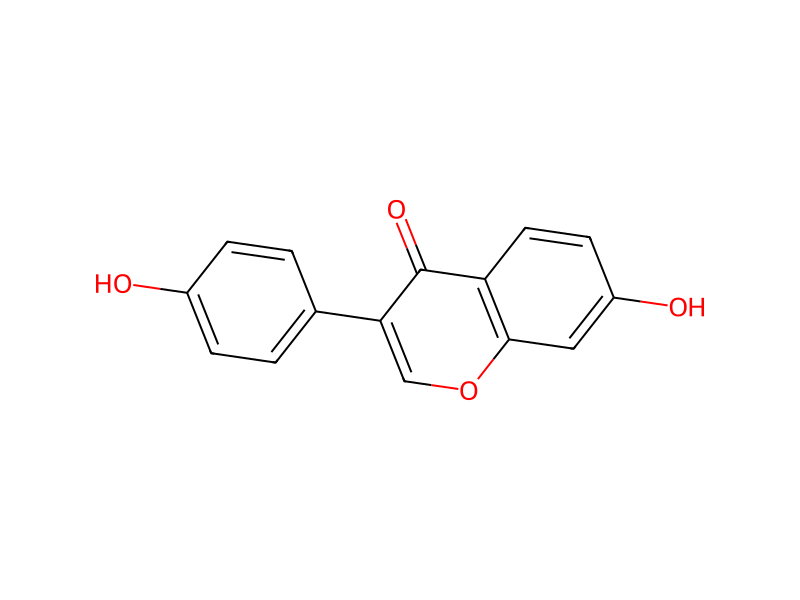
Basic information
- Standard SMILES
O=c1c(-c2ccc(O)cc2)coc2cc(O)ccc12- InChIKey
ZQSIJRDFPHDXIC-UHFFFAOYSA-N- Molecular formula
- C15H10O4
- Average molar mass
- 254.24 g/mol
Overview
Daidzein is a member of the class of 7-hydroxyisoflavones that is 7-hydroxyisoflavone substituted by an additional hydroxy group at position 4'. It has a role as an EC 2.7.7.7 (DNA-directed DNA polymerase) inhibitor, an antineoplastic agent, an EC 3.2.1.20 (alpha-glucosidase) inhibitor, a plant metabolite and a phytoestrogen. It is a conjugate acid of a daidzein(1-).
Names & identifiers
- Preferred name
- Daidzein
- IUPAC
- 7-hydroxy-3-(4-hydroxyphenyl)chromen-4-one
- English name
- Daidzein-d4
- Molecular formula
- C15H10O4
- Molecular weight
- 254.24
Names & synonyms
Show more names
Database identifiers
- CAS
1219803-57-2- ChEMBL
CHEMBL8145- ChEBI
CHEBI:28197- UNII
- 6287WC5J2L
- EC Number
- 207-635-4
- Nikkaji
- J6.014C
Properties
Computed structural properties
- XLogP
- 2.5
- Topological polar surface area
- 66.8 Ų
- Hydrogen bond donors
- 2
- Hydrogen bond acceptors
- 4
- Rotatable bonds
- 1
- Heavy atoms
- 19
- Formal charge
- 0
- Complexity
- 382
Experimental & physicochemical properties
Collision Cross Section
155.8 Ų [M+H]+ [CCS Type: DT; Buffer gas: N2; Ionization: ESI+; Dataset: TOXCAST; Source Identifier: DTXSID9022310]
162.33 Ų [M-H]- [CCS Type: DT; Method: stepped-field]
156.2 Ų [M+H]+
Physicochemical properties
- storage temp.
- -20 °C · Store at -20°C
- solubility
- 10 mg/ml,DMSO: · DMF: 10 mg/ml,DMSO: 30 mg/ml,Ethanol: 0.1 mg/ml
- form
- A solid
- color
- White to off-white
- Symbol(GHS)
- 7 · GHS07
- Signal word
- Warning
- Hazard statements
- 315 · H315-H319
- Precautionary statements
- 264 · P264-P280-P302+P352-P321-P305+P351+P338-P332+P313-P362+P364-P337+P313
Safety & regulation
GHS classification
GHS Classification
This chemical does not meet GHS hazard criteria for 3.7% (3 of 81) of reports.
Warning
H315 (95.1%): Causes skin irritation [Warning Skin corrosion/irritation]
P264, P264+P265, P280, P302+P352, P305+P351+P338, P321, P332+P317, P337+P317, and P362+P364 (click each P-code to see the statement)
Aggregated GHS information provided per 81 reports by companies from 5 notifications to the ECHA C&L Inventory. Each notification may be associated with multiple companies.
Hazard information
Toxicology
Safety data
- Signal word
- Warning
- Symbol(GHS)
- GHS07
- Hazard statements
- H315-H319
- Precautionary statements
- P264-P280-P302+P352-P321-P305+P351+P338-P332+P313-P362+P364-P337+P313
Chemistry & industry
Pharmacology
Uses & manufacturing
Uses
Isoflavones compounds are found in a number of plants, but soybeans and soy products like tofu and textured vegetable protein are the primary food source. Equol represents the main active product of daidzein metabolism, produced via specific microflora in the gut.
Applications
UsesDaidzein-d4 (4-hydroxyphenyl-2,3,5,6-d4) (CAS# 1219803-57-2) is a useful isotopically labeled research compound.
Suppliers9 total
Related reactions
No reaction records under the current filter.
Linked notes
Loading…