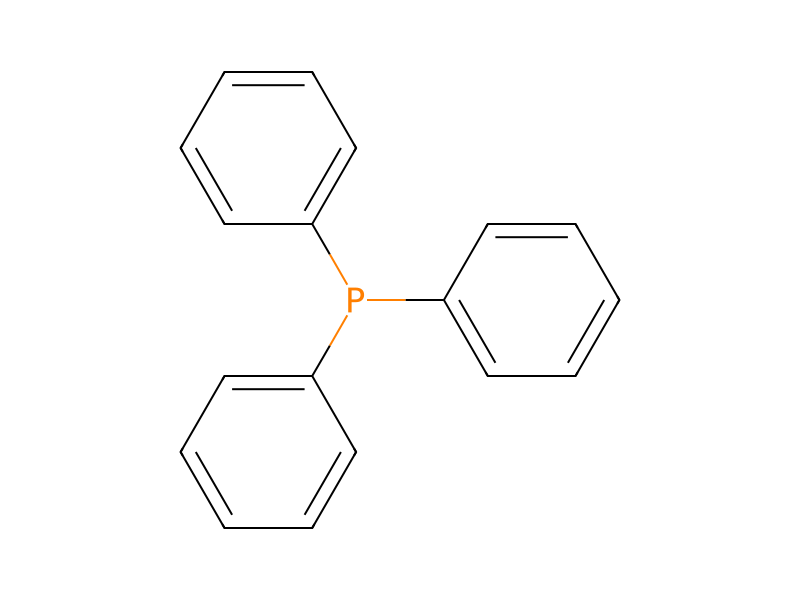
Basic information
- Standard SMILES
c1ccc(P(c2ccccc2)c2ccccc2)cc1- InChIKey
RIOQSEWOXXDEQQ-UHFFFAOYSA-N- Molecular formula
- C18H15P
- Average molar mass
- 262.3 g/mol
Overview
Triphenyl phosphine appears as white crystals. (NTP, 1992)
Names & identifiers
- Preferred name
- Triphenylphosphine
- IUPAC
- triphenylphosphane
- English name
- Triphenylphosphine resin
- Molecular formula
- C18H15P
- Molecular weight
- 262.285461
Names & synonyms
Show more names
Database identifiers
- CAS
39319-11-4- ChEMBL
CHEMBL1448331- ChEBI
CHEBI:183318- UNII
- 26D26OA393
- EC Number
- 210-036-0
- Nikkaji
- J1.652G
Properties
Computed structural properties
- XLogP
- 4.6
- Topological polar surface area
- 0 Ų
- Hydrogen bond donors
- 0
- Hydrogen bond acceptors
- 0
- Rotatable bonds
- 3
- Heavy atoms
- 19
- Formal charge
- 0
- Complexity
- 202
Experimental & physicochemical properties
LogP
5.69
5.69
Density
1.194 at 77 °F (NTP, 1992) - Denser than water; will sink
1.075 @ 80 °C/4 °C
1.1 g/cm³
1.194 @25 °C
Color/Form
MONOCLINIC PLATELETS OR PRISMS FROM ETHER
WHITE CRYSTALLINE SOLID
Solubility
Insoluble (NTP, 1992)
FREELY SOL IN ETHER; SOL IN BENZENE, CHLOROFORM, GLACIAL ACETIC ACID; LESS SOL IN ALCOHOL; PRACTICALLY INSOL IN WATER
SOL IN CARBON TETRACHLORIDE
Solubility in water, mg/l at 25 °C: 0.09 (very poor)
Flash Point
356 °F (NTP, 1992)
180 °C OC.
182 °C c.c.
Boiling Point
greater than 680 °F at 760 mmHg (NTP, 1992)
MORE THAN 360 °C
377 °C
Melting Point
176 °F (NTP, 1992)
80.5 °C
80 °C
79 °C
Physicochemical properties
- storage temp.
- 2 · 2-8°C
- form
- Beads
- color
- White to yellow
- Sensitive
- Air Sensitive
- InChI
- 1S/C18H15P/c1-4-10-16(11-5-1)19(17-12-6-2-7-13-17)18-14-8-3-9-15-18/h1-15H
- InChIKey
- RIOQSEWOXXDEQQ-UHFFFAOYSA-N
- SMILES
- c1ccc(cc1)P(c2ccccc2)c3ccccc3
- UNSPSC Code
- 12352200 · 12352200
- NACRES
- 22 · NA.22
- Symbol(GHS)
- 7 · GHS07
- Signal word
- Warning
- Hazard statements
- 302 · H302-H312-H315-H319-H332-H335-H302+H312+H332
- Precautionary statements
- 261 · P261-P280-P305+P351+P338
- PPE
- 95 · dust mask type N95 (US), Eyeshields, Faceshields, Gloves
- Hazard Codes
- Xn,Xi
- Risk Statements
- 22 · 22-43-20/21/22-36/37/38
- Safety Statements
- 36 · 36/37-36-26
- WGK Germany
- 3 · 3
- F
- 10 · 10-23
- HS Code
- 29310099 · 29310099
- Storage Class
- 11 · 11 - Combustible Solids
Safety & regulation
GHS classification
GHS Classification
This chemical does not meet GHS hazard criteria for 0.5% (6 of 1290) of reports.
Danger
H302 (97.1%): Harmful if swallowed [Warning Acute toxicity, oral]
P260, P261, P264, P264+P265, P270, P272, P273, P280, P301+P317, P302+P352, P305+P354+P338, P317, P319, P321, P330, P333+P317, P362+P364, and P501 (click each P-code to see the statement)
Aggregated GHS information provided per 1290 reports by companies from 56 notifications to the ECHA C&L Inventory. Each notification may be associated with multiple companies.
Danger
Hazard information
Regulatory Information
Chemical: Phosphine, triphenyl-
Phosphine, triphenyl- is listed on the EPA's Chemical Data Reporting (CDR) system. Manufacturers and importers of Phosphine, triphenyl- are required to report information about their production and use of this chemical to the EPA under the Toxic Substances Control Act (TSCA). (40 eCFR Part 711)
Status: Active Update: 14-04-2023 https://echa.europa.eu/registration-dossier/-/registered-dossier/13659
Triphenylphosphine: Does not have an individual approval but may be used under an appropriate group standard
Fire Hazards
This compound is combustible. (NTP, 1992)
Combustible. Gives off irritating or toxic fumes (or gases) in a fire. Finely dispersed particles form explosive mixtures in air.
Hazards Summary
Decomposed by heating forming phosphine and phosphorous oxides; A skin, eye, and respiratory tract irritant; [ICSC] Causes convulsions at lethal doses in animal experiments; [RTECS] A strong reducing agent; [CAMEO] Harmful if ingested; May cause skin sensitization; [Aldrich MSDS] See Phosphine.
Safety & protection
Fire Fighting
Fires involving this chemical can be controlled with dry chemical, carbon dioxide, or Halon extinguisher. (NTP, 1992)
Use water spray, foam, powder, carbon dioxide.
First Aid Measures
Fresh air, rest. Refer for medical attention.
Wear protective gloves when administering first aid. Remove contaminated clothes. Rinse and then wash skin with water and soap. Refer for medical attention .
Rinse with plenty of water for several minutes (remove contact lenses if easily possible). Refer for medical attention.
Rinse mouth. Refer for medical attention .
First Aid
EYES: First check the victim for contact lenses and remove if present. Flush victim's eyes with water or normal saline solution for 20 to 30 minutes while simultaneously calling a hospital or poison control center. Do not put any ointments, oils, or medication in the victim's eyes without specific instructions from a physician. IMMEDIATELY transport the victim after flushing eyes to a hospital even if no symptoms (such as redness or irritation) develop.
Spillage Disposal
Personal protection: particulate filter respirator adapted to the airborne concentration of the substance. Sweep spilled substance into sealable containers. If appropriate, moisten first to prevent dusting. Carefully collect remainder. Then store and dispose of according to local regulations.
Toxicology
Signs and Symptoms
Cough. Sore throat.
Redness.
Redness. Pain.
Cough.
Non-Human Toxicity Excerpts
CNS EFFECTS: WEAKNESS & ATAXIA ONLY SYMPTOMS. IRRITANT EFFECTS: SLIGHT SKIN IRRITANT IN GUINEA PIG. /FROM TABLE/
DURING INHALATION EXPOSURE MALE CHR-CD RATS SHOWED MILD RESP IRRITATION; SEVERE WT LOSS OCCURRED IMMEDIATELY AFTER EXPOSURE, FOLLOWED BY NORMAL RATE OF WT GAIN. MILD WT LOSS OCCURRED DURING 10-DAY EXPOSURE PERIOD, FOLLOWED BY NORMAL WT GAIN.
Triphenylphosphine (TPP) was tested for mutagenicity in the Salmonella/microsome preincubation assay using a protocol approved by the National Toxicology Program. TPP was tested over a wide range of doses (0, 89, 285, 854, 2733 and 8200 ug/plate) in four Salmonella typhimurium strains (TA98, TA100, TA1535, and TA1537) in the presence and absence of Aroclor-induced rat or hamster liver S9. TPP was negative in these tests and the highest ineffective dose level tested (not causing formation of a precipitate) in any Salmonella tester strain was 89 ug/plate.
Safety data
- F
- 10-23
- PPE
- dust mask type N95 (US), Eyeshields, Faceshields, Gloves
- wgk
- 3
- hs_code
- 29310099
- risk_code
- 22-43-20/21/22-36/37/38
- Signal word
- Warning
- Symbol(GHS)
- GHS07
- hazard_code
- Xn,Xi
- safety_code
- 36/37-36-26
- Storage Class
- 11 - Combustible Solids
- Hazard statements
- H302-H312-H315-H319-H332-H335-H302+H312+H332
- Precautionary statements
- P261-P280-P305+P351+P338
Chemistry & industry
Uses & manufacturing
Uses
Used as a polymerization initiator and an intermediate to make pharmaceuticals, phosphonium salts, and other phosphorus compounds; [HSDB]
ORGANIC SYNTHESIS; POLYMERIZATION INITIATOR
SYNTHESIS OF PHOSPHONIUM SALTS, OTHER PHOSPHORUS COMPOUNDS
CHEMICAL INTERMEDIATE, EG, FOR PHARMACEUTICALS
U.S. Exports
(1977) No Data
(1979) No Data
U.S. Imports
(1977) 2.72X10+7 G (PRINCPL CUSTMS DISTS)
(1979) 7.58X10+7 G (PRINCPL CUSTMS DISTS)
U.S. Production
2023: 1,000,000 - <2,500,000 lb
(1977) No Data
(1979) No Data
Methods of Manufacturing
REACTION OF PHENYLMAGNESIUM BROMIDE AND PHOSPHORUS TRICHLORIDE
FROM PHENYLMAGNESIUM BROMIDE & PHOSPHORUS TRICHLORIDE: PFEIFFER, PIETSCH, BER 37, 4621 (1904); SAUVAGE COMPT REND 139, 675 (1904); DODONON, MEDOX, BER 61, 910 (1928); DENNEY ET AL, J AM CHEM SOC 83, 1729 (1961).
BY A MODIFIED GRIGNARD SYNTHESIS.
General Manufacturing Information
Synthetic Rubber Manufacturing
Phosphine, triphenyl-: ACTIVE
Applications
UsesPolymer-bound triphenylphosphine is a solid-supported reagent that can be used as a better alternative to triphenylphosphine in the Mitsunobu reaction.It can also be used:For the esterification of alkylphosphonic acids using primary alcohols in the presence of iodine and imidazole.To catalyze the conversion of 3-[3-(1,3-dioxolan-2-yl)-1-hydroxypropyl]pyridine to 3-[1-bromo-3-(1,3-dioxolan-2-yl)propyl]pyridine using carbon tetrabromide.To isomerize (Z)-nitro olefins to the (E)-isomers.To prepare polymer-bound ylides which are useful in Wittig reactions.To convert alcohols or carboxylic acids to the corresponding chlorides.In combination with carbon tetrachloride for the coupling N-alkoxycarbonyl α-amino acids and primary amines to form the corresponding amides.
UsesTriphenylphosphine resin is used for the preparation of polymer bound ylids which are useful for Wittig reactions.
Suppliers41 total
Related reactions
No reaction records under the current filter.
Linked notes
Loading…