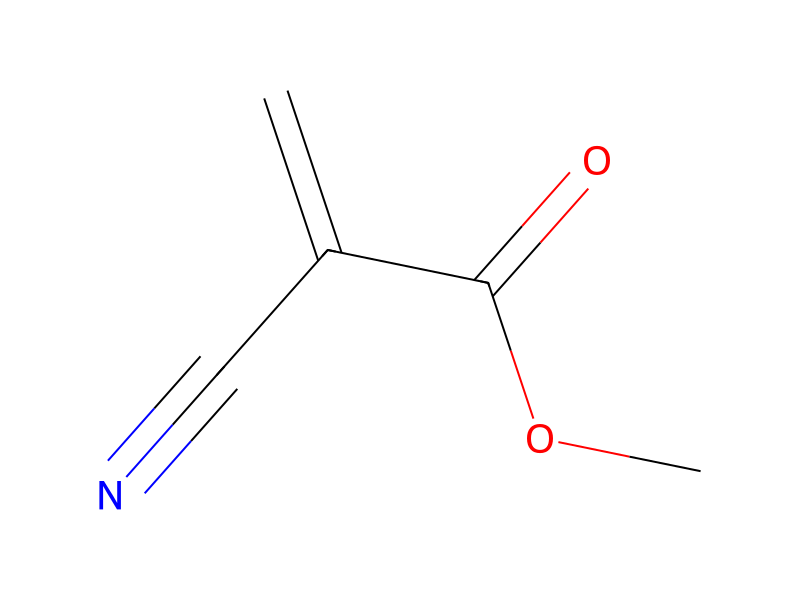
Basic information
- Standard SMILES
C=C(C#N)C(=O)OC- InChIKey
MWCLLHOVUTZFKS-UHFFFAOYSA-N- Molecular formula
- C5H5NO2
- Average molar mass
- 111.1 g/mol
Overview
Methyl 2-cyanoacrylate is a clear slightly yellow liquid. (NTP, 1992)
Names & identifiers
- Preferred name
- Methyl cyanoacrylate
- IUPAC
- methyl 2-cyanoprop-2-enoate
- English name
- Brn 1751282
- Molecular formula
- C5H5NO2
- Molecular weight
- 111.0987
Names & synonyms
Show more names
Database identifiers
- CAS
53028-65-2- ChEMBL
CHEMBL2106424- UNII
- WN7979561R
- EC Number
- 205-275-2
- Nikkaji
- J2.021D
Properties
Computed structural properties
- XLogP
- 0.6
- Topological polar surface area
- 50.1 Ų
- Hydrogen bond donors
- 0
- Hydrogen bond acceptors
- 3
- Rotatable bonds
- 2
- Heavy atoms
- 8
- Formal charge
- 0
- Complexity
- 163
Experimental & physicochemical properties
Odor
Strong, acrid odor
Characteristic odor
Density
1.1044 at 81 °F (NTP, 1992) - Denser than water; will sink
1.1012 g/cu cm at 20 °C
Relative density (water = 1): 1.1
1.1044 at 81 °F
1.1012 @25 °C
(81 °F): 1.10
Color/Form
Clear, colorless liquid
Thick liquid
Solubility
less than 1 mg/mL at 72 °F (NTP, 1992)
Soluble or partially soluble in methyl ethyl ketone, toluene, DMF /dimethylformamide/, acetone, nitromethane
30%
Flash Point
174 °F (NIOSH, 2024)
82.78 °C (closed cup)
79 °C
174 °F
174 °F
Boiling Point
117 to 120 °F at 1.8 mmHg (NTP, 1992)
47 °C at 2 mm Hg
BP: 47-49 °C (0.33-0.36 kPa)
66 °C
117-120 °F at 1.8 mmHg
200.5 °C @760 [mm Hg]
Decomposition
When heated to decomposition it emits toxic fumes of /nitrogen oxides and CN-/.
Decomposition: degradation products include formaldehyde; thermal decomposition products may include highly toxic fumes of hydrogen cyanide and toxic oxides of carbon and nitrogen.
Safety & regulation
GHS classification
GHS Classification
Warning
H315: Causes skin irritation [Warning Skin corrosion/irritation]
P261, P264, P264+P265, P271, P280, P302+P352, P304+P340, P305+P351+P338, P319, P321, P332+P317, P337+P317, P362+P364, P403+P233, P405, and P501 (click each P-code to see the statement)
Warning
H315 (100%): Causes skin irritation [Warning Skin corrosion/irritation]
P261, P264, P264+P265, P271, P280, P302+P352, P304+P340, P305+P351+P338, P319, P321, P332+P317, P337+P317, P362+P364, P403+P233, P405, and P501 (click each P-code to see the statement)
Hazard information
Regulatory Information
Chemical: 2-Propenoic acid, 2-cyano-, methyl ester
Status: Active Update: 08-11-2021 https://echa.europa.eu/registration-dossier/-/registered-dossier/16286
Methyl 2-cyanoacrylate: Does not have an individual approval but may be used under an appropriate group standard
The New Jersey Worker and Community Right to Know Act requires public and private employers to provide information about hazardous substances at their workplaces. (N.J.S.A. 34:5A-1 et. seq.)
Fire Hazards
Flash point data for this compound are not available but it is probably non-flammable. (NTP, 1992)
Combustible. Gives off irritating or toxic fumes (or gases) in a fire. Above 79 °C explosive vapour/air mixtures may be formed.
Special Reports
WHO; Concise International Chemical Assessment Document 36, Methyl Cyanoacrylate and Ethyl Cyanoacrylate (2001). CICADs are concise documents that provide summaries of the relevant scientific information concerning the potential effects of chemicals upon human health and/or the environment. The primary objective of CICADs is characterization of hazard and dose-response from exposure to a chemical.[Available from, as of February 15, 2011: http://www.inchem.org/documents/cicads/cicads/cicad36.htm]
TSCA Requirements
Section 8(a) of TSCA requires manufacturers of this chemical substance to report preliminary assessment information concerned with production, exposure, and use to EPA as cited in the preamble in 51 FR 41329. Effective date 1/26/94; Reporting date: 3/28/94.
Pursuant to section 8(d) of TSCA, EPA promulgated a model Health and Safety Data Reporting Rule. The section 8(d) model rule requires manufacturers, importers, and processors of listed chemical substances and mixtures to submit to EPA copies and lists of unpublished health and safety studies. 2-Propeonic acid, 2-cyano-, methyl ester is included on this list. Effective date: 1/26/94; Sunset date: 12/19/95.
Reactivity Profile
METHYL 2-CYANOACRYLATE is an unsaturated aliphatic nitrile and acrylate ester. Nitriles may polymerize in the presence of metals and some metal compounds. They are incompatible with acids; mixing nitriles with strong oxidizing acids can lead to extremely violent reactions. Nitriles are generally incompatible with other oxidizing agents such as peroxides and epoxides. The combination of bases and nitriles can produce hydrogen cyanide. Nitriles are hydrolyzed in both aqueous acid and base to give carboxylic acids (or salts of carboxylic acids). These reactions generate heat. Peroxides convert nitriles to amides. Nitriles can react vigorously with reducing agents. Acetonitrile and propionitrile are soluble in water, but nitriles higher than propionitrile have low aqueous solubility. They are also insoluble in aqueous acids. Esters react with acids to liberate heat along with alcohols and acids. Strong oxidizing acids may cause a vigorous reaction that is sufficiently exothermic to ignite the reaction products. Heat is also generated by the interaction of esters with caustic solutions. Flammable hydrogen is generated by mixing esters with alkali metals and hydrides.
Safety & protection
Fire Fighting
Fires involving this compound should be controlled using a dry chemical, carbon dioxide, foam or Halon extinguisher. (NTP, 1992)
Use foam, powder, carbon dioxide. NO water. In case of fire: keep drums, etc., cool by spraying with water. NO direct contact with water.
First Aid Measures
Fresh air, rest. Refer for medical attention.
Remove contaminated clothes. Rinse and then wash skin with water and soap. Refer for medical attention .
First rinse with plenty of water for several minutes (remove contact lenses if easily possible), then refer for medical attention.
First Aid
EYES: First check the victim for contact lenses and remove if present. Flush victim's eyes with water or normal saline solution for 20 to 30 minutes while simultaneously calling a hospital or poison control center. Do not put any ointments, oils, or medication in the victim's eyes without specific instructions from a physician. IMMEDIATELY transport the victim after flushing eyes to a hospital even if no symptoms (such as redness or irritation) develop.
(General first aid procedures)
Storage Conditions
The effectiveness of phenolic inhibitors is dependent on the presence of oxygen and the monomers must be stored under air rather than an inert atmosphere. Temp must be kept low to minimize formation of peroxides and other products. ... The acrylic esters may be stored in mild or stainless steel, or aluminum. /Acrylic acid & derivatives/
Nonfire Spill Response
SMALL SPILLS AND LEAKAGE: If you spill this chemical, FIRST REMOVE ALL SOURCES OF IGNITION, then use absorbent paper to pick up liquid spill material. Your contaminated clothing and absorbent paper should be sealed in a vapor-tight plastic bag for eventual disposal. Solvent wash all contaminated surfaces with toluene followed by washing with a soap and water solution. Do no reenter the contaminated area until the Safety Officer (or other responsible person) has verified that the area has been properly cleaned.
Disposal Methods
SRP: The most favorable course of action is to use an alternative chemical product with less inherent propensity for occupational harm/injury/toxicity or environmental contamination. Recycle any unused portion of the material for its approved use or return it to the manufacturer or supplier. Ultimate disposal of the chemical must consider: the material's impact on air quality; potential migration in soil or water; effects on animal and plant life; and conformance with environmental and public health regulations.
Spillage Disposal
Personal protection: face shield and filter respirator for organic gases and vapours adapted to the airborne concentration of the substance. Ventilation. Remove all ignition sources. Do NOT wash away into sewer. Absorb liquid in sand or inert absorbent. Let solidify.
Preventive Measures
Awareness of the dangers and of good engineering design are essential to safety. Employees should be instructed about the necessity of cleansing the skin if it is contaminated by materials which are irritants or skin-absorbed. With careful design, however, and complete enclosure of those processes where toxic chemicals or intermediates occur, dangerous exposures can be avoided. /Acrylic acid & derivatives/
The worker should wash daily at the end of each work shift, and prior to eating, drinking, smoking, etc.
SRP: The scientific literature for the use of contact lenses by industrial workers is inconsistent. The benefits or detrimental effects of wearing contact lenses depend not only upon the substance, but also on factors including the form of the substance, characteristics and duration of the exposure, the uses of other eye protection equipment, and the hygiene of the lenses. However, there may be individual substances whose irritating or corrosive properties are such that the wearing of contact lenses would be harmful to the eye. In those specific cases, contact lenses should not be worn. In any event, the usual eye protection equipment should be worn even when contact lenses are in place.
SRP: Contaminated protective clothing should be segregated in such a manner so that there is no direct personal contact by personnel who handle, dispose, or clean the clothing. The completeness of the cleaning procedures should be considered before the decontaminated protective clothing is returned for reuse by the workers. Contaminated clothing should not be taken home at the end of shift, but should remain at employee's place of work for cleaning.
SRP: Wastewater from contaminant suppression, cleaning of protective clothing/equipment, or contaminated sites should be contained and evaluated for subject chemical or decomposition product concentrations. Concentrations shall be lower than applicable environmental discharge or disposal criteria. Alternatively, pretreatment and/or discharge to a permitted wastewater treatment facility is acceptable only after review by the governing authority and assurance that "pass through" violations will not occur. Due consideration shall be given to remediation worker exposure (inhalation, dermal and ingestion) as well as fate during treatment, transfer and disposal. If it is not practicable to manage the chemical in this fashion, it must be evaluated in accordance with EPA 40 CFR Part 261, specifically Subpart B, in order to determine the appropriate local, state and federal requirements for disposal.
Toxicology
Treatment
Antidotes to cyanide poisoning include hydroxocobalamin and sodium nitrite, which release the cyanide from the cytochrome system, and rhodanase, which is an enzyme occurring naturally in mammals that combines serum cyanide with thiosulfate, producing comparatively harmless thiocyanate. Oxygen therapy can also be administered. (L97)
Health Effects
Exposure to high levels of cyanide for a short time harms the brain and heart and can even cause coma, seizures, apnea, cardiac arrest and death. Chronic inhalation of cyanide causes breathing difficulties, chest pain, vomiting, blood changes, headaches, and enlargement of the thyroid gland. Skin contact with cyanide salts can irritate and produce sores. (L96, L97)
Environmental Fate
TERRESTRIAL FATE: Based on a classification scheme(1), an estimated Koc value of 3.7(SRC), determined from a structure estimation method(2), indicates that methyl 2-cyanoacrylate is expected to have very high mobility in soil(SRC). However, movement of methyl 2-cyanoacrylate through soil will be hindered by its rapid polymerization as it comes into contact with moisture or other weakly basic substances(3-5). Since methyl 2-cyanoacrylate polymerizes rapidly on contact with moisture, volatilization from moist soil surfaces is not a relevant environmental process for this substance. Methyl 2-cyanoacrylate is not expected to volatilize from dry soil surfaces(SRC) based upon a vapor pressure of 0.2 mm Hg at 25 °C(3). Biodegradation is not an important environmental fate proces due to rapid polymerization(3-5).
AQUATIC FATE: Based on a classification scheme(1), an estimated Koc value of 3.7(SRC), determined from a structure estimation method(2), indicates that methyl 2-cyanoacrylate is not expected to adsorb to suspended solids and sediment(SRC). However, methyl 2-cyanoacrylate polymerizes rapidly on contact with moisture or other weakly basic substances(3-5). Therefore, environmental processes such as volatilization from water surfaces and bioconcentration in aquatic organisms are not relevant for this substance(SRC). Biodegradation is not an important environmental fate proces due to rapid polymerization(3-5).
ATMOSPHERIC FATE: According to a model of gas/particle partitioning of semivolatile organic compounds in the atmosphere(1), methyl 2-cyanoacrylate, which has a vapor pressure of 0.2 mm Hg at 25 °C(2), is expected to exist solely as a vapor in the ambient atmosphere. Vapor-phase methyl 2-cyanoacrylate is degraded in the atmosphere by reaction with photochemically-produced hydroxyl radicals(SRC); the half-life for this reaction in air is estimated to be 5.2 days(SRC), calculated from its rate constant of 3.1X10⁻¹² cu cm/molecule-sec at 25 °C(SRC) that was derived using a structure estimation method(3). Methyl 2-cyanoacrylate contains chromophores that absorb strongly at wavelengths >290 nm, and therefore may be susceptible to direct photolysis by sunlight(4).
Exposure Routes
The substance can be absorbed into the body by inhalation of its vapour.
inhalation, ingestion, skin and/or eye contact
Oral (L96) ; inhalation (L96) ; dermal (L96)
Toxicity Summary
Organic nitriles decompose into cyanide ions both in vivo and in vitro. Consequently the primary mechanism of toxicity for organic nitriles is their production of toxic cyanide ions or hydrogen cyanide. Cyanide is an inhibitor of cytochrome c oxidase in the fourth complex of the electron transport chain (found in the membrane of the mitochondria of eukaryotic cells). It complexes with the ferric iron atom in this enzyme. The binding of cyanide to this cytochrome prevents transport of electrons from cytochrome c oxidase to oxygen. As a result, the electron transport chain is disrupted and the cell can no longer aerobically produce ATP for energy. Tissues that mainly depend on aerobic respiration, such as the central nervous system and the heart, are particularly affected. Cyanide is also known produce some of its toxic effects by binding to catalase, glutathione peroxidase, methemoglobin, hydroxocobalamin, phosphatase, tyrosinase, ascorbic acid oxidase, xanthine oxidase, succinic dehydrogenase, and Cu/Zn superoxide dismutase. Cyanide binds to the ferric ion of methemoglobin to form inactive cyanmethemoglobin. (L97)
Signs and Symptoms
Cough. Headache. Sore throat.
Dry skin. Redness. Pain.
Redness. Pain.
irritation eyes, skin, nose; blurred vision, lacrimation (discharge of tears); rhinitis
Cyanide poisoning is identified by rapid, deep breathing and shortness of breath, general weakness, giddiness, headaches, vertigo, confusion, convulsions/seizures and eventually loss of consciousness. (L96, L97)
Soil Adsorption/Mobility
Using a structure estimation method based on molecular connectivity indices(1), the Koc of methyl 2-cyanoacrylate can be estimated to be 3.7(SRC). According to a classification scheme(2), this estimated Koc value suggests that methyl 2-cyanoacrylate is expected to have very high mobility in soil. However, movement of methyl 2-cyanoacrylate through soil will be hindered by its rapid polymerization as it comes into contact with moisture or other weakly basic substances(3-5).
Human Toxicity Excerpts
/HUMAN EXPOSURE STUDIES/ There is one ... study available in which odor perception and sensory irritation were investigated in humans exposed to methyl cyanoacrylate (MCA) vapor. The study involved the use of an exposure chamber; however, due to the difficulties in generating MCA exposure atmospheres, exposure was achieved via a simulated work procedure in which the subjects applied the adhesive to microscope slides or other glass sheets. ... The operations were graduated so as to produce vapor concentrations ranging from 1 to 60 ppm (4.5 to 272 mg/cu m). Air samples were taken in the breathing zone of each individual with sampling periods of 5 min, and collection was repeated 10 times/hr for the duration of the study. ... Subjects filled in a questionnaire at the end of each 5-min sampling period to indicate odor perception and irritancy responses. In preliminary trials marked eye and nose irritation were reported at 40 to 60 ppm (182-272 mg/cu m). For two individuals, blurred vision was reported some time after the exposure and persisted for approximately 2 hr. Fourteen individuals participated in the main study, with some performing the simulated occupational tasks more than once; adhesives were applied dropwise onto glass slides using a syringe or directly from the adhesive container. These procedures are a closer simulation of many of the occupational uses of the cyanoacrylate adhesives than was the preliminary study. ... No effects were reported in any of the 14 subjects at 1 ppm (4.5 mg/cu m). The odor threshold was reported to be 1 to 5 ppm (4.5 to 23 mg/cu m). Throat and nose "irritation" were subjectively reported from 2 to 20 ppm (9.1 to 91 mg/cu m) or more, although the severity was unclear (at 2 ppm [9.1 mg/cu m], ...no more than 3 of the 14 people reported effects). Eye irritation and "burning" were reported from 4 to 15 ppm (18 to 68 mg/cu m) or more, although ... it is impossible to tell exactly what proportion of volunteers reported effects. At concentrations above 20 ppm (91 mg/cu m), lacrimation and rhinorrhea were reported (except for one individual in whom rhinorrhea was reported at around 7 ppm [32 mg/cu m]), and these were more pronounced at 50 to 60 ppm (227-272 mg/cu m) (a level at which painful eye irritation was also reported). The study report suffers from a number of limitations. ... Despite these limitations, it is possible to identify a NOAEL for irritancy due to MCA vapor of 1 ppm (4.5 mg/cu m) from this study. At around 2 ppm (9.1 mg/cu m), the nasal and throat effects were of unclear severity in no more than 3 of the 14 volunteers, with marked effects (rhinorrhea and lacrimation) at around 20 ppm (91 mg/cu m) or more.
/HUMAN EXPOSURE STUDIES/ Vapor exposure of normal volunteers to /cyanoacrylate/ methyl ester ... @ 40-60 ppm in air ... is very objectionable, producing irritation of the eyes and nose, & "blurred vision" which was noted by two volunteers ... 2 hr after exposure. At lower concn, ... eye irritation ... noticed @ 5 ppm, & 20 ppm causes lacrimation & rhinorrhea.
/SIGNS AND SYMPTOMS/ Accidentally, cyanoacrylate glues that are in common household use have been applied to the eye mistakenly as eyedrops, causing immediate brief smarting, and firm gluing of the lids together. ... In the common accidental dropping of the glue on the eye or similar splashing, the glue may cause transient punctate epithelial keratopathy, but as a rule it does not adhere to the cornea or conjunctiva. /Cyanoacrylate glues/
/SIGNS AND SYMPTOMS/ An outbreak of irritant dermatitis among electronic assembly workers was caused by the vaporization of a monomer under conditions of low relative humidity. /n-alkyl-alhpa-cyanoacrylates/
For more Human Toxicity Excerpts (Complete) data for METHYL 2-CYANOACRYLATE (13 total), please visit the HSDB record page.
Regulatory information
TSCA Requirements
Section 8(a) of TSCA requires manufacturers of this chemical substance to report preliminary assessment information concerned with production, exposure, and use to EPA as cited in the preamble in 51 FR 41329. Effective date 1/26/94; Reporting date: 3/28/94.
Pursuant to section 8(d) of TSCA, EPA promulgated a model Health and Safety Data Reporting Rule. The section 8(d) model rule requires manufacturers, importers, and processors of listed chemical substances and mixtures to submit to EPA copies and lists of unpublished health and safety studies. 2-Propeonic acid, 2-cyano-, methyl ester is included on this list. Effective date: 1/26/94; Sunset date: 12/19/95.
Chemistry & industry
Pharmacology
Metabolism/Metabolites
Following sc implantation of (14)C-labeled methyl 2-cyanoacrylate into dogs radioactive urea was found in the urine. Hypothesis: hydrolytic chain scission & ester hydrolysis may be involved in in vivo degradation of cyanoacrylate tissue adhesives.
Organic nitriles are converted into cyanide ions through the action of cytochrome P450 enzymes in the liver. Cyanide is rapidly absorbed and distributed throughout the body. Cyanide is mainly metabolized into thiocyanate by either rhodanese or 3-mercaptopyruvate sulfur transferase. Cyanide metabolites are excreted in the urine. (L96)
Absorption, Distribution and Excretion
Following oral administration of 0.05 mL liquid beta-(14)C-methyl cyanoacrylate (MCA) (as monomer and polymer) to groups of two rats, radioactivity was detected in the urine, indicating that some absorption had occurred. For the rats receiving liquid MCA monomer into the oral cavity by syringe, approximately 2% of the radiolabel administered was recovered in urine over 48 hr. For rats receiving poly-MCA directly into the stomach, the total mean recovery from urine samples after 4 days was approximately 16%. A mean total of 18% of the radiolabel administered was recovered from feces on completion of the 4-day sampling period. However, the detection of radiolabel in the stool samples may well reflect the passage of poly-MCA particles directly through the gastrointestinal tract rather than any absorption and metabolism.
Following dermal application of 0.5 mL liquid liquid beta-(14)C-methyl cyanoacrylate (MCA) to groups of two rats, radioactivity was detected in the urine, indicating limited dermal absorption (up to 4% of the applied dose over a 6-day collection period). When the liquid was applied to skin with the epidermis removed, the amount of radiolabel recovered from urine increased approximately 3-fold.
Methyl 2-cyanoacrylate was rapidly absorbed from the skin incision site & eliminated in the urine in guinea pigs. Initial metabolites possessed the carbon skeleton of the monomer, whereas metabolites excreted from day 2 onward represented absorbed & degraded polymeric material.
The alkyl /cyanoacrylate/ esters can be absorbed through skin, with the methyl showing the highest rate of urine excretion, 12% of cmpd being excreted in five days when originally applied to rat skin.
Uses & manufacturing
Uses
Occupational asthma reported in workers using adhesives; [Malo]
Working with Glues and Adhesives [Category: Other]
Therapy category: tissue adhesive
In adhesives; manufacturing of plastics, electronics, scientific instruments, jewelry, sports equipment; in cable joining, manicuring, mortuaries
Dentistry
Raising finger prints
Methods of Manufacturing
The important step in most of the published syntheses is the classical Knoevenagel reaction using formaldehyde and a cyanoacetic ester. In this first step oligomeric cyanoacrylates, water, and other byproducts are formed. The reaction can be catalyzed by bases (e.g., amines), alkali metal tetraborates, metal carbonyls, or phase-transfer catalysts. The raw condensation product from the first reaction is depolymerized thermally (either continuously or discontinuously) and purified by distillation, chromatography on alumina or silica gel, crystallization in polyethylene columns, or treatment with zinc chloride. Alternatively, 2-cyanoacrylates can be manufactured by the ethoxycarbonylation of cyanoacetylene in the presence of nickel carbonyl. /2-Cyanoacrylates/
... /Alkyl 2-cyanoacrylates/ are prepared by pyrolyzing the poly(alkyl)-2-cyanoacrylates produced when formaldehyde is condensed with the corresponding alkyl cyanoacetates. /Cyanoacrylate adhesives/
Acrylate esters can be made by reacting a vinyl halide with carbon monoxide and an organic halide in the presence of a group VIII catalyst. Also developed is a process that yields acrylate esters after the generation of 2-halo-1-alkenes from hydrocarbon streams. Both processes were developed by Dow Chemical Co.
Formulations/Preparations
To prevent premature polymerization, inhibitors are added. Supplied commercially as "Eastman 910." /Cyanoacrylate adhesives/
... Hydroquinone or monomethyl ether hydroquinone are added to acrylic monomers to stabilize them ... . /Acrylic ester monomers/
General Manufacturing Information
2-Propenoic acid, 2-cyano-, methyl ester: ACTIVE
Initially, cyanoacrylates were used /experimentally and clinically as a new tissue adhesive/ but these monomers have now fallen out of favor because of their toxic properties. The chief disadvantages ... are their irritant properties and their rapid degradation.
These adhesives have excellent polymerizing and bonding properties. /Cyanoacrylate adhesives/
... /2-cyanoacrylic acid/ methyl ester has been used satisfactorily for a special purpose in patients, applied to the skin of the eyelids & to the eye lashes to glue the lids temporarily closed, & in this application it has produced no ocular inflammation.
Related reactions
No reaction records under the current filter.
Linked notes
Loading…